
Discover the FMCG sector
Fast-Moving Consumer Goods (FMCG): what are they, how big is this market, and what are the challenges for brands and retailers in France?

In short
8 min read
Fast-Moving Consumer Goods (FMCG) are everyday consumer products that are essential, low-priced, and have a high turnover rate.
This sector is a major economic pillar, representing approximately 11.4% of the French GDP and millions of jobs.
Distribution relies on various networks: large and medium-sized supermarkets (GMS), local convenience stores, out-of-home networks (RHD), and online retail.
FMCG marketing is distinguished by specific concepts such as trade marketing, category management, and the optimization of point-of-sale execution.
The sector is currently being transformed by corporate social responsibility (CSR) issues, the impact of inflation on purchasing power, and increasing digitalization (drive-to-store, quick commerce, and AI).
Fast-moving consumer goods constitute a specific sector, both in terms of its weight in the global economy and the specificities of its operation. This article demystifies a several of its key concepts, and some great surprises await you in the presentation below!
Whether you are a marketing student or newly starting out in a consumer goods company, you will be able to skim through a number of key elements that will allow you to better understand this world.
We will start by looking at which products fall into the FMCG category;
We will then explore its importance in the French economy;
Key professions and functions in this industry;
Finally, we will look at the specificities of FMCG marketing.
Happy reading!
What is a fast-moving consumer goods product?
A fast-moving consumer good (FMCG) is a product intended for a wide audience, generally for everyday consumption, and sold in large quantities. These are products frequently purchased by households, such as food, beverages, hygiene products or household items. These products are often distributed through mass retail channels (supermarkets, hypermarkets, etc.).
Fast-moving consumer goods are distinguished by their necessity, short life cycle, and relatively low price per unit. The chronic purchase of FMCGs leads to a high turnover rate at retailers.
These products purchased frequently and generally at a relatively low price, English speakers call them FMCG (fast-moving consumer goods), still referring to their turnover rate on shelves. FMCGs are a sub-family of CPG (Consumer Packaged Goods).
We can cite many examples of consumer goods: fruits, rice, soap, laundry detergent or even toothpaste are common products that consumers regularly buy to meet their daily needs.
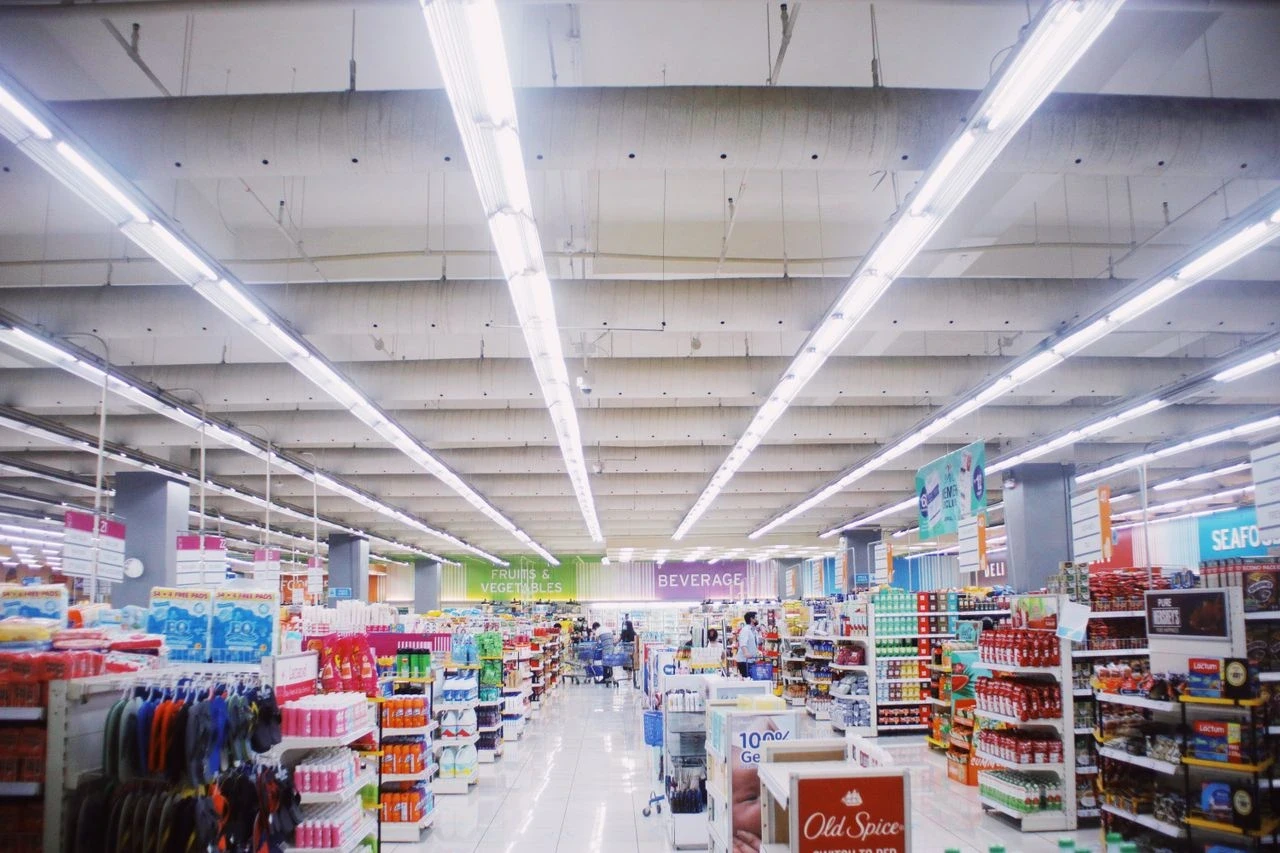
FMCGs can be found on the shelves of all types of stores, but it is in large and medium-sized supermarkets that French people buy them the most. They are arranged there in self-service aisles.
List of FMCGs according to the law
Decree No. 2019-1413 of December 19, 2019 lists the products classified as fast-moving consumer goods. These are products considered non-durable:
Food products and non-alcoholic beverages;
Alcoholic beverages;
Electric batteries for all uses;
Washing and cleaning products: soaps, washing powders, liquid washing products, scouring powders, detergents, bleach, fabric softeners, window cleaning products, drain unblockers, disinfectants, distilled water (excluding waxes, polishes, dyes, insecticides and fungicides);
Cleaning items: brooms, scrubbing brushes, dustpans and brushes, feather dusters, cloths, tea towels, mops, household sponges, scouring pads, steel wool, chamois leathers;
Paper items: filters, tablecloths and napkins, kitchen paper, vacuum cleaner bags, cardboard tableware, aluminum foil, plastic garbage bags;
Adhesive or non-adhesive bandages;
Pet food;
Non-electric appliances: razors and blades, nail files, toothbrushes (excluding mechanical clippers and blades), scissors, combs, shaving brushes, hairbrushes, nail brushes, hairpins, hair rollers, bathroom scales, baby scales;
Personal hygiene items: toilet soap, medicinal soap, baby oil and milk, soap, shaving cream and foam, toothpaste;
Beauty products, perfumes and deodorants: lipsticks, nail polish, makeup and makeup remover (including powder compacts, brushes, powder puffs), hairsprays and lotions, pre- and post-shave products, sunscreen products, hair removal products, perfumes and toilet waters, body deodorants, bath products;
Other products: toilet paper, paper tissues, paper towels, sanitary tampons, cotton wool, cotton buds, disposable baby diapers, toilet sponges.
A major sector of the economy
The fast-moving consumer goods sector constitutes a huge economic pool. Thus, LSA Conso reminds us that the top 50 FMCG brands represent a turnover of 1,337 billion dollars (2022)! Mass retail, on the other hand, represents around 190 billion euros in annual turnover in France. This represents approximately 11.4% of French GDP.
Employment figures are just as impressive. For example, L’Oréal employs 88,000 people globally. As for Danone, the figure is closer to 100,000. Globally, mass retail is the largest private employer with 1.84 million employees.
Of the top 50 FMCG groups in the world (in turnover for the year 2022), 4 are French: L’Oréal, Danone, LVMH and Pernod Ricard.
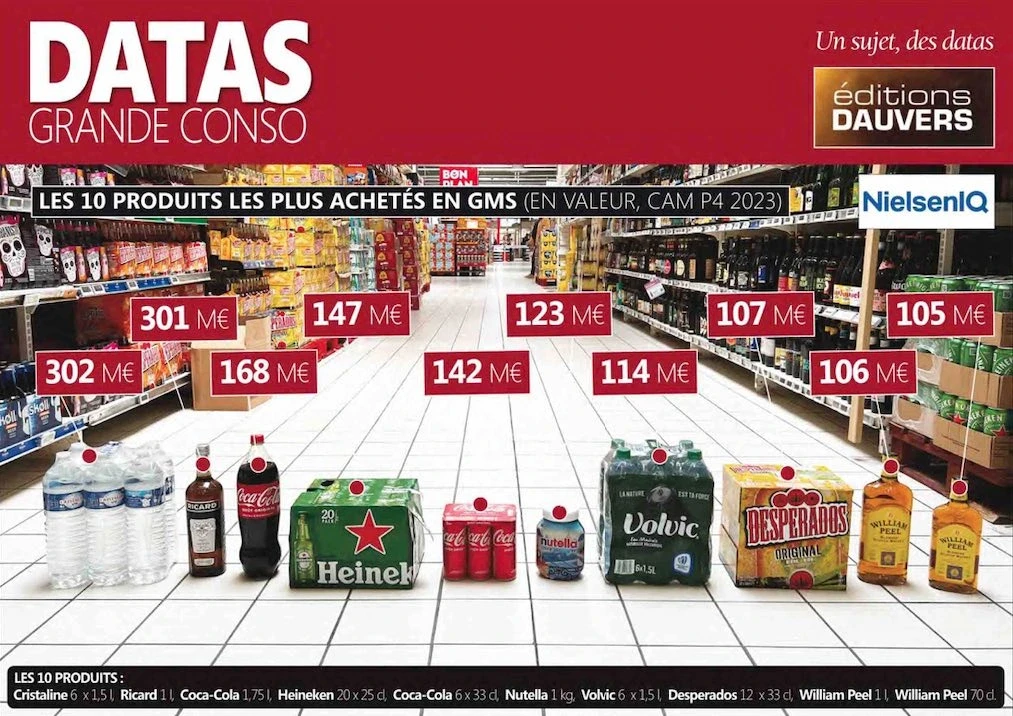
In France, in 2023, the top of the ranking was occupied by the agri-food sector and in particular beverage brands. While Cristalline water won first place, it is especially the sales of alcoholic beverages that impress!
Source: Olivier Dauvers
Consumption and purchasing power
The frequency of consumer goods purchases makes them particularly price-sensitive. French people shop regularly, and generally have prices in mind (which is not the case for more exceptional purchases). Price fluctuations are therefore often poorly received, and households are generally worried to see the price of the shopping cart increase faster than their wages or savings. This constraint is well known to brands, but the latter are also impacted by the increase in raw materials, or energy. For example, the price of cocoa has increased by more than 160% in ten years. In the last three years alone, its price has tripled. To respond to this, brands use two mechanisms: a change in their pricing policy, by increasing prices by 15 to 24% on average, and reducing portions (shrinkflation).
In the end, inflation of consumer products is influenced by multiple factors, such as production costs, supply chain disruptions, economic policies, imbalances between supply and demand, or international news.
To measure the inflation of consumer products in France, we mainly refer to the Consumer Price Index (CPI), calculated monthly by INSEE. The CPI tracks the price variation of a representative basket of goods and services consumed by households, allowing the inflation rate to be calculated.
To contain the inflation of fast-moving consumer goods, governments have various levers:
Increase interest rates to reduce credit demand;
Reduce public spending and increase taxes to decrease overall demand;
Impose temporary price controls (which can cause shortages);
Encourage supply by improving productivity and reducing trade barriers;
Use counter-cyclical policies to stabilize the economy.
In France, the different versions of the EGAlim law aim to regulate relations between food producers and retailers, these having a considerable impact on the agricultural sector, considered strategic for the economy.
This is a subject of national sovereignty (producing the food we consume rather than importing it) but the goal is also to guarantee French people access to fast-moving consumer goods, in particular by avoiding shortage phenomena that could result from too great an imbalance between food production and the income it generates.
Networks related to the world of FMCG
Fast-moving consumer goods (FMCG) are fast-rotating products, meaning they sell quickly, at low unit cost and with a high frequency of purchase.
In English, the term “fast-moving” is used because it describes the short life cycle of fast-moving consumer goods, the fact that they require frequent replenishment and that they generate a high volume of sales with low but significant cumulative unit margins.
This definition fits perfectly with the sales model of mass retail, which is the main sales channel for FMCG, with a strong need for merchandising and listing negotiation.
The listing model of supermarkets and hypermarkets is based on national or regional listing via central purchasing agencies, with annual negotiations representing the majority of listed products and the possibility of direct listing in-store.
Supermarkets/hypermarkets include hypermarkets (Carrefour, Auchan, E.Leclerc…), supermarkets (Intermarché, Carrefour…), hard discounters (Lidl, Aldi… and grocery drive-through and e-commerce (Leclerc Drive, Carrefour Drive…).
In the family of food stores, you can also look at convenience stores and mini-markets (Carrefour City, Franprix, Monop’…) which are adapted to occasional and urban purchases, with fast logistics and more flexible local listing. Listing is therefore often centralized at the national level and through groups, but adapted to frequent local needs and store sizes.
These two types of networks are the most famous in the FMCG universe, but not the only ones:
Out-of-home networks (foodservice / catering / HoReCa), such as canteens, corporate offices, snacking, bakeries, vending machines or restaurants, cafés, bistros… Mainly sold in these networks are food FMCG (drinks, snacks, portioned products) and non-food (maintenance, hygiene).
Specialized networks (specialist superstores), such as health and beauty stores (Sephora, Marionnaud…), parapharmacies, DIY stores (Leroy Merlin, Castorama) and pet shops (Maxi Zoo). Listing for these stores is centralized at the national level and often takes time, with longer selection processes, product tests and negotiated display slots.
Pure players and marketplaces like Amazon or Cdiscount which are experiencing rapid growth.
Independent networks and wholesalers, with cash&carry (Metro or Promocash for HoReCa for example), regional wholesalers (especially for foodservice) or independent food or non-food trade. These points of sale have a more fragmented distribution, which requires more intense work from sales representatives in the field.
Network | Examples | Specificity | Listing | Role of field sales representatives |
|---|---|---|---|---|
Supermarkets/Hypermarkets | Carrefour, Auchan, Leclerc | High volumes, centralized listing | National/regional | Visits, merchandising, promotion |
Convenience/mini-markets | Franprix, Monop’ | Urban, fast flows | Centralized + local | Replenishment, local activation |
HoReCa/Foodservice | Restaurants, canteens, bakeries | Portioned, specific needs | Wholesalers + direct | Direct sales, training |
Specialist Superstores | Sephora, Leroy Merlin, Animalis | Targeted non-food products | Merchandising, training | Targeted non-food products |
Pure players and marketplaces | Amazon, Cdiscount | E-commerce logistics | Vendor/marketplace | None |
Independents and wholesalers | Metro, regional wholesalers | Direct sales, variable margins | Direct | Ordering and relationship building |
Professions related to the FMCG universe
Fast-moving consumer goods therefore constitute a fully-fledged sector in the economy, and all major brands have their FMCG department, or dedicated subsidiaries (Unilever FMCG Company, Pepsico FMCG, Nestlé FMCG, L'Oréal FMCG etc.).
The specificity of the retail world has thus given rise to key professions and functions in companies, and particularly in mass retail:
FMCG Department Manager: manages stocks and merchandising in a food or general store. They analyze sales, negotiate with suppliers, and ensure customer satisfaction by optimizing retail space and maintaining a good level of service.
FMCG Area Manager (brand): as a sales representative or brand representative, they are responsible for ensuring that the brand's products are well positioned and highlighted in several stores in their geographical area. They negotiate with store managers to obtain the best visibility and sales conditions. Americans speak of fmcg crm to designate the commercial performance software used by brands in mass retail.
FMCG Area Manager (store): Manages all FMCG shelves within the store, ensures that products are well stocked, shelves are attractive, and sales are optimized.
FMCG Department Manager: supervises all FMCG shelves of a store, develops strategies to improve sales, manages teams, negotiates with suppliers, and ensures customer satisfaction.
FMCG Buyer: selects products, negotiates with suppliers, manages contracts, analyzes the market, optimizes stocks, and collaborates with internal teams to ensure efficient and profitable supply.
FMCG marketing in 10 key concepts
Let's now look at the marketing of fast-moving consumer goods, which has important peculiarities!
💡 To avoid drowning under a heavy mass of information, we have proposed brief definitions and give you access to more dense resources on the topics you would like to explore deeper.
Here are some key points of FMCG marketing:
Trade marketing: this technique consists of collaborating with its distributors to optimize the presentation, distribution and promotion of products in points of sale to improve sales and visibility.
→ Discover trade marketingCategory management: a strategic approach that consists of managing product categories as independent business units to optimize their performance and profitability within distribution channels.
Point of Sale Advertising: POP advertising refers to the communication strategies and materials used to promote products directly in stores, in order to attract consumers' attention and stimulate sales at the place of purchase.
Assortment management: this practice consists of selecting, organizing and optimizing the products available in store to meet consumer needs while maximizing sales and profitability.
Positioning and differentiation against private labels: FMCG brands must succeed in creating a unique identity for their products. This involves distinguishing them by specific characteristics, quality, or added value, to stand out from private labels, which are often perceived as cheaper alternatives.
Promotions: FMCG brands use many promotional techniques to increase their attractiveness in supermarkets: temporary price reductions, discount coupons, free samples or in-store events to capture customers' attention.
Marketing activation: this activity groups the concrete actions put in place to engage consumers and promote a brand, product or service, often through events, promotions or interactive activities constituting memorable experiences.
Commercial animations: in supermarkets, they generally include special events such as tastings or product demonstrations, contests and games to engage customers, temporary promotions, as well as presentations of innovative or seasonal products to attract attention and encourage purchases. These activities aim to boost sales, attract customers to stores and strengthen the visibility of products.
Marketing mix: includes product management, in terms of design, quality, and packaging, pricing strategy with adjustments and promotions to remain competitive, efficient distribution through various channels to guarantee product availability, and promotions that encompass communication and advertising activities aimed at attracting consumers and stimulating sales.
Retail execution: implementation and management of marketing strategies and operations at the point of sale to ensure optimal product presentation, efficient customer service and consistent execution of promotions and brand initiatives in-store.
Key trends shaping the FMCG sector
The FMCG sector has a major economic and social role in France. Its influence goes far beyond simple commerce: it shapes jobs, consumption and supply across the country. It is impacted by the evolution of society and consumption patterns, but holds the levers to push towards more responsible commerce. This is actually one of the main trends impacting this sector: societal and regulatory pressure on the environmental footprint of products (plastic packaging, carbon footprint, food waste) has led to the development of organic, natural or local products, recycled, recyclable or refillable packaging and a more present CSR communication. For example, Carrefour and Auchan have expanded their zero-waste and bulk private label ranges.
As indicated at the top of our article, inflation and shopper arbitration have a strong impact on the sale of fast-moving consumer goods. The sharp rise in prices (raw materials, transport, energy) has created tensions on purchasing power and therefore pushes consumers to choose baseline products or private labels, and promotions.
Grocery e-commerce and the digitization of society are also forcing brick-and-mortar stores to change direction. We are therefore seeing growth in drive-throughs and express deliveries, with strong growth in quick commerce. Quick commerce is delivery in less than 15 to 30 minutes, which mainly affects FMCG (drinks, snacks, fresh products, hygiene) and is based on the dark store model (small urban warehouses closed to the public, optimized for express order preparation). This way of consuming is favored by a young and urban population.
The last trend concerns rather those who work for the FMCG sector: automation and AI in the supply chain and commercial actions, notably through the optimization of field sales routes, finer demand forecasts to reduce stockouts or even the automation of shelf and store survey analyses. These technologies are used to meet a growing demand for operational efficiency in a context of squeezed margins.
Margot has been working in Tech and SaaS for 8 years, with a multi-product experience that has given her a unique understanding of business challenges. On a daily basis, she analyzes, relentlessly tests, and relies on facts to shed light on market trends and help sales teams move forward.
See also

Artificial intelligence and field professions: what our 2026 studies reveal
Adoption, barriers, use cases: discover what our three studies reveal about the role of AI among sector managers, sales representatives, and foodservice sales reps.

CHR and RHF Sales Representatives: portrait of a relationship-driven profession in the era of data
Equipment, productivity, AI: discover the major trends for the HORECA and food service sales profession in 2026 through our field study.

Pharmaceutical Sales Representative in France: Portrait of a Field Job Under Pressure
Compensation, aspirations, AI usage: discover the major trends in the pharmaceutical sales representative profession in 2026 through our field study.

Area Sales Managers in France: who are they and how is the profession evolving in 2026?
Compensation, aspirations, AI usage: discover the major trends in the field sales representative profession in 2026 through our field study.
The area manager professions in 2026
Discover the trends, the challenges, and the key figures.