

The complete guide to merchandising in mass retail
Layout, facing, endcap: understanding everything about merchandising in supermarkets. Methods, tools, and best practices for brands.

In short
15 min read
Merchandising aims to optimize product presentation and layout to stimulate sales and enhance the customer experience.
The four fundamental objectives are to attract attention, differentiate from the competition, increase the attractiveness of the point of sale, and maximize profitability.
Success relies on respecting the 4Ps (Price, Placement, Product, Promotion) and rigorous assortment management (width, depth, height).
In-store layout utilizes strategic techniques like the rule of thirds to divide shelves into distinct visibility zones.
The choice between brand-based or product-based layout depends on the sensitivity index of the concerned segment.
Actual visibility is governed by two mathematical thresholds: the visibility threshold (minimum 33 cm) and the saturation threshold (about 1 m) for facings.
How do retail chains showcase products? What are the key factors for getting prime shelf space in supermarkets? How can you increase your in-store visibility? These are all questions that merchandising can answer.
Discover the secrets of shelf layout in stores and learn how to position products strategically to maximize their visibility. From the main entrance aisle to the checkout aisle, including the rule of thirds, we explore the different techniques used by retailers to attract customer attention and boost sales.
What is merchandising?
Definition of merchandising
Merchandising is an essential strategy aimed at optimizing the presentation, layout, and promotion of products in-store or online to stimulate sales and improve the in-store customer experience.
In the specific context of supermarkets, it can be defined as a set of studies and application techniques implemented separately or jointly by distributors or producers in order to increase the profitability of the point of sale and the flow of products, through a permanent adaptation of the assortment to market needs and the appropriate representation of goods.
In other words: It is the way for brands and retailers to increase the profitability of their brand or a point of sale through a better assortment and the perfect presentation of products on shelves.
Origins and theoretical framework of merchandising
Merchandising originated in the United States before taking hold in France in the years 1970-1975 with the rise of supermarkets. Historically, it is based on the theory developed by economist Charles Keppner in 1963, known as the "6 Right" rule: offering the Right product, in the Right place, in the Right quantity, at the Right time, at the Right price, with the Right information. This founding theory directly aligns with the "4 Ps" mentioned later in this article (Price, Product, Place/Shelf Position, Promotion): both models describe the same operational logic under two complementary formulations.
The four objectives of merchandising
The main objective of merchandising is to spark consumer interest, guide them toward relevant products, and create a visually appealing environment that encourages purchase. It can be divided into four sub-objectives, which are interpreted differently whether you are a retailer or a manufacturer. Indeed, the manufacturer will seek to meet its goals for its brands, while the retailer will work for their aisle or store.
Attract customer attention and encourage consumption: To attract customer attention, it is important to optimize the shelf assortment. It consists of carefully selecting products to offer based on market needs, trends, and customer preferences. Merchandising aims to avoid product overload and ensure that each product contributes to the overall profitability of the point of sale. The ultimate goal is to spark consumer interest and encourage impulse purchases while browsing the retail space.
Stand out from the competition: Merchandising also aims to reinforce brand differentiation and promote its image. It helps create a unique and recognizable identity that distinguishes your brand or retail outlet from the competition and builds loyalty.
Increase the attractiveness of the sales space (store, aisle...): Improving the customer experience is a central goal of merchandising. It involves creating a welcoming, pleasant, and friendly environment for customers. This includes organizing products logically, making it easy to find products, using signage, and creating an atmosphere that encourages purchasing.
Increase sales and product profitability: The core focus: stimulating sales and increasing the profitability of a retail outlet or brand. To achieve this, the retailer will identify products with high sales potential, presenting them attractively and maximizing their visibility. The manufacturer, on the other hand, will select its assortment based on the retail outlets and seek to boost its presence and sales, particularly through promotions or events. The final goal is to maximize sales while optimizing profit margins.
Types of merchandising
Merchandising is not limited to a single practice: it actually covers several complementary approaches that you will find throughout this article. Distinguishing them helps to better understand which lever each action corresponds to.
Organizational merchandising: concerns the distribution of products by families and sub-families (width, depth, height of the assortment — see "The assortiments" section).
Management merchandising: relies on sales and rotation data to allocate the right shelf space to each product (facing, visibility/saturation thresholds, KPIs — see later in the article).
Visual merchandising (or sensory merchandising): concerns the presentation, theater, and staging of products (vertical/horizontal layout, POS advertising, end caps).
Discover the different types of merchandising in our dedicated article.
How to succeed in your merchandising in retail?
Merchandising is based on a mantra that aims to ensure the growth and profitability of a business. To achieve this, it is essential to offer the right product, in the right place, at the right time, in sufficient quantity, at a satisfactory price, and with the right information. By following the 4 Ps of Marketing (Price, Place, Product, and Promotion), brands and stores can understand customer needs, maximize their revenue, and strengthen their market position.
The assortments: choosing the right product
What is a store's assortment?
The assortment is the entire range of products and services offered by the store (the retailer).
An assortment is determined by its width, depth, and height.
The width of the assortment is defined by the number of needs covered in a category. For example, for beverages, we will have wine, soda, beer, water, ...
The depth of the assortment is defined by the number of possible choices for each need. For example, in the case of sodas, we will have colas, fruit drinks, tea drinks. In waters, we will have mineral, sparkling, flavored, etc...
The height of the assortment is defined by the quality level of the products offered. For example, entry-level prices, private label (MDD), national brands ...
Narrow assortment | Wide assortment | |
|---|---|---|
Shallow | 300 to 400 products: Convenience store, service station, etc... | 7,000 to 10,000 products: Convenience store, Supermarket |
Deep | 1,000 to 5,000 products: specialized stores | 10,000 to 30,000 products: hypermarkets |
The assortment can vary over time, as some categories or products are seasonal. That is why it is important for a brand to follow the assortment plan, which will be dynamic throughout the year. For example, at Christmas, the poultry assortment is wider and deeper. At Easter, the chocolate assortment is also wider and deeper.
Assortment constraints
The assortment meets various constraints and requirements which can be both internal (related to the retailer) or external (related to customers or competition).
The assortment is linked to the retail network:
Retail chains build an assortment plan at the national level that corresponds to national rather than local objectives. This is known as the core range. In this regard, independent retailers have more flexibility to adapt their offers than integrated ones: independent retailers must respect 80% of the core range compared to 95% for integrated ones.
Retail chains must respect their image and positioning. It is normal not to find the same products in an organic food store as in a traditional supermarket, and vice versa.
The assortment is linked to the commercial unit (store, aisle...):
As a reminder, the commercial unit, which can be physical or digital, is the place where customers can access all products and/or services sold by a brand. The commercial unit (CU) must respect several constraints:
The CU must take into account the available surface area (and therefore the store's strategy);
The CU must take into account logistical constraints (available storage, available shelf stockers, etc.);
The CU must respect the brand's positioning;
The CU must grow revenue and margin;
The assortment is linked to supply:
It is good to want to sell a product, but that product must actually be available. To build their assortments, retail chains take into account the supply offered by national and local suppliers.
They are also attentive to the range offered by their direct competitors.
The assortment is linked to demand:
This is perhaps the most complex point, as it relies heavily on behavioral and societal analysis:
We must follow macro demographic changes: aging population in certain regions, or the exponential growth of the halal section. While it only represented 80 million euros in 2009, the halal product market in large supermarkets grew to 282 million euros in 10 years, an increase of 247%.
You must know your customers and their consumption habits by geographic area: age, religion, socioeconomic status, income... You will never sell the same products in Chicago as in Miami. Regional cultures are important.
We must know societal developments: the rise of organic, gluten-free, the desire to consume more locally, the decrease in meat consumption...
We must meet consumer needs according to their logic, notably by playing on the staging of the offer.
The building of the assortment
What are the objectives of the assortment?
Assortment objectives are different depending on whether you are a retailer or a manufacturer. The manufacturer seeks to meet the objectives of its brands, while the retailer works for their aisle or store.
That being said, what are they?
Satisfy consumer demand
Offer the best possible profitability
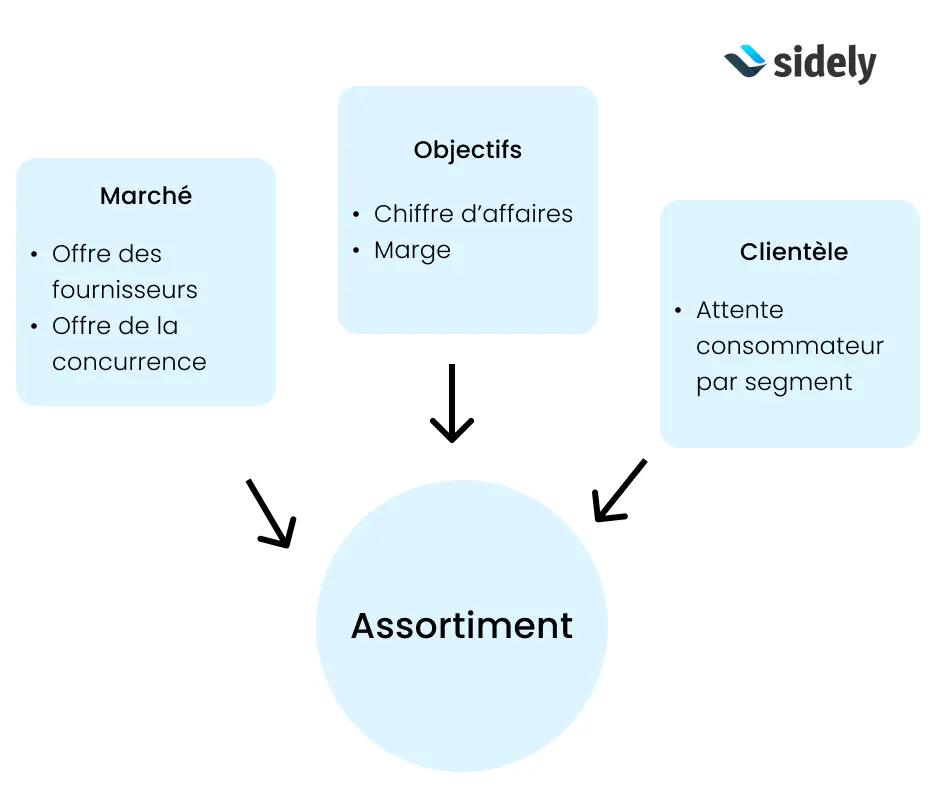
Satisfying customer demand is highly complicated because two expectations mechanically clash. The first goal is to be able to find everything the consumer wants; the second is to be able to find it quickly to reduce shopping time.
As you will understand, if we increase the number of products to satisfy the first expectation, then it will take more time to find the product in question.
Conversely, if we reduce the number of products, the consumer will shop faster, but might be disappointed not to find the specific item they want.
Who builds the assortment?
It depends on where the product is sold. It can be the buying groups, the stores, or the department managers.
On what basis do retailers base their analysis to select products to stock?
To build their assortments, buying groups, stores, or department managers rely on analyses from various sources:
Data from market research panels (Nielsen, Kantar...)
Professional studies
Specialized trade press (LSA, etc.)
Buying group data
Store data, to get information on consumer buying habits.
All these sources of information are essential for building a tailored assortment and meeting customer needs.
What quantity of products should you stock?
The quantity depends on the Market Share (MS). If tomato sauce has a 10% market share in the grocery aisle, it will represent 10% of the assortment.
Note that market share varies from national to local levels! Certain regional products have a much larger market share locally than nationally.
Understand consumer purchase logic
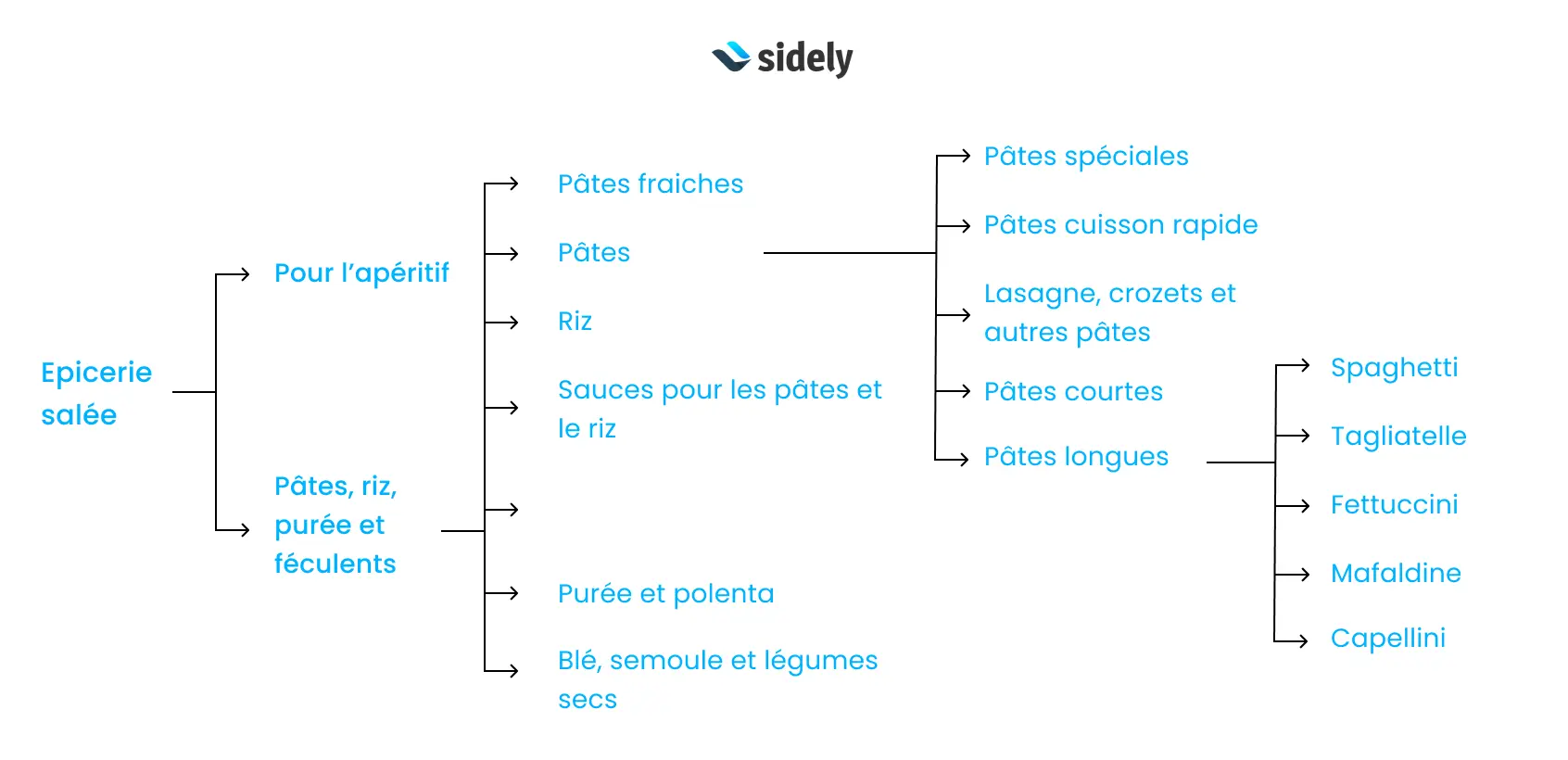
It is important to determine the consumer's purchasing criteria and prioritize them: • 1. Pasta 2. organic 3. whole wheat • 1. Wine 2. red 3. award-winning
The assortment will then be divided in the following way:
The fundamentals of in-store layout
The global layout plan of stores
The global layout plan is the general setup of the store. There are three main layout modes:
Guided layout, like Ikea stores
Grid layout, like supermarkets
Free-flow layout, like department stores
We see an evolution of layouts in retail. Layout plans are becoming more and more hybrid and mix grid layout and free-flow layout.
Layout still and always has economic profitability and customer satisfaction as its main goals. However, some constraints must not be ignored:
Keep the brand's visual identity. When a customer walks into a grocery chain or a discount store, they recognize the brand they are in by the layout, colors, etc.
The shape of the floor area
The location of technical spaces (backroom, employee lounge, etc.)
The grouping of refrigerated areas
These constraints are less significant in rural stores that have plenty of space. However, they can become crucial in urban environments.
🔍 Did you know?
Did you know that in our societies, we have a tendency to turn right. This is why labyrinth architects created dead ends if you turned right. If you want to come out a winner, go left! In retail, we use the same principle. At the entrance, on the right, you find products that are rarely needed, called "impulse buys", and on the left, highly attractive products, called "destination buys". Thus, the consumer is invited to navigate in a zig-zag. The goal is to make them stay as long as possible!
Universes in supermarkets
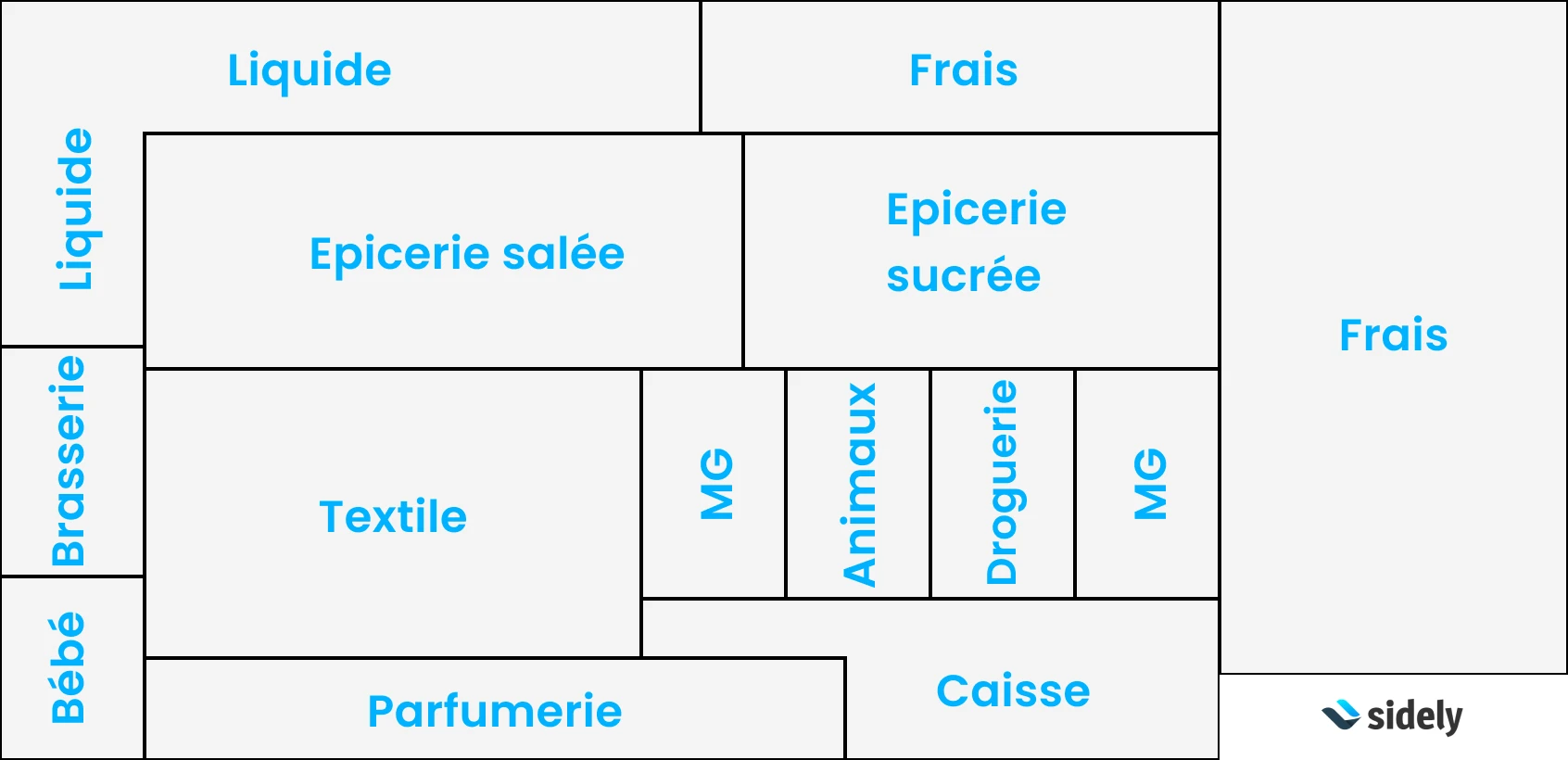
Universes in supermarkets refer to specific areas or sections dedicated to similar products or categories of products. Each universe generally has a theme or a specific objective to meet consumer needs or highlight specific products. They include several categories with complementary and substitute products.
Here is an example of a universe breakdown:
What are the best aisles in the store?
There are different types of aisles, each with specific characteristics that directly impact customer behavior. Here is an example of the different aisles in a store:
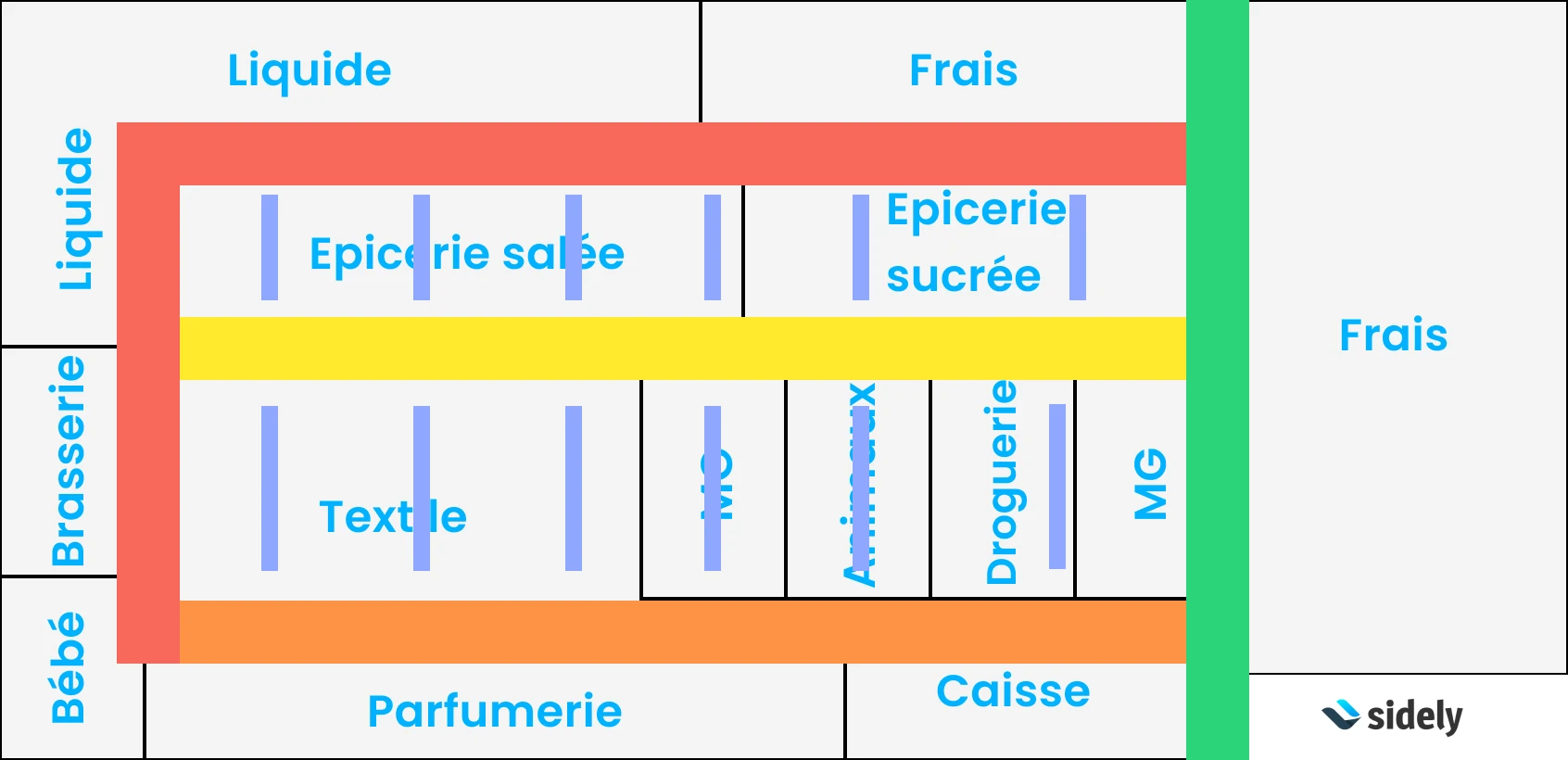
In green, the entrance aisle. This is the busiest aisle. It is the one through which all customers enter. It highlights seasonal products and major promotions.
In yellow, the central aisle. This is the most important aisle in the store. It is the one that crosses the store. It is perfect for promotions on "End Caps".
In orange, the checkout aisle. This is the slowest aisle. It is the one through which everyone exits. It is ideal for impulse buys.
In red, the perimeter aisle. Its importance depends on the brand's policy.
In purple, the secondary aisle. It gives access to product families. This is the standard shelf aisle.
Where to position yourself in the aisles?
Hot zones and cold zones in stores
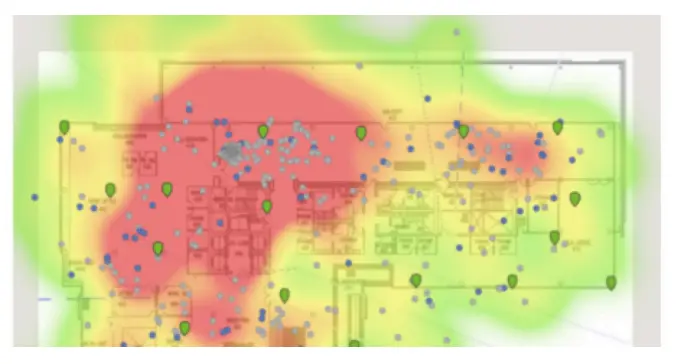
Hot zones are the areas with the highest foot traffic where customers spend the most time. Cold zones are the opposite: the areas with the lowest foot traffic where customers spend the least time. The challenge for stores is to guide customers through these cold zones. For example, in a supermarket, the seafood section will be colder than the savory grocery section.
Types of in-store purchases
Locating a product in a hot or cold zone only makes sense if you understand the purchase logic it serves. We generally distinguish three types of in-store purchases:
The planned purchase: the customer knows exactly what they are looking for and wants to find it as quickly as possible — hence the importance of a clear standard shelf layout even in a cold zone.
The suggested impulse buy: the consumer is tempted by a product they did not know about (new product, promotion), generally highlighted in a hot zone or on an end cap.
The recalled impulse buy: seeing the product on the shelf reminds the customer that they are out of it at home or that they saw a recent commercial — a lever that merchandising can activate with reinforced facing.
This logic is not only store-wide. Within the same aisle, there are hot zones and cold zones. This is known as the rule of Thirds.
The main idea behind the rule of thirds in retail is to divide the space of an aisle or display into three equal parts, in terms of height or width, using two lines or levels. Each third has a specific goal for product presentation.
The first Third (Upper Third): The first third, usually positioned on the left, is reserved for popular, high-quality, or high-profit-margin products. This area is the most visible and accessible, ideal for highlighting key products.
The second Third (Middle Third): The second third, in the middle of the display, is intended for mid-range or moderate-sized products. This is where complementary or similar products are arranged to encourage cross-selling. Although visible, they are not as prominent as those in the first third.
The third Third (Lower Third): The third third, on the right of the display, is often dedicated to basic products, promotional items, or lower-margin products. They can also be used for excess inventory or seasonal products.
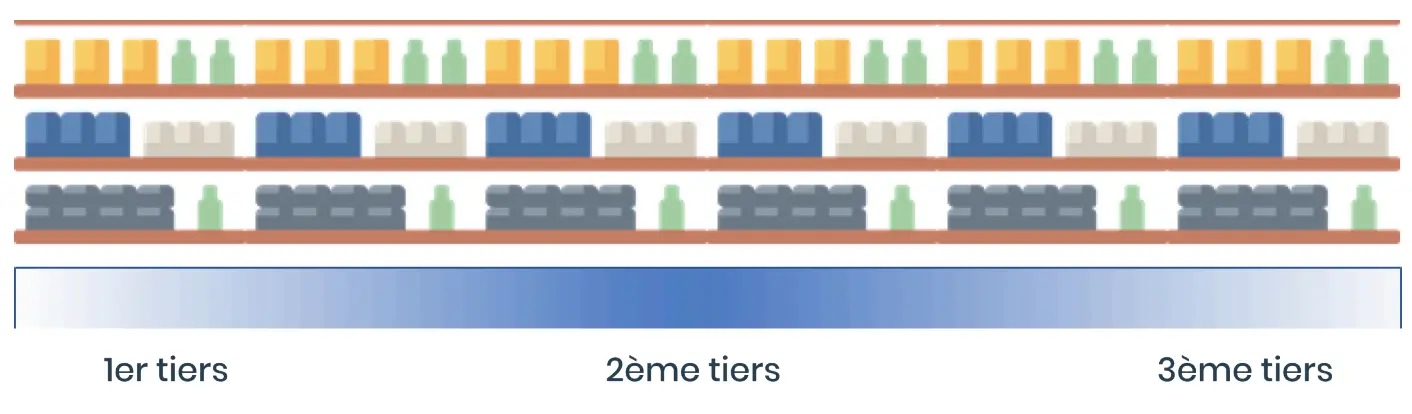
The goal of this strategy is to optimize the use of retail space by highlighting the most important products and making customer navigation easier. This approach can help increase sales by strategically positioning attractive products.
The retailer will prioritize high-margin products, namely private labels and new items. They will leave loss leaders and national brands on the less high-selling thirds to try to "warm up" the zone.
💡 For the sales representative
As a Sales Representative, it is vital to fight to place these products in the second third of the aisle; this will automatically generate rotation and therefore revenue. Ideally, you can also succeed in putting your competitors in the 1st and 3rd thirds.
POS: Point of Sale Advertising
Beyond layout and facing, Point of Sale (POS) Advertising represents the final communication link between the product and the consumer, at the exact moment of the purchase decision. It includes all advertising material present in-store: presentation posters and signs, promotional flags, shelf talkers, display units (sometimes oversized, like a giant replica of the packaging), demo stands, screens, and interactive kiosks.
POS advertising connects directly with the levers already discussed in this article: it reinforces the visibility of a product on an end cap, supports the staging of the seasonal offer mentioned for the entrance aisle, and can turn a planned purchase into a suggested impulse buy.
Objective: push the product toward the consumer through effective highlighting and create an atmosphere conducive to purchasing.
Common formats: posters, flags, floor or counter displays, live demonstrations, digital POS (screens, touch terminals).
Best practices: alignment with the traffic flow direction (see the "positive and negative faces of shelves" section), updating with commercial highlights, measuring the impact on the product's rotation.
Positive and negative faces of shelves
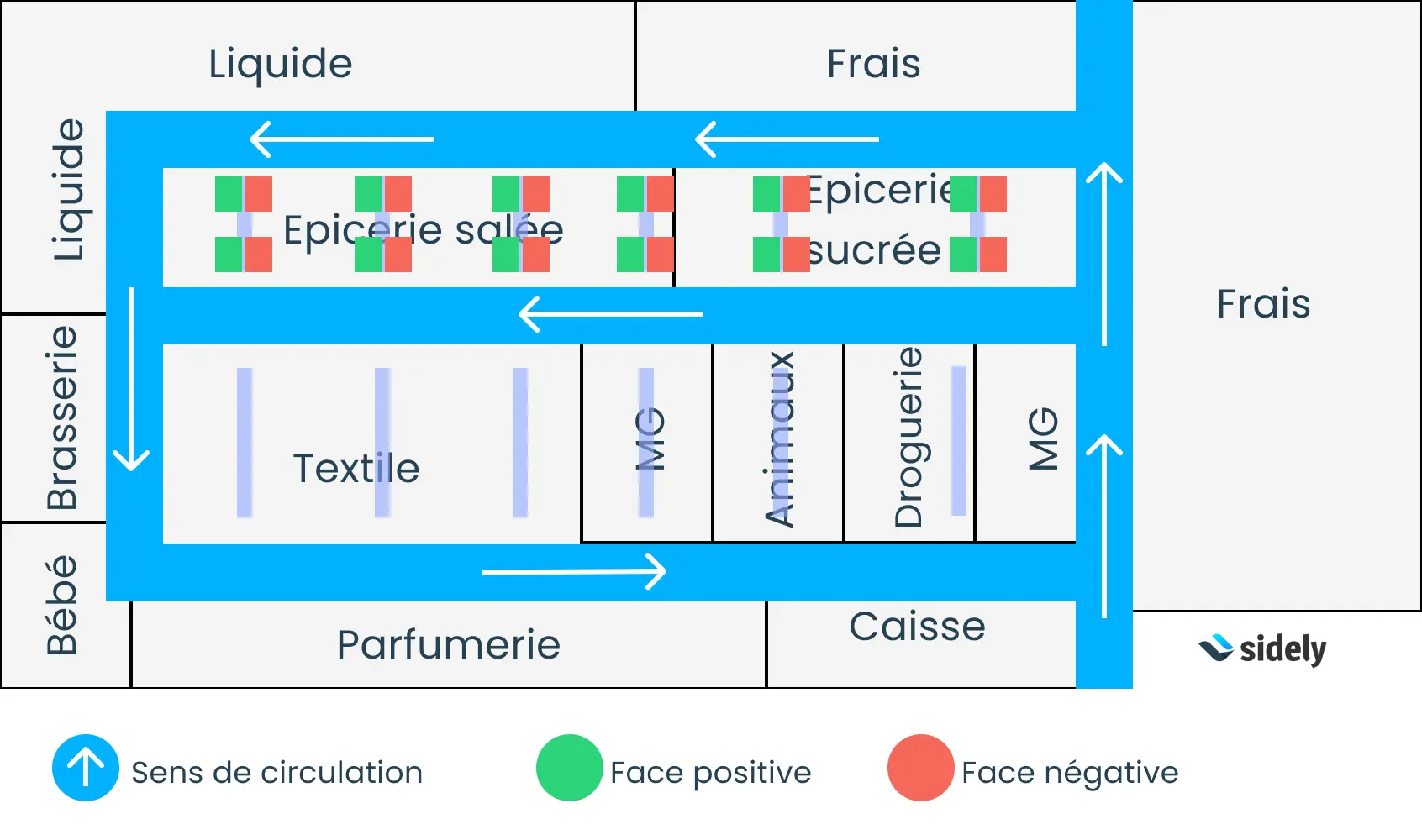
End caps and standard shelving units also have a less visible side. Indeed, depending on the customer's path, some faces are only partially visible or even invisible, since we do not have a 360-degree view.
On the less visible side, we find products that are complementary to those highlighted on the main face.
💡 For the sales representative
Always try when negotiating an end cap to ensure it is facing the flow of traffic. Your products will be much more visible, and you will ensure a successful promotion.
Shelf arrangement
Different layout techniques
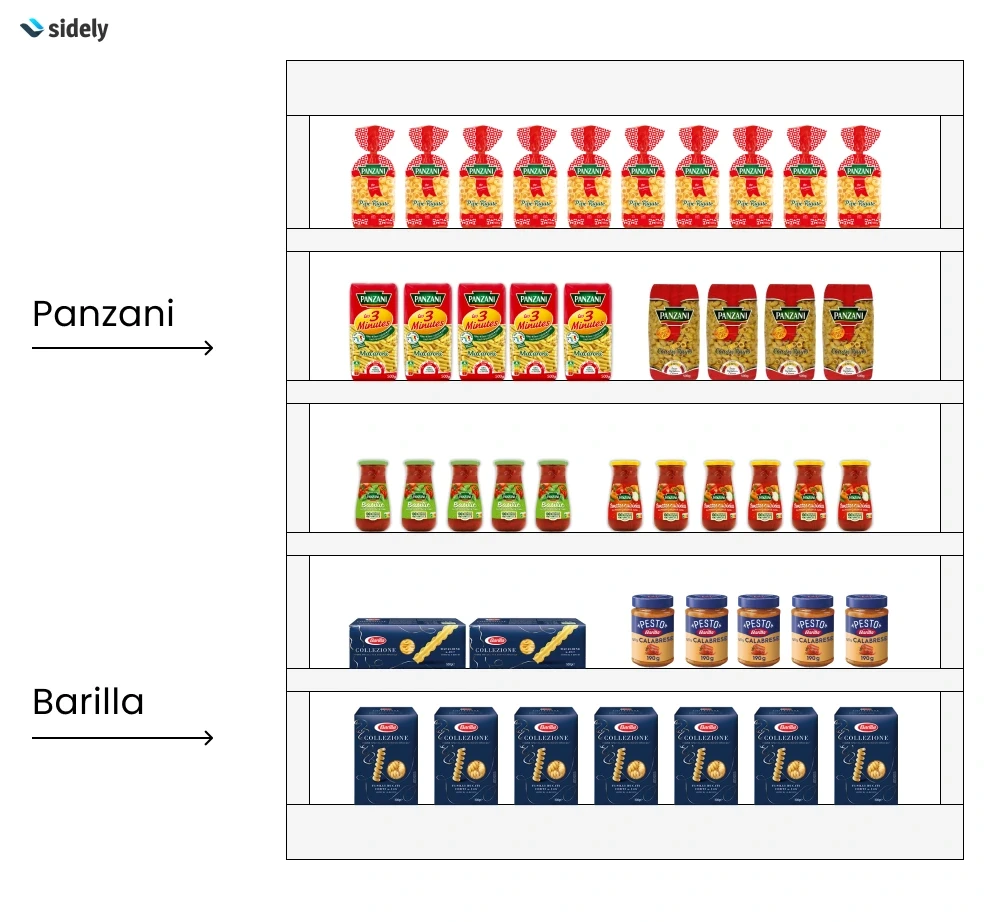
Two main techniques stand out: a vertical or horizontal layout. It can be done according to different criteria. Generally, by brand, by segment, by price, or by product. It is also possible to mix them for a block layout.
Horizontal presentation
Classifying products in ascending order of selling prices, in relation to the direction of customer traffic.
Vertical presentation
Verticality is considered more effective because:
Comprehension and visibility are better due to the natural horizontal movement of the head
It facilitates price comparison
It slows down customer movement without making them backtrack
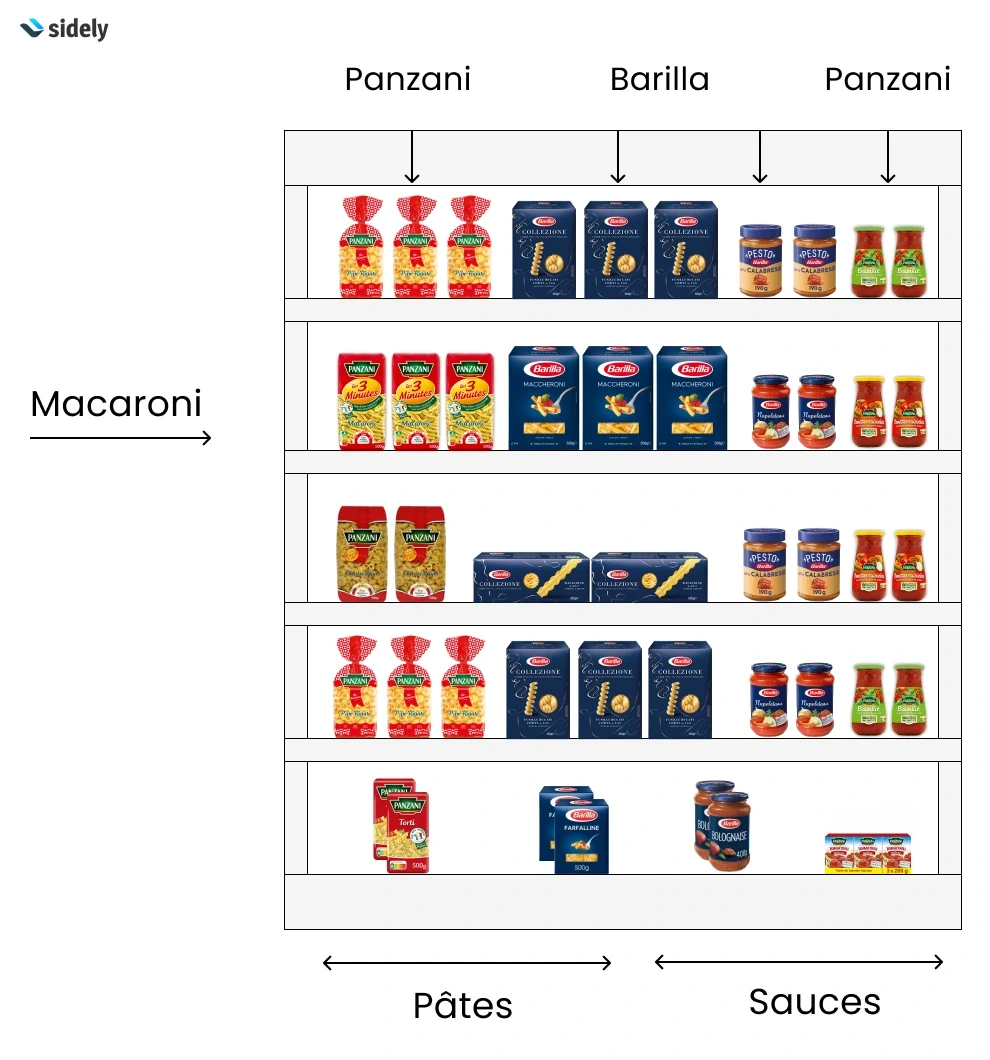
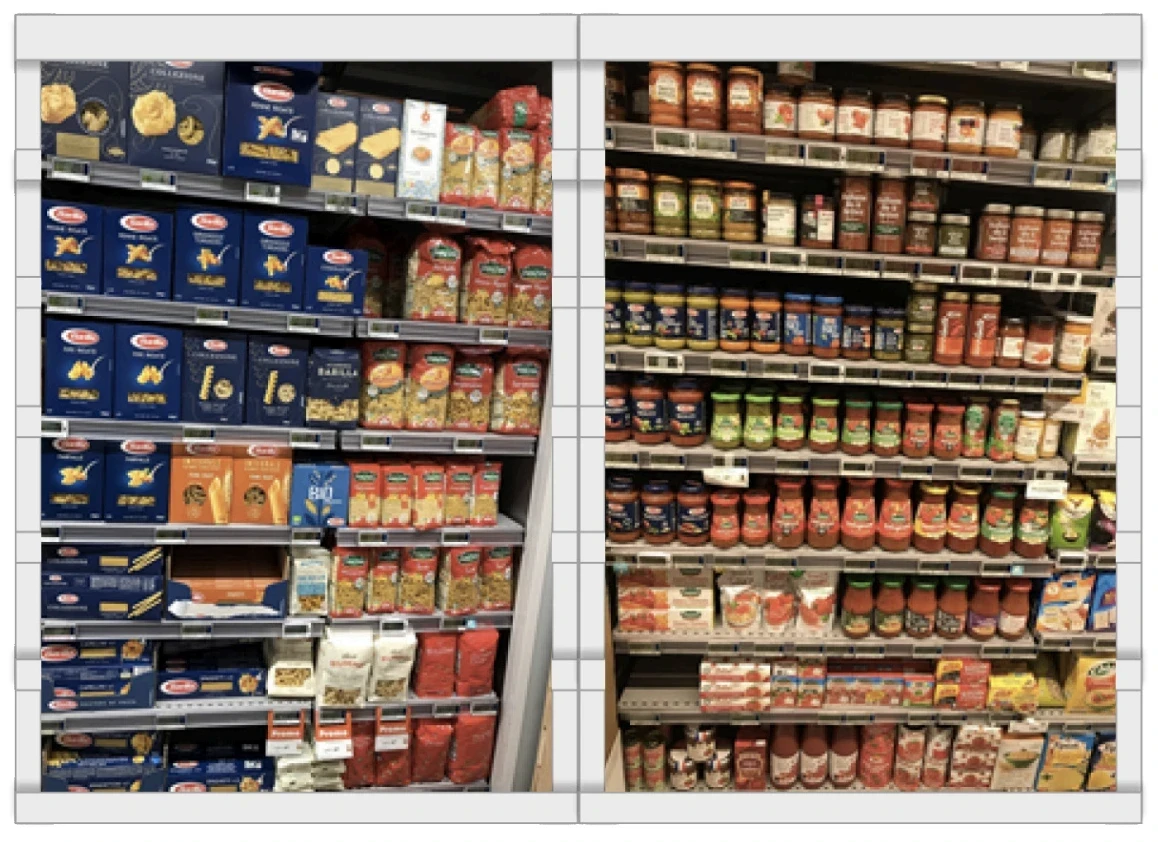
The reality
So do we position by brand or by product?
This question is answered in a very rational way thanks to the brand sensitivity index. The brand sensitivity index is an indicator used to assess the receptivity and importance of brands in the retail sector. This index measures how customers and consumers react to brands and their presence in a retail environment, such as a supermarket or a hypermarket.
Some segments have brands with a high sensitivity index. This means the consumer absolutely wants their brand and no other. For example: the consumer has a high index for shampoo or coffee. If the brand sensitivity index is high, we favor a layout by brand rather than by product.
Brand positioning on shelf (National Brands, Private Labels, entry prices)
Once the "brand or product" choice is settled by the sensitivity index, each type of brand must be positioned in the right place on the shelf to optimize the overall aisle margin:
National Brand (NB): benefits from strong draw power and serves as an indicator of the store's price positioning.
Private Label (PL / Store Brand): offered at a lower price than the national brand for a quality perceived as equivalent, it offers higher profitability than the average aisle margin. It is generally positioned at the best level (eye level), immediately adjacent to its target national brand, with an equivalent facing. Discover how to position yourself against private labels in our dedicated article.
Entry price: the cheapest on the shelf, it is usually positioned at the bottom of the segment, consistent with the price gradient logic already mentioned in this article.
Other criteria to consider in a layout
Physical
Product volume: We favor placing heavy products at the bottom of the shelving unit and lighter products at the top.
Management
Top shelf stock: Some products, "destination products," are placed on the very top shelf of the unit, which is inaccessible to customers because it is too high. However, it gives a sense of abundance and allows for extra stock.
Bulk bins: We place products in dump bins in front of the shelves for high-rotation products. This allows customers to access products easily without messing up the shelf facings. It limits out-of-stocks.
Price
Price gradient: This involves placing products according to their prices. The most common way is to place the cheapest products at the bottom and the most expensive at eye level, with a gradual transition in between.
For a brand, the dream shelf layout is the mosaic. This means being the only brand in the aisle. Of course, reality is more complex, and we are going to discover the best positions to take on a shelf.
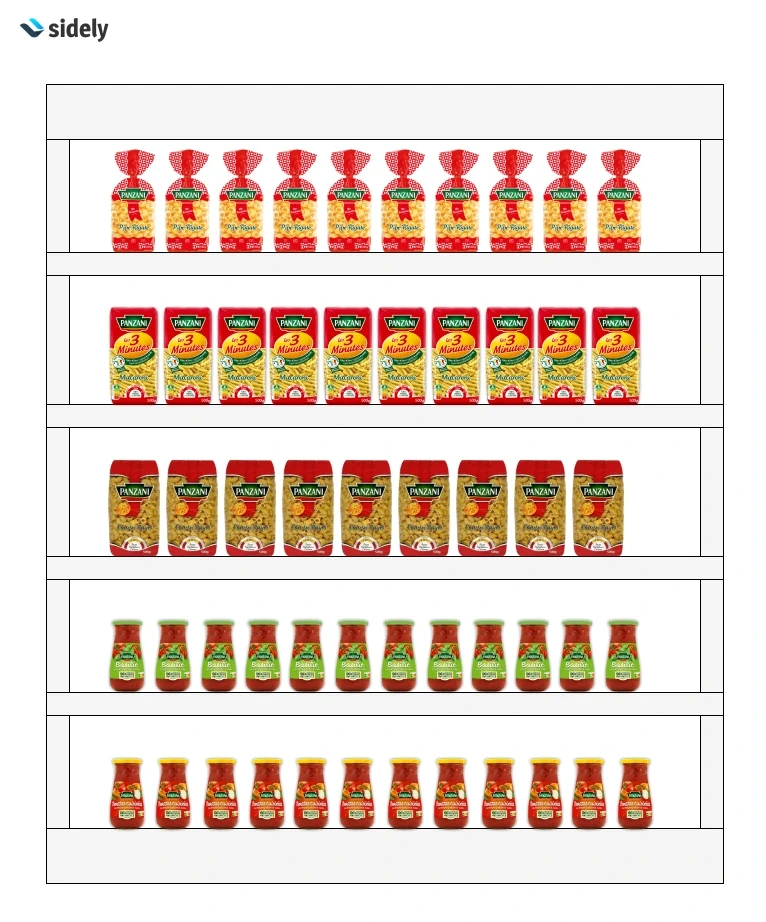
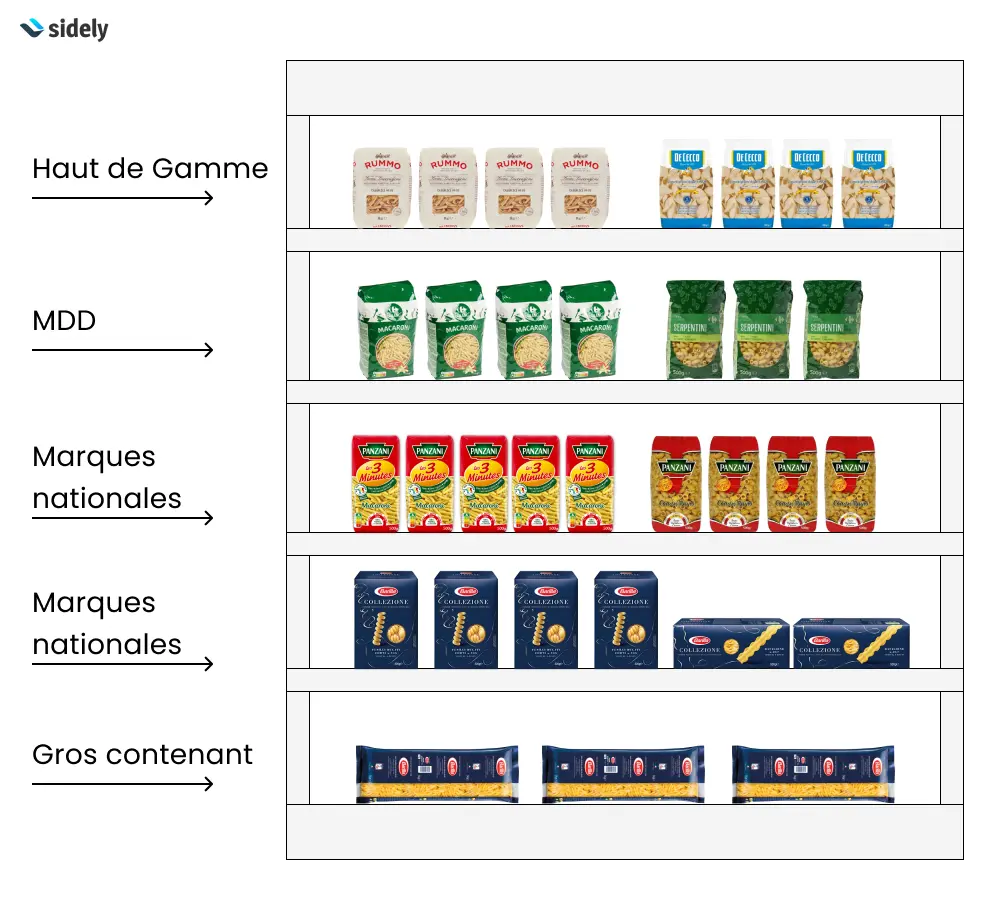
The retailer's shelf layout
The most visible zones on a shelf
Closer to hands and eyes, and I'm in love! In many countries, women still do the majority of grocery shopping. Their average height is around 5'4" (1.63m). Thus, the most visible and accessible zones are between 2 feet (0.60m) and 5.7 feet (1.75m). Beyond 5.7 feet, products are no longer easily reachable, hence the placement of top shelf stock.
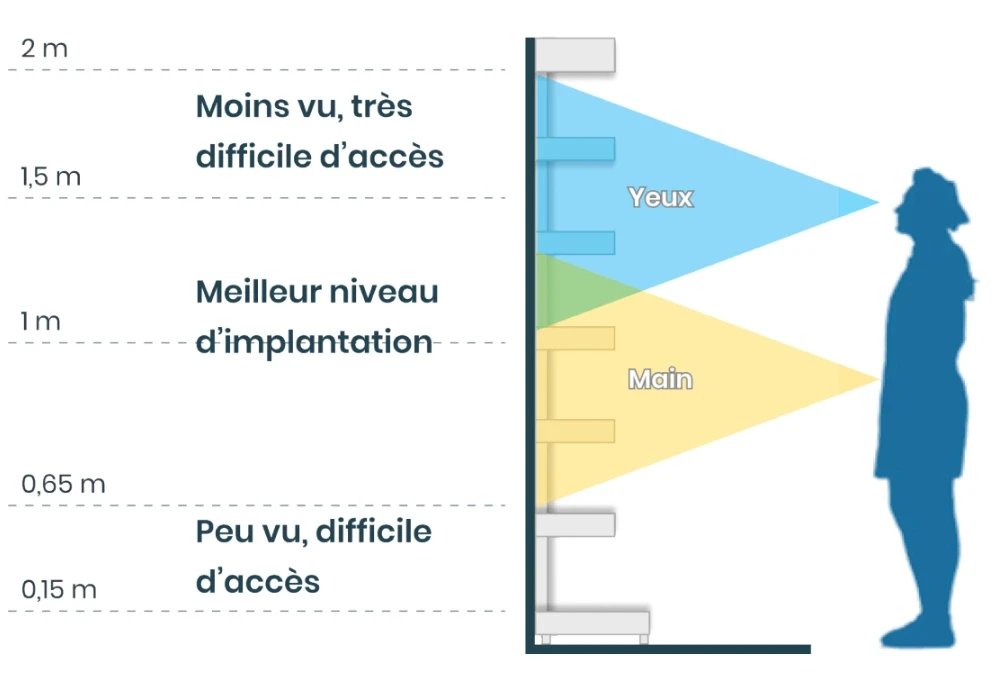
Combined with the rule of thirds, we can deduce the most visible, reachable, and therefore highest-selling zones of a shelf layout.
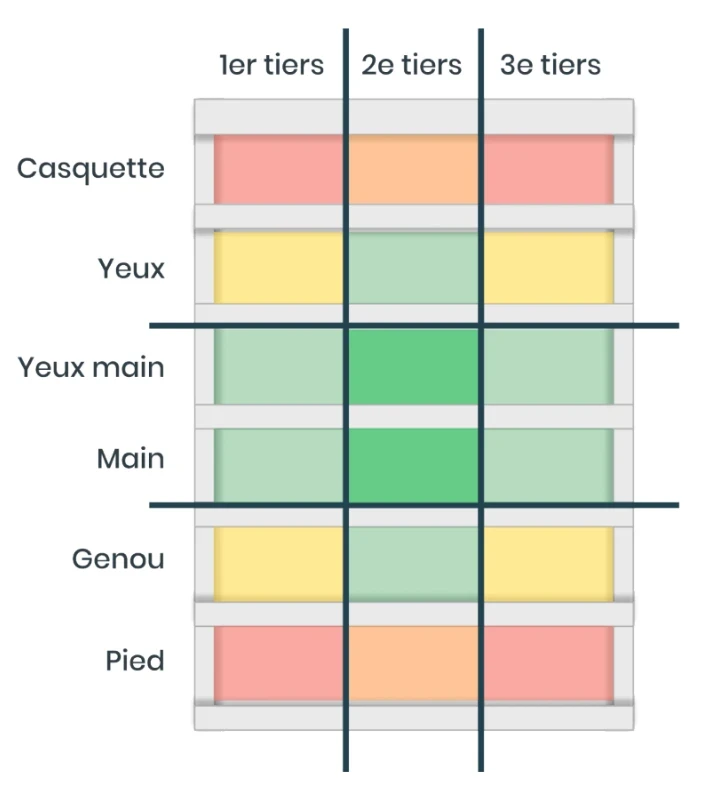
At the scale of a shelving unit
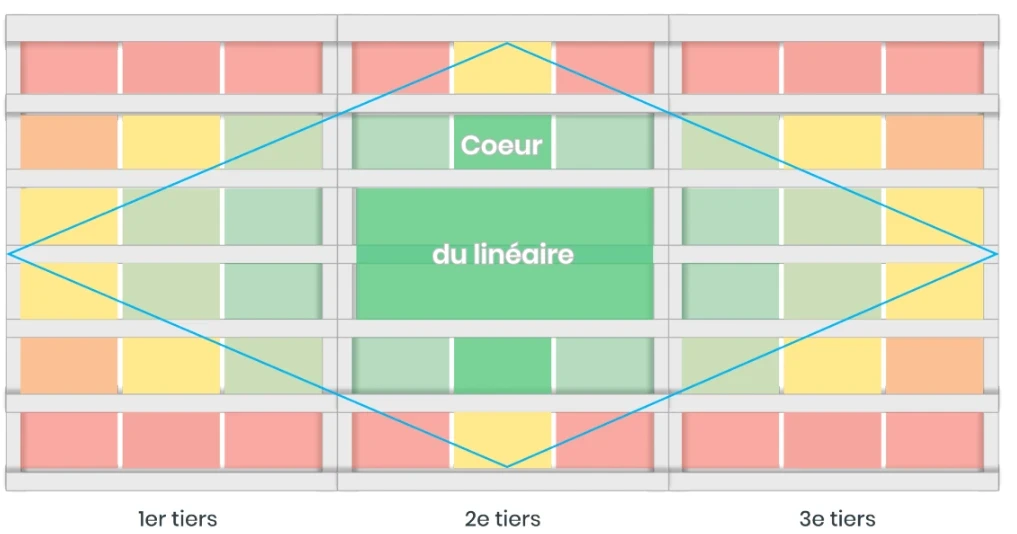
Be center stage!
Facings correspond to the number of times a product is directly visible to the consumer on a shelf. Facing is crucial data for sales. Indeed, beyond the position in the store or on the shelf, there is the actual visibility of the product. The more facings your product has, the more visible it will be! At least, up to a certain threshold. Indeed, optimizing visibility with facings follows a very clear mathematical rule: the visibility threshold and the saturation threshold.
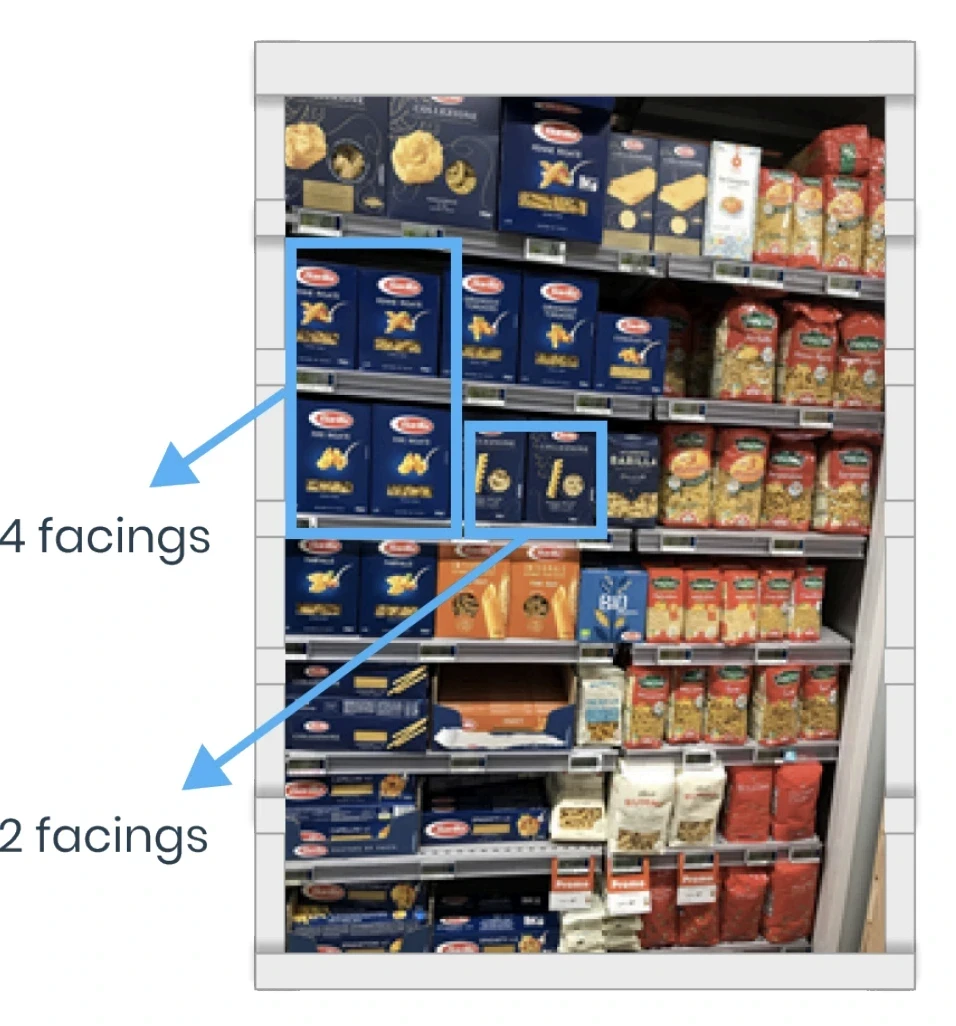
The Visibility Threshold
It corresponds to the minimum size for a product to be seen by a customer passing through the aisles. We consider that a customer moves:
In "cold" zones at a speed of 1.5 to 2m per second
In "hot" zones at a speed of 0.5m to 1m per second
At the same time, the eye is capable of seeing a limited number of images per second. Yes! The faster you go, the less you see! Think of your trips by car or train.
Visibility Threshold = Speed in m/s / Retinal perception in images per second
In "Hot" Zone = 2m/s / 3 images per second = 0.66 m
In "Cold" Zone = 1m/s / 3 images per second = 0.33 m
The visibility threshold is between 13 inches (33 cm) and 26 inches (66 cm). This means that adjacent product facings must have a minimum width of 13 inches (33 cm) to have an impact.
The Saturation Threshold
This is the opposite of the visibility threshold. The saturation threshold corresponds to the point where increasing the facing size no longer has an impact on increasing product sales. It is considered that beyond 31 inches to 3.2 feet (80 cm to 1 m) of facing width, the product will not sell more.
KPIs and metrics for monitoring merchandising
A layout is not judged only by eye: it is managed with numerical indicators, which make it possible to verify that the principles set out in this article (facings, thresholds, thirds, assortment) actually produce the expected effects on shelves.
Linear shelf space and total shelf space: professional units used to express shelf space allocations; total shelf space takes into account the number of display levels, while linear floor space does not.
Out-of-stock rate: the portion of time a listed product is missing from the shelf. An out-of-stock usually leads to a purchase switch to another brand, a delay in purchase, or a direct loss of sale if the customer goes to another store — hence the importance of the safety stock mentioned in connection with top shelf stock.
Share of shelf (SOS): the proportion of space occupied by a product or brand relative to the total aisle space, to be compared with its market share (MS) to judge over- or under-representation.
Revenue or margin per linear foot: a profitability indicator that helps choose between two candidate products for the same spot.
Frequently asked questions about merchandising in retail
What is retail merchandising?
What are the different types of merchandising?
What is the rule of thirds in merchandising?
What is a planogram?
How to measure the effectiveness of a merchandising strategy?
Practical checklist: points to check on shelves
Does the assortment reflect the actual market share of each category?
Are high-margin products well positioned in the 1st or 2nd third?
Does the facing of each item respect the visibility threshold (13-26 inches) without exceeding the saturation threshold (31 inches-3.2 feet)?
Are top shelf stock items limited to the zone above 5.7 feet (1.75 m)?
Is the private label positioned at eye level, close to its target national brand?
Is the in-store POS advertising aligned with the traffic flow of the aisle?
Is safety stock sufficient to avoid out-of-stocks on high-rotation products?
Does signage make it easy to find products for planned purchases?
Does the layout respect the core range defined by the brand?
Alexis co-founded Sidely after several years of service as a sales director. To understand what builds, or breaks, a salesperson's performance, he conducted more than 100 telephone interviews with field sales representatives. At Sidely, he transforms this raw knowledge into concrete support, based on facts rather than assumptions.
See also

Artificial intelligence and field professions: what our 2026 studies reveal
Adoption, barriers, use cases: discover what our three studies reveal about the role of AI among sector managers, sales representatives, and foodservice sales reps.

CHR and RHF Sales Representatives: portrait of a relationship-driven profession in the era of data
Equipment, productivity, AI: discover the major trends for the HORECA and food service sales profession in 2026 through our field study.

Pharmaceutical Sales Representative in France: Portrait of a Field Job Under Pressure
Compensation, aspirations, AI usage: discover the major trends in the pharmaceutical sales representative profession in 2026 through our field study.

Area Sales Managers in France: who are they and how is the profession evolving in 2026?
Compensation, aspirations, AI usage: discover the major trends in the field sales representative profession in 2026 through our field study.
The area manager professions in 2026
Discover the trends, the challenges, and the key figures.