

How to optimize product assortments in mass retail?
Width, depth, rotation, seasonality: how to optimize product assortment management in supermarkets to improve shelf presence and sales.

In short
8 min read
Define a balanced assortment strategy between consumer expectations and profitability.
Analyze key factors such as product nature, location, and seasonality.
Optimize retail space by prioritizing fast-moving and high-margin products.
Rigorously manage inventory to maximize availability and reduce stockouts.
Regularly adapt the assortment based on sales performance and local trends.
Use a CRM to structure the offering, integrate picking, and facilitate access to the catalog.
Assortment optimization in retail is a key element for the commercial success of a store and a brand.
However, finding the right balance between meeting consumer expectations and maintaining high profitability can prove complex.
That's why negotiating and optimizing your assortments in retail requires a careful and constant analysis of various factors such as the nature of the product, the location of the point of sale, seasonal variations, consumer ability to buy the product, etc.
This article aims to guide you through the different steps to achieve an optimal assortment in retail.
Table of contents:
Criteria to consider when building the assortment
Establishing your retail strategy
Depending on the retailers through which you are going to distribute your products, you will not implement the same strategy.
Beyond changing your offer, price, or even packaging, you must distribute your products in retailers that match your brand image. Not all products are sold in all stores.
Also take into account that some retailers want exclusivity on certain brands. This does not necessarily mean that you cannot be sold anywhere else. However, to attract a target clientele and stand out through the product offering, some stores or chains request exclusivity on a range or a product, which therefore cannot be included in other assortment plans.
Understanding retailers' objectives
The sales objectives vary between you and your retailers.
While you want to align your stores' offerings with your sales targets, retailers seek to satisfy consumer demand and maximize profitability. When building assortments, the main factor is consumer ability to buy the products available in the store. For example, the demographic profile is taken into account: if a store's primary clientele consists of high-income households, it can stock more expensive products on the shelves.
The challenge therefore lies in the price/volume effect for the store:
"Do I have enough loss leaders to draw them to my store instead of another?" ;
"Do I have enough complementary products to encourage buying the most expensive products as much as possible?".
Their challenge lies in satisfying customer needs while reducing shopping time. Since retail space is limited, store managers seek to maximize their profitability per square foot.
In addition to these diverging objectives, there is the determination of the product quantity. The quantity of products in the assortment depends on market share (MS).
For example, if the tomato sauce MS is 10% in a given aisle, it must represent 10% of the assortment of that aisle. Retailers, when creating assortments, also take into account the market share of each brand.
And MS is important to maintain revenue! To understand this better, let's look at a concrete example:
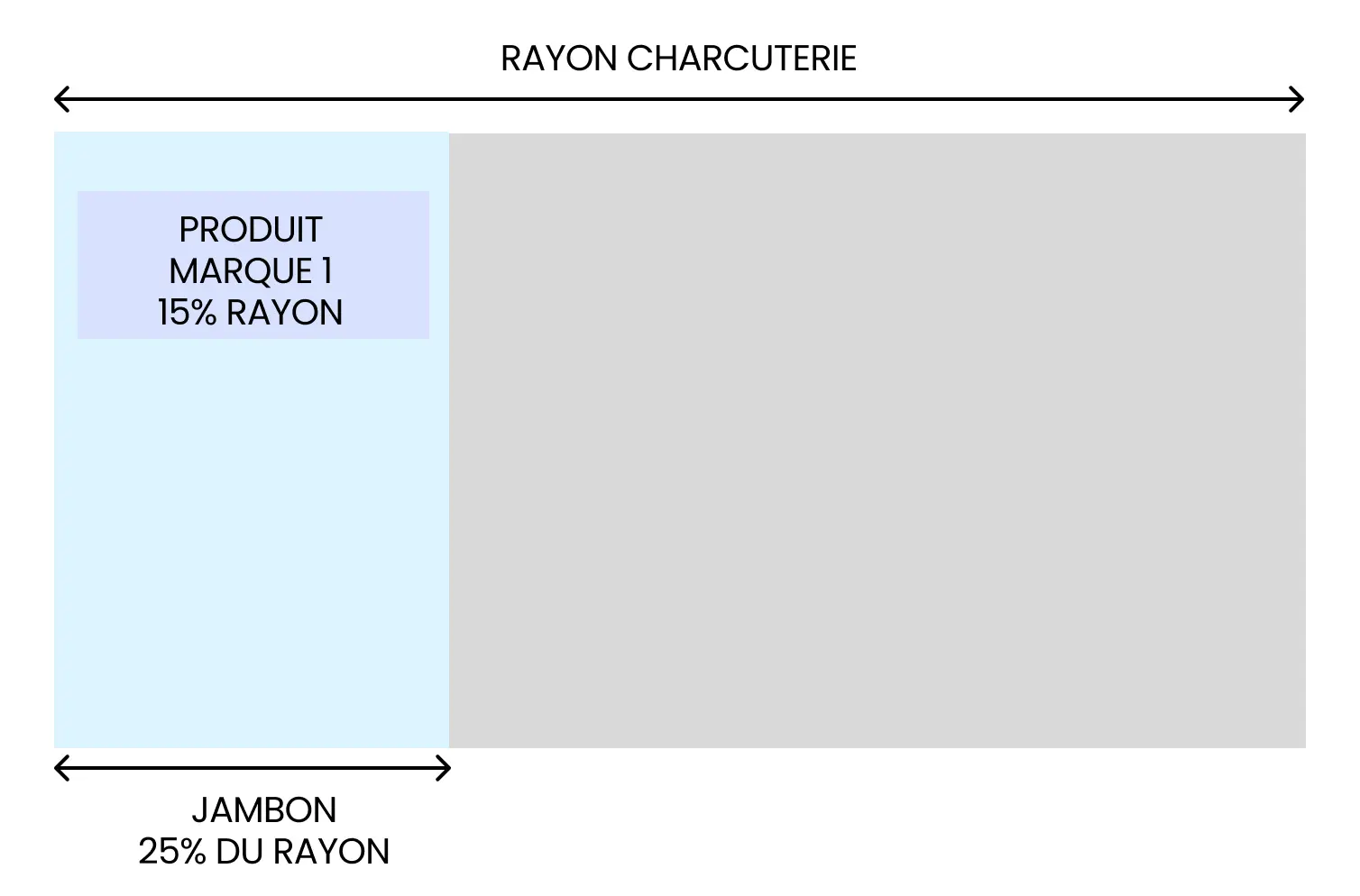
In France, ham has a 25% market share in the cold cuts category.
Among the brands selling ham, brand 1 has a 15% MS.
Naturally, ham represents 25% of the cold cuts aisle. Among the brands selling ham, brand 1 represents 15% of the aisle.
This aisle generates an average of €10,000 / week, meaning €480,000 / year.
Ham MS represents €120,000 in revenue / year and brand 1 represents €18,000 / year.
Except, this is not always the case.
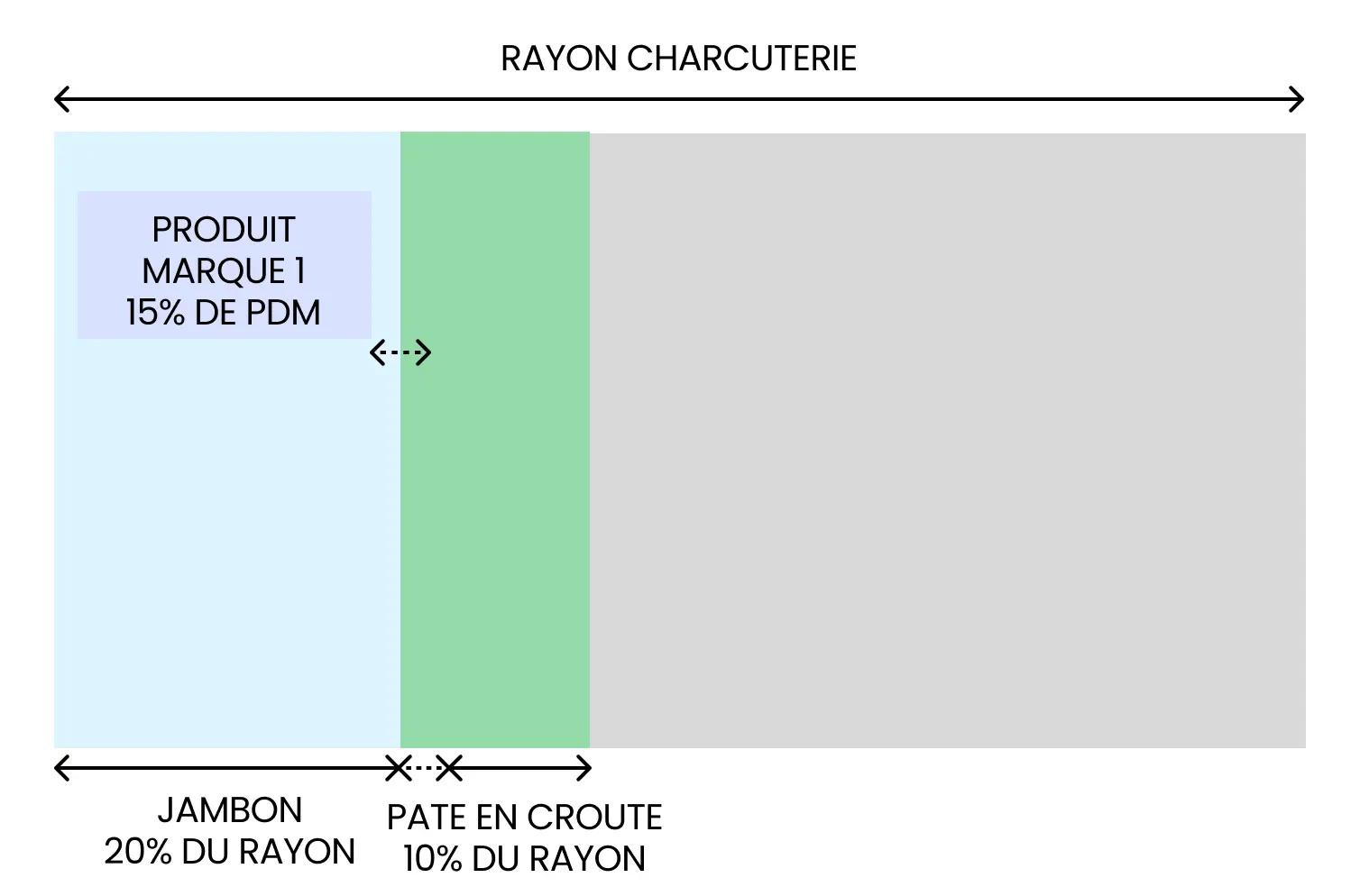
The store did not take into account the ham's MS. It allocates only 20% of the aisle to ham. The remaining 5% is reallocated to meat pies, which normally only have an MS of 5%.
In this case, the volume allocated to meat pies is greater than the actual sales volume.
The revenue for meat pies is €24,000 / year.
The ham revenue drops to €96,000 / year (-20% revenue on the aisle / year).
The revenue for brand 1 drops to €14,400 / year (-20% revenue / year).
Everyone loses, even though brand 1's MS changed. But it can change upward or downward in the assortment.
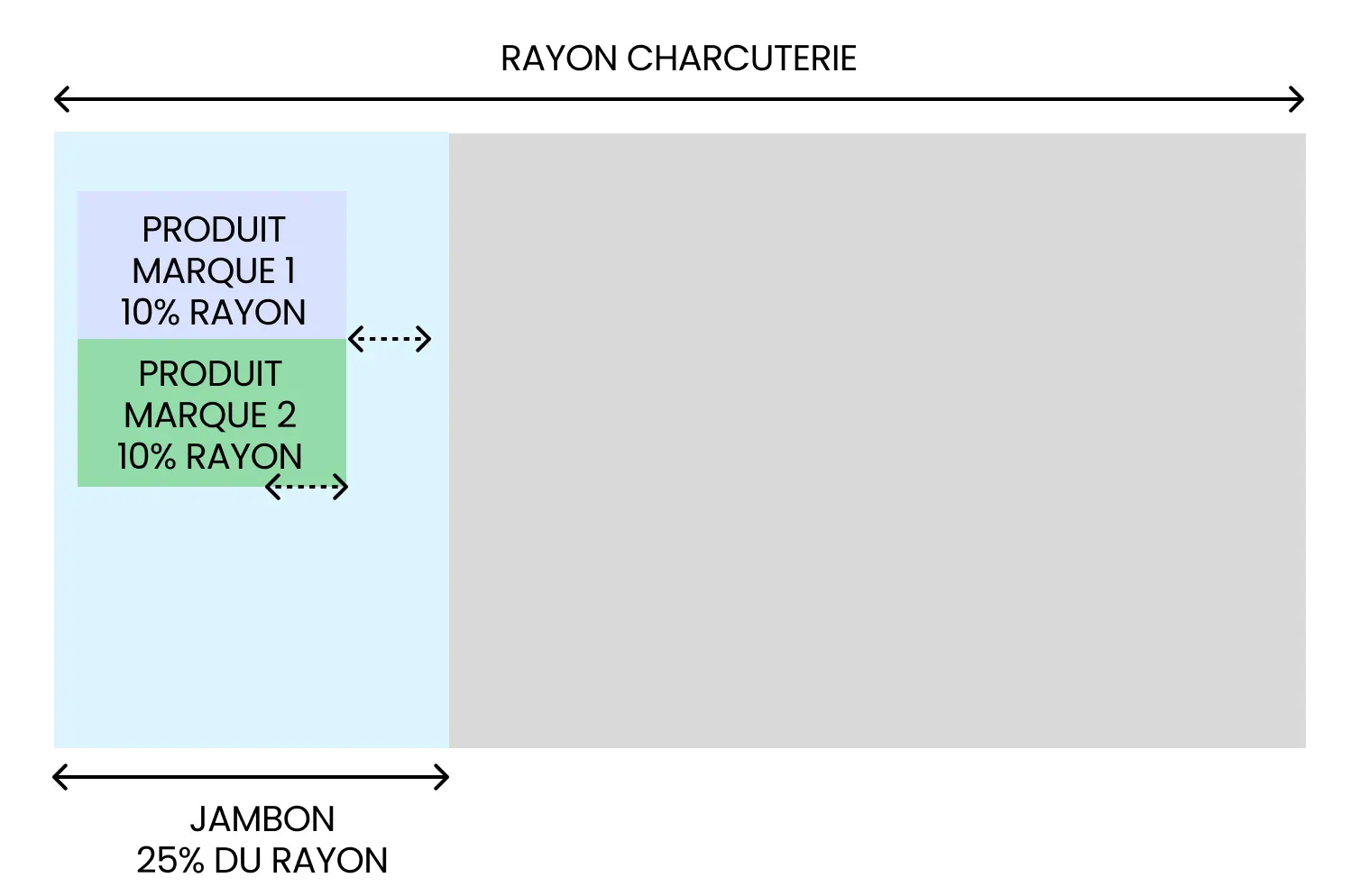
The ham MS is respected and generates €120,000 in revenue / year. But brand 1 loses 5% to the benefit of brand 2, which normally only has 5% of the MS.
Brand 1 will therefore generate €12,000 / year in revenue for the store on hams.
Brand 2 generates €6,000 / year in revenue for the store.
In this case, the volume allocated to brand 2 is greater than the actual sales volume. Because of a poor assortment in the aisle, the store loses €4,000 and brand 1 loses €6,000.
It is important to understand that if one or more flagship products are missing, the aisle will lose sales volume, which will also impact the manufacturer. Manufacturers and retailers are not in competition. On the contrary: they are allies, with the common goal of increasing revenue. If one wins more, intrinsically, the other does too.
MS, based on reliable external data like IRI, is a good asset to explain to your retailers how they can increase their revenue by expanding your presence in the assortments. Indeed, if they allocate the missing MS to another product, they may incur more waste, especially when it comes to fresh products like ham!
It is important to note that MS can vary from one region to another. For example, crepes have a much larger MS in Brittany than in Auvergne.
Finally, the type of assortment will change based on the retailer type. For example, Lidl and Monoprix do not base their commercial strategy on the same criteria and therefore do not sell the same products. Additionally, within the chains themselves, the tier or modulation will affect the width and depth of the assortment.
This is what we will see together in the rest of this article.
Types of assortments in retail
In retail, assortments refer to the variety of products available for sale in a store. The types of assortments are generally classified based on the width and depth of the product ranges offered.
In total, there are five types of assortments in retail.
The Wide assortment, which offers a wide variety of different product categories. For example, a hypermarket that offers items ranging from food to clothing, and electronics to household products.
The Deep assortment, which offers many choices within a specific product category. For example, a specialized wine and spirits store offering a wide selection of wines from different regions, grape varieties, and vintages.
The Limited assortment, which offers a small number of products, often focusing on the most popular or best-selling items. For example, a convenience store or a small grocery store that focuses on basic everyday consumer goods.
The Scrambled assortment, which combines width and depth, offering a wide variety of product categories and many options within each category. For example, a large supermarket or hypermarket offering a wide range of products in each category.
The Seasonal assortment, which temporarily offers products based on the season or specific events. For example, Christmas products in December, gardening items in spring, school supplies in August-September.
How to create your assortment plan?
An assortment plan in retail is a detailed strategy defining which products will be sold in a store or a store chain. This plan is essential to ensure that product choice is available to meet customer needs and preferences, while maximizing profitability and retail space efficiency.
Here are some key elements of an assortment plan:
Product selection: The plan determines the product categories and specific SKUs to stock. This can include a variety of goods, from basic items to specialized or seasonal products. The goal is to take up as much space as possible in the aisle (thus displacing your competitors);
Depth and width of the assortment: Depth refers to the number of variations of the same product (such as different flavors or sizes), while width concerns the range of different product categories offered;
Adaptation to local needs: Retailers generally establish a national assortment plan. The plan must also take into account the unique characteristics of local customers. That is why stores have the freedom to adapt. The national assortment plan is respected to a certain percentage. It is generally ~95% for integrated stores and ~80% for independent ones;
Consideration of seasonality: Planning must anticipate demand and adapt to consumers' seasonal needs. This is why it is important for a brand to follow the assortment plan, which will be dynamic throughout the year. For example, at Christmas, the poultry assortment is wider and deeper;
Adaptation to market trends and consumption habits: To optimize your assortments, you must also take into account demographic macro-changes at local and national levels as well as societal developments. The halal market in France is a good example. While it represented only 80 million euros in 2009, the halal products market in grocery stores grew to 282 million euros in 10 years, which is a 247% increase;
Profitability: Each product in the assortment must contribute to overall profitability, taking into account factors such as profit margin, stock turnover rate, and customer appeal;
How to optimize your assortment
Optimizing the sales space
There are three types of products in retail stores:
Loss leaders: without their presence on the shelf, consumers will not come to the store. These are strong products on which retailers and stores have little leverage to make high margins. These products are generally placed on end caps or at the aisle ends. For example: Nutella spread;
Other national brand products: these are the products that bring the most profitability to stores because they can make bigger margins on them. These products are generally placed in the middle of the aisles. For example: Lucien Georgelin spread;
Private labels: these products are growing more and more, because they allow control over the retailer's image, expansion of their range, and the generation of significant margins. These products are generally placed around national brand products. For example: Carrefour spread.
Currently, supermarkets offer an average of 7,000 to 10,000 SKUs. Hypermarkets between 10,000 and 30,000 SKUs. But the current trend is toward optimization of the sales space usage by retailers.
🚨 To understand the upcoming trends for 2026 in retail, I invite you to read our white paper on sales optimization in retail.
This can result in a more restricted selection of products, prioritizing those that offer rapid turnover. In addition, the number of new brands and SKUs on the market is exploding, and the growing presence of private labels further reduces the available space on the shelves.
Sales space is a precious resource, and there isn't room for everyone. And it is mainly the second type of product (other national brand products) that suffers.
It is therefore vital to select products that guarantee rapid turnover and high profit margins. According to a study by Nielsen, high-turnover products can contribute up to 80% of a store's total revenue. By focusing the assortment on these high-demand products, stores can maximize their profitability while effectively meeting customer needs.
Refined inventory management
Well-orchestrated inventory management is crucial to maintain availability of the most popular items while avoiding surplus. According to McKinsey & Company, optimized inventory management can lead to a 2% to 5% increase in sales and a 5% to 10% improvement in gross margins. This involves a balance between constant product availability and reducing overstock or out-of-stock situations.
Regular adjustment of the assortment
Regular adjustment of the assortment is a fundamental element to ensure the relevance and appeal of the store offering. This approach involves a constant evaluation of product sales performance, with specific attention paid to customer feedback and changes in buying behavior.
The key lies in the ability to adapt. By frequently revising the assortment based on your analyses, you can adjust your offer to better meet current market expectations and thus sell more. This strategy ensures that the product range offered remains not only attractive but also perfectly aligned with consumer needs and desires.
How to optimize your assortments in your sales CRM?
Are your assortments optimized? That's a good start! All you have to do now is integrate them into your sales CRM to improve sales management in retail. This allows field teams to access a clear and updated view of the products to promote in each point of sale. Here are some tips to achieve this:
Create and regularly update assortments
It is essential to configure assortments adapted to each retailer or store profile. This involves grouping specific products with customized prices, taking into account local specificities and commercial strategies. A regular update of the assortments ensures that field teams constantly have the latest information, thus facilitating their work and commercial execution.
Create specific views for assortments
The principle is simple: we never work on all points of sale at the same time, but only on those that meet a particular criterion. Sometimes, this criterion can be the assortment, in order to optimize the tracking of visits and orders. By creating dedicated views in your CRM, you segment your stores to identify those where a specific assortment is applied.
For example:
➡ View "E.Leclerc Hypermarket Assortment - South Region": list of E.Leclerc hypermarkets applying a specific assortment in the South.
These views can be shared with the entire team or filtered to show only to certain employees according to their needs.
Integrate picking
Picking consists of offering additional products in complement to the main assortment. This flexibility allows sales reps to adjust their offer based on the opportunities and specific needs of each point of sale, while respecting the frameworks defined by the commercial direction.
To take full advantage of picking, we advise you to define a list of eligible products beforehand and integrate it into your CRM.
The CRM must be used by your sales reps to record the added products, thus ensuring better visibility of the assortments actually implemented in store. This will help you analyze the performance of picked products. By comparing their results with those of the main assortments, you will be able to identify the SKUs that deserve to be permanently integrated into your offer.
Manage multi-brand with precision
For companies selling multiple brands, it is important to structure assortments in a way that reflects this diversity. Two approaches are possible:
Create distinct assortments for each brand, in order to better segment the offer.
Group multiple brands within a single assortment when this meets the retailer's expectations.
This organization facilitates filling out field reports and allows for a more detailed analysis of performance by brand. For a clearer organization, we advise structuring your assortments by retailer, tier, and brand.
Ensure easy access to the product catalog
Simplified and real-time access to the product catalog is essential for sales teams. This must include:
Detailed product descriptions
Visuals
Prices
Availability
Having this information directly in the CRM allows sales reps to quickly respond to customer requests and identify additional sales opportunities.
By applying these tips, your teams will be able to manage their assortments more effectively, optimize their in-store execution, and improve their commercial impact.
Margot has been working in Tech and SaaS for 8 years, with a multi-product experience that has given her a unique understanding of business challenges. On a daily basis, she analyzes, relentlessly tests, and relies on facts to shed light on market trends and help sales teams move forward.
See also

Artificial intelligence and field professions: what our 2026 studies reveal
Adoption, barriers, use cases: discover what our three studies reveal about the role of AI among sector managers, sales representatives, and foodservice sales reps.

CHR and RHF Sales Representatives: portrait of a relationship-driven profession in the era of data
Equipment, productivity, AI: discover the major trends for the HORECA and food service sales profession in 2026 through our field study.

Pharmaceutical Sales Representative in France: Portrait of a Field Job Under Pressure
Compensation, aspirations, AI usage: discover the major trends in the pharmaceutical sales representative profession in 2026 through our field study.

Area Sales Managers in France: who are they and how is the profession evolving in 2026?
Compensation, aspirations, AI usage: discover the major trends in the field sales representative profession in 2026 through our field study.
The area manager professions in 2026
Discover the trends, the challenges, and the key figures.