

Flagship product in supermarkets: challenges and strategies
What is a flagship product in supermarkets? Its role in the product range, listing challenges, and strategies to defend it against private labels and competitors.

In short
6 min read
The flagship product is the brand's emblem, generating a major share of revenue and guaranteeing customer recognition.
It serves as a strategic lever to attract new customers, strengthen brand image, and encourage the purchase of other products in the catalog.
The success of a flagship product relies on ten major challenges, including differentiation, profitability, scalability, and marketing support.
The choice of flagship product must be based on a precise market analysis (trends, competition) and can be aided by the use of the BCG matrix.
An effective strategy requires concentrating advertising and merchandising efforts on this product to maximize the overall return on investment of the range.
The flagship product and the loss leader can coexist in a complementary way to balance price attractiveness and profitability.
Like all brands selling in large retail distribution, you are led to question your product strategy to set yourself apart from the competition. At the heart of these reflections is the flagship product! This is the first product that customers think of when your brand is mentioned. It is the product that generates the most revenue for your brand. It plays a central role in your brand's commercial strategy and therefore has a significant impact on your sales in supermarkets.
In this article, we will examine the essential challenges of the flagship product, its place in your marketing strategy, and how to define it, within a logic of overall company performance.
Flagship product: definition
The term "flagship product" refers to a particularly important, iconic, or popular product of a company. It is generally the best-selling product of that brand, generates a significant share of its revenue, and is intended to be widely recognized by customers. It symbolizes the brand and is often associated with its success.
The flagship product plays a key role in your marketing strategy and your market position. It can also be the product that distinguishes you from your competitors and contributes significantly to your reputation, as well as your brand awareness.
The flagship product, also known as the "star product" or "leader product," thus constitutes your brand's signature: an identifiable, recognizable product that consumers associate with your name.
The role of the flagship product in your assortment
The flagship product is often the entry point to your range or brand. Choosing a flagship product must therefore be accompanied by an assortment strategy. It thus involves a global reflection on all the products you offer for sale in large retail distribution.
The main objectives of the flagship product in large retail distribution are as follows:
Attract new customers;
Strengthen brand image;
Differentiate the brand;
Generate significant revenue;
Serve as leverage to promote other products.
Flagship product in large retail distribution: 10 strategic challenges
Differentiation: since your flagship product shares the shelf with competing products, its first quality is to set you apart. This can be achieved through its packaging, its quality, or its level of innovation;
Brand image: a differentiating product contributes to building a strong brand. It is then referred to as an ambassador product, and its quality works in favor of your reputation;
Complementarity: a true figurehead of your brand, your flagship product also encourages the purchase of other products in your range. This is why it often concentrates the largest share of your advertising, promotional, and merchandising budgets;
Profitability: often a generator of high margins, the flagship product allows your brand to maximize profits. If it also plays the role of a loss leader, the margin rate will be reduced, but overall profitability will benefit from its attractiveness;
Scalability: customer trends and purchasing behaviors change over time. Your flagship product must therefore adapt to these changes;
Operational management: the specific consumption level of this product must be anticipated and managed with precision. Production, logistics, and storage are all factors that impact your company's profitability;
Marketing and communication: marketing must support the flagship product with intense efforts, as its adoption drives the overall success of your brand;
Competition: conduct ongoing monitoring of your competitors' developments to maintain a strategic positioning;
Consumer trust: flagship products often have a long history and an established reputation. Consumers are more likely to trust a brand that offers a flagship product, as it suggests consistent quality and a positive long-term experience.
Customer loyalty: by investing in the promotion and continuous improvement of the flagship product, your brand can strengthen customer loyalty, encouraging them to remain loyal to the brand over the long term.
How to choose your flagship product?
Choosing your flagship product is a crucial decision that can define the success of your company.
However, keep in mind that even if you choose a product, your end customers may prefer another of your items: in the end, the flagship product imposes itself on you as much as you choose it!
When you select a product that you hope will become your flagship product, you must accurately analyze the elements that structure your market. Here are the main ones:
Consumption trends;
Gaps in the market (opportunities);
Your distributors' assortments;
Your competitors' product range strategies.
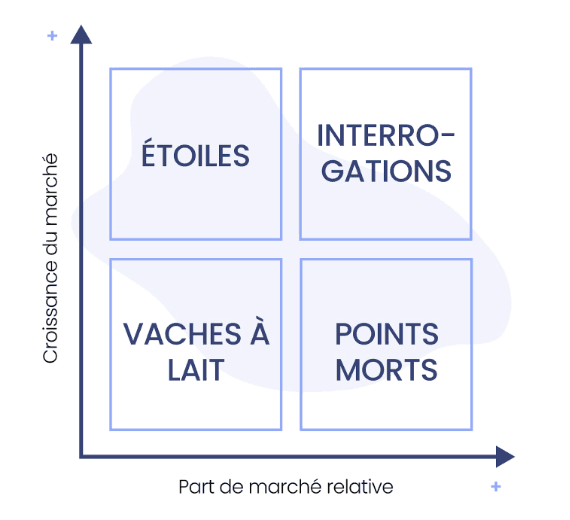
To choose your flagship product, you can use the BCG matrix. This practical tool will help your brand allocate its resources by identifying the most promising opportunities and recognizing less profitable sectors/products to divest from or abandon.
Also known as the Boston Consulting Group's "growth/share matrix," it is used to help you analyze your products. The matrix classifies them into four categories based on two dimensions: market growth and relative market share.
Here are the four categories:
Stars: these products or units have a high market share in a fast-growing industry. They often require significant investment to maintain their position, but can also generate substantial revenue.
Cash Cows: they have a high market share in a slow-growing industry. These products or units require little investment and generate stable, high cash flows.
Question Marks: these items have a low market share in high-growth industries. They require strategic decisions: either invest more to increase market share, or sell or abandon them.
Dogs: they represent products or units with low market share in low-growth industries. These items generally do not generate significant profits and can even cost the company money.
The life cycle of a product is quite similar. When it is a flagship product, it is likened to the cash cow. It helps finance your next innovation, which will eventually become a flagship product itself, pushing the previous one into the background. Your new flagship product can then finance your next innovation.
The flagship product must be capable of capturing attention, building customer loyalty, and playing a central role in the company's overall strategy.
Furthermore, opt for a product that embodies your brand's values and promise, while presenting distinctive and attractive features for consumers.
Also consider profitability and logistical feasibility. Sales volumes do not always translate into proportional profitability. You therefore need to work on an economic strategy across your entire product range.
🧠 The final goal is indeed to maximize overall revenue, and not to sell the largest number of units of your flagship product!
Choosing between a flagship product and a loss leader
This question comes up very often among brands in supermarkets: many decision-makers hesitate to base their strategy on a flagship product or on a loss leader.
To settle this question, one must start with the company's positioning:
Opting for a flagship product: this strategy involves standing out qualitatively, even at a higher cost, and may therefore require… attractively priced loss leaders! These two types of products can therefore coexist, sometimes even as variants;
Launching a loss leader relies on a low price and a certain form of originality, attracting word-of-mouth to guide customers toward more profitable products;
Loss-leader flagship product: in reality, each case is unique, and it is even entirely possible to mix the two approaches with a loss-leader flagship product, combining quality, price attractiveness, customer loyalty, and revenue optimization.
Marketing strategy and flagship product
The central role that the flagship product plays in your brand's strategy leads you to give it a prominent place in your marketing actions.
Thus, this iconic product generally concentrates a large portion of your budgets, and this at different levels:
Advertising budgets: online and offline campaigns, to make your brand known through an iconic product;
Promotional activities: attracting new customers to help them discover the brand in retail outlets;
Merchandising: optimizing the visibility of the flagship product increases the revenue of your entire range.
Keep in mind that the effectiveness of advertising for consumer goods largely relies on repetition and simplicity of the message. Thus, concentrating your budgets on a flagship product increases the impact of your campaigns, and therefore your return on investment.
The flagship product therefore also participates in your financial strategy by increasing the return on investment of your marketing activity.
Finally, like the stabilizer product, promoting the flagship product can have a stabilizing effect on sales. Recognition of the brand, the advertising, the slogan, and the product helps facilitate the "reception" of the advertising message by your target audience. This consistency promotes customer acquisition, loyalty, and retention.
💡 Have you evolved your product offering and are looking to analyze its impact on your revenue? -> Discover the price-volume effect!
Thus, as we have seen throughout this article, a brand present in large retail distribution has every interest in structuring its product range around a flagship product. It plays a central role in your commercial strategy and must be supported by an intense marketing strategy. The reward: an optimized assortment that boosts your brand's profitability across its distribution network.
It was by observing the still-fledgling digitalization of sales forces that Arthur envisioned Sidely. A graduate of EM Lyon and Le Wagon, he combines a rare commercial rigor with a true product culture. This dual expertise allows him to decipher the shifts in the profession and build a product that truly speaks to sales teams.
See also

Artificial intelligence and field professions: what our 2026 studies reveal
Adoption, barriers, use cases: discover what our three studies reveal about the role of AI among sector managers, sales representatives, and foodservice sales reps.

CHR and RHF Sales Representatives: portrait of a relationship-driven profession in the era of data
Equipment, productivity, AI: discover the major trends for the HORECA and food service sales profession in 2026 through our field study.

Pharmaceutical Sales Representative in France: Portrait of a Field Job Under Pressure
Compensation, aspirations, AI usage: discover the major trends in the pharmaceutical sales representative profession in 2026 through our field study.

Area Sales Managers in France: who are they and how is the profession evolving in 2026?
Compensation, aspirations, AI usage: discover the major trends in the field sales representative profession in 2026 through our field study.
The area manager professions in 2026
Discover the trends, the challenges, and the key figures.