
Store stratification in supermarkets: what is the strategic importance for brands?
Discover all the supermarket tiers. Understand their role, determination, and impact on the listing and sales of your products in stores.

In short
4 min read
Strata in large food retailers (GMS) classify points of sale based on department size and the number of orderable products.
They are also referred to as modulations or typologies and vary by retailer and sales area.
Understanding strata is essential for optimizing a brand's assortment in store.
Picking allows sales representatives to manage negotiated optional products, in addition to the main inventory check.
Mastering strata and picking helps sales teams negotiate better, strengthen product listings, and boost in-store performance.
Large-scale food retailing has its own language. At the heart of this jargon, "strata" occupy a central place.
Whether they are called strata, modulation, or typology, their importance is crucial, and yet they are still rarely discussed.
In this article, we have compiled everything you need to know about strata in supermarkets. What they are, how they are determined, and why understanding them is essential for any brand looking to optimize its presence in large-scale retail.
Get your notebooks ready? Go!
What is a stratum in supermarkets?
Strata are an internal classification of points of sale (supermarket, hypermarket, convenience store...). Each stratum corresponds to the number of references (store assortment) orderable by the store for a product range. It varies between stores depending on the size of the shelf.
Each stratum corresponds to an assortment. It is important to note that the store assortment is different from the brand's assortment.
When talking about strata, we can also talk about modulation or typology.
Strata by retailer
The name of the strata changes every time depending on the retailer:
T = Carrefour
M = Monoprix
H = Auchan
S = Cora
The name may differ depending on the size of the sales areas.
Retailer | Modulation name | Number of strata |
|---|---|---|
Auchan Supermarket (SM) | S | S1, S2, S3, S4 |
Auchan Hypermarket (HM) | H | H1, H2, H3, H4 |
Carrefour SM / HM | T | T1, T2, T3, T4, T5 and TAC (Common assortment trunk) |
Carrefour Market | T | T1, T2, T3, T4, T5, T6, T7 |
Franprix | D | D0, D1, D2, D3, D4 |
Monoprix | M | M5, M6, M10, M20, M30, M40, M50 |
Supermarché Match | S,P,M,G | S, P, M, G |
Cora | S | S1, S2, REG |
E.Leclerc Drive | D | D1, D2, D3 |
This is why, when you want to be listed at Monoprix, you will hear about Mod10, 20, 30, 40... and at Carrefour, about T1, T2, T3, T4, T5, T6... Well, you will hear about them. Store strata are difficult to obtain, since the store's typology justifies your brand assortment in it.
Some retailers, like U or E.Leclerc, classify their point of sale by size:
Système U classifies them by supermarket and hypermarket, and by area:
SM: SU 1200m2, SU 1800m2, SU 2500 m2, SU 3500m2
HM: HU 5000m2, HU 6500m2
E.Leclerc classifies them by point of sale typology and assortment type: SM-, SM+, HM-, HM+
Finally, Intermarché keeps this format but details its classification: XP 400, XP 700, CT 450, CT 650, SA 1500, SA 2500, SG 2000, SG 3000, HM 4200, HM 5000…
How are strata determined?
A store's stratum or typology is determined by several criteria:
The size of the store, which determines the shelf space;
The location of the store, which determines the size of the shelf and its location in the store.
Depending on the store's typology, the number of mandatory products (store assortment) will differ. In other words, the number of assortments per modulation/stratum/typology equals the number of assortments per store.
It is important to take into account that a store can have different strata depending on the aisle and that strata can change over time, notably via store remodeling. The question asked during allocation is: what size do I allocate to each of my product categories?
Let's take an example. You are a beer brand, listed at Franprix Quai de Jemmapes, in Paris. You are in multiple aisles in this supermarket: both in the fresh food aisle (at the entrance of the store) and the beverage aisle (at the back of the store).
You have two different assortments: single canned and bottled beers in the fresh food aisle, and packs of 6 and 12 in the beverage aisle.
Beer consumption is mainly focused on cold drinks, as the channel is nearby. The fresh food aisle therefore has more space than other aisles (including beverage). The Franprix thus has at least two different strata: one for the store, and one for the fresh food aisle.
How do I know the stratum of my stores?
As mentioned a bit earlier in the article, it is difficult to access this information as a brand and category manager.
To find out the stratum of your stores, you have several options:
Ask: it's simple, but it's worth a try. Ask the department manager and/or the store. They can sometimes agree, especially if you have a good business relationship with them.
Use the terminals: some stores have terminals where you can scan product prices. Take your brand's products present on the shelf and scan them. If a price is displayed, it means the product is in the mandatory assortment. You can then deduce the modulation.
Study retail panel data providers: the role of panels (IRI, Kantar, Nielsen...) is to advise retailers on their store assortments, allow brands and stores to know market shares (different according to regions and consumption habits) and understand market trends. The information provided by panels helps to have an agnostic view of the market and allows determining the strata. You can then deduce the strata of your stores, or at least eliminate those that do not correspond at all.
Why is it interesting to know the stratum of my stores?
Knowing the typologies of their stores will help your sales representatives better negotiate their positioning and listings, but also increase sales through picking, by adding extra, out-of-assortment references.
It is interesting here to do some basic refreshers on large-scale retail distribution. There are three main types of assortments:
The common core: it corresponds to the minimum number common to all points of sale of a retailer;
The recommended optimum assortment: it theoretically covers all consumer needs according to their expectations, and is relative to the stratum or modulation of the store concerned;
The adapted optimum assortment: in this case, the retailer's policy is an additional parameter that impacts the point of sale's assortment.
To add products outside the mandatory assortment - or TAC (common assortment core) at Carrefour - sales representatives will look for the recommended optimum assortment. To do picking, they will have two options:
The product is listed in the central database, meaning it is in the purchasing center but not in the mandatory assortment. This is often the case for independent stores (E.Leclerc, Intermarché, Système U...) that have freedom of choice regarding products on shelves. Purchasing centers then list products (at a given price), and stores order from the center the listed products that interest them. In this case, the sales rep will sell new references, using a well-crafted pitch, and offer an in-store display, a promotion, or immediate discount coupons for the occasion.
The product is not listed in the central database. In this case, the sales rep will do direct sales and place an order. It is therefore important to closely monitor delivery, shelf display, and ensure the product sells through to place a new order. In this case, the sales rep also offers an in-store display, a promotion, or immediate discount coupons.
Still unclear? Let's look at something concrete!
Two stores are the same size, with different strata. Your brand sells several product categories, present in 4 different aisles.
Here is the first store:
Store 1 | Aisle stratum | # references in store | Market share according to panelist | # references that should be in the store | # of references agreed in contracts |
|---|---|---|---|---|---|
Charcuterie | T2 | 150 | 10% | 15 | 15 |
Cheese | T1 | 200 | 5% | 10 | 5 |
Beer | T2 | 200 | 5% | 10 | 15 |
Drugstore | T2 | 90 | 3% | 3 | 3 |
Here is the second store:
Store 2 | Aisle stratum | # references in store | Market share according to panelist | # references that should be in the store | # of references agreed in contracts |
|---|---|---|---|---|---|
Charcuterie | T2 | 150 | 10% | 15 | 15 |
Cheese | T3 | 75 | 2% | 0.5 | 3 |
Beer | T2 | 200 | 15% | 30 | 15 |
Drugstore | T2 | 90 | 3% | 3 | 3 |
Store 1 is a supermarket that has a cheese offering superior to the national offering.
The sales rep therefore has a double objective:
Do picking on cheese. He has 5 references to get.
Put up POS materials to be as visible as possible, and thus increase sales.
The value of the panel data here is to understand the market share of the product and the brand: listening to panelists allows negotiating and advising department managers.
Your sales representative will therefore negotiate with the department manager to get the 5 missing references, highlighting:
The loss of potential earnings: if MS is not respected, in terms of product numbers or categories, the store risks selling less. Your sales reps can advise the department manager;
The extra gain: In store 2, you managed to place POS material in the cheese aisle. You have more references than your MS but you sell well (especially thanks to merchandising and your positioning). Your sales rep can therefore highlight the sales development of store 2 to convince store 1 to do the same. To do this, several data points can be used: your sales figures from store 1, the evolution of your sales volume, the analysis of merchandising placement...
In store 2, you managed to reference more cheeses than your MS. This includes a risk and an opportunity:
If you have too many references, there are risks of shrinkage. Especially on fresh products.
This allows you to position yourself better, and win MS.
In this store, we advise you to place your innovations. They will be complementary products to your star product, and allow you to gain sales volume.
Quick reminder: having a large market share does not mean having high revenue, because... it depends on the market.
The key to an effective use of data in the field lies in personalizing the sales pitch to meet the specific needs of each store. Data allows for tailor-made recommendations, whether it's adjusting product layout, optimizing visibility, or suggesting targeted promotions.
After all, the department manager's goal is also to increase the revenue generated.
Qualifying strata and managing assortments in your CRM
The management of store typologies (or store strata) can be optimized through precise tracking of assortments.
If your products, although belonging to the same retailer and point of sale, are divided into different typologies, it is essential to structure your assortments accordingly. You can thus create several specific assortments, identifiable by the retailer's name and the corresponding stratum.
Example:
🛒 Carrefour Market - T1
🛒 Carrefour Market - T2
Simplified in-store tracking
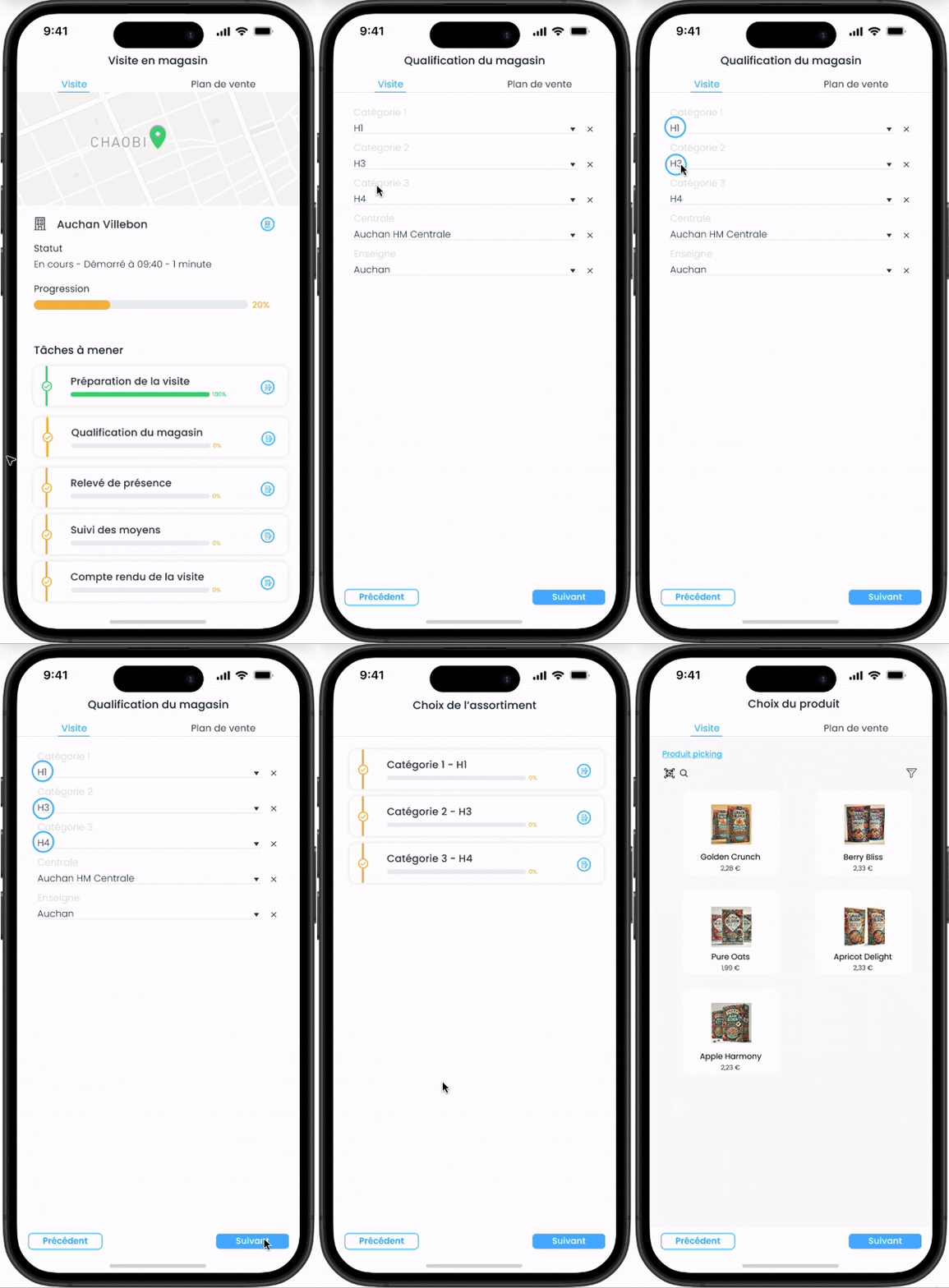
To guarantee effective monitoring, your sales representatives must qualify the point of sale during their first visit to the store. Once this step is completed, the information is automatically logged in your CRM. These assortments are then linked to field audits, allowing each audit to be seamlessly associated with the right stratum.
What does this change for your sales teams?
Your sales representative will see an audit divided into as many assortments as your brand has modulations in the store. But on the user side, there is no extra complexity: He will simply fill out his audit as usual via his mobile app or tablet, without any additional steps.
Thanks to this structure, he will be able to track precisely:
The Numeric Distribution (ND) by aisle and stratum
The Share of Shelf (SOS) by brand and stratum
And what about picking in all this?
Once the main audit is completed, a page dedicated to picking will automatically display.
The sales rep will then be able to select the optional products he negotiated directly at the point of sale. This information will be integrated into the audit, with a clear distinction between mandatory products and optional products.
If you use separate assortments for each brand, apply this same logic to picking to ensure perfect consistency.
Example:
📌 Picking - Carrefour Market - Grain de Sail
📌 Picking - Carrefour Market - Météor
Usage example
Strata in large-scale retail play a key role in optimizing assortments and managing points of sale. By understanding how they work, your sales teams can better negotiate their presence in-store and maximize product visibility.
Using an adapted CRM will simplify the tracking of assortments and picking. By mastering these levers, you optimize your listings, strengthen your positioning, and boost your commercial performance in supermarkets.
Margot has been working in Tech and SaaS for 8 years, with a multi-product experience that has given her a unique understanding of business challenges. On a daily basis, she analyzes, relentlessly tests, and relies on facts to shed light on market trends and help sales teams move forward.
See also

Artificial intelligence and field professions: what our 2026 studies reveal
Adoption, barriers, use cases: discover what our three studies reveal about the role of AI among sector managers, sales representatives, and foodservice sales reps.

CHR and RHF Sales Representatives: portrait of a relationship-driven profession in the era of data
Equipment, productivity, AI: discover the major trends for the HORECA and food service sales profession in 2026 through our field study.

Pharmaceutical Sales Representative in France: Portrait of a Field Job Under Pressure
Compensation, aspirations, AI usage: discover the major trends in the pharmaceutical sales representative profession in 2026 through our field study.

Area Sales Managers in France: who are they and how is the profession evolving in 2026?
Compensation, aspirations, AI usage: discover the major trends in the field sales representative profession in 2026 through our field study.
The area manager professions in 2026
Discover the trends, the challenges, and the key figures.