
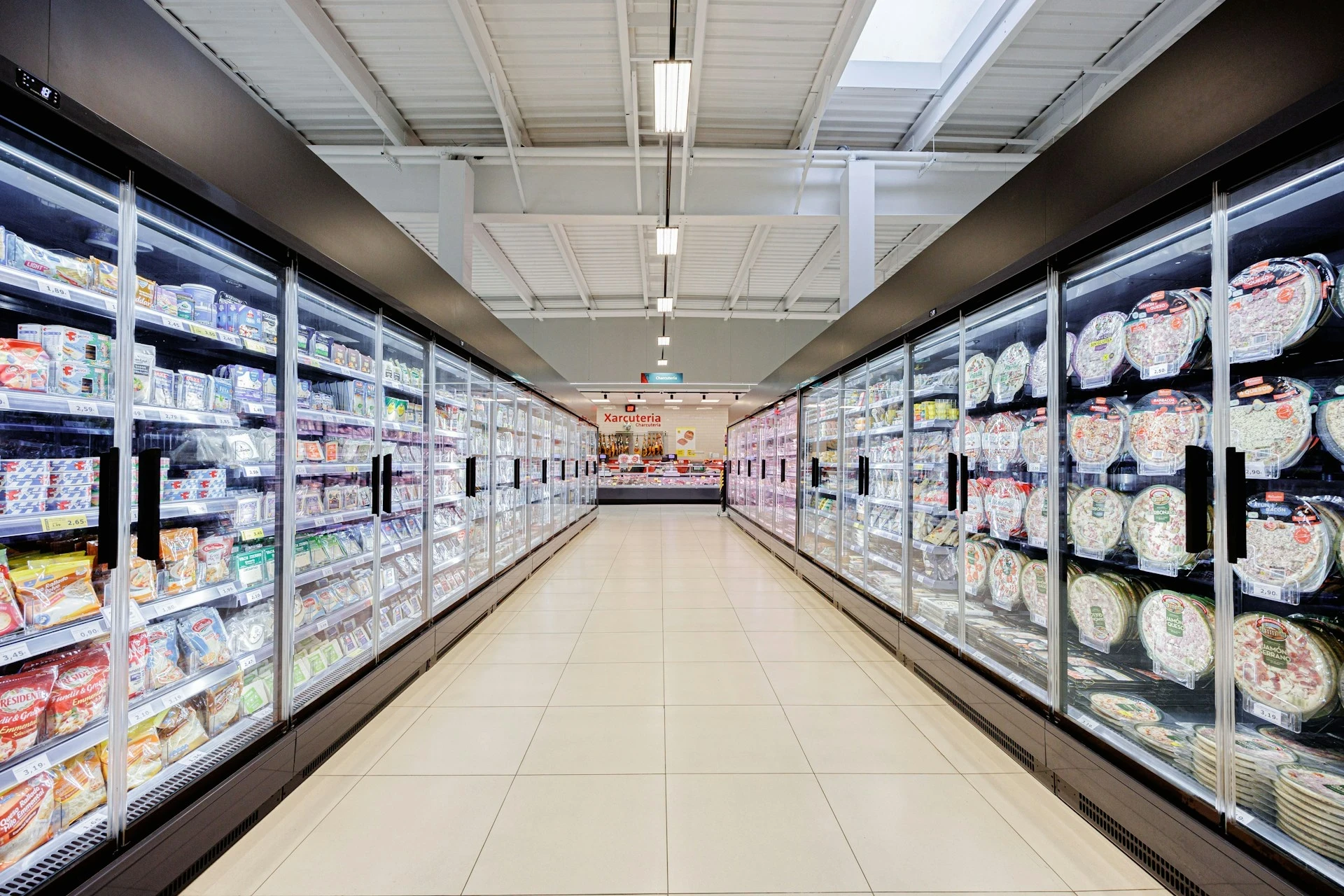
Understanding everything about supermarket distribution
How does distribution in large and medium-sized supermarkets work? Channels, retailers, listing, negotiation, and strategies for brands looking to enter or grow within the market.

In short
7 min read
Supermarkets and hypermarkets (GMS) represent a major strategic choice in France, accounting for 70% of food products purchased and 85% of the sector's revenue.
The role of distribution is crucial: it serves as the indispensable intermediary between brands (producers) and consumers, ensuring logistics and market access.
The players in the GMS sector are divided between brands, retailers (independent or integrated), and points of sale, each with specific roles.
Producers must choose their distribution method (intensive or exclusive) and channel (direct to store or via a central purchasing office), with each option presenting trade-offs in terms of costs, margins, and control.
Selling through a central purchasing office allows for reaching high volumes and a wide geographical area, while direct distribution promotes autonomy and customer knowledge despite heavier management.
What is GMS?
GMS (Grande et Moyenne Surface - Large and Medium-sized Supermarket) refers to all self-service retail stores with a dominant food focus: hypermarkets, supermarkets, convenience stores, and hard discount stores. It is the primary food distribution channel in France, with approximately 44,000 general food points of sale. It is also referred to as mass retail.
Large and Medium-sized Supermarkets represent a strategic choice for many companies wishing to expand their presence in the market. And with good reason: the food retail sector accounts for approximately 258 billion euros in revenue (Xerfi, 2025) and represents more than 750,000 jobs, or nearly 8% of French GDP. It is also a highly concentrated market: 6 groups (Carrefour, Auchan, E.Leclerc, Casino, Les Mousquetaires, and Système U) alone capture nearly 85%, according to Je Bosse en Grande Distribution in 2026.
Being listed in GMS offers access to a massive potential audience. In addition, increased visibility on shelves, prime locations in the store, and promotional campaigns help build your brand awareness.
However, be careful: selling in GMS is not all rosy. Certain power dynamics can complicate your negotiations and make activating point-of-sale displays harder than it seems.
Who are the players in GMS? How are relations structured between retailers and brands? How are roles shared? Find the answers in this article.
What is distribution?
We want to start with a reminder of the basics. Distribution is the intermediary between the consumer and brands (which can also be the producer). It is the link that connects the two ends of the chain, making it indispensable. Very few markets manage to do without distribution.
Why? Because central purchasing agencies and buyers secure access to a market and a target audience for brands through a physical or digital network, along with its marketing strategy. They reduce the costs of making products available by managing invoicing, logistics, storage, etc.
For its part, the distributor must offer the right products, at attractive prices, in the right quantity, and at the right time to consumers, so that they buy.
As you can see, you cannot avoid distribution. That is why you have to choose carefully. Selecting a distributor means targeting a customer base. And that can have significant repercussions.
The players in GMS
The brands
Brands are producers who sell under a distinctive sign or a combination of distinctive signs (Name, logo, color, scent, etc.) to consumers.
Brands want to sell as many products as possible and at the prices that are most advantageous to them. Nothing new so far, they are businesses like any other.
A brand's mission is to create a product or range of products, manufacture it in the right quantity, make it attractive and visible through marketing, so that the consumer buys it, tries it, approves it, and recommends it.
Here is a slideshow of the biggest brands, to perfect your GMS knowledge.
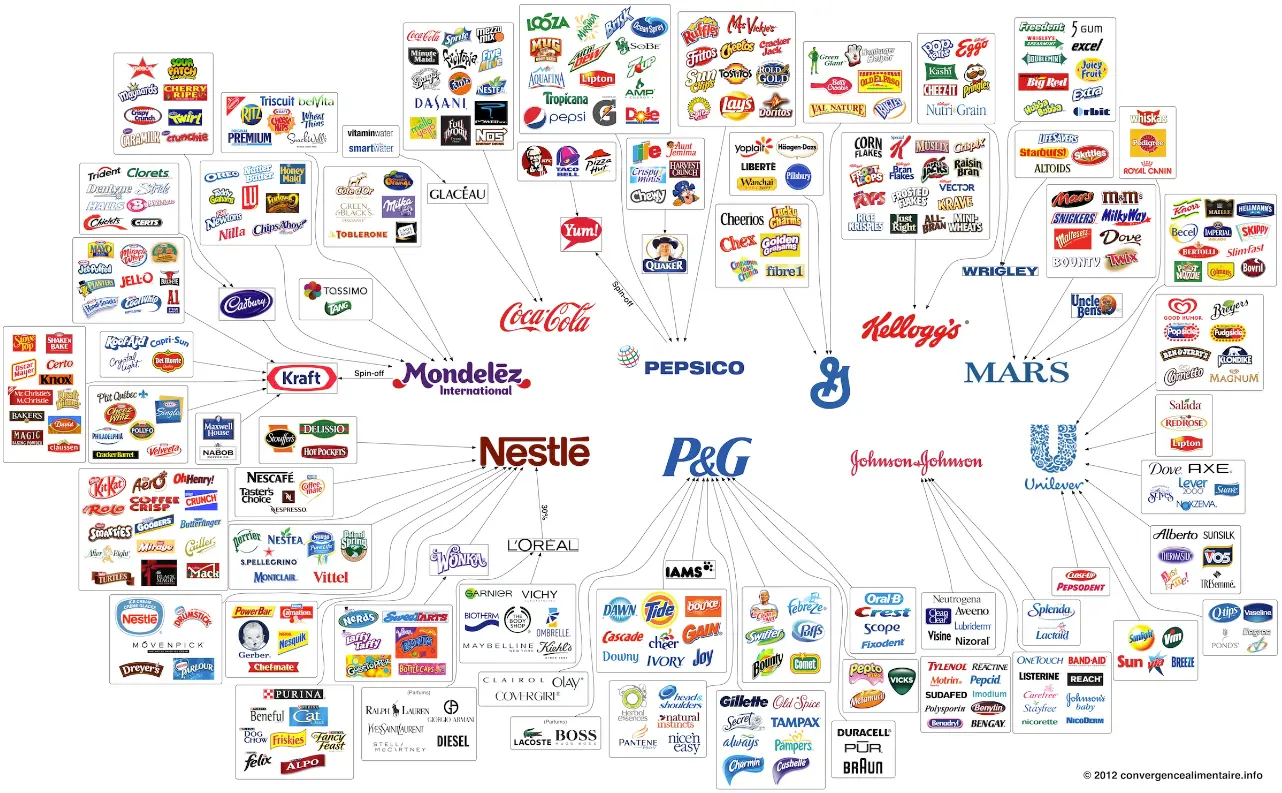
The 10 largest GMS industrial manufacturers
What are the best-selling brands in the world?
Every second, 17,360 bottles of Coca-Cola are sold worldwide. That represents about 1.5 billion bottles per day! That is far too many for us to count. The red and black bottle certainly deserves its first place in the ranking.
On the podium of the best-selling food brands in the world, we then find:
Maggi
Lay’s
Pepsi
Nescafé
Indomie
And in France?
Well, we'll let you guess the leader among these logos: ... No cheating, okay? ;)
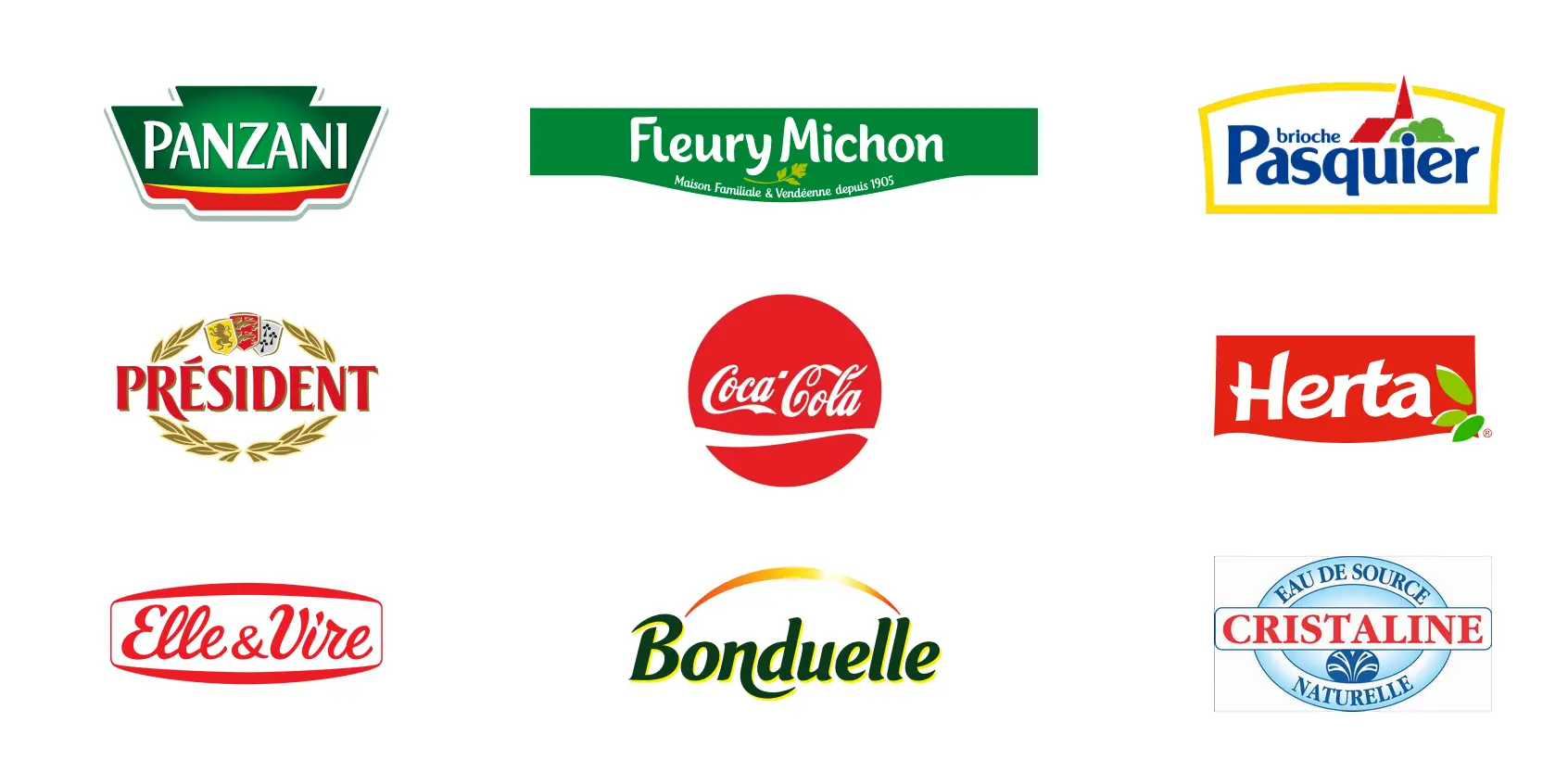
Unsurprisingly, the French ranking is not the same. It is not the American soda leader that takes first place, but rather Herta that comes out on top.
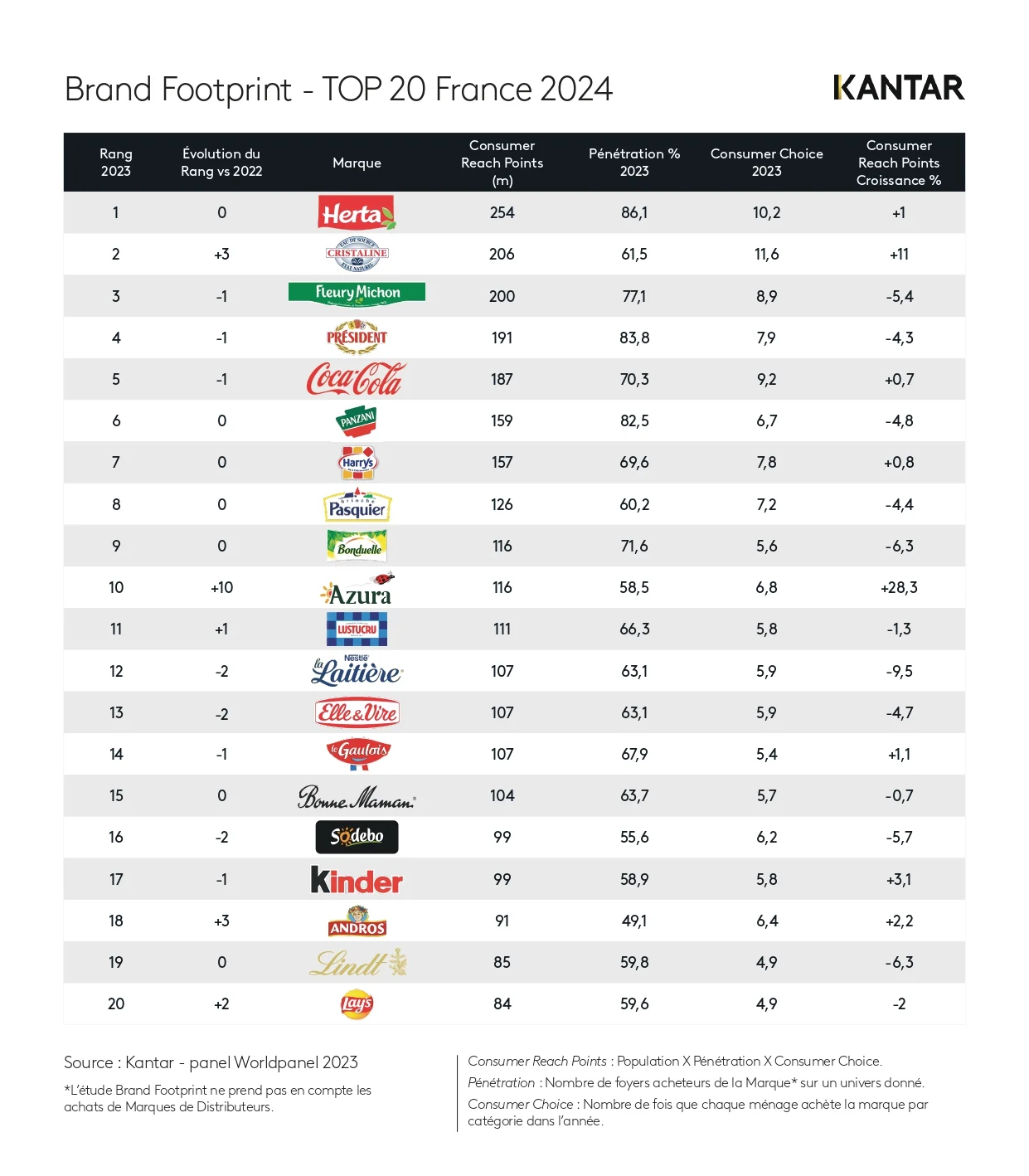
French people's favorite brands
Among these brands, which ones are most appreciated by the French?
According to the 2026 Observatoire of French people's favorite brands (OpinionWay), food favorites dominate more than ever. La Laitière takes back the lead in the ranking for the third time after 2017 and 2023, ahead of Saint Michel and Samsung, the only technology brand on the podium. BIC, number one last year, drops to 5th place, just behind Panzani.
A sign of a true return to "comfort": 21 of the top 30 brands are food brands, driven mainly by groceries. A trend that OpinionWay interprets as a response to an uncertain economic climate, where everyday brands play a comforting role. Here is the complete Top 30:
La Laitière
St Michel
Samsung
Panzani
BIC
Bonne Maman
Amora
Barilla
Moulinex
Lustucru
Amazon
Lindt
Alsa
LU
Nestlé Dessert
Google
Magnum
Le Petit Marseillais
Decathlon
Cristaline
Danone Natural Yogurt
Président
Elle & Vire
Tefal
Maille
Yoplait
Bosch
Ducros
Vahiné
Côte d’Or
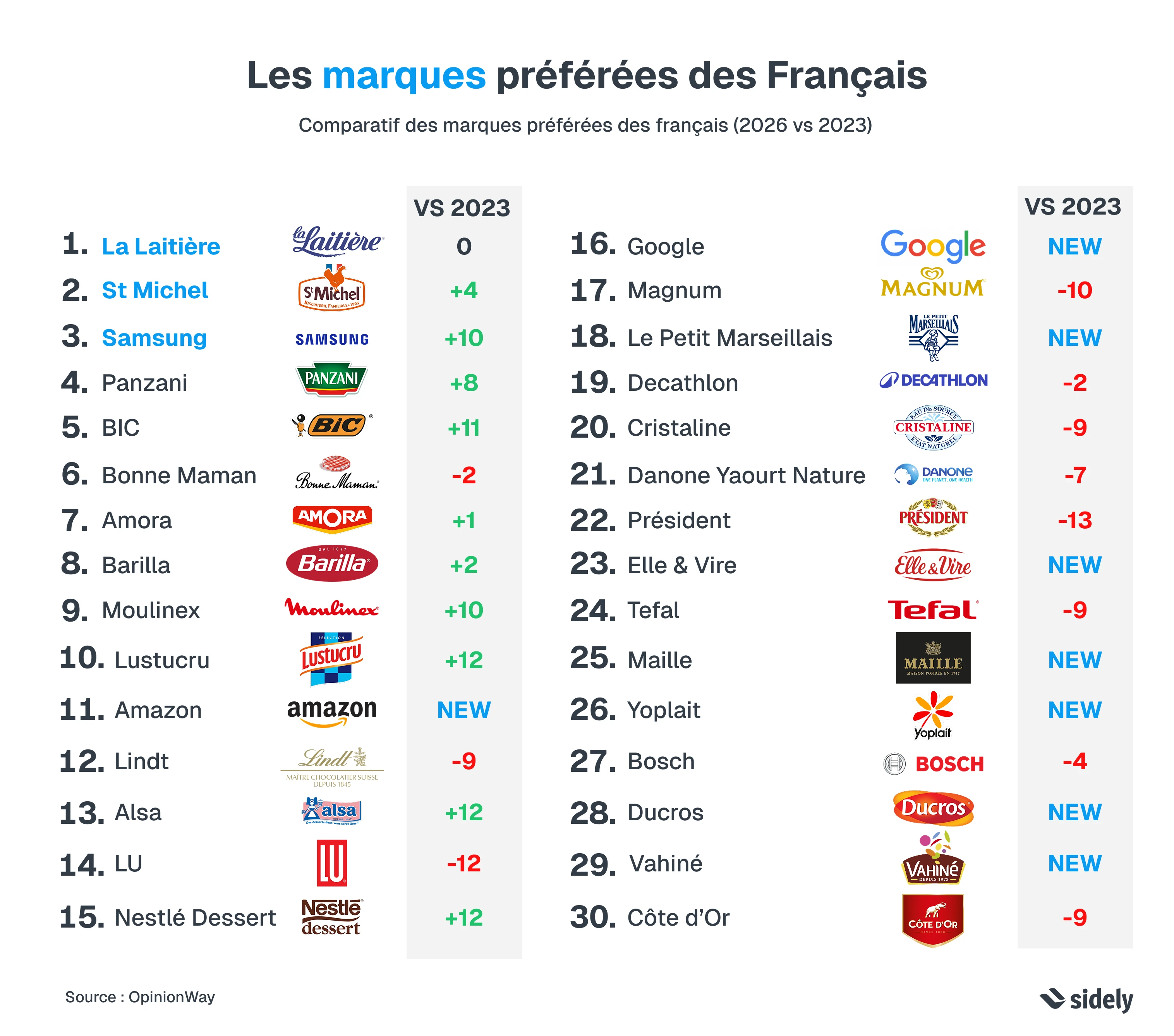
French people's favorite brands (2026 vs 2023)
The retail chains
Retail chains are the corporations that group a set of points of sale directly or through affiliation.
There are two major types of retail chains in the French landscape:
Independent retailers: store owners who own their points of sale, joined together in a group to pool purchases, tools, and marketing.
Integrated retailers: points of sale that all belong directly to the brand, with salaried staff.
Integrated vs. independent distribution: what's the difference?
Integrated distribution: all points of sale belong to the retailer, and the staff are employees of the company. Decisions (assortment, prices, promotions) are centralized. Examples: Carrefour, Auchan.
Independent (or associated) distribution: stores belong to independent owners, joined together within a cooperative group to pool purchases, tools, and marketing, while keeping their decision-making autonomy. Examples: E.Leclerc, Intermarché, Système U
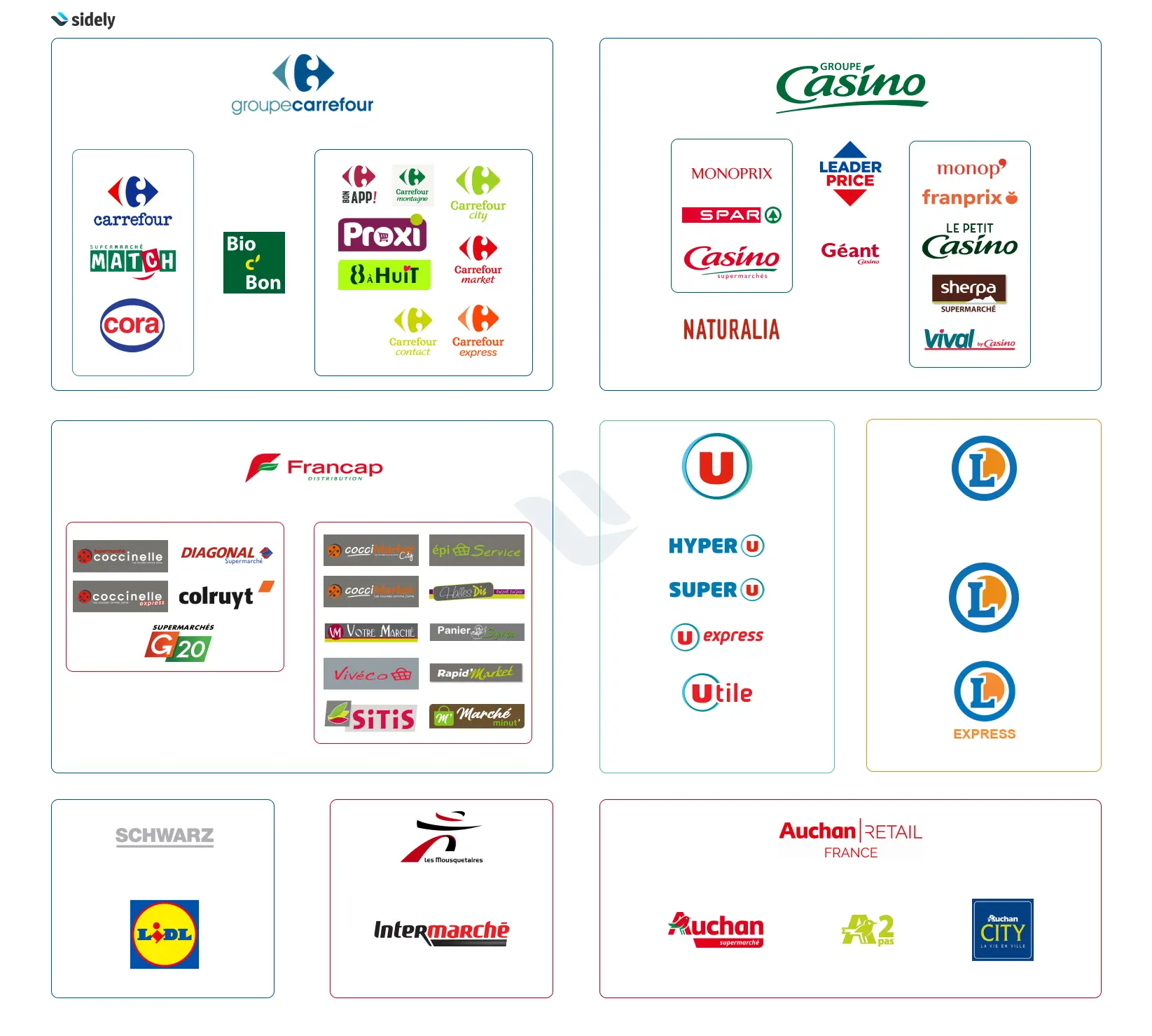
The different types of GMS stores (large retailers)
Stores are characterized by their sales floor areas and their assortments. Location can also be taken into account. We will distinguish between general food retailers and specialized food retailers.
Store Type | Hypermarket | Supermarket | Convenience Store | Hard Discount |
|---|---|---|---|---|
Area (sqm) | > 2,500 | 400 to 2,500 | 120 to 300 | 600 to 1,200 |
Location | Suburbs, shopping mall | Urban and semi-urban - neighborhood and suburbs | City center, town, village | Suburbs and peri-urban areas |
Assortment | Food + non-food (appliances, textiles, leisure...) | Food (80%) + basic non-food | General food | Food (limited offer, mostly private label) + non-food (appliances, textiles...) |
Number of items (SKUs) | 20,000 to 40,000 | 3,000 to 5,000 | 300 to 1,500 | 1,500 to 2,500 |
Number of food items | 3,000 to 5,000 | 500 to 1,500 | 200 to 1,000 | 1,300 to 2,200 |
Shopping Frequency | Low (average 2 visits per month) | Higher than a hypermarket | Frequent | Frequent |
Average Basket Value | High | High | Low | Medium |
Example of chains | E.Leclerc, Carrefour, Auchan, Intermarché | Super U, Carrefour Market, Intermarché, Monoprix | Carrefour city, Franprix, Monop', U Express | Aldi, Leader Price, Netto |
Trends and developments | Gradual decline due to new consumption habits (proximity, drive-through, organic…) Development of "phygital" (click & collect, drive-through, scan & go, home delivery) Strengthening of specialized corners: organic, short supply chains, premium products | Increase in local and organic items Development of drive-through services to capture customers seeking convenience Digitalization of services: mobile scanning, contactless payment, self-checkouts | Explosion of demand in city centers Increase in additional services (parcel collection, home delivery) Adaptation to urban needs (ready-to-eat, snacking, organic) | Moving upmarket: diversification of the offer (organic, fresh, premium products) Expansion of hard discount into middle-class habits |
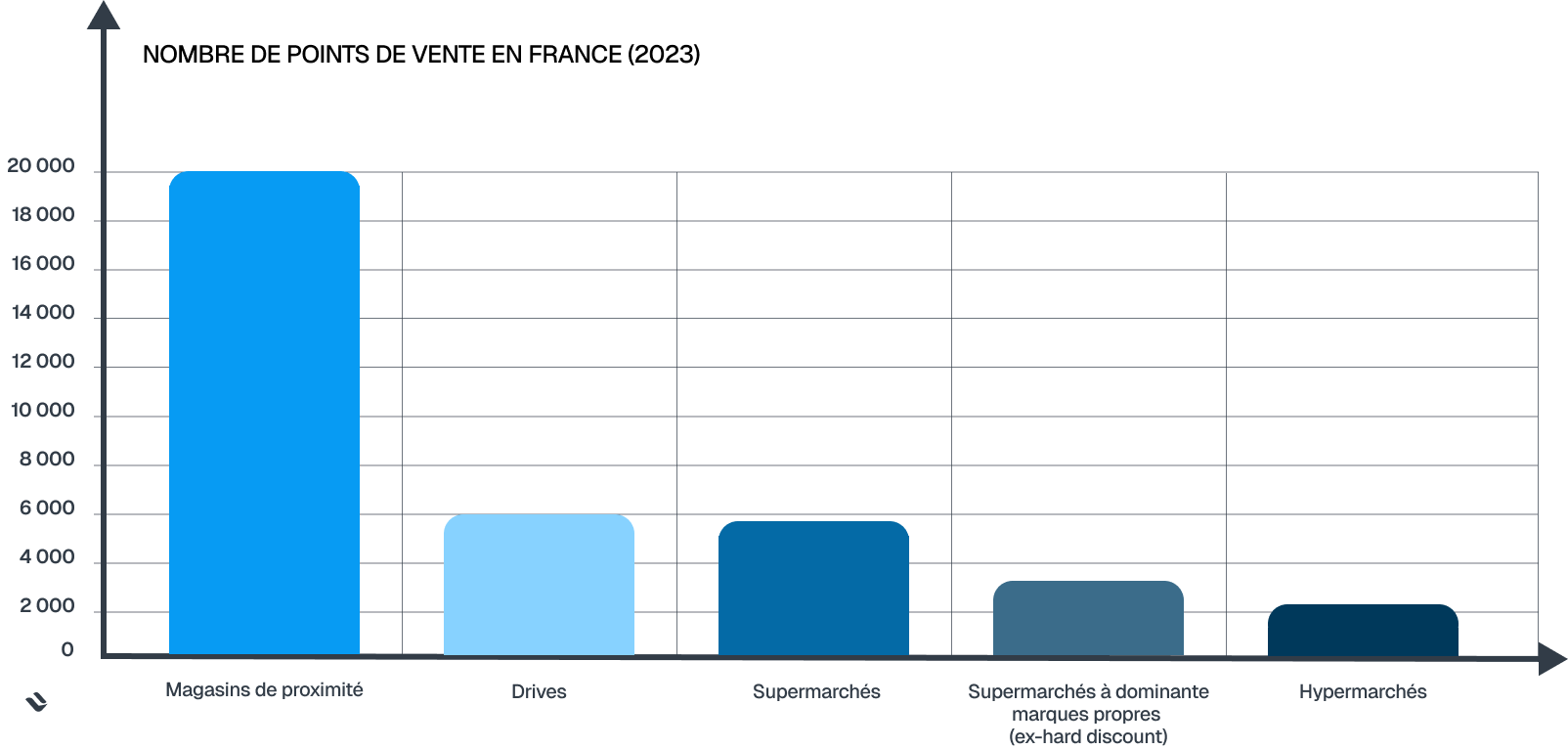
Chart showing the number of points of sale in France by GMS store type
The importance of distribution
As you can see, distribution is key to business success. Without it, there is no economy. Indeed, the producer designs. They identify potential customers and manufacture the first product samples. They iterate, validate, and package their products. Once out of the factory, it still has to be commercialized, which means distributing it.
And distributing a product is no simple task, as it requires considerable expertise and investment. If every brand group, like the clothing industry, created its own distribution network, there would be Nutella, Ariel, Colgate, and Herta shops everywhere.
In reality, this would not be profitable. That is why it is more logical to use a distributor. Outsourcing distribution reduces various costs associated with making products available on the market, such as storage and transport costs, as well as sales expenses related to prospecting and negotiating, for example.
Distribution is the essential link between the producer/brand and the consumer. It guarantees brands access to a market and a client base through a physical or digital network, along with a marketing strategy. It also reduces the costs of making products available by managing billing, logistics, storage, etc.
We can summarize a distributor's contribution to a producer in four areas:
Space: services related to transport of goods
Time: storage
Merchandising: the correct presence of products in the right quantity, etc. To learn more, I invite you to read our complete guide on merchandising.
Communication: the distributor's image to the producer's potential target audience
Distribution policies
Do production capacities and product characteristics favor distributing products intensively, or should it be limited to a certain number of points of sale?
Thus, three options are available to the producer: intensive distribution, exclusive distribution, and selective distribution. In GMS, only intensive and exclusive distributions exist.
What is intensive distribution? (GMS)
Intensive distribution is defined by selling to the greatest number of people in the greatest number of points of sale. This type of distribution is used in GMS in the majority of cases.
What are the advantages and disadvantages for brands selling through intensive distribution?
Intensive distribution allows brands to gain visibility faster, and thus, generate significant revenue. Indeed, sales volumes are much larger in supermarkets: 83% of food purchases in France are made in GMS.
In addition, building brand awareness through intensive distribution helps support other distribution channels, such as digital channels. However, it also has disadvantages, notably:
High and annual listing fees;
Store activities driven by a significant sales force;
Substantial advertising and promotions;
Mass-market product features;
Low unit margins (and potentially degressive margins)
What is exclusive distribution?
Exclusive distribution is defined by selling exclusively in a territory or through a single retail chain. This distribution policy can be a negotiation point often requested by retailers from small brands wanting to enter mass retail for the first time. Monoprix often uses this clause. It is somewhat of an entry cost to the market.
Distribution channels
Two types of distribution channels exist in GMS / GSS (Large Specialized Supermarkets):
Direct distribution: there is no intermediary between the producer (the brand) and the store. This means that the distributor sells, delivers, and bills the store directly.
Indirect distribution: there is an intermediary between the producer (the brand) and the store, which is usually a central purchasing agency. This means that the central purchasing agency buys, sells, delivers, and bills the store.
Focus on direct distribution
Direct distribution removes any intermediary from the distribution process, leaving the brand to sell directly to stores. This brings both advantages and disadvantages for the brand.
The advantages of direct distribution
Direct selling offers almost complete autonomy to brands, providing them with:
Excellent knowledge of their target customers' needs;
The ability to quickly launch new products;
Customization of the services offered;
Control and partial preservation of the margin;
The opportunity to open an official store.
The disadvantages of direct distribution
Direct distribution nevertheless imposes constraints on brands, which need to be taken into account, such as:
A very large inventory to store;
Heavier sales management for teams and stores;
A significant need for financial capacity;
An often more limited product offering.
The specificity of selling through central purchasing
A central purchasing agency is a structure that groups and negotiates purchases for several points of sale or retail chains as a single contact. It aggregates volumes to obtain better terms from suppliers, then passes listings and pricing on to the network's stores.
Selling through central purchasing, also known as indirect distribution, presents a distinct set of advantages and disadvantages that shape how companies approach this type of distribution.
The advantages of selling via a central purchasing agency
The main function of central purchasing agencies is to centralize all purchases of different products in a single point. They have a broader reach, which brings many advantages to the brands they distribute, including:
The capacity to sell larger volumes;
A smaller required sales team;
Denser geographic coverage;
Better sales regulation;
Flexibility in financing production;
Reduced management costs, particularly regarding invoicing and transport.
Do you want to sell via a central purchasing agency? Discover how to negotiate with mass retail.
The disadvantages of selling via a central purchasing agency
Central purchasing agencies, due to their power, can also present disadvantages, notably regarding:
The risk of losing connection with consumers;
Loss of contact with retailers;
Wholesaler disloyalty;
The growing need to promote products to intermediaries and retailers.
What does GMS mean?
What is the difference between a hypermarket and a supermarket?
Who are the main players in GMS?
What is the difference between integrated and independent distribution?
Alexis co-founded Sidely after several years of service as a sales director. To understand what builds, or breaks, a salesperson's performance, he conducted more than 100 telephone interviews with field sales representatives. At Sidely, he transforms this raw knowledge into concrete support, based on facts rather than assumptions.
See also

Artificial intelligence and field professions: what our 2026 studies reveal
Adoption, barriers, use cases: discover what our three studies reveal about the role of AI among sector managers, sales representatives, and foodservice sales reps.

CHR and RHF Sales Representatives: portrait of a relationship-driven profession in the era of data
Equipment, productivity, AI: discover the major trends for the HORECA and food service sales profession in 2026 through our field study.

Pharmaceutical Sales Representative in France: Portrait of a Field Job Under Pressure
Compensation, aspirations, AI usage: discover the major trends in the pharmaceutical sales representative profession in 2026 through our field study.

Area Sales Managers in France: who are they and how is the profession evolving in 2026?
Compensation, aspirations, AI usage: discover the major trends in the field sales representative profession in 2026 through our field study.
The area manager professions in 2026
Discover the trends, the challenges, and the key figures.