
How to position oneself against private label brands
Faced with the rise of private labels, how can a national brand differentiate itself? Positioning, pricing, innovation, and retailer relationship strategies.

In short
4 min read
Private label brands (store brands) are products owned by retailers seeking to maximize their margins by replicating successful products at a lower cost.
The pressure of private labels on manufacturers is heightened by inflation, driving them to represent a growing share of food purchases (up to 50% among some European neighbors).
Although perceived as a threat, private labels also serve as differentiation tools for retailers, sometimes moving toward segments like local products or SMEs that national brands do not cover.
Legal protection against private labels is weak, making brand strategy, constant innovation, and differentiation essential for manufacturers.
Manufacturers can adopt hybrid strategies, such as becoming suppliers for private labels while preserving the value of their own national brands.
To counter private labels, brands must leverage tools such as product transparency, service excellence, or equipping field teams for better competitive intelligence.
For any national brand selling its products in large-scale retail distribution, competition is a major component of the sales environment. Private labels (PLs) add even more pressure on manufacturers, and the distribution agreement generally does not present an obstacle to the emergence of substitute products.
This article covers the fundamentals of the private label phenomenon, this new form of competition born about ten years ago, which pits retailers and brands against each other—economic operators who are nevertheless supposed to collaborate!
After a quick economic focus, we will talk about contracts. Finally, we will list 10 strategic measures that will allow your brand to win the competition or defend its market share against store brands.
Private Label: What is it exactly?
A private label (PL) refers to a brand owned by the distributor itself. Elementary!
But it's important to know that products sold under this banner are generally manufactured by external operators, and sometimes even national brands with whom production agreements have been made. The launch of a private label therefore corresponds to a commercial objective of the distributor itself, which tries to maximize its revenues by using its points of sale to sell products on which it limits purchases and other external payments as much as possible.
Distributors generally launch private labels with the aim of replicating successful products, allowing them to limit financial risk taking, while maximizing profits in case of success. In practice, these products are often sold at lower prices than the national brands they were inspired by. The price difference is notably explained by the fact that retailers have virtually no R&D costs on these products.
This is why retailers generally communicate about combating the high cost of living, and offer (often flagship) products at more accessible prices, in order to give consumers more choice.
Private Label: Competition that destabilizes manufacturers in mass retail
After a historic sales record for private labels in 2023, 2024 is unprecedented. Private labels accounted for up to 40% of food sales in some chains like Carrefour, Leclerc, or Intermarché. In France, private labels represent one-third of purchases. This figure reaches 50% among our European neighbors. This trend is all the more impactful as its growth has been exponential since COVID: +2% per year, with a gap of 13% in 2023. The main reason is inflation, which has impacted the purchasing power of French households. Distributors, whose margin rate is higher on these products, dedicate more space, promotional efforts, and therefore, a lower price than national brands.
💡At 36% of supermarkets and hypermarkets sales, French private labels remain 13 points below the average of some European neighbors.
Thus, private labels can be problematic for manufacturers who sell their products in large-scale retail distribution, for various reasons. Indeed, as we have just seen, private labels are generally positioned at lower prices than national brands (-30% on average), and this can generate downward pressure on prices, likely to negatively impact manufacturers' profit margins. Nevertheless, what Emily Mayer, Business Insights Director of Circana, points out on the podcast Je bosse en grande distribution, is not the market share gain of private labels on shelves (36% of large-scale retail revenue in 2025) or inflation, but rather what is sold opposite private label products. "While we have still had 20% inflation in two years, the market share gain for private labels is 2-3 points. It's not colossal. There has been no reversal in the balance of power," observes Emily Mayer. For her, France is still largely dominated by national brands, but recently, some private labels have been launched with no matching national brand standing opposite them. "Distributors use the private label as a tool for differentiation, and also for customer preference because national brands are everywhere," explains Emily Mayer. This therefore allows chains to position themselves in niches that work very well with French consumers today: more local sourcing, promotion of SMEs... Moreover, some manufacturers are adapting their strategies by becoming suppliers for private labels. Lactalis, for example, with Milbona, Envia, Chêne d’Argent... produces private labels for Lidl, while keeping its national brands.
But the loss of market share is not the only impact for companies: private labels can contribute to reducing the manufacturer's brand recognition. And for good reason, in the absence of strong branding or a differentiating product, consumers will have no qualms about opting for a cheaper substitute. "Private labels don't just do promotions, they communicate, and they have quite distinctive innovations. Those are the historical levers of national brands. There is a challenge for national national brands, I would say more than there has ever been," explains Emily Mayer.
Finally, if a brand relies heavily on major retailers to distribute its products and the latter introduce competing private label products, the risk of finding oneself in a vulnerable position increases for the manufacturer, and its negotiating power is significantly reduced. Also, as we will see a bit further down, launching brands that are entering large-scale retail must thus anticipate this type of risk, and fully understand what is permitted in the distribution agreement.
French retailers' private label strategies
In France, private labels (PLs) hold a very distinct place in the strategy of the main retail groups. These tactical choices can vary depending on the objectives of each retailer, its market positioning, and its target customer base.
For example, Carrefour has numerous private labels, such as Simpl, Carrefour Bio, Reflets de France, or My Carrefour Baby. Their positioning generally plays on accessibility (price) and verticalized marketing. Carrefour also takes advantage of the "all-local" trend to diversify its local range, notably via "Reflets de France".
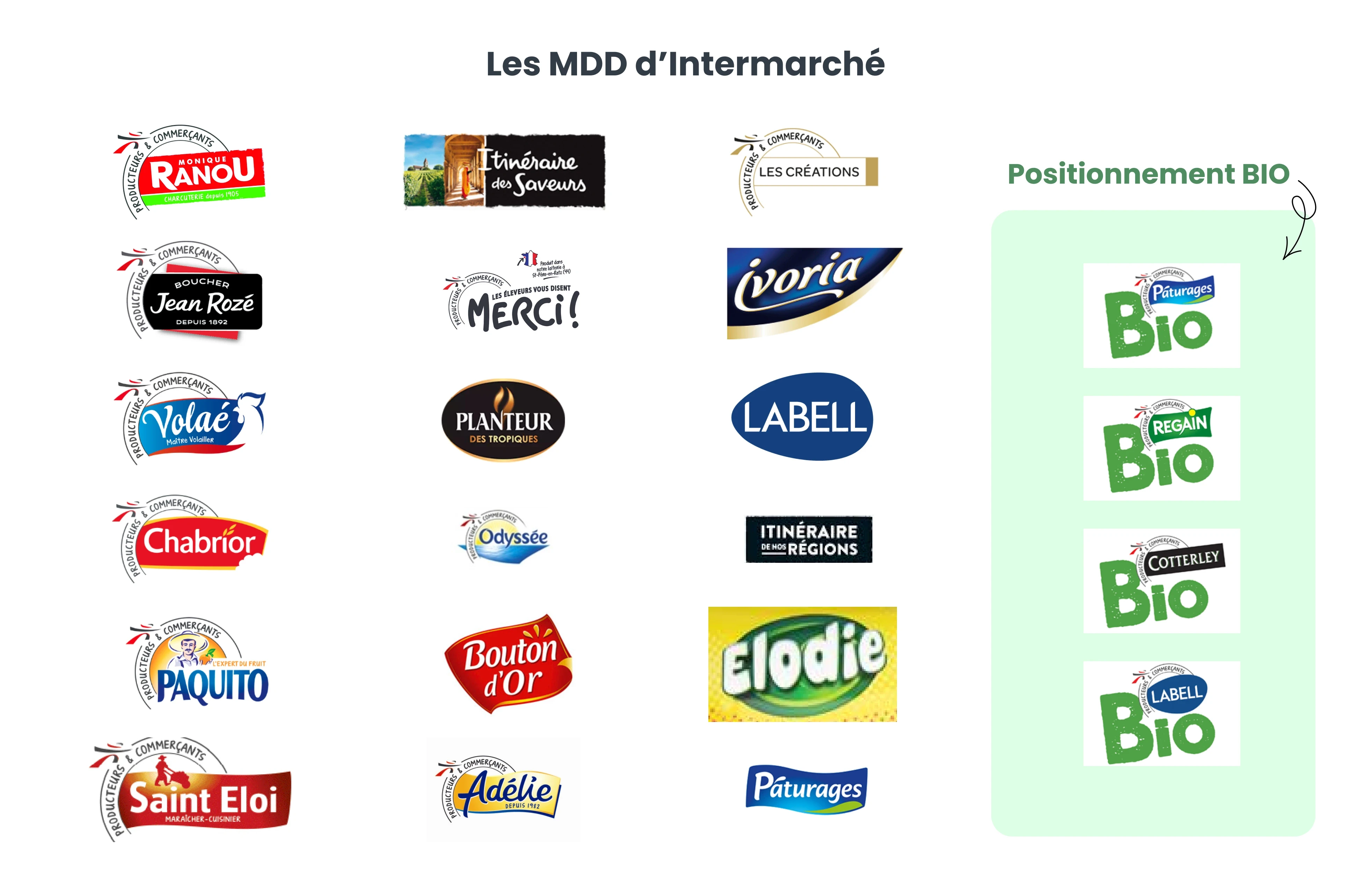
Intermarché also tries to reconcile authenticity and price with brands like Monique Ranoux, Pâturages, or Jean Rozé. The retailer implements co-branding strategies with local producers to create co-branded products, combining the renown of the private label with the authenticity of the local producer.
The same logic applies to Auchan, which boasts La qualité au meilleur prix (Quality at the best price). Note that Auchan does not hesitate to market home goods or household appliances under brands such as Garden Star, Qilive, or Actuel.
As for Leclerc's "Marque Repère", its name clearly indicates the retailer's ambition to position itself as a benchmark in its industry, an image largely cultivated by its highly publicized CEO Michel-Edouard Leclerc and his anti-inflation stances.
Finally, Monoprix is undoubtedly the most daring retailer in its store brand strategy: "To be a forerunner and democratize trends": a commitment that the company regularly features in its communications.
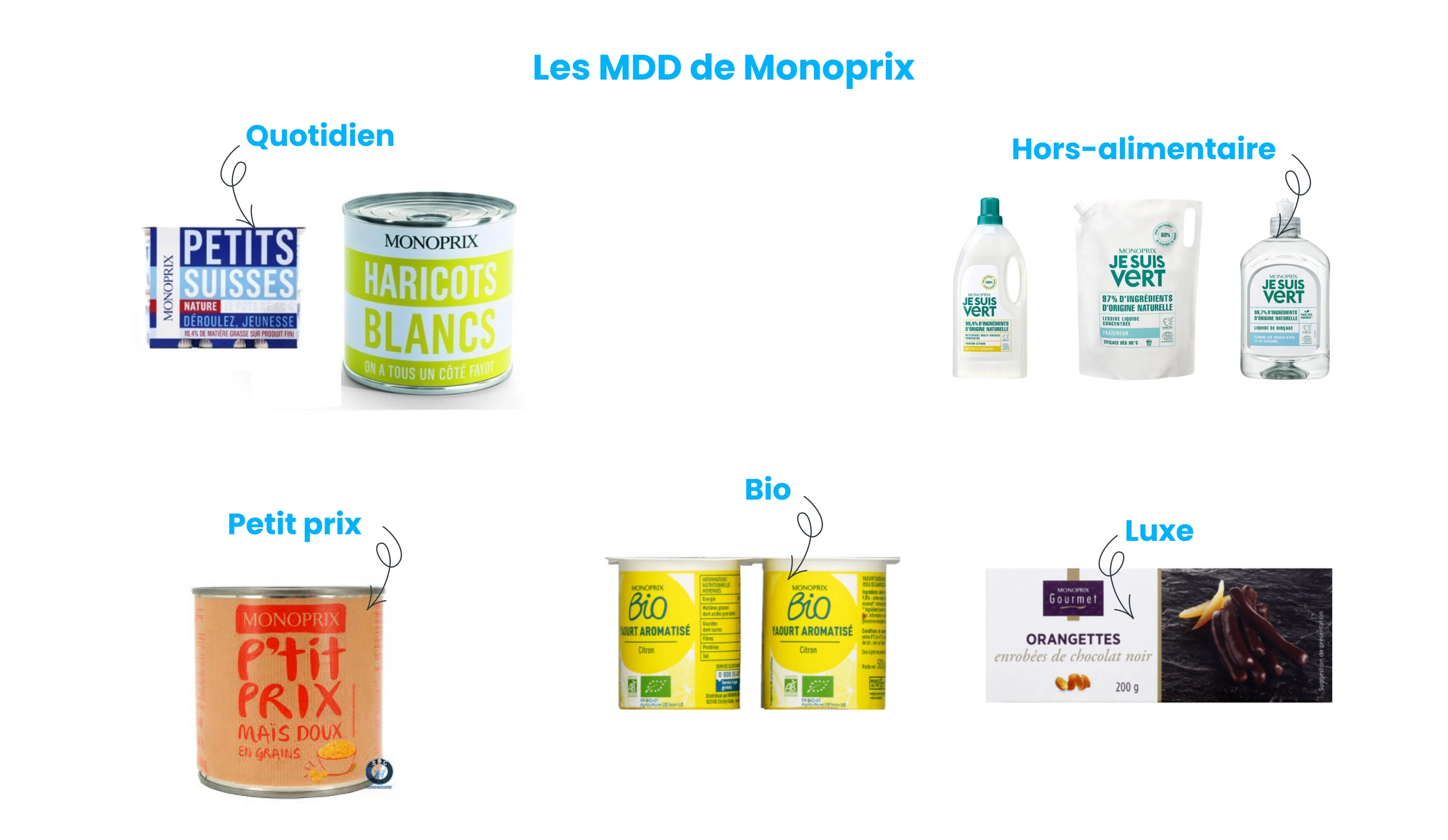
These examples illustrate the diversity of strategies adopted by major French retailers regarding private labels. Some focus on low prices, while others seek to differentiate their private labels through quality, innovation, or specific market segments. A winning strategy since private labels (PLs) captured 34.6% of French consumer spending on fast-moving consumer goods, according to the tracking firm NielsenIQ.
Although it may come as a surprise, competition between private labels and national brands is thus a key aspect of the retail landscape in France.
Legal and contractual protection against private labels
Short of being a "technical invention," a consumer good cannot be patented. Thus, only the distribution agreement can prevent the retailer from launching substitute products. But there is a very slim chance that your distributors will commit to never launching equivalent products, especially when they can reference those of your competitors, and private labels are an integral part of their business model.
Thus, the legal protection you have as a manufacturer is limited to the trademark as well as any potential plagiarism of your image or communication actions. Only one conclusion: you must activate every possible lever to remain competitive and differentiate yourself in the market, and that is what we are going to look at now.
10 levers that brands can activate against private labels
For an independent brand seeking to avoid losing market share to private labels, it is essential to implement effective strategies to differentiate and build customer loyalty. Here are 10 strategic recommendations:
Product Innovation: maintain a level of R&D and monitoring that allows you to develop innovative, differentiated products in anticipation of consumers' needs and desires. Emphasize quality, taste, convenience, or any unique feature to create a distinct value proposition. The Barilla brand is a very good example: in recent years, it has launched numerous product innovations that meet current consumer needs and desires: “Al Bronzo,” its new premium pasta range, designed to hold sauce better, “Collezione,” its first premium range, but also its “gluten-free,” “organic,” and “Integrale” whole wheat pasta ranges. Innovations that are paying off!
Quality and Transparency: ensure that the quality of your products is flawless. Transparency about ingredients, production methods, and product origin can strengthen consumer trust;
Solid Brand Strategy: develop a strong and consistent brand identity. Clearly communicate your values, your story, and what sets you apart from other brands. Create an emotional connection with consumers;
Differentiated Marketing: invest in creative marketing campaigns that highlight the unique benefits of your products. Use social media, blogs, videos, and other channels to engage your audience;
Strategic Partnerships: explore partnerships with other brands, influencers, or companies to expand your reach and build credibility. These collaborations can help increase your brand awareness;
Exceptional Customer Service: provide exceptional customer service to retain existing customers. Customer satisfaction can lead to positive recommendations, thereby strengthening your market position and the power of your brand;
Diversification of the Offer: diversify your product range to meet a broader spectrum of needs. This can allow you to reach different market segments and minimize the impact of private labels in specific categories;
Pricing Flexibility: be aware of price competition, but don't sacrifice quality. If necessary, offer promotions, bundles, or loyalty programs to maintain your appeal;
Selective Distribution: choose your distribution channels wisely to maximize your visibility while preserving your brand's exclusivity. Do not neglect online sales opportunities;
Market Monitoring: keep a close eye on market trends, changes in purchasing behavior, and emerging fashions. And the primary place to conduct market research for your brand is the point of sale! By equipping your field sales managers with a shelf survey application, you give yourselves the means to accelerate the flow of strategic information related to assortments, merchandising, or competing prices.
Thus, despite increased competition from the presence of private label products, your brand has a number of levers at its disposal to position itself and win or defend its market share. Innovation and differentiation are the watchwords when facing products that will generally attempt to replicate what already exists.
Margot has been working in Tech and SaaS for 8 years, with a multi-product experience that has given her a unique understanding of business challenges. On a daily basis, she analyzes, relentlessly tests, and relies on facts to shed light on market trends and help sales teams move forward.
See also

Artificial intelligence and field professions: what our 2026 studies reveal
Adoption, barriers, use cases: discover what our three studies reveal about the role of AI among sector managers, sales representatives, and foodservice sales reps.

CHR and RHF Sales Representatives: portrait of a relationship-driven profession in the era of data
Equipment, productivity, AI: discover the major trends for the HORECA and food service sales profession in 2026 through our field study.

Pharmaceutical Sales Representative in France: Portrait of a Field Job Under Pressure
Compensation, aspirations, AI usage: discover the major trends in the pharmaceutical sales representative profession in 2026 through our field study.

Area Sales Managers in France: who are they and how is the profession evolving in 2026?
Compensation, aspirations, AI usage: discover the major trends in the field sales representative profession in 2026 through our field study.
The area manager professions in 2026
Discover the trends, the challenges, and the key figures.