

Marketing Mix in Supermarkets: A Mini-Guide for Brands
Product, Price, Place, Promotion: how brands adapt their marketing mix in mass retail. Concrete examples and action levers for each P in large-scale distribution.

In short
10 min read
The marketing mix is a structured strategy aimed at defining a company's overall positioning to achieve its business objectives.
The initial 4Ps model (Product, Price, Place, Promotion) constitutes the fundamental levers for influencing demand.
The product strategy relies on creation, design, and user feedback to ensure a relevant and available offering.
The pricing strategy must balance profitability, competitive positioning, and value perception by the target audience.
The choice between direct and indirect distribution (or cross-channel) determines market access and margin management.
The evolution toward the 7Ps (adding People, Process, Physical Evidence) and the 10Ps (Partnership, Purple Cow, Permission Marketing) allows brands to better integrate services and customer trust requirements.
In mass retail, the success of the marketing mix requires close collaboration with distributors to optimize shelf presence and visibility.
In an economy marked by inflation, companies are seeking to optimize their sales and marketing strategies. Particularly sensitive to market fluctuations, brands that sell in mass retail must ensure that their marketing strategy is perfectly aligned with achieving their business objectives.
To do this, we must return to one of the fundamentals in this field: the marketing mix. But beware, the latter is not static. As we will see in this article, the marketing mix has undergone several revisions over time, and companies must therefore choose a model before applying it!
Once we have reviewed these different key concepts, it will be time to look at the case that interests you first: how your brand can exploit the marketing mix in its mass retail strategy.
What is the marketing mix or market offering plan?
The marketing mix, also known as the mix marketing, is a strategy that aims to define the marketing positioning of a company in its market in a global and coherent manner.
The market offering plan generally follows the completion of a market study. It aims to identify and master the expectations of target customers and to develop a strategy adapted to the market, achievable with the resources available to the company, to achieve business objectives.
The logical next step of the marketing mix is the implementation of the marketing plan.
What are the 4Ps of the marketing mix?
Popularized by American marketing and management professor Jérôme McCarthy in the 1960s, the 4Ps of the marketing mix correspond to the different levers on which a company will act in order to exert an influence on the demand for its products or services.
The term 4Ps therefore refers to the components of a successful marketing strategy, which all begin with the letter P in English:
Product;
Price;
Place;
Promotion.
1) Product: product strategy
To start the marketing mix, the product strategy, sometimes called the product policy, studies all the strategic components of the product (quality, design, features, packaging, composition, etc.):
Design and manufacturing aim to plan and optimize production to ensure constant availability of the product;
Characteristics encompass the features, quality, and benefits of the product. In addition to the vision developed by the designers, it is the feedback from end-users that validates or invalidates the strategy: this is why it is crucial to set up special operations to obtain user feedback in order to develop the features expected by the target;
Design concerns both the product itself and its packaging. What will its color be? Its format? Its style? Its size? ;
Associated products and services will allow you to ask the following questions: should we provide an integrated or additional warranty? What about after-sales service? And in a medium- and long-term vision, questions will arise about accessories, such as refills that can be sold in addition to the product. We must also study the repairability index and the lifespan of the product itself.
2) Price: price strategy
The price strategy seeks to set the right price for a product and define the general pricing strategy. It follows the study of the product.
The price depends on the target market, existing competitors, product volume, and the positioning that the company wishes to offer for its product.
In addition to calculating the selling prices of products, it is also appropriate to integrate discounts, promotions, and payment terms.
The goal is to achieve the highest possible profit while taking into account manufacturing, distribution, and promotion costs.
Finally, to this financial dimension is added the consideration of a general pricing strategy:
Market penetration consists of setting a low price when launching your new product, in order to rapidly enter the market;
Market alignment leads you to align with the prices of your competitors;
Skimming is a strategy based on a price deliberately higher than that of the competition, so as to attract a wealthier clientele and thus give a more luxurious or high-quality image to your product;
Value-based pricing allows you to determine your price relative to what your target will be willing to pay for your product.
To go deeper into this section, learn to master pricing policy.
3) Place: choosing a distribution channel
After dealing with the product and its price, it is necessary to determine how it will be made available to target customers, and in particular through which distribution channel. This reflection includes the logistics system, the distribution method, and the geographical area.
The distribution policy can be direct or indirect, and sometimes a mix of both. The choice is made based on the product itself and the company's sales objectives.
What is a direct distribution channel?
Direct distribution allows a product to be sold to the final customer through its own stores, whether physical stores or e-commerce sites.
The main advantages of direct distribution are the proximity of contact with the final consumer and the higher profit margin due to the absence of intermediaries.
This option carries significant disadvantages: internal costs (staff, training, infrastructure, etc.) and the cost of a global geographical reach that can prove deterrent. This reality of costs explains why many companies decide to target the market indirectly.
What is an indirect distribution channel?
Indirect distribution consists of selling products to the final consumer through one or more intermediaries (distributors, wholesalers, retailers). The main advantage of this channel is that the company benefits from a much wider potential customer base.
The disadvantage of the indirect channel is that the profit margin is reduced.
It is also possible to opt for a combination of direct and indirect distribution channels, which is called cross-channel.
4) Promotion: communication strategy
The promotional policy - or communication strategy - will allow defining in what framework (on what occasions? at what frequency? for whom?) and on which media the company will carry out its promotional actions. Its objective is to understand how to communicate with customers to inform them and convince them to buy.
There are 2 main categories of communication channels: Media and Non-Media.
Media communication channels are the main traditional means of mass communication. They encompass television, cinema, radio, print media, or outdoor advertising, etc. The goal is to be able to broadcast a message on a large scale in a relatively short time. However, this can involve high costs depending on the type chosen.
Non-media communication channels bring together the various means of direct communication that can reach a specific target. These techniques are more easily measurable to track their impact on sales. With the arrival of the internet, new non-media communication channels have appeared, such as digital marketing, with websites (e-commerce, blogs), social networks, mobile applications, etc. The advantage of digital marketing is being able to reach a wide audience at a lower cost and measure costs more easily.
An effective promotion will increase your brand awareness, and therefore the appeal of your product.
What does the evolution from 4Ps to 7Ps consist of?
Since the 1960s and the beginning of the 4Ps model, the market has evolved, and other elements have become crucial in marketing strategy and - ultimately - customer satisfaction.
Three new levers have come to reinforce the initial 4Ps:
People;
Process;
Physical Evidence.
5) People: direct relations with customers
People - or customer relations - corresponds to the staff involved in providing the service and who will interact with the customer. This includes salespeople, shelf managers, store managers, but also merchandisers, sales promoters, or sector managers.
The quality of interactions will serve to create or maintain a good brand image of the company. It is necessary to focus on the appearance, training, motivation, and behavior of anyone in contact with the final customer. They directly impact the customer experience and, therefore, sales performance.
Here are some examples:
A sector manager negotiating the prominent display of an innovation with a department manager.
A merchandising manager ensuring the quality of facing, promotional signage, and therefore, shelf visibility.
A host or demonstrator running a tasting corner to promote a product launch, and thus influencing the purchase behavior of new (and old) customers.
6) Process: sales process
The sales process encompasses all the steps to ensure customer satisfaction, create a positive customer experience, and, consequently, promote loyalty. This concerns procurement (logistics) as much as sales or after-sales (customer service). The entire journey must be considered, from the first interaction with the customer to the conclusion of the sale or even the service. Indeed, it has become clear that the way the product is provided is just as important as the product itself.
Here are some concrete examples:
The product listing process: from national negotiation with the retailer to in-store placement via central buying offices.
The promotional process: designing operations and theater displays, internal validation, communication to stores, in-store setup, monitoring and analyzing sales…
The logistical process: from order taking to warehouse delivery, up to store dispatch to avoid stockouts.
The after-sales service process, which generally concerns household appliances more: return terms, handling, customer <> brand relation, repair, or replacement.
Overall, the simpler and clearer the processes, the more efficient the management will be, improving satisfaction for both the final customer and the retailer, and increasing the profitability of commercial operations.
7) Physical Evidence: physical proof
The physical evidence relies on all tangible components relating to the product (store layout, signage, POS materials, brochures, etc.). The environment in which the sale takes place will impact the customer's experience and play on their perception of the product. They will be more inclined to buy in a place where they feel good.
Physical evidence varies enormously:
The product packaging is physical evidence. For example, a premium glass yogurt jar conveys quality and ecological commitment.
POS (Point of Sale Advertising): displays, shelf-talkers, box pallets, or display units catch the eye and enhance the brand value.
Clear nutritional labeling on a food product, certified by official labels (organic, Nutriscore, PDO).
The uniform and badge of the promoter or host, which reinforce the professionalism of the brand.
The design of the refrigerated unit that allows immediate identification of the brand and, ideally, the product.
This physical evidence reassures the buyer, reinforces the perception of quality, and supports the purchasing decision.
This last point is very close to merchandising and is associated with the role of the catman.
The transition from Marketing Mix to 10Ps
In the 2000s, 3 new Ps made their appearance in the marketing mix. Note that these are still somewhat debated.
8) Partnership: using a partner's reputation to sell
Partnership is a system allowing a company to associate with other entities to carry out a mutually beneficial exchange (develop their business, pool resources, strengthen a value proposition, etc.), each benefiting from the reputation of the other. These entities can be other companies, non-profit organizations, etc. These partnerships can be commercial, technological, or logistical.
We can notably think of co-branding: a well-known example in food service is La vie x Burger King, which join forces to create vegetarian and vegan burgers, responding to an increase in demand for meat alternatives. In mass retail, we can think of Monoprix making partnerships for its snack aisle, such as with Liv Happy Food or HappyVore.
Another type of partnership concerns promotional partnerships, such as with Ferrero, Kinder, and Carrefour teaming up to celebrate their anniversary.
9) Purple Cow: originality of a product
Introduced by former Yahoo vice-president Seth Godin, the purple cow comes from the idea that if, in the middle of a herd of identical cows, a purple cow appears, you will only see her.
In a market where all products are similar, it is essential to stand out from the competition. The purple cow then encourages you to be innovative by differentiating yourself both in terms of the product and in your communication.
As long as you are innovative in your market, you can differentiate yourself via your product. For example, 10 years ago, launching a plant-based milk allowed you to offer a differentiating product. Today, this must involve specific ingredients like Hoope and spirulina. This requires good communication to successfully make final customers understand how your product differs from your competitors (and truly differs).
Otherwise, it will rely more on your brand image or your recognizable and standout packaging. On this subject, the launch of Squeezie's brand, Ciao Kombucha, got people talking. Many internet users lamented a more than striking resemblance to the Rise brand in terms of packaging. We'll let you judge for yourself.
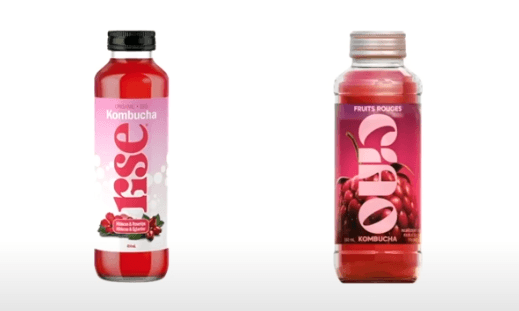
Having a product visible by its colors and packaging will help you improve brand visibility in-store.
10) Permission Marketing: asking for a prospect's consent before pitching them
According to Seth Godin, permission marketing aims to ask for the consent of prospects before soliciting them with targeted advertising or promotional messages. In this case, the company commits to respecting the consumer's wishes, allowing them to modify their preferences, or even unsubscribe easily at any time. This does not only concern compliance with GDPR laws, but also aims not to buy address databases, not to send emails without authorization, etc. It is the opposite of traditional interruption marketing.
The means to use to collect opt-ins are, for example, online or paper forms to fill out, voluntary in-store subscriptions, newsletter subscriptions, etc.
This system allows for a more transparent and trusting relationship with customers. Brands with strong online marketing can use these techniques to improve their relationship with consumers as well as their brand image "outside the store." But buying in large supermarkets can also be the starting point for an online marketing approach: for example, your dairy product brand can integrate a QR Code into its products, which, once scanned, redirects to a recipe site / cooking blog. It is at this point that permission marketing can be activated, with agreement to receive notifications, subscription to a newsletter, etc.
How to create your marketing mix?
Before starting to build your marketing mix, it is important to take into account that the marketing mix is not set in stone.
First, going from 4Ps to 7Ps to 10Ps, it evolves over the decades to adapt to the transformation of markets and consumer behavior. Recently, digitalization, AI, or ecological and societal transformation have impacted companies' marketing mixes. For example, the unprecedented rise in coffee or chocolate has impacted the "price" of companies using one of these products as a raw material. If a competitor launches a new disruptive product, you can adapt your Product or accelerate a launch planned for later.
We therefore advise you, once your marketing mix is built, to monitor it quarterly to quickly adjust your action plan.
Steps to build an effective marketing mix
Analyze your market and customer needs
Even before talking about the Ps, start by analyzing your market: who are your customers, what are their needs, their expectations, their constraints? Use market studies, qualitative interviews, or existing data analysis.
Define your positioning
Decide where you want to position yourself in the market. E.g.: entry-level, premium, innovative, accessible, local, etc.
Define your marketing objectives
Thanks to the two previous points, you will be able to define the objectives you want to achieve:
What is the objective? (e.g., increase market share, launch an innovation, strengthen visibility)
Which target? (e.g., national mass retail chains, independent stores, premium foodservice)
For example: launch a new protein yogurt to gain +2 points of market share in the health segment by the end of the year.
Break down each P into concrete actions
Product
What are its key characteristics?
(packaging, format, composition, innovation, consumer benefit)
How does it differentiate itself from competitors?
For example: 0% fat yogurt, 15g protein, recyclable pot, positioned as health + convenience.
Price
What is its recommended retail price?
What pricing strategy? (premium, penetration, alignment…)
Are there any planned promotions?
For example: positioned at +20% vs classic yogurt but -10% vs Skyr, with a BOGOF (buy one get one free) launch offer.
Place (Distribution)
Where will it be distributed? (chains, types of stores, geographic areas)
What target numeric distribution (ND)?
What shelf placement / facing / endcap display?
For example: placement in the fresh dairy aisle next to Skyr yogurts, with national endcap display for 2 weeks at launch.
Promotion (Communication)
How will you promote it?
Which levers: in-store POS, tastings, animations, digital, influence?
For example: shelf-talkers + tastings in 300 points of sale + social media campaign via nutritionists.
Add the 3Ps of services marketing to upgrade to the 7Ps
People
Who interacts with the product? (sales teams, merchandisers, advisors)
What training or messaging should they have?
For example: training sector managers on nutritional benefits and differentiating sales pitches.
Process
What processes guarantee quality and efficiency?
Example: logistics, restocking, promo follow-up, shelf checks.
For example: clear process for reporting stockouts via CRM to react within 48 hours.
Physical evidence
What concrete elements reinforce the credibility of the offer?
Packaging, POS, certifications, labels, proofs of efficacy.
For example: Nutriscore A printed on pack, "High Protein" label, POS with athlete endorsement.
Integrate the 3 additional Ps to reach the 10Ps (optional, advanced vision)
Partnership
What partnerships strengthen your mix?
(distributors, influencers, manufacturers, tech startups)
For example: partnership with a sports influencer or using sports coaches for in-store promotion and online content.
Purple Cow
What makes your product truly remarkable?
For example: first protein yogurt in a drinkable sport cap format.
Permission marketing
How to engage your target in a non-intrusive way and create an ongoing relationship?
For example: QR code on pack giving access to a personalized sports and nutrition program.
Verify overall consistency
The 10Ps must be aligned and consistent with each other and with your positioning. For example, a premium product poorly distributed or poorly presented loses credibility.
Implement, measure, and adjust
Once your plan is activated, track your indicators: sales, margins, brand awareness, customer satisfaction.
Analyze your KPIs by P every month or quarter. Adjust if necessary.
For example, after 2 months, achieved ND = 65% vs 80% target → booster plan via sales forces.
Marketing mix and mass retail: practical tips
The table below lists, for each pillar of the marketing mix (7Ps), one or more recurring issues in mass retail, and action levers to solve them.
7Ps | Constraints in mass retail | Solutions and best practices |
|---|---|---|
Product | Listing policy specific to each mass retail chain. Abundance of competing offers tending to disqualify poorly differentiated products. | Work closely with your distributors, maintain a privileged relationship with buyers and department managers. Try to find ways to stand out through packaging or product variations specific to retail (cf. Seth Godin's purple cow). |
Price | Pressure on margins due to negotiations with distributors, caused by intense competition. | Ask for benefits in exchange for your pricing efforts, such as merchandising or periodic endcap displays. |
Promotion | Distributors have a promotional schedule to respect (negotiated at the head office), which can limit your promotional options. | Negotiate catalog promotions during the negotiation period, collaborate with distributors to design effective promotional campaigns, anticipate strategic periods, and ensure you understand your resellers' strategic objectives to propose appropriate actions consistent with their plans. Also negotiate off-schedule promotional actions throughout the year. And to convince them, show the increase in sales generated by the promotion based on real case studies! |
Place | Dependence on distribution networks, risk of depending on a single distributor. | Diversify distribution channels, look for alternative partners, evaluate distribution contracts to minimize risks. |
People | Distributors' employees may not be sufficiently trained to properly promote the brand's products. | Offer training to distributors' employees, provide promotional resources, establish strong relationships with key account managers. |
Physical evidence | Limited actions for the brand when it comes to making the sales environment conducive to purchasing its products. | With the help of your distributors, implement merchandising, POS, and signage to create an environment conducive to buying. Study the possibility of setting up a shop-in-shop. |
Process | Lack of visibility on the customer journey in mass retail stores. | Conduct surveys with your customers to learn as much as possible about their journey. Work closely with department managers to get their feedback. Perform store audits to better understand what is happening on the shelves. |
Examples
Let's finish with some practical cases based on brands you all know. Starting from a particular brand and product, we reproduce key elements of 3 major pillars of their marketing mix: Price / Place / Promotion.
Brand | Context / global strategy | Product | Price | Place | Promotion |
|---|---|---|---|---|---|
Nivea | Broad Target / Here: younger target (13-19 years old) | Nivea Visage Young, then name changed to: Nivea Visage Pure Effect: High-quality beauty care | Launch strategy with an attractive price | Hypermarkets and Supermarkets, small stores, online, etc. | TV, online teen websites |
Nestlé | Broad Target | Herta Ham | Competitive strategy | Hypermarkets and Supermarkets, small stores, online, etc. | TV, family magazines |
Coca-Cola Company | Broad Target | Classic Coca-Cola | Adaptation to the local market and the price of its competitor Pepsi-Cola | Hypermarkets and Supermarkets, corporate offices, gas stations, airports, etc. Intensive strategy | Implementation of promotions (Christmas, sporting events, etc.). Massive advertising budget |
Marketing remains an essential technique in defining an approach aimed at maximizing the commercial potential of brands. Its theoretical content is bound to change over time, as the number of Ps bears witness!
Once your model is chosen, you must also take into account your sector: mass retail involves both constraints related to business partners and the omnipresence of competition in sales outlets. Succeeding in your marketing mix will allow you to find your place and defend it, whether you are operating in a new or already mature market.
For the past five years, Corentin has supported more than 200 sales teams, making him one of the longest-serving members of the company. He has seen the product evolve alongside the industries he supports, giving him a deep understanding of actual use cases. Between onboarding calls and training sessions, he has built up rare, hands-on expertise: knowing exactly what saves teams time.
See also

Artificial intelligence and field professions: what our 2026 studies reveal
Adoption, barriers, use cases: discover what our three studies reveal about the role of AI among sector managers, sales representatives, and foodservice sales reps.

CHR and RHF Sales Representatives: portrait of a relationship-driven profession in the era of data
Equipment, productivity, AI: discover the major trends for the HORECA and food service sales profession in 2026 through our field study.

Pharmaceutical Sales Representative in France: Portrait of a Field Job Under Pressure
Compensation, aspirations, AI usage: discover the major trends in the pharmaceutical sales representative profession in 2026 through our field study.

Area Sales Managers in France: who are they and how is the profession evolving in 2026?
Compensation, aspirations, AI usage: discover the major trends in the field sales representative profession in 2026 through our field study.
The area manager professions in 2026
Discover the trends, the challenges, and the key figures.