

How can you improve the presence and visibility of your products in stores?
Facing, POS displays, endcaps, planograms: how can you improve your product visibility on the shelves? Concrete levers for brands in supermarkets.

In short
10 min read
The visibility of a product in-store depends on key factors like its location, shelf height, and the number of facings.
It is essential to distinguish between physical presence, actual visibility, and sales performance to effectively steer your strategy in supermarkets.
A strategic placement, especially at eye level, promotes quick product identification and stimulates impulse purchases.
Merchandising, including POS advertising and promotional displays, transforms the point of sale into a powerful activation lever to capture attention.
Rigorous field execution, supported by regular visits and simple data collection tools, is essential to ensure compliance with commercial agreements.
Monitoring precise indicators, such as distribution (numerical and value) and share of shelf, helps objectify visibility and adjust corrective actions.
In supermarkets and hypermarkets, consumers' purchasing acts are influenced from the moment they enter the store.
For a brand to establish itself, it is crucial that its products are not only present on the shelves, but also truly visible.
In-store product visibility refers to a product's ability to be quickly spotted by the shopper along the customer journey: it depends in particular on its location, its shelf height, the number of facings, the signage (POS advertising) and promotions (endcaps, central aisle, checkout, etc.).
That is why a brand must collaborate closely with retailers to guarantee not only the presence of its products, but also a preferential positioning. It is this prime position that will make it possible to capture customers' attention and be selected as a priority.
The goal is twofold: increase product visibility and boost sales, by creating an attractive sales environment and optimizing product layout to encourage impulse buying.
In this article, we will understand why it is important to work on your in-store presence, what strategies to implement to achieve this, and which KPIs to track to optimize it.
Presence, visibility, and performance in-store: what are the differences?
Before seeking to improve the visibility of your products in-store, it is essential to distinguish between three concepts that are often confused: presence, visibility, and performance.
In-store presence means that the product is physically available in the point of sale. A listed product that is absent from the shelf (out of stock, partial delisting, shelf placement error) has no chance of being bought.
In-store visibility refers to the ability of a product to be seen by the consumer. It depends on several factors: location on the shelf, number of facings, shelf height, signage, promotional endcaps, or theatrical displays.
Finally, sales performance refers to the results generated: sales, rotation, revenue. A product can be present without being visible, or visible without being high-performing if the offer, price, or merchandising is not adapted.
Working effectively on your in-store presence therefore consists of acting simultaneously on these three levers, starting with guaranteeing presence, then optimizing visibility to improve performance.
Optimizing shelf space and layout to maximize product visibility
Physical levers (Layout, facing, shelf space)
The layout of products in-store is one of the primary drivers of their visibility. A poorly positioned product, with few facings or placed outside the consumer's field of vision, mechanically sees its chances of being purchased decline.
Why? Consumers browse the aisle quickly. The more space a product occupies and the better positioned it is, the more it captures attention and triggers a purchase.
Choosing strategic locations to maximize in-store visibility
The art of positioning your products to maximize sales.
The location of your products in the store is a determining factor for their visibility and, consequently, for their sales. Understanding linear share and the various strategic locations is essential to negotiate the best positions.
Consider the following aspects for an effective layout.
The department and the category aisle: ensuring consistency and product presence
The Department: In hypermarkets and department stores, the department groups various aisles under the same theme or shopping experience. Your products will generally be located in a specific department, but events or promotions may allow you to temporarily place them outside of it, creating additional visibility opportunities.
The Aisles: Each aisle is dedicated to a specific product category, designed to facilitate and improve the shopping experience in that category. As a brand, you can position yourself in several aisles, much like certain PDO cheeses, present in the self-service dairy section and at the cheese counter.
Aisles and high-traffic zones: capturing the shopper's attention
Aisles, the pathways for movement between shelves, play a key role in the shopping experience. Their design influences consumer purchasing decisions. A strategic position in an aisle, especially in high-visibility areas, can significantly increase the chances of selling your products.
The shelf: a key visual lever in the aisle
The shelf, representing the total length of the racks where products are displayed, is crucial for presentation and visibility. A well-arranged shelf, with neat shelf stocking and clear signage, can boost the visibility of your products. A good shelf placement, in particular with an optimal number of facings, increases visibility.
To ensure the optimal presence of your products, negotiating strategic locations is essential. Work closely with department managers to obtain prime positions, such as shelves at eye level, near checkouts, or next to complementary products. These locations increase visibility and the probability of being chosen by customers.
Negotiating an eye-level shelf placement
Eye-level shelf placement is one of the most coveted locations in retail. It corresponds to the area of the shelf located approximately between 1.20 m and 1.60 m from the floor, where the consumer's gaze naturally lands.
Products placed at eye level benefit from maximum visibility with no cognitive effort on the shopper's part. They are identified, compared, and selected more quickly.
Concrete examples of eye-level shelving
For high-value margin products, retailers often prioritize eye level in order to optimize shelf profitability.
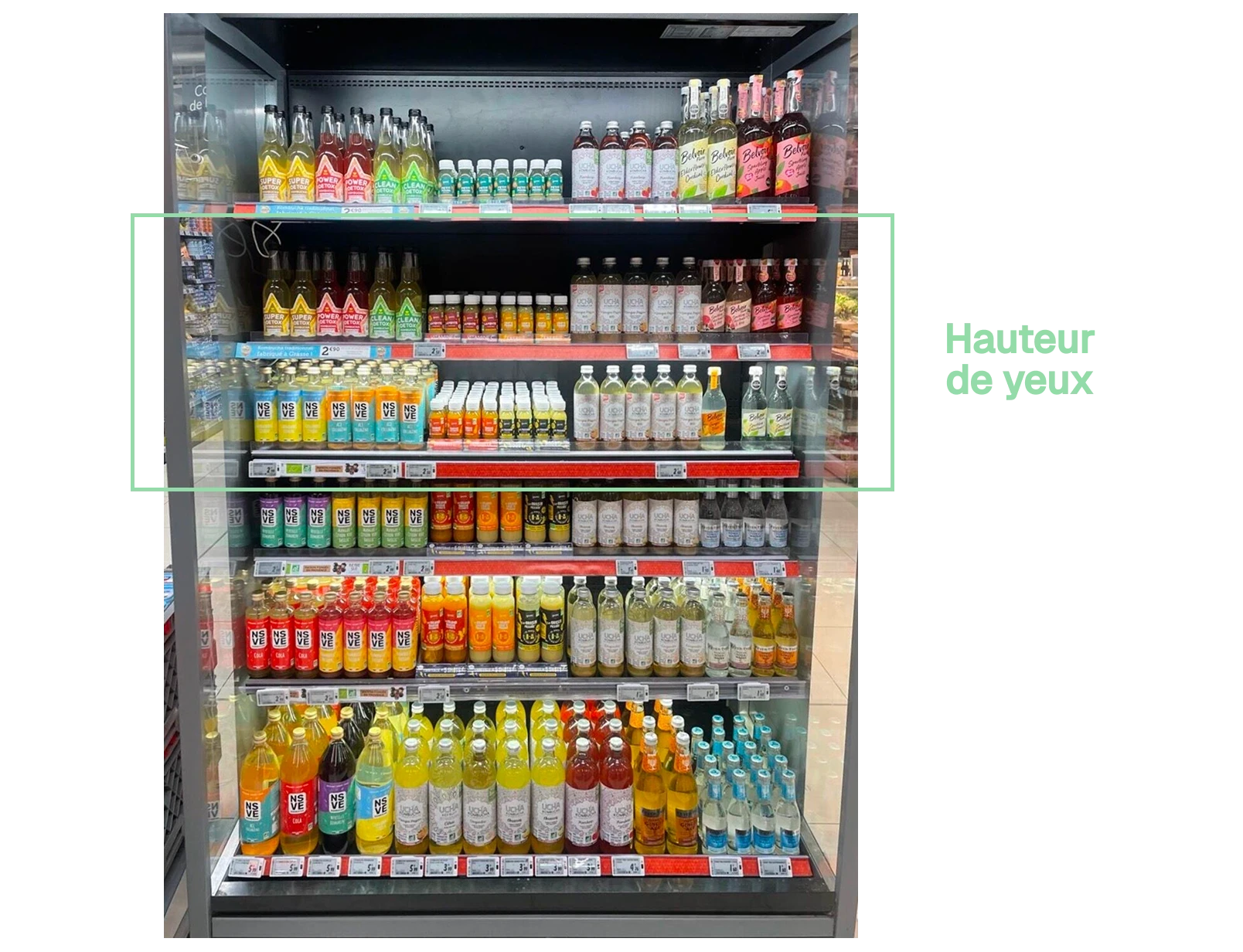
Example in a fresh food section / endcap display
Eye level also applies to endcaps.
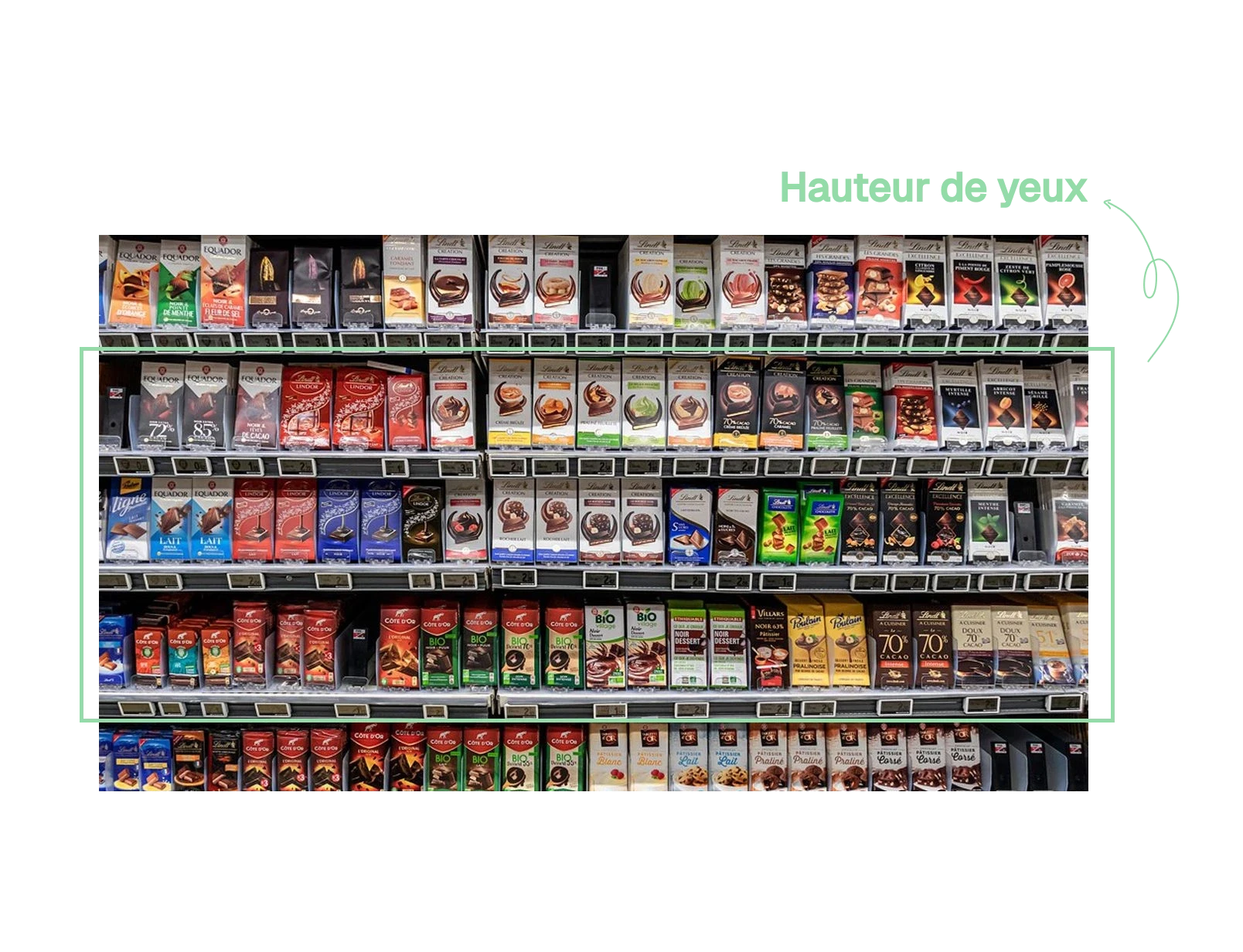
Example in a chocolate aisle
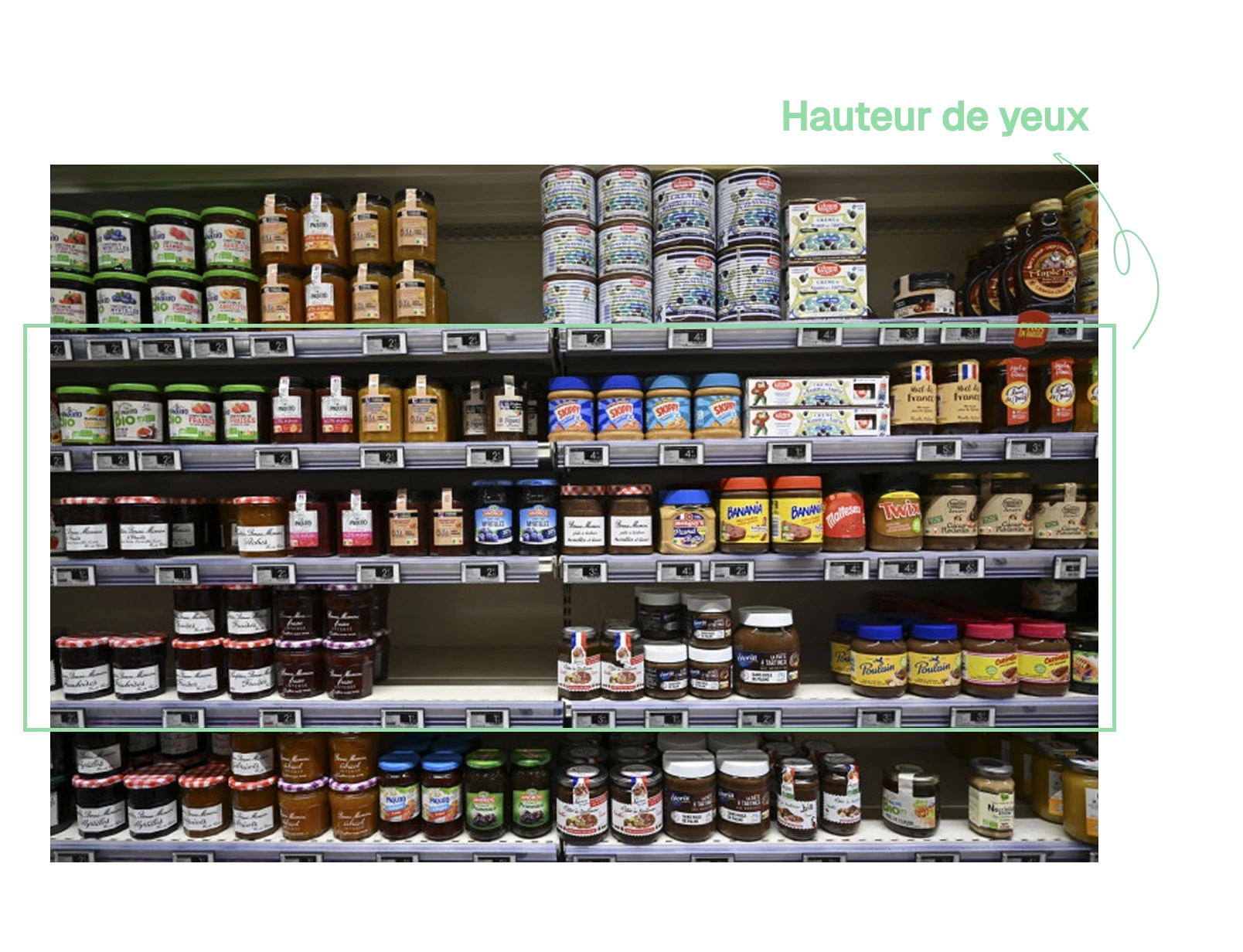
Example in a sweet grocery aisle
In the grocery aisle, positioning a national brand or a new product in the center of the shelf at eye level significantly increases rotation compared to items located at the bottom of the shelf.
How to negotiate this location?
Rely on sales and rotation data to demonstrate product performance.
Highlight complementarity with adjacent products.
Offer commercial trade-offs (in-store events, promotions, temporary displays).
Optimizing the number of facings to strengthen visual impact
The number of facings plays a direct role in a product's visibility on the shelf. The more facings a product has, the greater its visual surface area, which mechanically increases its chances of being spotted by the consumer during the shopping journey.
Concrete examples of eye-level facings
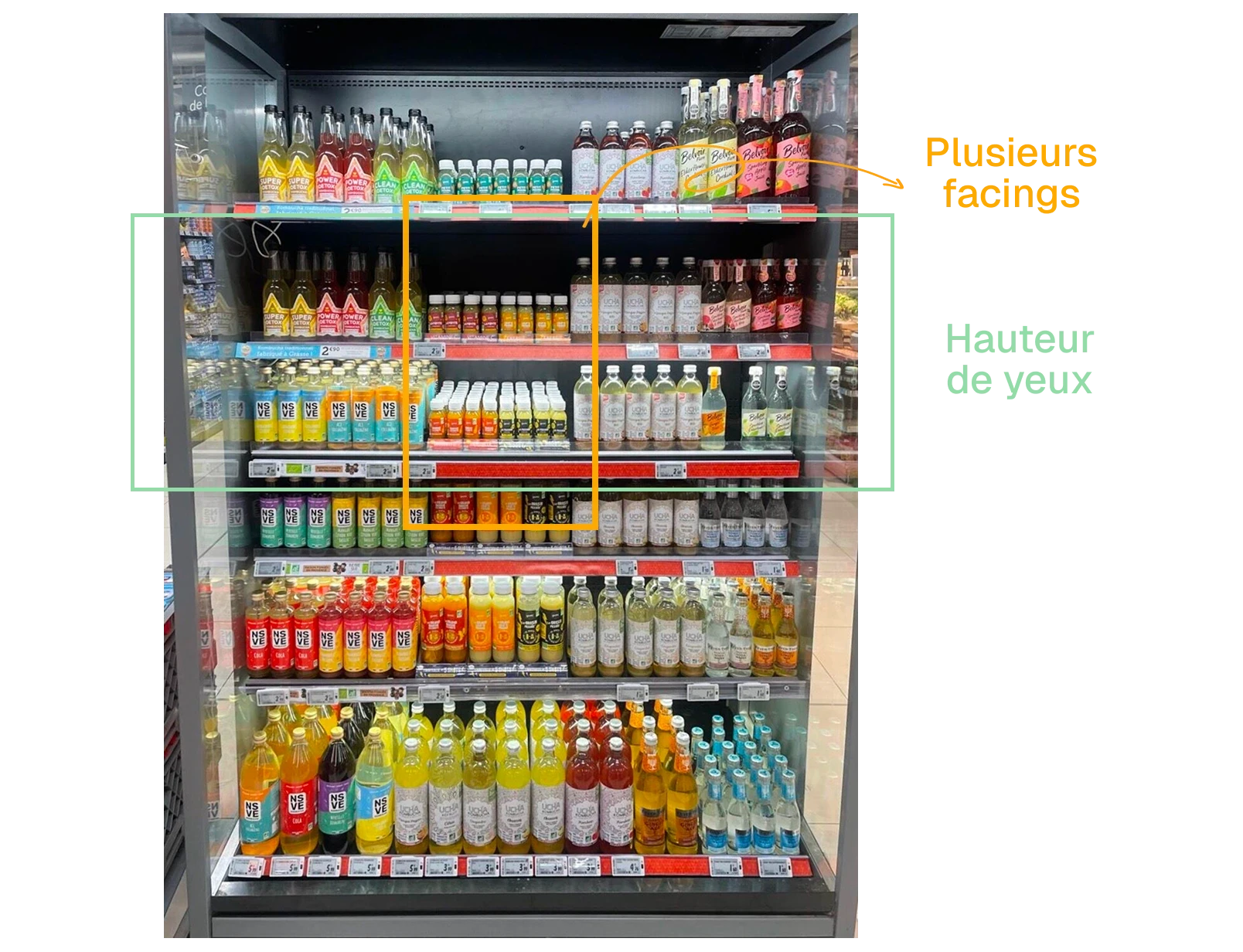
Example in a fresh food section / endcap display
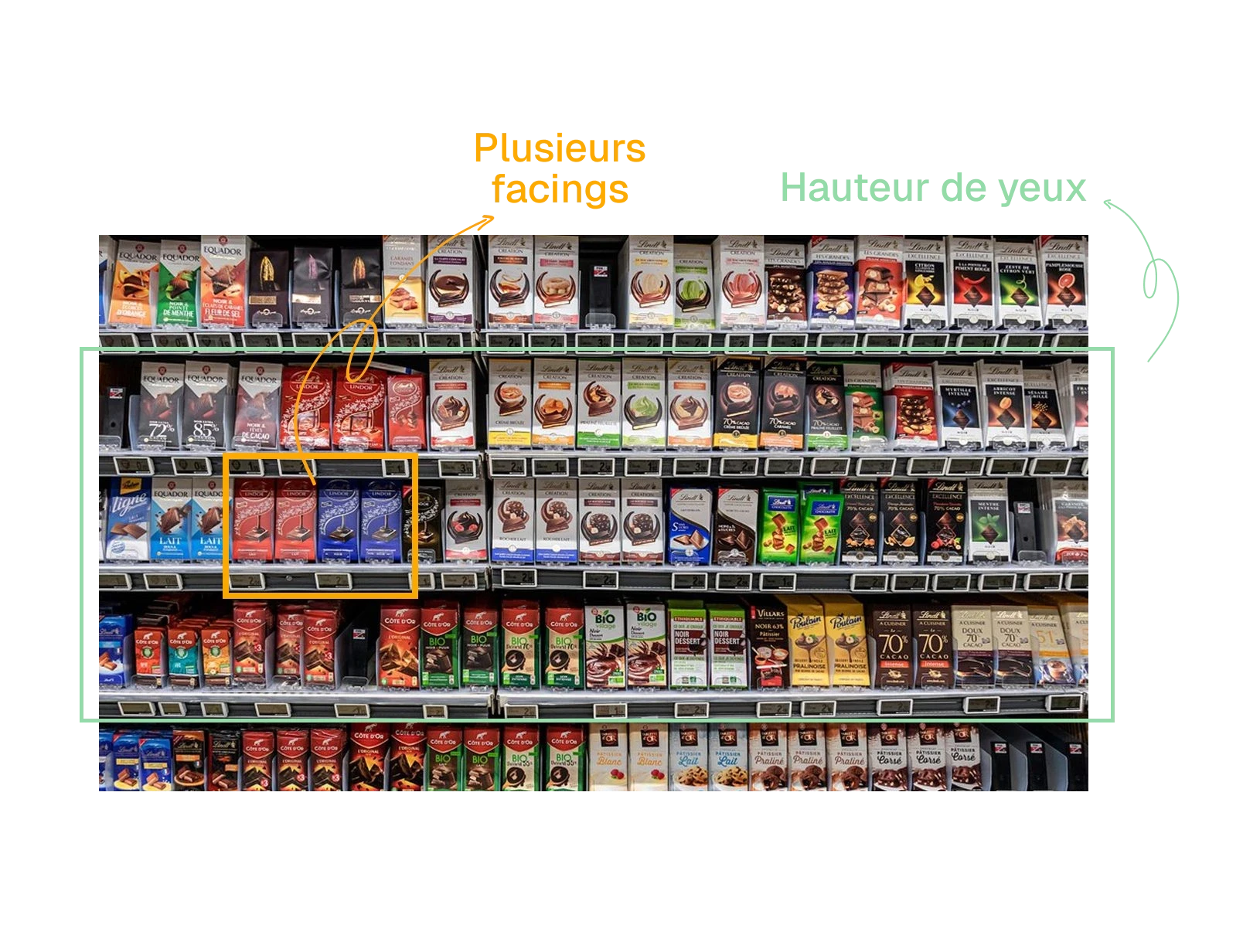
Example in a chocolate aisle
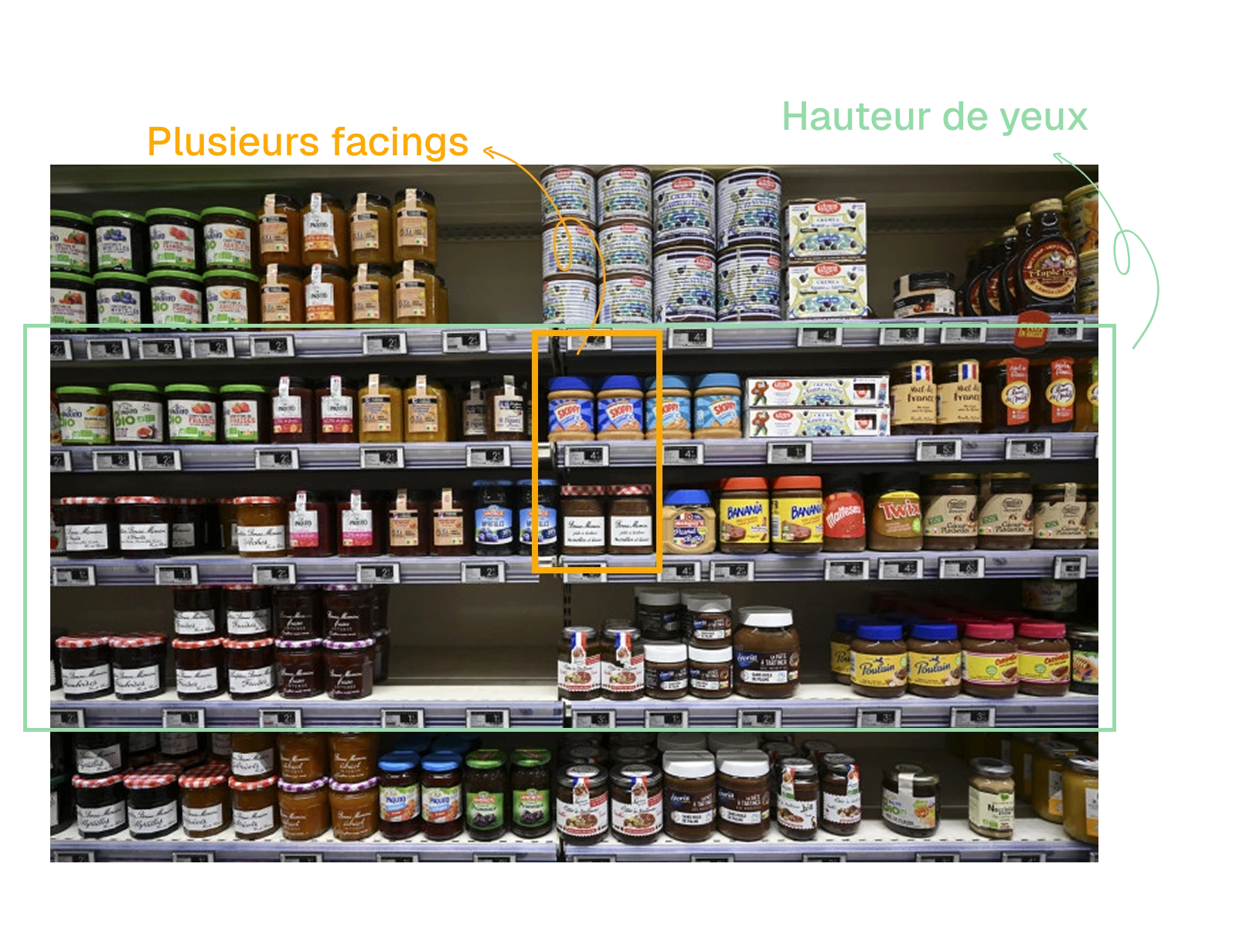
Example in a sweet grocery aisle
How to define and monitor an optimal number of facings
The optimal number of facings depends on several criteria:
the product category,
the width of the available shelf space,
the performance of the product (rotation, margin),
the commercial agreements negotiated with the retailer.
To ensure that the negotiated facings are properly respected, it is essential to conduct regular in-store audits. These audits make it possible to compare the contractual number of facings with the reality in the field and quickly identify discrepancies.
Monitoring the number of facings over time thus makes it possible to take targeted action to preserve shelf visibility and secure sales performance.
Ensuring compliance with assortment and shelf-space agreements
There is frequently a gap between the contractual visibility negotiated with the retailer and the actual visibility observed in the store. A product may be officially listed, but poorly laid out, partially missing from the shelves, under-exposed compared to agreements, or moved to a low-visibility area.
In these situations, presence exists on paper, but real visibility is insufficient to generate sales.
Understanding the difference between contractual visibility and real visibility
Contractual visibility corresponds to the commitments negotiated with the banner: planned assortment, number of facings, retail shelf share, specific locations.
Real visibility, on the other hand, corresponds to what the consumer actually sees on the shelf during their visit to the store.
Without regular tracking, visibility remains theoretical and does not necessarily translate into sales performance. Securing in-store execution means transforming commercial agreements into real and measurable visibility, in service of performance.
Activating merchandising and promotions to capture attention
Marketing levers (POS, promo, activation)
Merchandising and in-store promotions go beyond simple shelf presence. They transform the point of sale into a true activation lever because they disrupt the purchase path and encourage impulse buying.
Using merchandising to transform the customer experience
Creating a stimulating sales environment
Merchandising goes far beyond simple product placement. It is a strategic approach aimed at reshaping the in-store customer experience. Effective merchandising ensures that products are not only visible, but are also presented in a way that stimulates interest and encourages buying, particularly for impulse purchases.
When you apply visual merchandising techniques and organize your products logically and attractively, you create a sales environment that appeals to the customer and positively influences their purchasing decisions. Here are some keys to successful merchandising:
Aisle Strategies: Place promotional products or new items on endcaps, at the ends of rows bordering high-traffic aisles, to capture customers' attention as soon as they enter. In addition, aisles can host temporary displays or stands to highlight specific offers or special products.
In-store events and theatricalization: Certain areas of the store are dedicated to commercial events and the theatricalization of the retail outlet. These spaces offer a unique and dynamic shopping experience, attracting consumers and making their store visit more memorable.
Shelf Space Optimization: Concepts such as planograms, product highlighting, and assortment management are essential. They determine how products are arranged and interact with customers. A neat and thoughtful shelf layout makes product discovery easier for customers and increases purchasing opportunities.
Effective merchandising will transform your product presentation into a sales opportunity by actively encouraging purchasing decisions.
Highlighting products on endcaps or in the central aisle
Endcaps and central walkways are among the most visible areas in a store. Located in high-traffic zones, they display products to a high number of consumers, including those who did not originally plan to browse the associated aisle.
Example of a successful endcap display
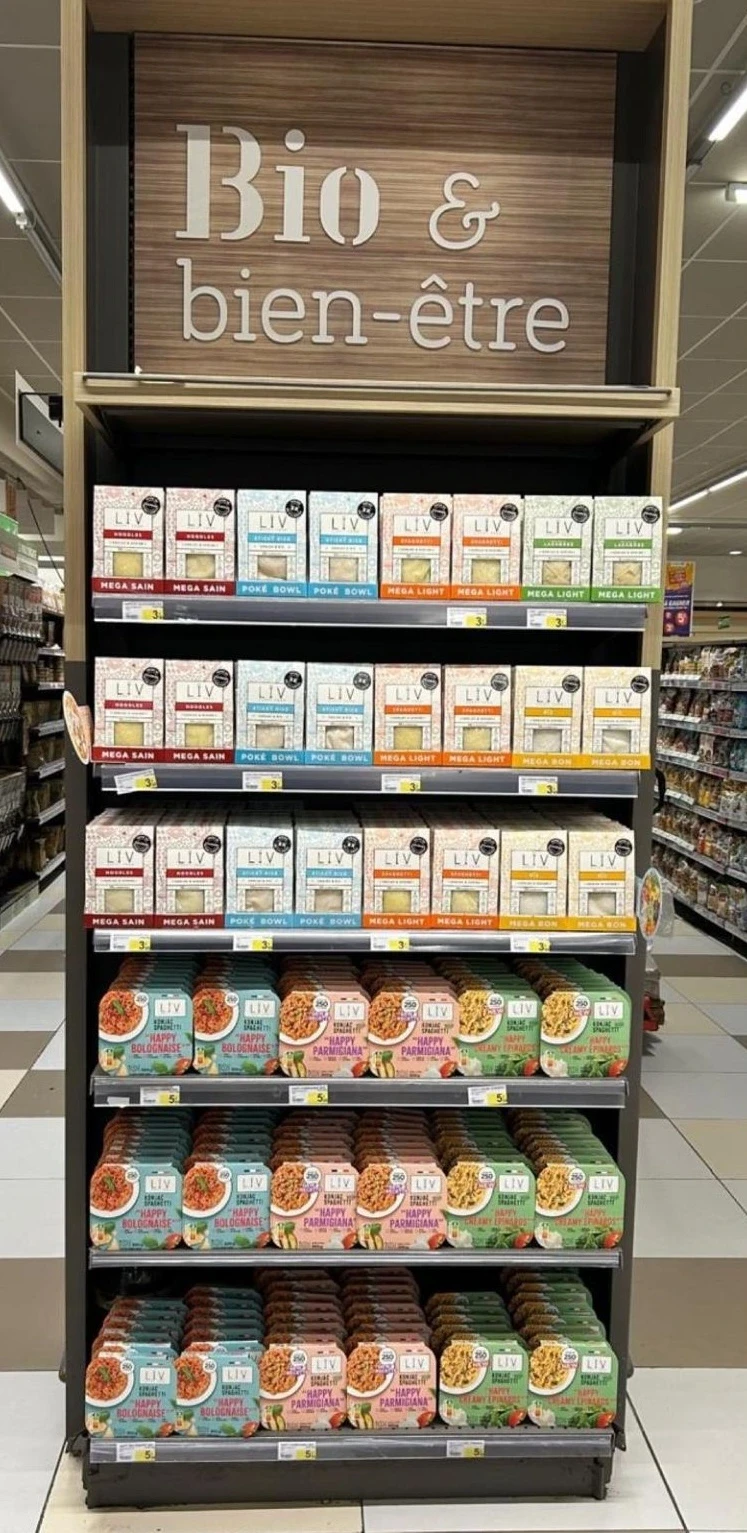
Example of an endcap display by the brand Liv Happy Food
This endcap display is successful because it is not generic. One can easily identify the aisle context, the message, the brand, and the products. Nevertheless, it remains simple, with a limited number of items.
How to build them effectively?
Select a small, clear assortment to avoid visual overload.
Adapt the message to the context (novelty, promotion, seasonality).
Ensure consistency between the product, the visuals, and the displayed price.
A successful display on an endcap or in the central aisle strengthens product visibility while generating an immediate impact on sales.
Using highly visible POS materials consistent with the brand
In an environment saturated with products, POS advertising acts as a visual guide. It facilitates product identification and helps the consumer quickly understand the brand's value proposition.
Best practices for high-performing POS displays
Use visuals consistent with the brand's identity.
Prioritize simple, readable, and immediately understandable messages.
Adapt the format of the POS material to the available space (shelf talkers, banners, display stands).
Regularly check its presence and proper shelf positioning in the store.
A well-designed and correctly installed POS display improves shelf visibility and helps guide consumers' choices at the key moment of the purchasing decision.
To learn more about best practices for convincing your retail distributors, we invite you to read our dedicated article.
Deploying targeted promotions (discounts, special offers, sampling)
Before launching a promotion, you must clearly define your objectives. Are you looking to increase sales in the medium term or to improve the visibility of your products and brand in-store?
Next, select the type of promotion best suited to your business goals. There are several approaches to promoting your products in-store, including:
Price Discounts: Ideal for building customer loyalty and driving sales volume.
Special Offers: Effective for driving sales over a short period.
Contests and Sweepstakes: Perfect for increasing the awareness of your brand or a specific product.
Sampling: Highly useful for introducing a new product and boosting its awareness.
Once you've defined your promotional strategy, the next step is to negotiate its location inside the store. This requires regular visits to the field by your area managers and retail reps to ensure that your promotions are well implemented and effective. These in-store interactions are crucial to ensure the success of your promotional efforts, which is what we will explore in the second part of this article.
Improving retail execution to secure in-store visibility
The best layout or promotional strategy has zero impact without rigorous in-store execution. Store visits are therefore a key lever to guarantee the actual presence of products, as your sales merchandisers and area managers are your reliable source to verify real product presence and visibility.
Training teams on visibility and merchandising challenges
The efficiency of store visits is a key pillar to guarantee optimal product presence. These visits must be strategically planned. The area manager, playing a central role, handles multiple tasks, from checking store layouts to monitoring competitors and verifying stock levels.
To support these missions effectively, training is crucial for two main reasons:
Developing the expertise of area managers: often young and newly hired, area managers need training to gain efficiency. A well-trained area manager will know how to maintain an impeccable product presence and adopt a business approach aligned with your brand's goals.
Mastering the CRM: we hope you are equipped with a solution that evolves rapidly and offers you new mobile features that help you gain efficiency. Training may be necessary so the entire team masters the tool perfectly.
Prioritizing high-potential stores or stores experiencing difficulties
Once teams are trained on brand messaging and objectives, consistency in the frequency and targeting of visits becomes a key performance lever. Not all stores present the same stakes: it is therefore essential to prioritize the sales outlets to visit.
We advise you to prioritize your efforts on stores with high business potential, active outlets where product shelf-holding is low, or those where presence has recently dropped (loss of lists, reduction in facings, recurring out-of-stock issues).
Providing area managers with simple reporting tools
During store visits, area managers collect essential information to analyze the presence and visibility of products. To be effective, this data collection must rely on simple, structured, goal-oriented, and mobile-friendly tools.
We advise providing your sales force with quick-to-complete store checks focus on key performance indicators (product presence, facings, shelf share, POS displays), and designed around the logical route of a store visit.
Clear, standardized tools allow sales reps to immediately identify present or missing products, detect placement discrepancies, and transform store observations into concrete actions to improve in-store visibility.
How to measure the visibility of your products in-store?
Improving the in-store visibility of your products necessarily requires measurement. Without reliable indicators tracked over time, it is impossible to identify areas for improvement, compare situations between different sales outlets, or prioritize field actions effectively.
Measurement allows a perceived or contractual visibility to be transformed into real, objective visibility that can be directly used by sales teams and management.
Key indicators to manage in-store visibility
To evaluate product presence and visibility at the point of sale, several indicators are indispensable:
Numeric Distribution (ND): number of stores in which the product is actually present in a given region.
Weighted Distribution (WD): the economic weight of the distributing stores, in relation to their contribution to global retail revenue.
Product Holding (or retail list achievement depending on the brand): number of items present in-store compared to the theoretically planned assortment.
Shelf share and number of facings: key indicators of on-shelf visibility and the real exposure of products.
Regular monitoring of these indicators makes it possible to quickly identify at-risk points of sale, detect placement discrepancies, and take targeted action to sustainably improve shelf visibility.
Evaluating the economic and organizational impacts of insufficient visibility
Measuring in-store visibility does not only serve to produce indicators: it also allows us to quantify the concrete consequences of an insufficient presence on the overall performance of the company.
Poorly managed visibility can lead to:
a direct loss of revenue when products are not seen or accessible;
a risk of delisting linked to under-performance on the shelf;
a lack of reliable data for commercial negotiations, limiting the ability to defend positions with retail chains;
a weakened commercial strategy due to a lack of a clear vision of store reality;
a degradation of database reliability and tracking quality, requiring constant manual corrections;
frustration among sales teams, deprived of concrete data to act on;
and, more broadly, more complex managerial decision-making relying on partial or imprecise information.
Objectifying visibility therefore secures both economic performance and sales organization.
Tracking your shelf share to increase on-shelf visibility
Among the measurement levers, shelf tracking plays a central role. It allows verification that products have the planned space on shelves and benefit from sufficient exposure.
Carrying out regular shelf-share audits in-store allows you to:
quickly detect out-of-stock situations,
verify compliance with commercial agreements (assortment, facings, promotions),
verify the correct deployment of merchandising initiatives,
and adjust strategy according to observed performances.
Shelf audits also allow for calculating shelf share, a key indicator to evaluate a brand's real presence on retail shelves. The larger this share, the more visible products are... and the higher their likelihood of being purchased.
Analyzing results to trigger corrective actions
Collecting data in stores only has value if it is followed by analysis and concrete actions. Analyzing retail store checks makes it possible to evaluate the evolution of product presence and identify priorities for action.
By observing trends in Numeric Distribution, Weighted Distribution, and Product Holding, it becomes possible to:
identify stores where visibility is deteriorating,
prioritize field visits,
adjust commercial negotiations,
and strengthen consistency between strategy and execution.
It is also essential to track complementary elements of merchandising, such as price checks, POS presence, or facing counts. This information helps contextualize results and make informed strategic decisions.
By combining measurement, analysis, and action, in-store visibility becomes a fully managed lever serving sustainable commercial performance.
Which CRM meets my retail presence needs?
In-store presence is one of the challenges brands face most: how do you maximize revenue across your retail outlets while ensuring an optimal presence and representation of your products?
One of the solutions is to adopt technologies that address everyone's daily challenges:
Sales reps struggle to have a clear view of the impact of their actions and how their in-store presence is evolving. They don't always know which outlets require their attention most eagerly, and they can miss sales opportunities due to a lack of an overall vision.
The Sales Director experiences difficulties in identifying growth areas and negotiating effectively, limited by the absence of tangible data. This lack of visibility also hinders the development of an informed business strategy and weighs on the ability to guide sales teams.
Do you see yourself in these challenges? Many actions can be taken! The first is to equip yourself with the CRM designed for your needs.
Identifying the solution that is right for you
To identify the CRM that will best meet your needs regarding presence, let's look at the commercial timeline of your activities. We advise you to choose a CRM based on the field reality of your sales reps.
You might be encountering difficulties ensuring data reliability, data collection, or effectively supporting your field sales reps so they can make relevant decisions. Perhaps you are even facing these three challenges simultaneously. The primary essential need is therefore a tool that allows your reps to retrieve information quickly and easily.
However, information alone is not enough. The goal is to make it actionable. For this, you need to equip yourself with a solution that facilitates your analyses.
Data analysis is fundamental, but requires efficient gathering of this data. To achieve this, verify that your CRM meets certain criteria. Choose:
A solution compatible with mobile devices and tablets and available on Android/iOS, encouraging greater mobility for your teams;
A CRM that works online and offline, as a reliable network connection is not always available inside stores;
A solution that simplifies data collection using customizable and smart forms, based on logic rules and tailored to your sector of activity;
A CRM that enables you to track your orders;
A solution that makes life easier for your sales force, through features like voice notes, photo uploads...
These solutions will help you transform data collection and analysis into a seamless and efficient process, thereby reinforcing the presence and visibility of your products in-store.
Margot has been working in Tech and SaaS for 8 years, with a multi-product experience that has given her a unique understanding of business challenges. On a daily basis, she analyzes, relentlessly tests, and relies on facts to shed light on market trends and help sales teams move forward.
See also

Artificial intelligence and field professions: what our 2026 studies reveal
Adoption, barriers, use cases: discover what our three studies reveal about the role of AI among sector managers, sales representatives, and foodservice sales reps.

CHR and RHF Sales Representatives: portrait of a relationship-driven profession in the era of data
Equipment, productivity, AI: discover the major trends for the HORECA and food service sales profession in 2026 through our field study.

Pharmaceutical Sales Representative in France: Portrait of a Field Job Under Pressure
Compensation, aspirations, AI usage: discover the major trends in the pharmaceutical sales representative profession in 2026 through our field study.

Area Sales Managers in France: who are they and how is the profession evolving in 2026?
Compensation, aspirations, AI usage: discover the major trends in the field sales representative profession in 2026 through our field study.
The area manager professions in 2026
Discover the trends, the challenges, and the key figures.