

Store layout: understand everything in less than 10 minutes
What is in-store positioning? Types of placement, selection criteria, planogram, and best practices to optimize your products' shelf presence.

In short
9 min read
In-store placement is the concrete application of commercial agreements negotiated between brands and distributors, directly influencing sales performance.
It plays a strategic role by increasing product visibility, encouraging purchasing decisions at the point of sale, and reducing out-of-stock situations.
There are various types of placement tailored to specific objectives (shelves, endcaps, promotional islands, cross-merchandising), each having specific effects on volume and brand image.
The success of a placement relies on rigorous coordination between the brand (strategy), the sales representative (execution/control), and the store (operations).
Regular monitoring through tracking tools (CRM, time-stamped photos, surveys) is essential to secure the return on investment (ROI) of actions carried out in the field.
In-store setup is much more than simply putting products on shelves: it is the practical application of agreements negotiated between brands and retailers.
It determines the visibility, availability, and commercial performance of your products. Without a controlled and monitored setup, even the best negotiations can lose their impact.
In this article, find out what in-store setup really is, why it is strategic, and how to use it as a growth lever for your sales.
What is an in-store setup?
An in-store setup refers to the way products are arranged and presented in a point of sale. It includes all display elements: standard shelves (called linear in supermarkets), endcaps, promotional islands, specific display units, refrigerators, or brand POS (point-of-sale) advertising.
The setup has a dual objective: to structure the offering for the consumer (readability, accessibility, attractiveness) and to translate the agreements negotiated between brands and retailers on the ground (merchandising plan, visibility, share of shelf space, etc.).
In large-scale retail, the setup is therefore the practical application of a plan validated by headquarters with the chains or negotiated locally with the department manager or store manager. It directly influences product visibility and commercial performance.
Why is in-store setup strategic?
In-store setup is not limited to simple shelf placement. It boosts product visibility, improves conversion at the point of sale, and makes the investments made by the store—and also by the brands—profitable!
Gain visibility against the competition
In large-scale retail, visibility largely determines commercial success. A well-placed product (on an endcap, in a branded refrigerated unit, or at eye level) catches the eye much more than an item relegated to the bottom of the shelf. The setup therefore acts as a real presence amplifier.
To better understand the impact of your placement on the shelves, I invite you to read our article on merchandising in large-scale retail.
Influence the buying decision
More than 50% of purchasing decisions are made directly at the point of sale. A clear, attractive, and well-thought-out setup facilitates this transition to action. An aligned, well-presented product placed in the right spot reduces hesitation and encourages impulse buying.
Ensure availability and limit out-of-stocks
The setup directly impacts product rotation. A presence that complies with the merchandising plan (number of facings, inventory depth) prevents out-of-stocks, ensures shelf availability, and guarantees a seamless experience for the consumer.
Strengthen brand image
The setup translates the visual identity and values of the brand into the point of sale. Specialized brand-colored displays, high-quality POS, original theater-style displays, or careful presentation contribute to a positive perception, consistent with national communication. This enhances the brand's value against competitors.
Make commercial investments profitable
Retailers do not give in-store visibility away for free: every product showcase (endcaps, promotions, POS, displays, fridges...) is subject to price negotiations (on selling price, volume, promotions...). For the brand, this represents a commercial investment in terms of design, logistics, labor, or setup on the ground.
An unmatched, poorly executed, or missing setup completely cancels out any return on investment. Tracking and verifying setups is therefore essential to secure ROI.
Drive commercial performance
A good setup is measurable. Brands can analyze their real presence rate, compare performances between well-established stores and those that are not, and identify the best practices to replicate. The setup thus becomes a key indicator in driving field activities.
The different types of setup
There are different types of setups, each with its specific objectives: stimulate sales, enhance brand value, generate volume, or capture attention at key moments of the customer journey. Here are the most common setup types in large-scale retail.
In-line or permanent setup
This is the most common form of setup. Products are arranged continuously in their original aisle, according to a planogram defined at the national or regional level. This planogram specifies the exact position of each SKU, based on the range, market segment, revenue generated, or category strategy.
The objective of this setup is twofold: to ensure product availability at all times, and to secure the brand's presence in the highly competitive environment of the shelf. For example, in the fresh food aisle, yogurts are displayed by segment (plain, flavored, dairy-free) and each brand has a negotiated number of facings. This permanent setup guarantees constant visibility, facilitates product rotation, and allows the brand to maintain its share of shelf space.
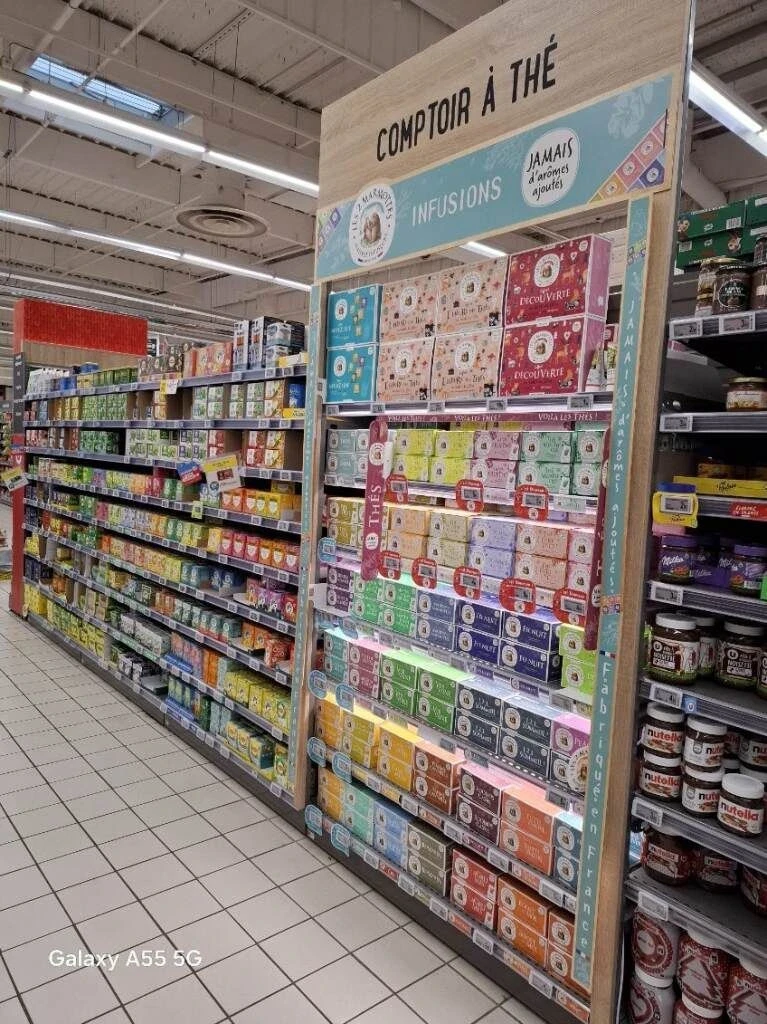
Example of an in-line setup for Les 2 Marmottes
The endcap
Located at the end of the aisle, the endcap is a strategic location, particularly visible to consumers. It is generally used for promotional operations or for launching a new product. Its high visibility allows it to capture attention right from the entry to the aisle, or even from a cross aisle.
Endcaps are often paid for and negotiated as part of annual commercial agreements. Their effectiveness depends on their location, the relevance of the offer, and field execution. A well-executed showcase can generate a strong sales spike in just a few days.
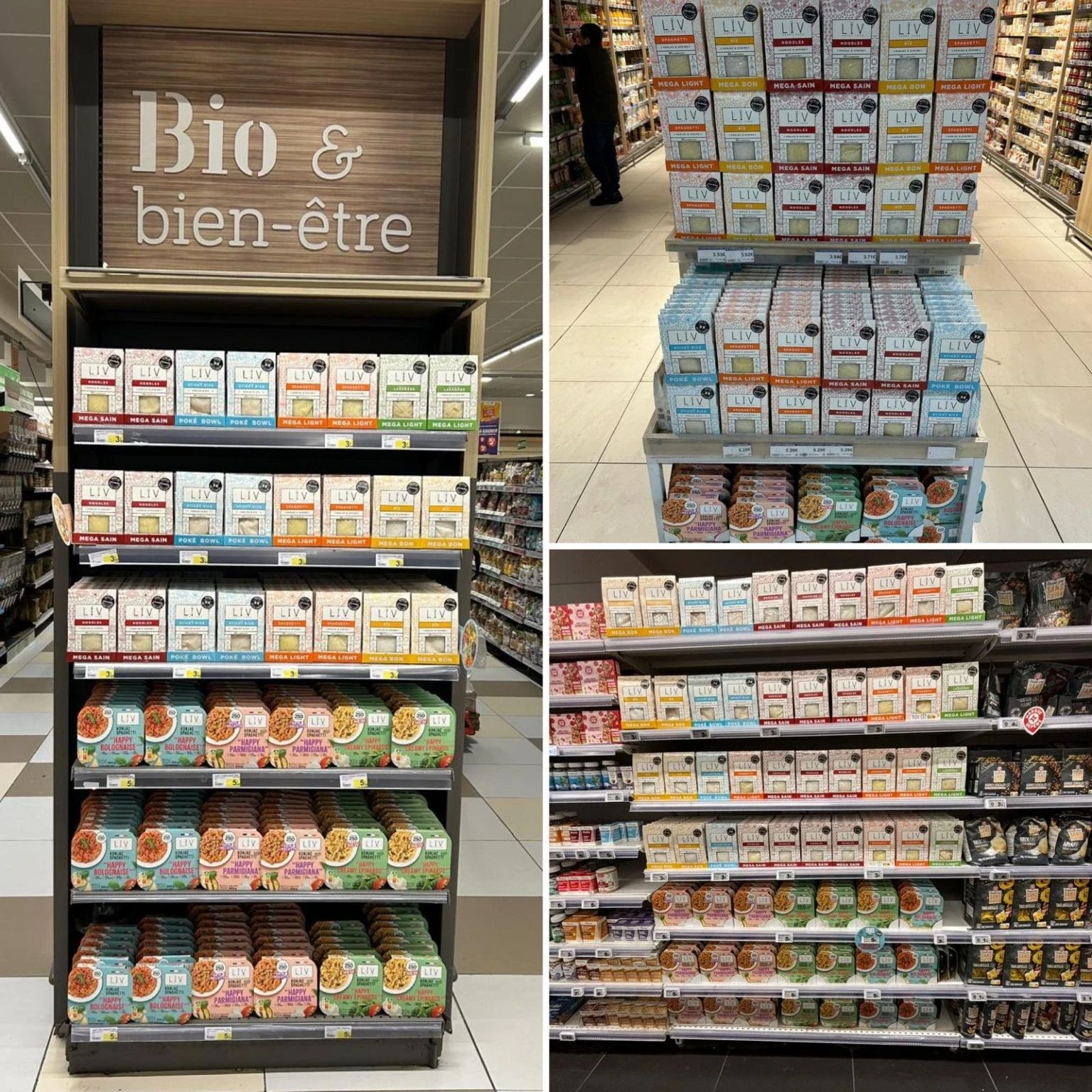
Example of an endcap for Liv Happy Food
The island or promotional pallet
Set up in the center of the store or near the entrance, this setup groups a large volume of products in a standalone space. It relies on a strategy of immediate visual impact. The "bulk stock" effect catches the eye, suggests a promotion or special event, and encourages bulk buying.
This type of setup is commonly used for high-turnover or high-volume products, such as mineral water, laundry detergents, or beverages. It is particularly effective during promotional highlights or national campaigns. Here too, the success of this setup depends on coordination between the chain, field teams, and territory managers.
Seasonal or event-based setup
Certain times of the year call for specific product displays: Christmas, Easter, Back-to-School, Candlemas, or summer are all opportunities to create dedicated setups.
These showcases fit into a frequently themed visual universe and allow for boosting sales over a short period. For example, you can find Christmas chocolates in the central aisle or barbecue products grouped under a summer arch. For brands, this is the opportunity to offer limited editions or specific packaging while aligning with consumption peaks.
However, these setups require high logistical responsiveness and rigorous coordination between sales teams, headquarters, and stores to ensure they are effectively deployed on time.
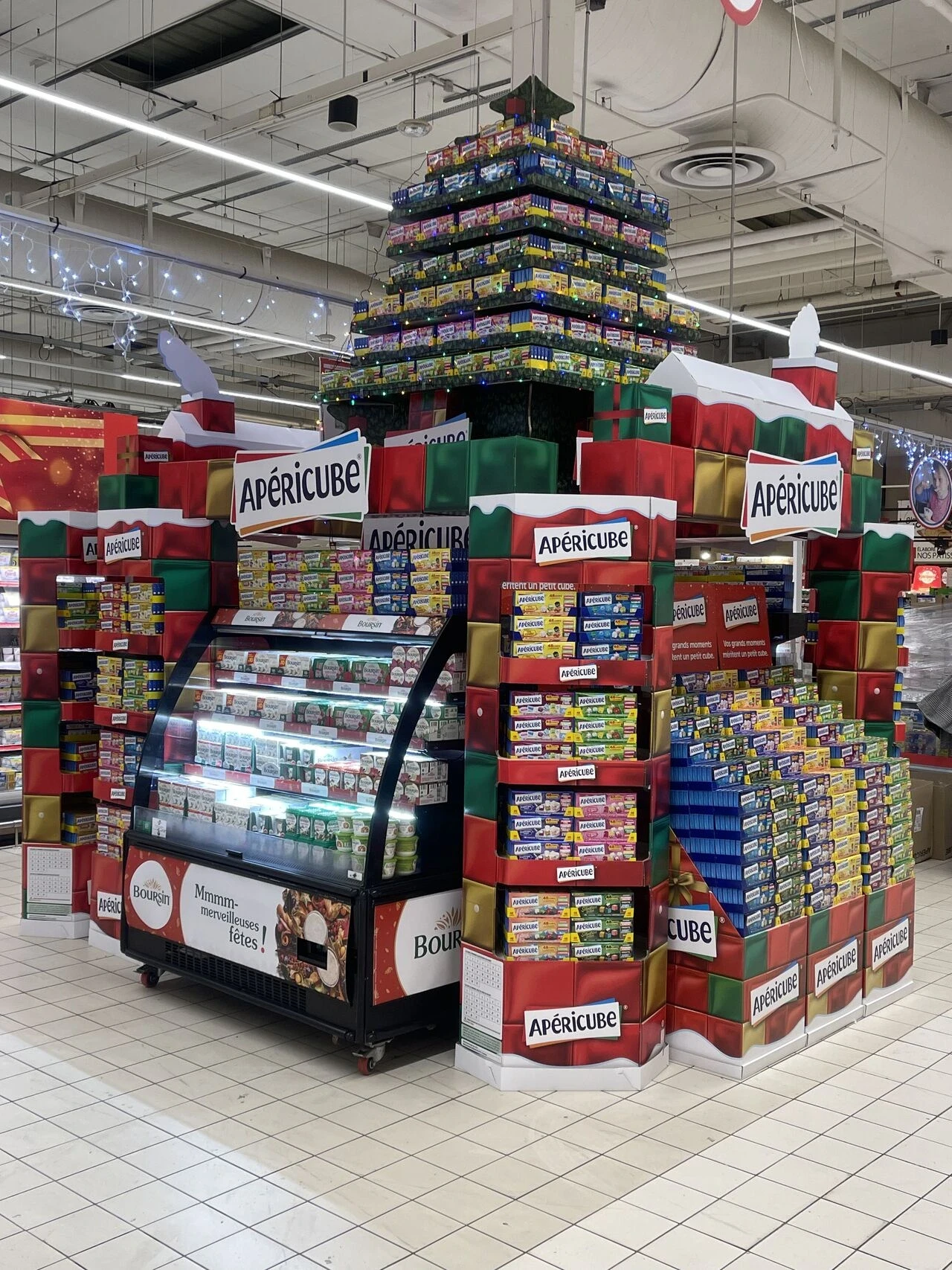
Example of a Christmas setup for Apéricube
Dedicated setup (off-shelf)
Some brands invest in custom displays to reinforce their in-store presence. This can include fridges, boxes, display cases, or permanent POS displays installed outside the standard aisle. This type of setup aims to create a distinctive brand universe that is easily identifiable by consumers.
For example, a Red Bull fridge next to the checkout lanes or a Coca-Cola display case in the chilled beverage zone increases visibility and encourages impulse buying. These setups allow brands to break out of purely categorical logic to occupy strategic flow areas. However, they require careful monitoring: maintenance, restocking, cleanliness, and compliance with the retailer's standards.
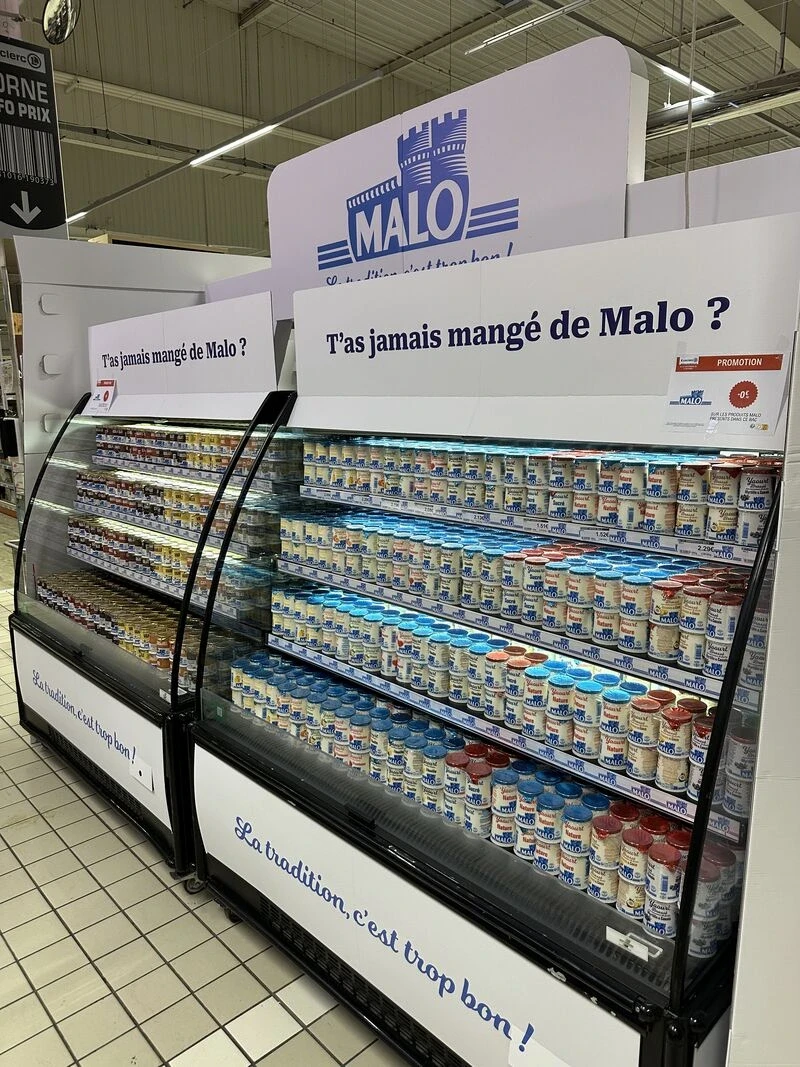
Example of a dedicated setup for Malo
Cross-merchandising
Cross-merchandising consists of grouping two complementary products in the same space. The goal is to encourage cross-purchasing and increase the average basket size. For example, placing cookies next to coffee, or barbecue sauces near the meat. This setup reinforces the coherence of the offer and improves the shopping experience by responding to a complete consumer consumption pattern.
Cross-merchandising requires close collaboration with in-store teams, as it disrupts traditional aisle arrangements. Well-executed, it generates additional sales and highlights products with lower visibility.
To guarantee their effectiveness, all these setups must be rigorously monitored in the field. And this is precisely the role of the territory manager or sales rep, equipped with a customized CRM, to check their correct execution.
Setup Type | Definition | Main Objectives | Advantages | Limitations |
|---|---|---|---|---|
In-line (standard aisle) | Products permanently placed on the shelf according to a planogram. | Ensure baseline availability and visibility. | Continuous presence, product line consistency, ease of use for the consumer. | Less visible than a special showcase, strong competition. |
Endcap | Product showcase at the end of the aisle, highly visible. | Stimulate impulse buys, maximize visibility. | High exposure, immediate sales impact. | High cost (negotiation with the retailer), limited duration. |
Island / promotional pallet | A bulk of products grouped in the center or at the store entrance. | Generate volume and attract customers through the bulk-stock effect. | Eye-catching, encourages volume purchases. | Less premium, perceived as clearing out inventory. |
Dedicated display / off-shelf | Specific fixture provided by the brand (fridge, box, display cabinet). | Create a brand universe, drive additional sales. | Differentiation, powerful image, off-shelf exposure. | Significant logistics and financial investment, maintenance required. |
Seasonal / event-based setup | Temporary showcase linked to a season or event. | Capitalize on consumption peaks. | Commercial momentum, strong appeal over a short period. | Time-limited effect, dependency on calendar dates. |
Cross-merchandising | Grouping of complementary products. | Promote additional purchases, increase average basket size. | Logic of use, enriched customer experience. | Complexity of setup, relies on collaboration with the retailer. |
The role of key players in store setups
A successful in-store setup relies on the coordination of several players, each with a well-defined role, from design to point-of-sale execution.
The brand
Strategy, financial support, and tools
Upfront, it is the brand, through its sales department or trade marketing team, that defines the setup strategy. It chooses the products to feature, the type of display to prioritize (in-line, endcap, display unit, themed theater...) and the objectives to achieve: duration, share of shelf space, number of facings, and volumes to move.
It invests in the resources required for successful field execution and campaign success. It therefore invests in creating refrigerated units, promotional boxes, or POS materials. To guarantee consistent application in store, the brand also provides structural supports: detailed planograms, merchandising guidelines, setup visuals, or field checklists.
The sales representative or territory manager
Daily execution and monitoring
The territory manager serves as the link between HQ strategy and reality on the ground. They negotiate locally with the department manager or store management to secure the best locations and ensure agreements are respected.
They take part in the installation: setting up the display fixtures, respecting the planogram, and positioning products at eye level.
Their role is also to monitor execution. During store visits, they check that the setup is well-maintained, take photos, perform shelf audits, and log observations in a reporting tool like a field CRM. Finally, they must ensure that the setup remains compliant over time: restocked displays, properly positioned products, and untouched visibility
The store or retailer
Validation and operational execution
It is the department manager or the store manager who validates the sales rep's request and allocates the space. Once the agreement is reached, store staff perform the endcap or fixture setup, initial restocking, and subsequent regular maintenance.
The success of the setup directly depends on their commitment, as they are responsible for product availability, maintaining facings, restocking, and keeping up the POS materials.
Methods of control
Your setup has been approved. Now, you just need to make sure it is executed correctly and generates the expected results in the field. In-store setup monitoring is therefore a vital step to guarantee the return on investment of your sales activities.
You must verify that agreements negotiated with retailers are respected in every single outlet. Endcap presence, implementation of a custom display, planogram compliance: every element must be verified to avoid gaps between field execution and the strategy defined at HQ.
Monitoring can be done in several complementary ways. In the field, commercial visits allow for direct visual verification. Sales representatives can rely on their CRM to take timestamped photos, complete compliance checklists, and document actions taken.
Some brands go further by requiring formal validation from the store, through a signature or written agreement. Finally, analyzing sales and order data allows for cross-referencing field observations with numbers to adjust strategies in real time.
To go further, we have put together an article on the topic: how do you know if your store setup actually took place?
An in-store setup should never be viewed as an isolated action. It fits fully into a global sales strategy, linking product visibility, retailer negotiations, and field execution tracking. A successful setup that matches defined goals can have a direct impact on your sales, your share of shelf space, and the perception of your brand in the aisle.
On the other hand, a missing or poorly monitored setup completely wastes the investments made, whether on POS, displays, or field sales time.
To stay in control of your setups and maximize their efficiency, it is crucial to centralize data, secure reliable field execution, and track results.
Looking to professionalize the way you track setups in supermarkets?
Discover how a CRM designed for field sales teams can help you gain efficiency, visibility, and responsiveness.
Angela heads up Customer Success at Sidely. She leads her team with an approach that is both highly human-centric and deeply product-oriented. This dual perspective—understanding customer needs while mastering how technology solves them—allows her to see what others miss. She supports sales teams by experiencing their daily challenges alongside them.
See also

Artificial intelligence and field professions: what our 2026 studies reveal
Adoption, barriers, use cases: discover what our three studies reveal about the role of AI among sector managers, sales representatives, and foodservice sales reps.

CHR and RHF Sales Representatives: portrait of a relationship-driven profession in the era of data
Equipment, productivity, AI: discover the major trends for the HORECA and food service sales profession in 2026 through our field study.

Pharmaceutical Sales Representative in France: Portrait of a Field Job Under Pressure
Compensation, aspirations, AI usage: discover the major trends in the pharmaceutical sales representative profession in 2026 through our field study.

Area Sales Managers in France: who are they and how is the profession evolving in 2026?
Compensation, aspirations, AI usage: discover the major trends in the field sales representative profession in 2026 through our field study.
The area manager professions in 2026
Discover the trends, the challenges, and the key figures.