
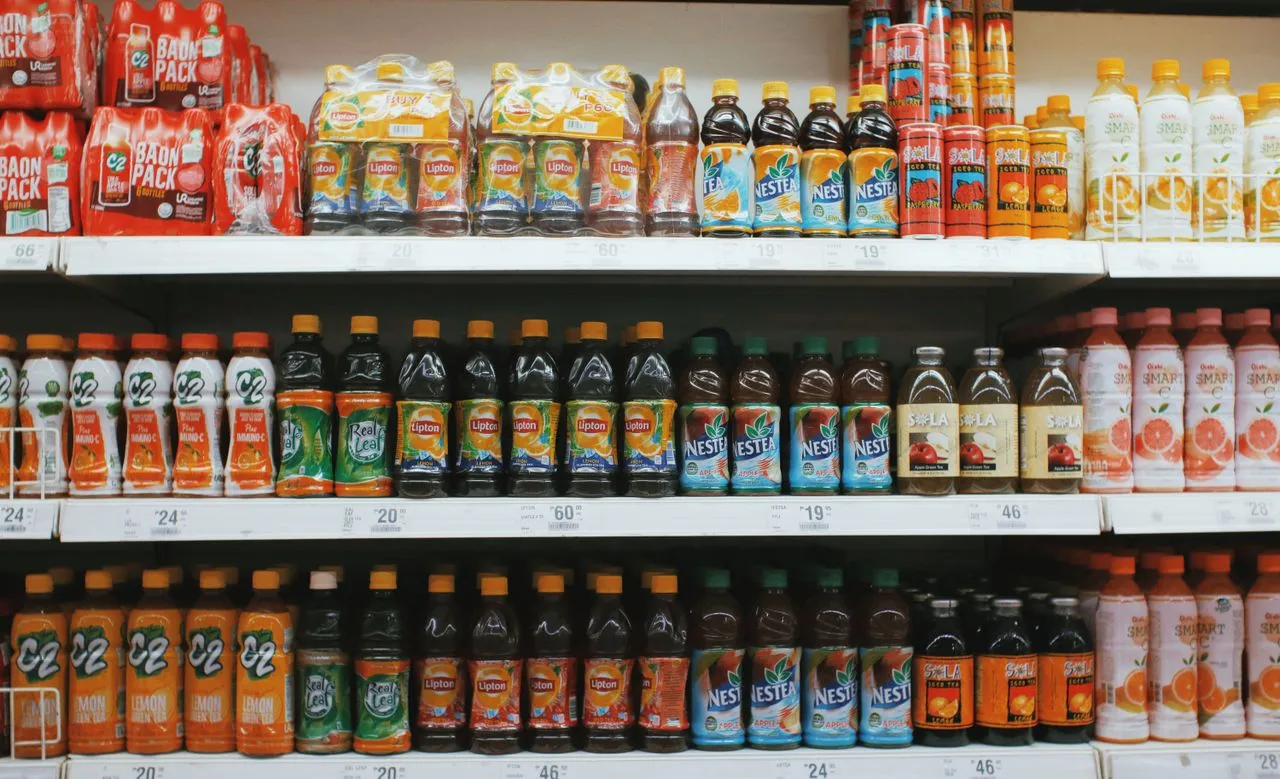
Share of shelf: boost your brand's visibility in-store
How is share of shelf calculated? How can you increase it and negotiate with retailers? Definition, formula, and concrete strategies for brands in large food retailers.

In short
5 min read
Definition: Share of shelf measures the proportion of retail space occupied by a brand, essential for its visibility and sales.
Calculation methods: It is obtained by dividing the length occupied by its products by the total length of the shelf, using facing counts, physical measurement, or image recognition.
Strategic importance: It is a key indicator for steering commercial performance and analyzing competitiveness in-store.
Visibility factors: Share of shelf must be interpreted with caution, as eye level and shelf zone influence the shopper more than the raw percentage.
Automation: The use of artificial intelligence for facing analysis increases productivity and accuracy compared to manual methods.
Measurement frequency: Monitoring must be adapted to the product life cycle and its strategic importance to optimize the time of field teams.
Like any brand present in a distribution network, you are probably looking to increase your visibility in points of sale. But seeing that your product is highly visible to consumers is a matter of perception, and a company's strategy should always rely on objective data.
This is where the share of shelf (SOS) becomes valuable. This key measurement indicator allows you to evaluate your representation based on reliable criteria that can be tracked over time and crossed with other data, such as sales checkout data.
Here, we will review the definitions and calculation methods of the share of shelf, how to calculate floor shelf space and total shelf space (TSS), supported by formulas and examples, and then we will look at its purposes, its limitations, and best practices.
What is the share of shelf?
Before diving into the heart of the matter, let us recall a few fundamentals!
In the context of retail, the term "linear" or "shelf space" refers to the total length of shelves or racks available in a store to display products. This measurement is often expressed in linear meters (or feet) and is used to evaluate the retail space allocated to a specific product category. For example, one could say that a supermarket dedicates 10 linear meters to the dairy aisle.
We refer to floor shelf space to designate the length of the product display fixture. If the fixture has several shelves, we can then calculate the total shelf space (TSS), which corresponds to the sum of the linear measurements of all the shelves.
💡 The formula for total shelf space (TSS)
Total shelf space = floor shelf space × display levels
When the levels are the same length, we multiply the floor length by the number of levels.
Example: a product occupies 1 m on the floor across 2 levels → total shelf space = 1 × 2 = 2 linear meters of total shelf space.
⚠️ If the levels do not all have the same length (stepped shelves, endcaps...), we do not multiply: we add the actual length of each level.
Share of shelf = (total shelf space occupied by your products ÷ total shelf space of the category) × 100
Example: your products occupy 2 m of shelf space out of a total of 6 m → SOS = 2 ÷ 6 × 100 = 33.3%.
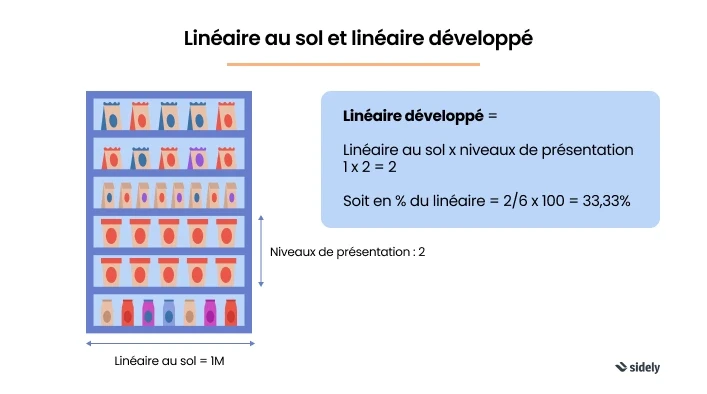
The share of shelf then indicates the proportion of the retail space occupied by a product or a brand, usually as a percentage. It is a key performance indicator because it influences brand visibility and can have a direct impact on its sales.
The total number of products placed and visible on each shelf is called facing, or front. Brands present in mass distribution and retail seek to maximize their exposure, and compete to obtain as many facings as possible on the shelves. This is an essential component of merchandising.
English speakers refer to this as Share of Shelf (SOS), which perfectly expresses the idea of competing to win the biggest share of it possible. In France, you might also hear the expression “parts de rayon”.
Like any KPI, the share of shelf can be used to track performance at the level of a store, a region, a sales representative, or even a distributor.
How to calculate your share of shelf?
Three calculation methods are generally used to determine your share of shelf:
Method | How | Advantage | Limitation |
|---|---|---|---|
Counting facings | Count the product fronts and calculate the ratio over the aisle total | Fast, tool-free | Approximate if products have different widths |
Tape measure measurement | Physically measure the shelf space in store | Precise | Time-consuming, sometimes frowned upon by the store manager |
Image recognition (AI) | Take a photo of the planogram, automatic analysis | History tracking, correlation with cash register sales, time-saving | Requires a dedicated tool |
We will come back to automation and technology later. Let's start with the most common case, manual calculation, detailing step-by-step how to proceed during a shelf audit.
Calculating your share of shelf in 5 steps
Measure the floor length of the aisle. Record the length of the display fixture involved, in meters (or centimeters). This is your calculation base.
Count the levels and calculate the total shelf space. Multiply the floor length by the number of shelves: total shelf space = floor length × display levels. If the levels do not have the same length, add them up one by one.
Count your facings. Record the number of products visible on the front shelf for each of your references, then measure the total shelf space they occupy.
Calculate your share of shelf. Divide the shelf space occupied by your products by the total shelf space of the aisle, then multiply by 100: (occupied space ÷ total space) × 100. Example: products that occupy 2 m out of a total shelf space of 8 m represent a share of shelf of 25%.
Compare your SOS to your market share (MS). This is the step that gives meaning to the number. An SOS lower than your MS signals under-representation that needs to be corrected; an SOS higher must be justified by sales, otherwise the distributor might re-evaluate it.
Note: the calculation on the floor or total shelf space depends on the installation method. The arrangement of facings can be horizontal (on the same shelf) or vertical (on different levels); the combination of both is called block facing. For vertical and block layouts, your share of shelf calculation must take total shelf space into account.
How to calculate and track your share of shelf with Sidely?
To track your share of shelf, your sales teams need to collect information during their store visits using a shelf space audit.
You can either use ready-to-use audit templates, create a custom audit that fits your specific needs, or use AI in your shelf space audits. Need guidance? Our teams can help you structure your audits and optimize your field visits.
Store shelf audit checklist
To be filled out during the visit, for a complete calculation:
☐ Floor length of the aisle (in m or cm)
☐ Number of display levels
☐ Number of facings per product reference
☐ Total shelf space occupied by your products
☐ Presence / out-of-stock of each product reference
☐ Position in the aisle (eye level, start/end, hot/cold zone)
☐ POS materials and promotional campaigns in place
☐ Photo of the planogram (for historical records)
💡
At Sidely, audits are not siloed. Rather than multiplying forms, you can create a single global audit for all your supermarket visits, including all the essential information you wish to collect in-store: product presence on shelves, installation and tracking of your displays and POS materials, implementation and monitoring of your commercial or promotional campaigns... This helps optimize your field teams' time.
First visit: setting up the audit
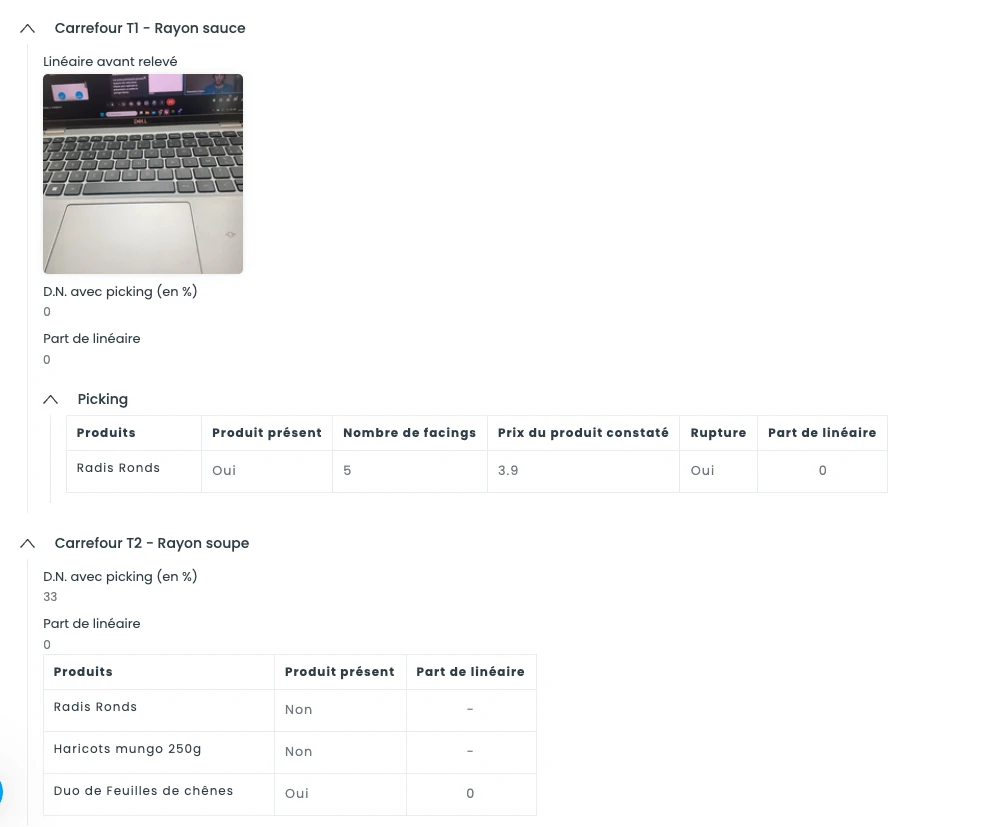
During your first point-of-sale visit, it is essential to fill in the basic information: aisle size, number of levels, and number of facings per product reference (see the audit checklist above). Once this data is entered, the audit automatically calculates your share of shelf and your on-shelf availability rate.

Calculation of the share of shelf in Sidely
Subsequent visits: saving time with historical data
During your next visits, you don’t need to re-enter everything. Thanks to historical fields, information such as aisle size and number of shelves is pre-filled from your last visit. You only need to update the specific data (like the number of facings) to obtain a real-time analysis.
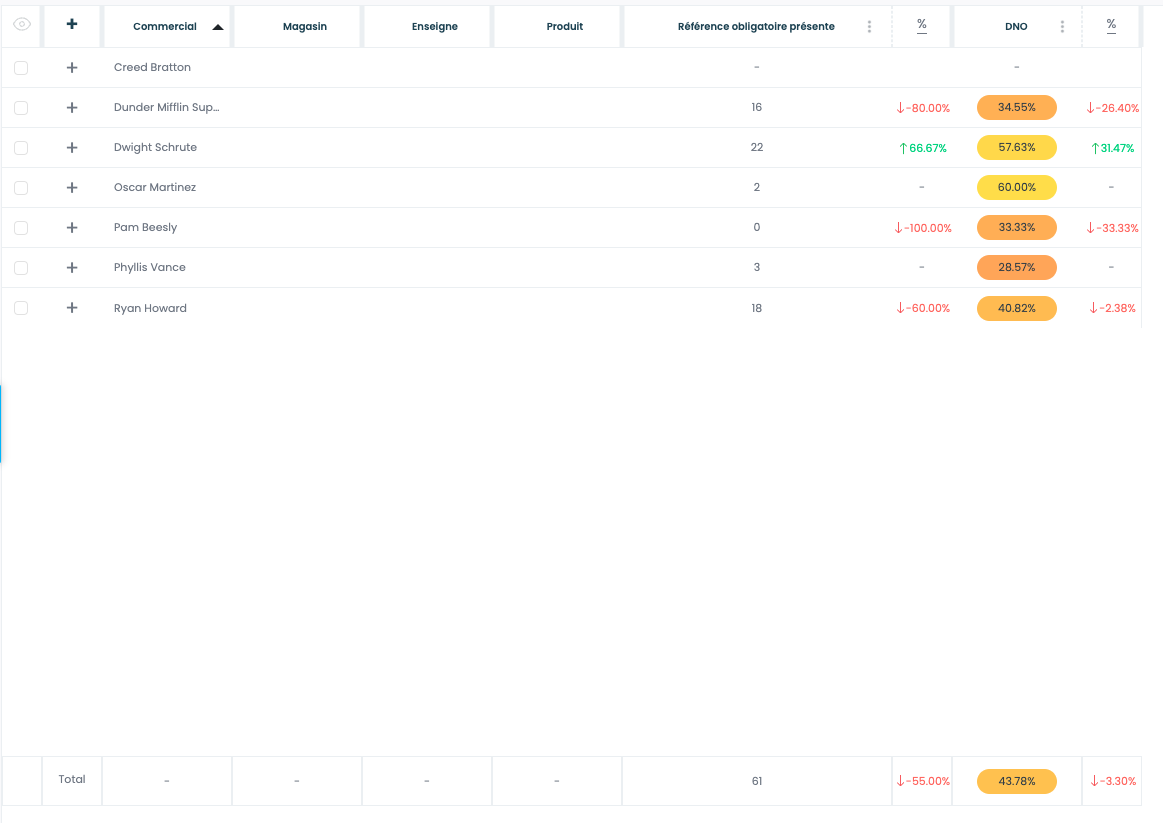
You can track your share of shelf on your reports by product, retailer, sales rep...
Why measure your share of shelf?
Since physical retail space is limited, your brand's performance does not rely on an absolute number of facings, but rather on the share of space you manage to occupy. Furthermore, once compared to the sales revenue of the products concerned, the SOS provides valuable analysis and performance interpretation insights.
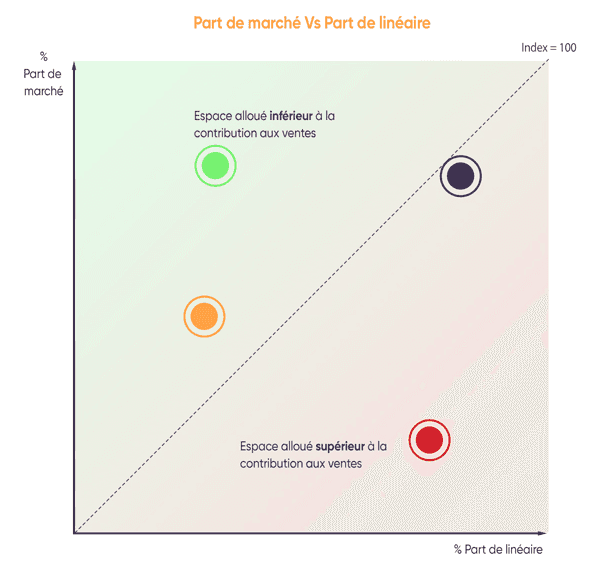
It is thus considered that the share of shelf should always be proportional to the market share (MS) of the product in its category or aisle.
That is why it is crucial to establish an ideal share of shelf. If it is poorly defined, or if it is not respected by your distributors, your SOS / MS ratio suffers, and various risks can result from this.
Let's look at a few examples:
Situation | What it means | Risk / Action |
|---|---|---|
SOS > MS | Your product occupies more space than its sales weight | The distributor may reduce your facings, especially for perishable goods (expiration date risk). Needs to be justified with POS advertising or sales support. |
SOS < MS | Your product is under-represented compared to its performance | Favors competitors and exposes you to stockouts. Strong argument to regain facings from the department manager. |
SOS = MS | The allocated space corresponds to the product's weight in its category | Good alignment. You avoid overstocking and stockouts. Target situation. |
In the case of perishable goods, an oversized share of shelf carries a risk of reaching expiration dates, which can lead to a re-evaluation of your facings.
When should this count be carried out?
Measuring or counting should be done during store visits, either by your staff (field sales reps in mass retail) or by a service provider you mandate for this purpose.
However, as the operation can be time-consuming, it is important to clearly define its frequency. Just as manufacturers habitually score their stores by assigning them an importance rating, it is vital to know when to measure your SOS to justify the allocated time.
For example, during a product launch, the share of shelf must be tracked very regularly because a launch is always risky and represents a gamble as much as an opportunity for the point of sale or the retailer. For a well-established product, however, the SOS might only be measured 2 to 3 times a year.
The frequency therefore depends on many criteria, such as:
The product's contribution to your turnover;
The product life cycle;
The store's contribution to your turnover;
The short, medium, or long-term threat of a competitor;
The available resources to carry out the audits versus the company's priorities, etc.
Share of shelf: best practices for tracking your performance
Counting your share of shelf can therefore be costly in terms of time and resources. To improve team productivity and eliminate low-value tasks, it is now possible to use image recognition on store shelves.
Based on a planogram photo, software will automatically identify the product references and calculate the number of facings and linear meters per brand. For the user company, the benefit also lies in linking the observed shelving to sell-out results.
In short, automation is gaining ground in retail performance analysis, and sales reps will soon be able to spend more time negotiating and less time on the shelves taking price audits. This is why Americans no longer hesitate to speak of shelf intelligence to refer to real-time facing analysis!
💡 Automated or not, taking photos also has the benefit of eliminating doubts surrounding the methods of merchandisers who sometimes have an interest in "embellishing" the situation.
The limitations of share of shelf in performance analysis
However, caution is required: the SOS as a percentage is not enough to evaluate the attraction power of your brand or your product in its aisle, for several reasons.
The first is that not all shelves are equal! As we explain in our retail merchandising guide, shoppers' eyes first fall on products... at eye level! Your product's position at the beginning or end of the aisle (relative to the main traffic flow) is also an important variable, as is the location of the aisle itself, in a hot or cold zone. In other words, you can have the same share of shelf between two aisles, but not the same visibility, and therefore, not necessarily the same sales.
Furthermore, the number and variety of competing or substitute products can vary the "strength" of your facings. Remember also that POS materials, price, and other external parameters can boost or, on the contrary, hinder your products' sales volume, independently of your share of shelf.
Finally, each product family in a supermarket is supposed to occupy space proportional to the market share it represents in its aisle. For example, if olive oil represents 15% of the grocery department's sales in a given geographical area, then the store should allocate 15% of the grocery aisle to olive oil.
For your brand, knowing these statistics allows you to look critically at store layouts: suppose the space allocated to oil is not proportional to its weight in the grocery aisle's sales, your share of shelf is not the only issue, and your sales rep must also try to convince the department manager to increase the overall total facings of olive oil in their grocery department!
Calculating your share of shelf is good... But it is not everything!
Frequently asked questions about shelf space calculation
How to calculate linear shelf space?
How to calculate total shelf space?
What is the difference between floor shelf space and total shelf space?
Total shelf space percentage: what is the formula?
What is a shelf space audit?
Alexis co-founded Sidely after several years of service as a sales director. To understand what builds, or breaks, a salesperson's performance, he conducted more than 100 telephone interviews with field sales representatives. At Sidely, he transforms this raw knowledge into concrete support, based on facts rather than assumptions.
See also

Artificial intelligence and field professions: what our 2026 studies reveal
Adoption, barriers, use cases: discover what our three studies reveal about the role of AI among sector managers, sales representatives, and foodservice sales reps.

CHR and RHF Sales Representatives: portrait of a relationship-driven profession in the era of data
Equipment, productivity, AI: discover the major trends for the HORECA and food service sales profession in 2026 through our field study.

Pharmaceutical Sales Representative in France: Portrait of a Field Job Under Pressure
Compensation, aspirations, AI usage: discover the major trends in the pharmaceutical sales representative profession in 2026 through our field study.

Area Sales Managers in France: who are they and how is the profession evolving in 2026?
Compensation, aspirations, AI usage: discover the major trends in the field sales representative profession in 2026 through our field study.
The area manager professions in 2026
Discover the trends, the challenges, and the key figures.