
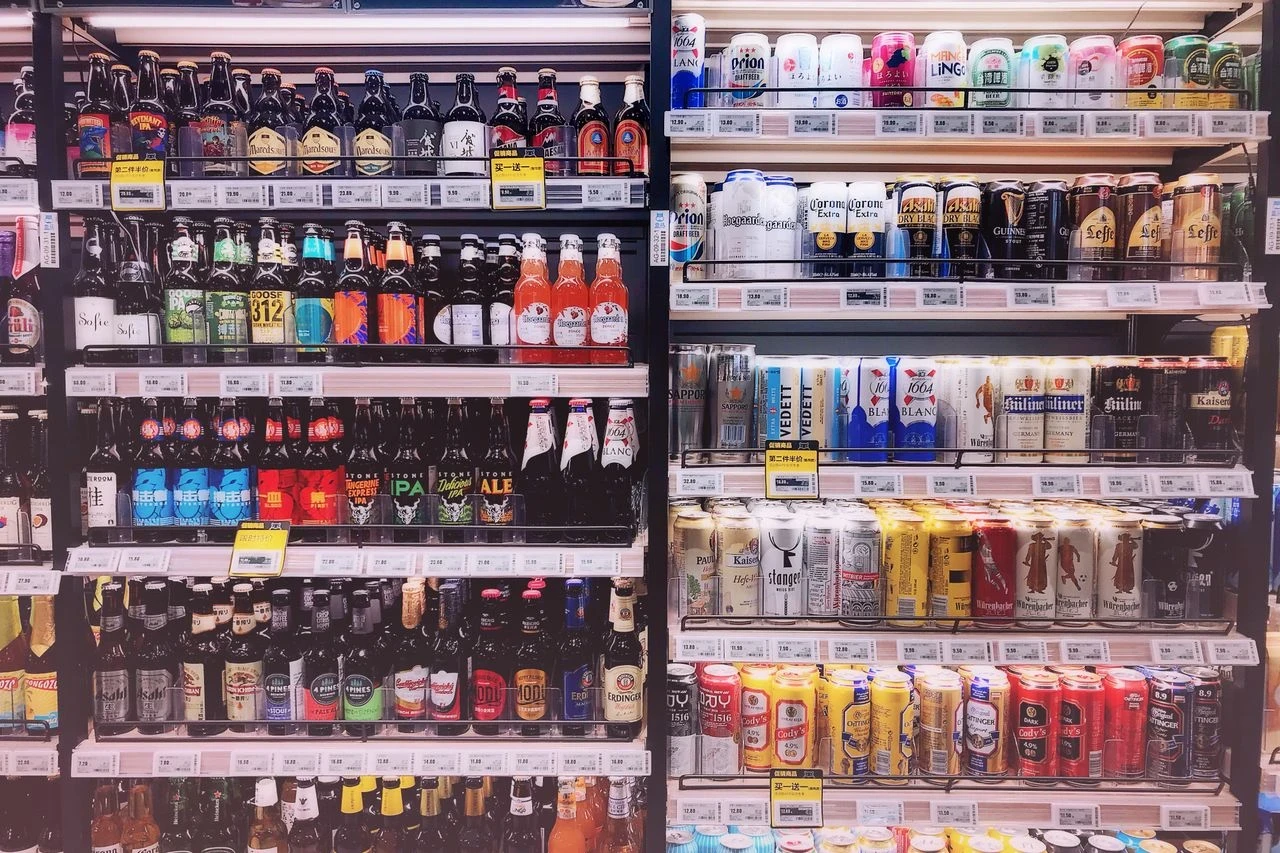
In-store facings: challenges and techniques to boost sales
What is product facing in a store? How is it calculated and how do you negotiate to get more? Method and concrete examples.

In short
8 min read
Facing is a marketing technique for displaying products that aims to maximize revenue and promote inventory turnover.
It refers both to the practice of styling and pulling products to the front of the shelf and to the number of units displayed to stimulate sales.
Vertical shelving organizes products by columns, promoting fairness among brands and direct comparison by the customer.
Horizontal shelving prioritizes a tier-based hierarchy, placing the most profitable or strategic products at eye level.
Commercial success also depends on placement within the store's 'hot zones' and the complementary use of cross-merchandising.
The choice of merchandising layout strategy varies depending on the constraints of the retail space and the distributor's profitability objectives.
Facing is a marketing technique that consists of arranging products in a retail store in a way that maximizes revenue. Originating in supermarkets, this practice has since spread to all types of physical stores.
In this article, Sidely explores the key concepts of this fundamental merchandising tool for the profitability of retailers and brands.
We will cover the definitions and benefits of facing, the various layout techniques, their impact on the retailer-supplier relationship, and finally the techniques brands use to maximize their presence in retail stores.
In-store facing: definition
Facing in a store refers to the products that face customers on the shelves. In French, the term is sometimes translated as "frontale" or "façade".
By extension, the word can also refer to the number of units of a displayed product, hence the expression "number of facings".
In the daily routine of department managers, doing the facing means bringing the products to the front of the shelf. And arranging the facing means building or restocking the shelves (or even the window displays). Depending on the context, the word refers either to the merchandising technique or to the act of tidying (or supplying) the shelves.
The benefit of having a high number of facings is to increase product exposure, which stimulates sales. Increased visibility for the product generally translates to high rotation, which implies frequent restocking, and therefore good stock management.
For the retail store, facing helps boost revenue and brand image. For brands, it also serves to differentiate them from the competition.
💡 Although the term facing generally refers to a product layout that faces the consumer, there are a few exceptions: we speak of flat facing (or flat laying) for freezer chests or ultra-fresh items, or book-style or edge-wise facing for garments on hangers, whose dimensions do not allow them to be presented front-on to customers.
Impact of facing on sales performance
Customers prefer to find properly stocked shelves, synonymous with abundance and availability.
In addition to boosting sales, facing supports many marketing and sales objectives:
Enhancing the visual appearance of the shelves;
Improving the store's brand image through well-kept displays;
Facilitating product and price comparisons;
Making products attractive;
Simplifying the product search process;
Encouraging impulse buys;
Increasing the average basket value;
Revitalizing sections that are losing revenue;
Pushing new arrivals and promotional offers.
Mass effect
The mass effect in retail consists of displaying a product in large quantities on a shelf or on POS display units, thereby creating high visibility. This leverages consumer psychology, as shoppers associate quantity with popularity and demand. This strategy often drives impulse buys and reinforces the perception of a limited or exclusive offer. The mass effect is commonly used to stimulate sales and draw attention to promotional products or new arrivals.
How to do facing well?
To maximize product visibility and effectively stimulate sales, retailers use several well-established practices:
Optimize space by aligning products to fill the entire width of the shelf;
Restock the shelves regularly to guarantee the continuous visibility of the products;
Avoid overloading the shelf and maintain a clean, attractive presentation;
Promote stock rotation with the FIFO rule (first in, first out);
Clarify and organize the offer with tidy products and labels facing the customer;
Adapt the number of facings to the commercial performance of the products.
💡 When checking shelves, self-service clerks pull products to the front to better manage store restocking and ensure compliance with expiration dates for food products. It is also up to the area managers to visit stores and handle restocking to ensure the right number of facings is maintained; brands are also heavily involved in optimizing facing.
The different types of shelf layouts
There are different types of layouts in retail, and their choice depends as much on the store's strategy as on what the retail space allows.
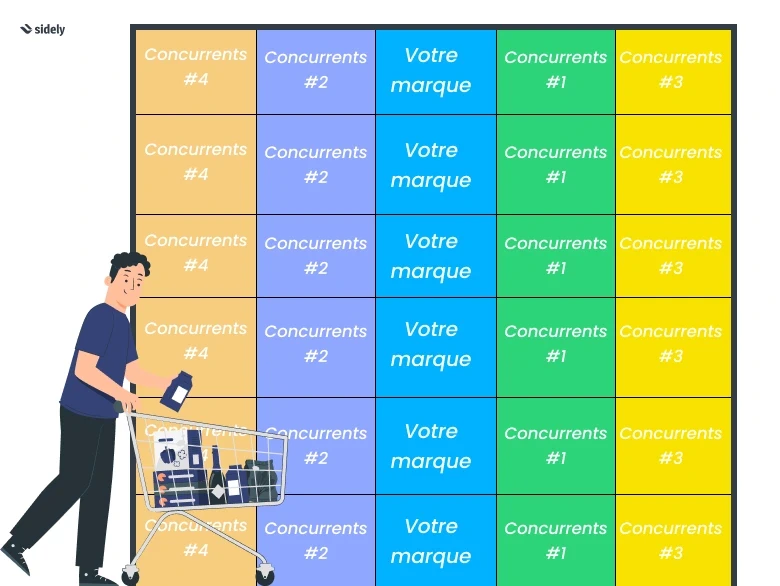
Vertical layout
Vertical layout consists of arranging a brand's products vertically across several shelves, creating a column effect. Each level contains products from different brands.
This is the fairest arrangement for brands, as none is placed more at eye level than the others. However, the center of the gondola display will be highly coveted, because it is the space that yields the best sales figures. This is why retailers often place their private labels (store brands) there, or sell these spots at premium prices.
For consumers, vertical layout makes it easier to compare different brands for the same product, provided the aisle offers enough distance for all the products to fall within their field of vision.
Vertical facing is widely used in convenience stores due to the optimization of floor space. It also helps avoid access issues at higher levels.
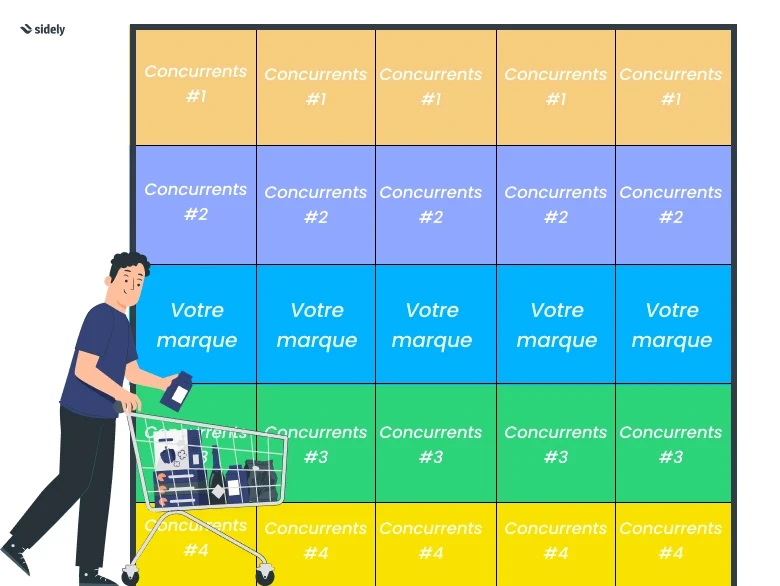
Horizontal layout
Horizontal layout is used to arrange a brand's products - and/or ranges - side-by-side along the length of a shelf.
The shelf then ranks brands by level, which generally creates a hierarchy, with premium brands at the top and discount or entry-level products at the bottom. Retailers work on the principle that the products customers search for will always be found, and that they must promote the highest margin-generating products by giving them the default visual space at eye level.
Naturally, competition is fierce for the rows at eye level. It is no surprise to find the most profitable products, current promotions, or seasonal goods there. If the arrangement is consistent from one shelf to another, comparing prices between competing brands is simplified.
Horizontal facing is often better suited to large stores. In the food sector, it is found across all tiers, from convenience stores to hypermarkets. Non-food sectors, however, often show a mix of layouts, for example with vertical layouts on the end caps and horizontal layouts on the shelves.
Advantages and disadvantages of layout types
Criteria | Vertical Layout | Horizontal Layout |
|---|---|---|
Main advantages | - Saves floor space; | - Clarification of product ranges; |
Main disadvantages | - Possible visual overload; | - Requires more floor space; |
Suitable store size | Restricted spaces (but requires depth in the aisle to view the selection). | Large surfaces, stores with long aisles. |
Mixed layout: block facing
It is also possible to choose a hybrid organization: block layout combines vertical and horizontal presentations. Facings can then stack up both in height and width, creating blocks of products.
Restocking: impact on profitability
The availability of products is an important choice criterion for consumers, who shop where they can find their favorite items. By preventing the risk of out-of-stock situations on the shelves, restocking becomes a crucial factor for the profitability of the shelves and the store. Additionally, replenishment contributes to regular inventory turnover, a main indicator of profitability. The frequency of restocking is influenced by the number of facings, which can be evaluated with the Floor Space Coefficient: a good balance between shelf space allotment and demand optimizes in-store stock, avoiding shortages as well as overstocking.
Facing in the retailer/supplier relationship
In large-scale retail, shelf organization is generally decided at the store brand level. Subsequently, shelf managers make product layout choices while respecting the strategy promoted by the merchandising team.
To maximize profitability per linear meter, large and medium-sized stores use merchandising software to simulate planograms and visualize potential performance.
The logic behind facing is simple: retailers allocate space to each product SKU in proportion to its contribution to the revenue of the respective shelf. Thus, when a brand succeeds in increasing its market share in a product category, it can logically claim a larger facing.
Commercial negotiations and presence control
Manufacturers negotiate the placement of their products during annual negotiations. It is in the brands' best interest to secure retail agreements specifying a minimum number of facings, particularly for product launches or promotional periods.
Leading brands also send merchandising guidelines for this purpose (they create their own planograms too!). For special events, POS displays (end caps, dedicated displays, etc.) can also specify a contractually agreed number of facings.
However, retailers generally remain free to adjust facings based on inventory turn and sales performance, and department managers also adjust the layout according to available space. Furthermore, independent retailers enjoy greater freedom in selecting their assortment, forcing brands to constantly measure their numeric distribution in each store, despite what was initially recommended to the procurement centers. Finally, retail stores do not hesitate to demand substantial positioning fees to grant the best shelf space.
For all these reasons, a brand can never be guaranteed maximum and permanent presence. This is why regular in-store monitoring is necessary to verify compliance with commitments and guarantee product visibility.
To optimize shelf audits, field representatives use a retail execution CRM.
How your brand can secure more facings in stores
As we have seen, retailers determine the space dedicated to a product based on its contribution to the overall revenue of its zone.
The secret is simple: to secure more facings, you must improve your sales performance!
At Sidely, we advise manufacturers to focus on 3 key levers to boost their sales performance in supermarkets in order to increase their facings: reinforce communication, improve merchandising, and optimize in-store auditing.
1) Visibility and popularity: reinforce brand communication
When your advertising campaigns generate interest in your products, retailers are more inclined to display them better to meet demand and maximize sales.
Digital media offers extremely interesting reach possibilities: by working on your own digital channels, you have unlimited communication space while keeping control over costs and evaluating return on investment. Furthermore, modern web-to-store techniques or localized campaigns allow you to direct your customers to store locations.
In certain industries, like the food industry, mass media such as television or radio, as well as billboard advertising, remain essential for creating maximum visibility.
Whether you invest in digital or traditional channels, it is up to you to take control of your destiny and present retail stores with the reality of growing demand.
2) Improve merchandising and in-store commercial actions
The rest happens on the shelves.
Regardless of your shelf share, merchandising must reinforce the visibility and appeal of your products. Activation campaigns, commercial operations, or POS displays can lead some SKUs to outperform the competition despite being placed in less strategic areas.
And when retailers notice unexpected commercial success, they are more willing to grant better positions, including end caps, banners, or creative displays. Note that promotional campaigns planned in distribution contracts do not prevent you from offering unscheduled operations during the year to support your business activity.
This is where the trade marketing approach comes in, promoting cooperation between supplier and retailer, with the goal of building operations together that yield value for both sides, rather than seeking results at the partner's expense.
💡 A/B testing: the ideal course is often to test multiple configurations across different store locations, and arm yourself with the best results to influence your entire retail network.
3) Shelf audits: effectively monitor your in-store presence
Finally, any business aiming to increase its results at retail locations must equip itself to monitor proper retail execution. This includes checking for the presence of your products on shelves, but also the merchandising supporting your sales.
With the Sidely CRM, your sales reps and area managers can perform shelf audits in just a few clicks: layout monitoring, shelf share, competitor surveys... The mobile app accelerates reporting and even allows taking orders directly from the aisles.
Sidely works across multi-tier, multi-category, and multi-brand levels, automatically calculating your numeric distribution.
To further increase your profitability, Sidely helps you plan your sales rep routes in a few clicks, allowing you to optimize the presence checks conducted in stores.
In conclusion, remember that the number of facings is far from the only factor affecting a product's sales performance. In a supermarket, it is therefore important to successfully place your products in the store's high-traffic zones, and in the best spots on the shelf itself.
With this in mind, brands aim to appear in different sections of the same retail outlet. Cross merchandising is a prime example: it consists of placing products near complementary items, like charcoal near barbecues, or chocolate spread near crêpes during Candlemas campaigns. Checkout areas can also work well for certain products subject to impulse buying.
Now you know everything there is to know about the world of facing! All that is left for us is to wish you great sales!
Margot has been working in Tech and SaaS for 8 years, with a multi-product experience that has given her a unique understanding of business challenges. On a daily basis, she analyzes, relentlessly tests, and relies on facts to shed light on market trends and help sales teams move forward.
See also

Artificial intelligence and field professions: what our 2026 studies reveal
Adoption, barriers, use cases: discover what our three studies reveal about the role of AI among sector managers, sales representatives, and foodservice sales reps.

CHR and RHF Sales Representatives: portrait of a relationship-driven profession in the era of data
Equipment, productivity, AI: discover the major trends for the HORECA and food service sales profession in 2026 through our field study.

Pharmaceutical Sales Representative in France: Portrait of a Field Job Under Pressure
Compensation, aspirations, AI usage: discover the major trends in the pharmaceutical sales representative profession in 2026 through our field study.

Area Sales Managers in France: who are they and how is the profession evolving in 2026?
Compensation, aspirations, AI usage: discover the major trends in the field sales representative profession in 2026 through our field study.
The area manager professions in 2026
Discover the trends, the challenges, and the key figures.