
Web-to-store: definition, examples, strategies, and KPIs
Drive to Store, geomarketing… Web-to-store generates real visits to physical points of sale. Techniques, best practices, and mistakes to avoid to activate this lever.

In short
7 min read
Web-to-store encompasses marketing techniques aimed at generating traffic to physical points of sale through digital channels.
It optimizes the customer journey by providing a tailored response at each stage, from online research to in-store purchase (ROPO/ROBO).
The strategy relies on complementary variations: drive-to-store (geolocated advertising), mobile-to-store (mobile contextualization), and walk-to-store (immediate proximity).
Success requires solid digital foundations, including updating local information (hours, inventory, Google Business Profile).
Performance is measured via indirect indicators such as directions requests, clicks to store listings, or local interaction rates.
Web-to-store is inseparable from a consistent customer experience between digital and physical channels to build trust and loyalty.
Implementation requires technological investments (e.g., PIM) and rigorous alignment of in-store teams with promises made online.
While online sales continue to modernize, and many industries are being transformed by the arrival of pure players, brick-and-mortar retail remains favored by a large majority of Americans. In fact, in-store sales still account for nearly 90% of retail trade!
Armed with this observation, brands are trying more than ever to use digital to support traffic to their physical points of sale. This is called web to store, and any business offering its products for physical sale is affected!
Brands, chains, manufacturers, this article is for you; and to understand the importance of this unavoidable phenomenon, there is nothing like a good example.
Web-to-store: definition
Web to store encompasses all web marketing techniques that generate visits to a physical point of sale and guarantee an optimal purchasing journey for the customer. And as a sales cycle always includes different phases, an effective web to store strategy provides the right answer at the right time on the right channel, without ever harming the customer experience.
It is therefore about optimizing the user journey by deploying devices tailored to their behavior, both for actions carried out online and in real life.
ROPO and ROBO
To refer to the act of researching on the web before buying in a physical point of sale, marketers use the acronym ROPO (research online purchase offline). We also find the term ROBO (research online buy offline).
Conversely, it also happens that a customer stumbles upon a product by chance while visiting a store, and then researches on the web before making the purchase. We can then speak of store to web.
💡 Seamless customer journeys
There is no typical user behavior that applies to all industries and all companies. Depending on the product/service, the region concerned, but also the level of digital adoption, consumers are led to use the internet in different ways and at different times in the purchasing cycle. Conversion funnels must be seamless enough to provide satisfactory answers to different use cases.
The main variations of web-to-store
Web-to-store groups together several complementary approaches, often grouped under the term "derived strategies". They rely on the same objective: use digital to generate a visit to a point of sale, but rely on different levers and contexts of use.
Drive-to-store
Drive-to-store mainly aims to generate in-store traffic via geolocated digital devices, such as local advertising or search results. For example, a couple is on a weekend getaway with their newborn and runs out of diapers. They type on Google "open drugstore near me". They see a local ad, a Google Business Profile listing, or a "Drugstore x" page. They click, check the hours, get directions, and go to the store. Here, the trigger is the online search. Digital serves to guide the choice of point of sale.
→ Work on local SEO, local Google Ads, Local Inventory Ads.
Mobile-to-store
Mobile-to-store (or app-to-store) relies on smartphone usage to encourage visits, notably via notifications, apps, or interactions while on the move. For example, a customer is spending her Saturday afternoon downtown. She has a major chain's app installed on her smartphone. She receives a notification: "-10% today in our store 200 yards away". She is already outside, phone in hand. She decides to enter the store. Here, the smartphone is the central channel. The message is contextualized (time, place, and mobility).
→ Work on push notifications, geolocated SMS, wallet, your mobile app...
Walk-to-store
Walk-to-store focuses on activating consumers who are already close to the point of sale, capitalizing on geographical proximity and the immediacy of the need. For example, a passerby sees an immediately valid offer on a store's digital window. They are just a few yards away, had not planned to enter, but decide to do so on the spot. Unlike mobile-to-store, which relies on smartphone usage, walk-to-store relies primarily on immediate physical proximity to the point of sale and the ability to capture a purchase decision in the moment, sometimes without prior mobile interaction. In this specific case, immediate physical proximity is the main trigger, not the smartphone.
→ Work on ultra-short radius geofencing, real-time local campaigns...
How a web-to-store strategy works
A web-to-store strategy is based on a simple principle: use digital channels to encourage a consumer to go to a point of sale. Unlike an e-commerce logic, the objective is not to convert online, but to generate a physical visit to the store.
Concretely, the journey starts on the web. The internet user performs a search related to a product, a brand, or a local need. Digital content and tools – store pages, practical information, local visibility, or geolocated messages – influence their decision and guide their choice toward a specific point of sale.
To be effective, this approach relies on data. The ability to cross-reference online interactions with in-store actions allows for adjusting the activated levers, improving the proposed experience, and measuring the real impact of web-to-store actions on commercial performance.
Example of a web-to-store strategy
Peter has just moved and wants to equip his new living room with a home theater.
Fearing the expense, he starts by typing on Google: "home theater price".
He browses a few product lines, discovers lower prices than expected, and decides to move forward by searching for: "home theater store" to find a shop near his home.
He goes to one of them and meets Michael, an excellent salesperson whose questions make him realize that he was leaning toward products completely unsuited to his interior.
Back home, Peter begins genuine research online to better define his needs and choose a product more suited to his space and tastes.
The next day, he finds Michael at the shop again and shares his thoughts. Michael then guides him to the ideal product. All that's left is to sign. Except that... Peter is a cautious buyer. Before finalizing, he is going to take the time to check on the internet if he is buying at the best price.
In the end, if he bought online from a competitor, Peter would not save more than 5%. Won over by Michael's guidance, he decides to buy from his store.
In this example, we saw that Peter used the internet at different times and for different purposes:
Researching the cost of a product;
Finding a point of sale near him;
Getting documentation on a subject;
Comparing different offers;
Buying online.
In our example, the sale is finalized in-store. And if Michael's company won the sale, it is partly because they have mastered web-to-store, this set of online and offline marketing best practices that guarantees the prospect a coherent, fluid, logical experience that meets their expectations.
Web-to-store, drive-to-store, and store-to-web: what are the differences?
Approach | Starting point | Main objective | Dominant logic | Key channel | Place of conversion |
|---|---|---|---|---|---|
Web-to-store | Web | Generate a store visit | Omnichannel | Web and Local | Store |
Drive-to-store | Search or digital ad | Direct to a specific point of sale | Local acquisition | Geolocated digital | Store |
Store-to-web | Store | Extend the relationship online | Customer relationship | QR code, email, app | Web |
Pure e-commerce | Web | Sell directly online | Transactional | E-commerce site | Web |
Web-to-store encompasses several complementary logics, including drive-to-store. Conversely, store-to-web and pure e-commerce meet different objectives, centered on online conversion or relationships.
How to implement a web-to-store strategy?
To set up an effective web-to-store strategy, we advise you to adopt a simple method: Audit → Foundations → Acquisition → Experience → Measurement → Optimization.
Clarify objectives and scope
Before activating any levers, it is essential to define what your digital-to-store strategy should generate: increased in-store traffic, highlighting specific points of sale, supporting a commercial operation, or improving local visibility...?
This step also helps specify the geographical areas concerned and the types of stores to prioritize.
Lay solid digital foundations
A web-to-store strategy relies on the quality of information available online. Store pages must be complete and up-to-date, as must local listings on Google Business Profiles. Hours, addresses, services offered, and practical information must be consistent across all digital touchpoints to avoid any friction along the customer journey.
Activate the right acquisition levers
Once the foundations are in place, the goal is to make the points of sale visible. This involves local visibility actions on search engines, geolocated advertising campaigns, or activations on social networks. The objective is not to sell online, but to trigger the intention to visit.
Care for the experience between the web and the store
The transition from digital to physical point of sale must be seamless. Information seen online must match the in-store reality: product availability, offers, services, welcome conditions. The more consistent the experience, the higher the probability of in-store conversion, because the consumer who travels has, in most cases, already matured their purchase decision beforehand.
Measure the impact of actions taken
Even if the conversion takes place in-store, performance can be tracked through indirect indicators: local interactions, direction requests, phone calls, reservations, or in-store pickups. These signals help evaluate the effectiveness of web-to-store actions and identify the most successful levers.
Adjust and optimize continuously
A web-to-store strategy is a long-term commitment. Analyzing results allows you to adjust messages, targeted areas, or highlighted points of sale. This logic of continuous improvement is essential to maximize the impact on traffic and commercial performance.
💡Before launching a web-to-store strategy, make sure that:
- store information is reliable and up-to-date (hours, address, services);
- product availability matches the promise made online;
- Google Business Profile listings are correctly filled out;
- tracking setups allow for measuring local interactions;
- the highlighted offer is clear and understandable;
- in-store teams are informed of ongoing actions.
Measuring the performance of a web-to-store strategy (KPIs and indicators)
A question often arises: how to measure web-to-store? Since the final conversion takes place in-store, it is necessary to rely on indirect indicators, which are nevertheless indicative of intent and real impact on traffic and sales.
At Sidely, we believe that less can be more. That is why we offer you a short list of web-to-store KPIs to better manage your digital-to-store acquisition strategy.
Store traffic indicators
These KPIs help evaluate the digital capability to generate a physical visit and reflect an intention to travel.
Direction requests to a store
Clicks to a store page or a local page
Phone calls from local search results
Interactions with a Google Business Profile listing (clicks, views, actions)
Purchase intent indicators (ROPO)
These KPIs measure the web's role in preparing for the in-store purchase and help understand customers who "research online purchase offline". The more these indicators progress, the more we can judge the digital influence on the in-store purchase decision.
ROPO (Research Online, Purchase Offline) Rate
Consultations of local products or offers
Additions to a reservation or in-store pickup
Consultation of store availability or services
Indirect store conversion indicators
They help estimate the real impact of web-to-store actions on sales. These indicators are often analyzed by correlation over a given period.
Click & collect conversion rate
Volume of in-store pickups or reservations
Incremental sales in a targeted geographic area
In-store revenue trend during a campaign
Experience and satisfaction indicators
These KPIs reflect the consistency between the digital promise and the in-store experience.
Customer reviews and local ratings
Satisfaction rate after visit
Product availability rate
Gap between digital promise and in-store reality
Local campaign effectiveness indicators
These KPIs help prioritize the most successful levers and stores and guide the activated actions:
Cost per estimated store visit
Local interaction rate per campaign
Performance by trade area or point of sale
Store traffic trend during activation periods
These indicators, tracked together, make it possible to evaluate the digital capacity to generate traffic, trigger an action, create business value, and guarantee a consistent experience at the point of sale.
The benefits of an effective web to store strategy
For brands, the benefits of deploying effective web-to-store strategies are numerous. Here are the main ones.
Adapting to research methods
While some consumers prefer to get help from an advisor face-to-face, others have the reflex to research on their own, and only go to the store when they already know what they are going to buy. These customer profiles therefore need digital tools that provide precise and comprehensive information.
The right info in the right place! This is the credo of companies that perform well in web-to-store. This is why some retailers also install interactive kiosks or tablets in stores: their customers find answers to their questions without having to speak to a salesperson.
Furthermore, younger generations spend several hours a day in front of their smartphones. The youngest are therefore accustomed to immediacy: no waiting around to get answers to their questions...
On the web, withholding commercial information (such as pricing) has logically become counterproductive for brands.
Purchase journey and business models
Brands and chains often have a favorite distribution channel. For example, e-commerce to boost margins or offer lower prices. Or, on the contrary, the physical point of sale, which is so conducive to a more global sensory experience. Unfortunately for them, it is not always possible to force a customer to go to a store or buy online.
On the other hand, the psychology and purchasing behavior of consumers evolve based on their experience with the brand. For example, it is common for a first in-store sale to lead to additional online purchases.
Optimizing web-to-store is therefore not a rejection of e-commerce but rather a necessary step to maximize initial sales by adapting to customer preferences, while maintaining the possibility of making additional sales or contract renewals afterward without having the customer return to the store.
In terms of budget management, brands can therefore accept a higher acquisition cost in web-to-store, to then increase profitability thanks to online sales.
Conversely, a store-to-web journey would look like this: imagine you bought a floor lamp online from Maisons du Monde for $90. Won over by your experience with the brand, you are thinking about buying the modular sofa of your dreams there. But at that price and for furniture of that size, you will probably want to take a look in-store!
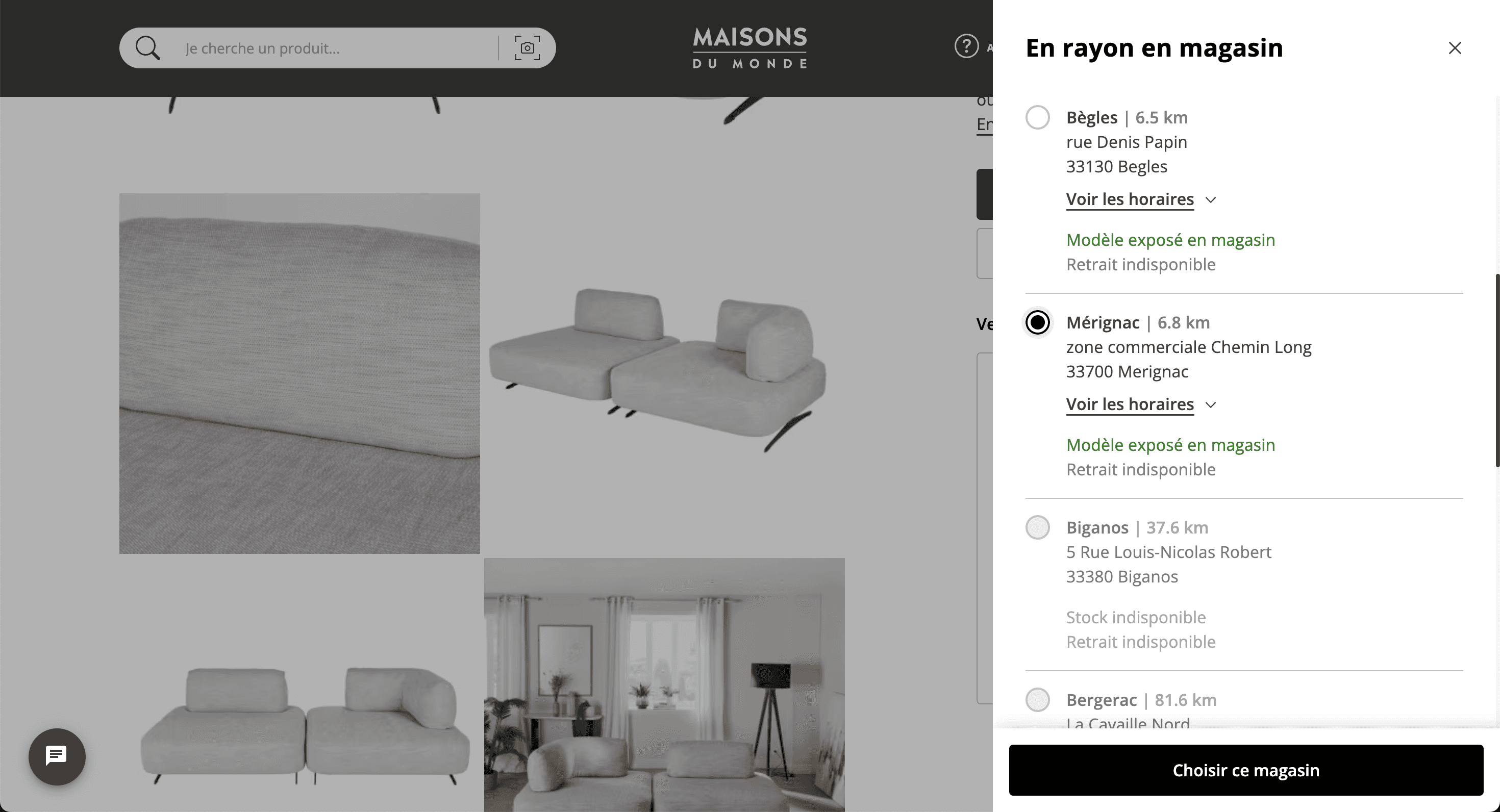
Checking availability on the maisonsdumonde.com website
💰In marketing, a customer usually costs more to acquire than to retain (in B2B, it is even 7 times more expensive on average). And to build customer loyalty, retailers have other tools, like loyalty cards!
Conclusion: web-to-store allows you to maximize acquisition without forcing customers to change their habits. The diversity of customer journeys offers just as many opportunities to generate value for retailers.
Broader communication
In 2025, it is hard to imagine a promotional campaign whose communication does not include digital. The web and social networks have become indispensable to reach a target that is both broad and segmented. Indeed, digital platforms allow for the creation of audience groups by affinity, a level of granularity that TV or radio advertising, for example, did not offer.
The need to push online visibility has thus become essential for all retail players. Ultimately, all digital communication for products or services sold in a retail location can be considered web-to-store promotion!
It is not for nothing that even major supermarkets are getting in on it!

E-reputation
Brand image is also built in the digital space. Indeed, when researching a product or service, internet users are very sensitive to feedback from their peers. In short, we will often trust consumers' statements more than those of brands.
Brands that master their digital reputation thus have a better chance of winning the e-commerce battle, but also the web-to-store battle, since trust is also built online.
Brands cannot afford to neglect a neat online presence, which will allow users to express themselves, and will attempt to react appropriately. A quality reputation can then turn into a powerful promotion tool and bring customers back to the points of sale.
On the other hand, a company that disables reviews on platforms such as Google, Facebook, or TripAdvisor can arouse suspicion. Many customers will be wary, and in this case, needless to say, you won't be seeing them in your stores anytime soon!
In the same way, online comparison must highlight your comparative advantages.
Typically, internet users will take into account the Google rating and associated comments. And when the comment says "warm and professional welcome, Damien knows his products inside out and guided us perfectly," then the user does not think twice and goes straight to the location.
The constraints and points of vigilance of a web-to-store strategy
Adopting web-to-store can involve quite strong technological changes, which imply several points of vigilance. Indeed, you will need to develop adapted digital tools, as well as powerful digital marketing strategies.
Human and technological investment
Your information system is not left out, especially if you practice multichannel sales, because you will then need to invest in product information management software (PIM) to synchronize distribution, stocks, and web interfaces.
Finally, many brands opt to develop mobile apps to support their websites.
All of these services require you to budget for significant investments, which will often need to be spread out over time to master your digital transformation.
Reliability of online information
Web-to-store is based on a promise made prior to the visit. You are the guarantors of this promise. Highlighting a product or offer without ensuring its availability at the relevant point of sale is one of the main risks of web-to-store.
You must therefore ensure total consistency of the local information distributed online. Hours, addresses, services offered, promotions, and availability must be correctly documented, both on the site and on Google Business Profile listings. This implies rigorous stock management and synchronization of information as close to real-time as possible.
Data collection and use (GDPR issues)
A web-to-store strategy involves collecting and leveraging data related to online behavior or local interactions. Depending on the setups used, some data may be considered personal, especially when relying on geolocation or individual identification.
It is therefore essential to respect the regulatory framework in force, in particular the GDPR. This involves transparent collection, explicit consent when necessary, and data usage strictly aligned with the stated purposes. A respectful approach to data not only avoids legal risks but also strengthens consumer trust.
Alignment with in-store teams
A web-to-store campaign can generate an influx of visitors that store teams did not anticipate. Without prior information or adjustment of in-store organization, the customer experience can suffer. Internal communication is therefore paramount!
Overall, the investment of time and money should not deter you; after reading this article, you should be convinced that web-to-store is not a luxury but a necessity. Any brand wishing to maximize traffic in points of sale must adopt its codes and best practices!
Drive to store: web marketing techniques
When marketing campaigns specifically target mobile users—meaning users browsing on their smartphones—the term drive to store is generally used. Mobility leads to the integration of different tools, such as voice search, which is particularly useful for finding directions while traveling.
Web to store or drive to store, the line is thin! But what matters is knowing the methods and technologies at your disposal to turn internet users into visitors to your retail locations.
Local SEO
According to Semrush, nearly one in two Google queries is... a local search! This staggering statistic clearly shows the importance gained by local SEO, which aims to "be found". Your Google My Business listing is a major asset to appear in geolocated search results.
Proof of this is that for some months now, Google Maps no longer appears in search results, under the Digital Markets Act, a European legislation designed to combat monopoly effects on the web.
This highlights the importance of local SEO in the economy!
Geolocated advertising campaigns
To boost their results, many brands also use paid search; it is actually a very common practice. For example, retail chains typically centralize their local marketing campaigns, the objective of which is to boost traffic to each point of sale within its trade area.
Different tools offer this type of geographic advertising campaign. The most well-known are Google Ads and Facebook Ads (also available on Instagram). These drive-to-store campaigns are particularly suited to activation campaigns. There are also drive-to-store agencies and software solutions dedicated to this type of geolocated marketing.
Other channels can be used to encourage internet users to visit your stores. These include mobile-to-store, which involves sending push notifications on an app, or SMS marketing. Text messages in 2025? And why not, if it sells!
Finally, emailing-to-store remains an option, which also has the advantage of waking up inactive customers!
Product locator and store locator
Company websites are also essential tools for web-to-store.
For example, integrating a product locator will allow the user to find the physical address and phone number of the stores where the searched product is available.
These features often support real-time stock display to enrich and refine the information provided. If the module only allows for geolocating a store without viewing its stock, we use the term store locator.
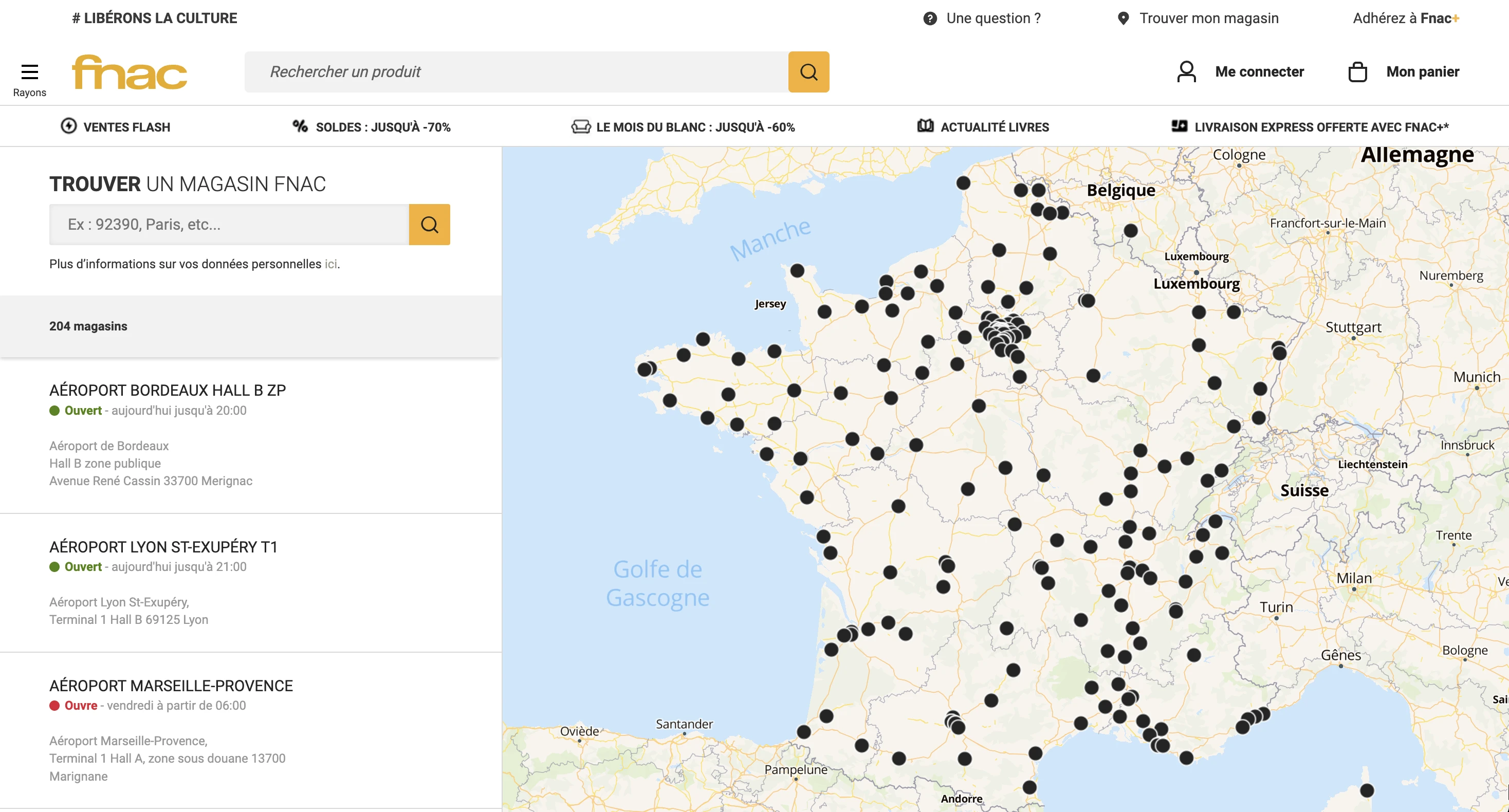
To unlock their full potential, these features must offer a perfect mobile experience (display, speed) and interface with route planning apps like Google Maps or Citymapper.
Consumers are not the only ones who need to organize to access different stores; brands that use distribution networks also try to optimize their sales routing plans with advanced automation tools.
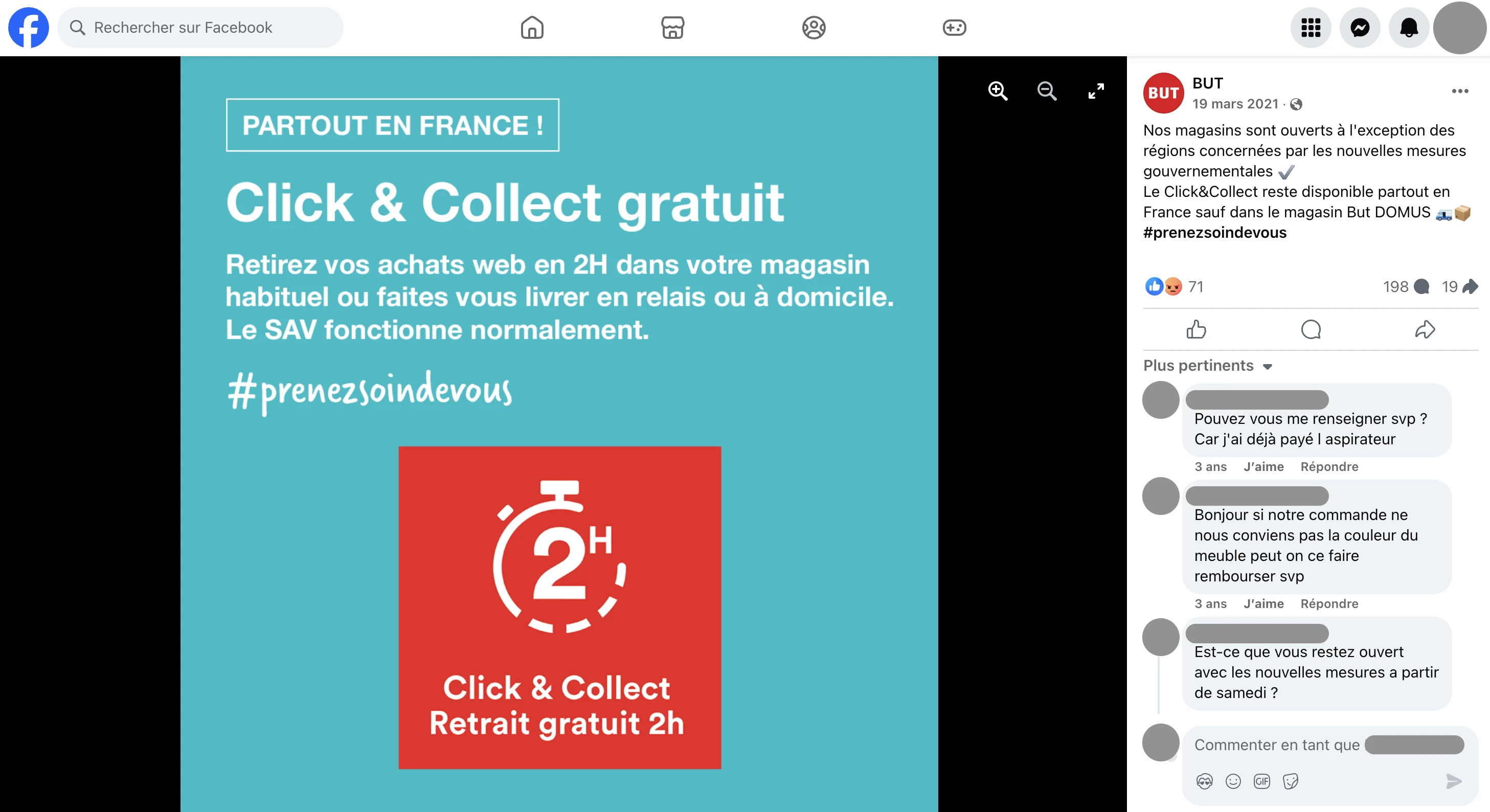
Click-and-collect
It is hard not to mention mass retail players here for their famous in-store pickup model.
Many customers do not want to bear the cost of home delivery, and this hybrid formula allows them to avoid crowds and save a little money: "Leclerc is on my way home from work, so why pay for delivery?!"
When you know that shipping fees are behind most cart abandonments in e-commerce, click & collect quickly becomes an option to consider for brands, especially since nearly half of consumers say they have already used it!
Supermarket chains are not the only ones to have adopted click-and-collect, and the Covid-19 pandemic encouraged many players to opt for this operating method, which then presented itself as a solution adapted to the sanitary conditions of the time.
Customer service excellence: the best traffic generator?
Let's finish with a pillar of customer management. Yes, the attitude and professionalism of your staff in stores has a considerable impact on the experience your customers have during their purchases. Excelling in customer relations is the best way to keep them coming back.
In an omnichannel logic (but also brand image), it is vital that online customer service is aligned with in-store practices. A smile on the phone can be heard! As for your chatbots and other smart agents, make sure they generate the highest possible satisfaction rate. Because traffic in your stores relies on the overall perception customers have of your company, making customer service a vital point of your digital and physical commercial activity.
Welcome to the era of phygital retail, where web-to-store champions are kings 👑
Examples of effective web-to-store strategies
Web-to-store examples: the case of FNAC and click-and-collect
Note that click & collect is a web-to-store lever, but web-to-store is not limited to click & collect.
Fnac allows consumers to browse products online (detailed sheets, reviews, availability by store), then to reserve or prepare their purchase before going to the store. Digital serves to inform and reassure, the store to finalize the purchase.
📌 Summary
Main objective: generate qualified store visits
Starting point: website
Place of conversion: store
Key channel: e-commerce site + store pages
Dominant logic: omnichannel (ROPO)
What this brought to the brand: better qualification of store visits and an increase in physical conversion rate, with customers arriving already informed and often ready to buy.
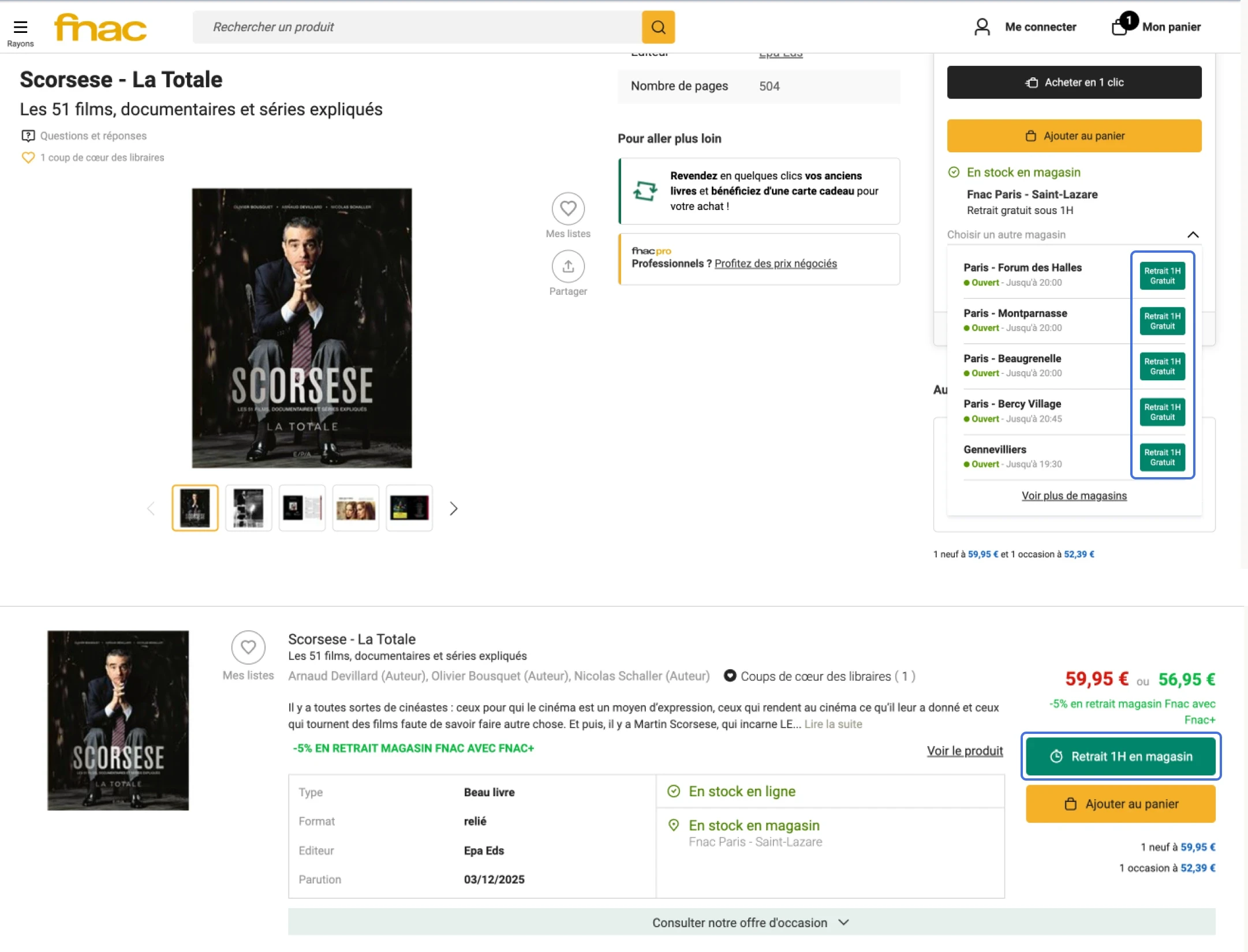
Example of FNAC's click-and-collect strategy
Drive-to-store example: the case of Decathlon
Decathlon captures local purchase intent through organic SEO and geolocated Google campaigns. When an internet user searches for a product nearby, they are directed to the most relevant store, complete with directions, hours, and sometimes availability.
📌 Summary
Main objective: generate store traffic
Starting point: search engine
Place of conversion: store
Key channel: local SEO / local Google Ads
Dominant logic: local acquisition
What this brought to the brand: effective capture of immediate purchase intent and better performance of stores within their trade area.
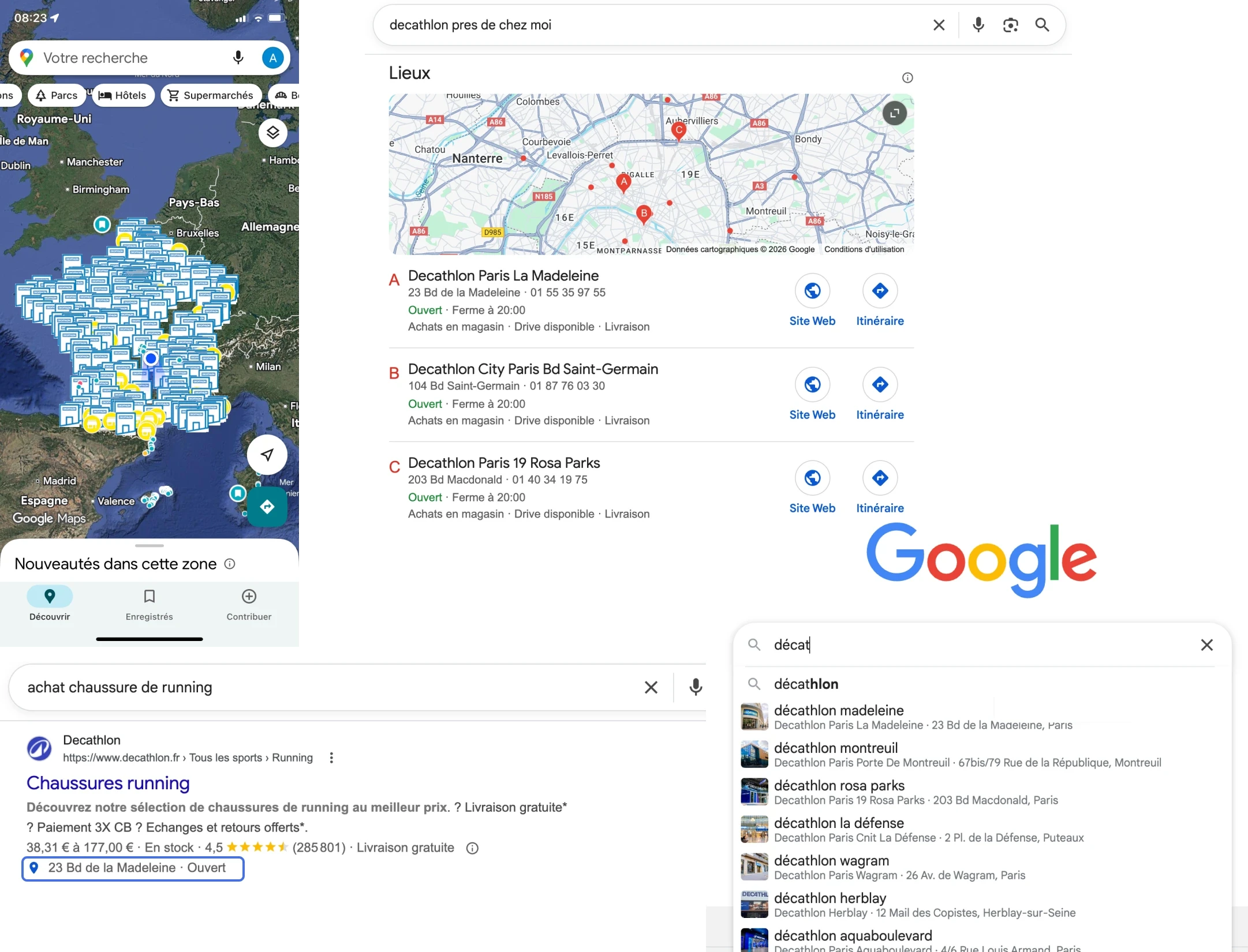
Example of Decathlon's drive-to-store strategy
Store-to-web example: the case of Sephora
In-store, Sephora encourages customers to use its digital tools: QR codes on products, mobile app, loyalty account creation. The store becomes an entry point into the digital ecosystem.
📌 Summary
Main objective: extend the customer relationship online
Starting point: store
Place of conversion: web / app
Key channel: QR codes, mobile app
Dominant logic: customer relationship
What this brought to the brand: better customer insight, ongoing relationship after the visit, and increased ability to activate customers across other channels.
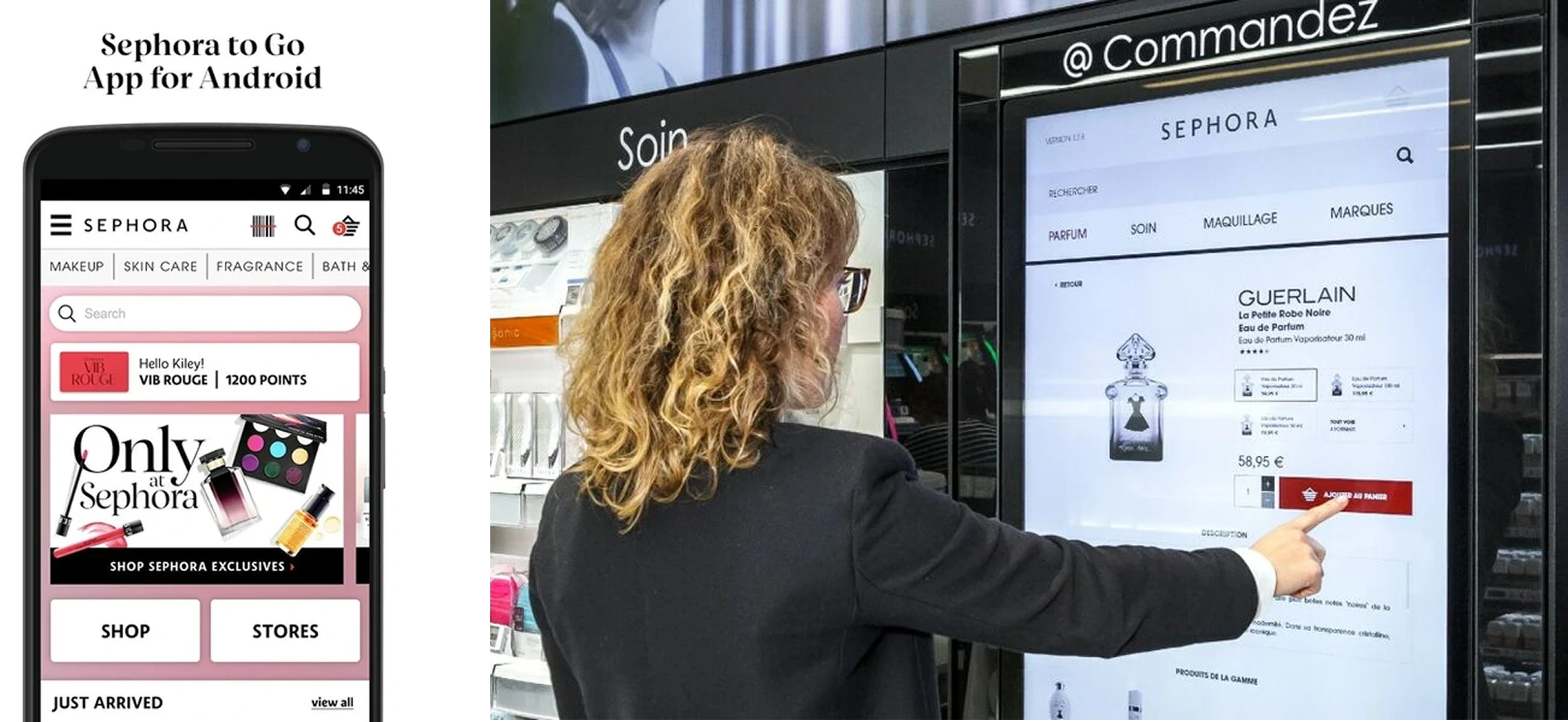
Example of Sephora's store-to-web strategy
Walk-to-store example: the case of Monoprix
Monoprix capitalizes on the immediate proximity of its downtown stores. Window displays, street signage, or visible offers just a few yards from the store encourage passersby to enter, often without prior purchase intent.
📌 Summary
Main objective: trigger an impulse visit
Starting point: street / physical environment
Place of conversion: store
Key channel: local display / window display / proximity
Dominant logic: impulse
What this brought to the brand: an increase in spontaneous visits and better capture of pedestrian traffic in dense urban areas.
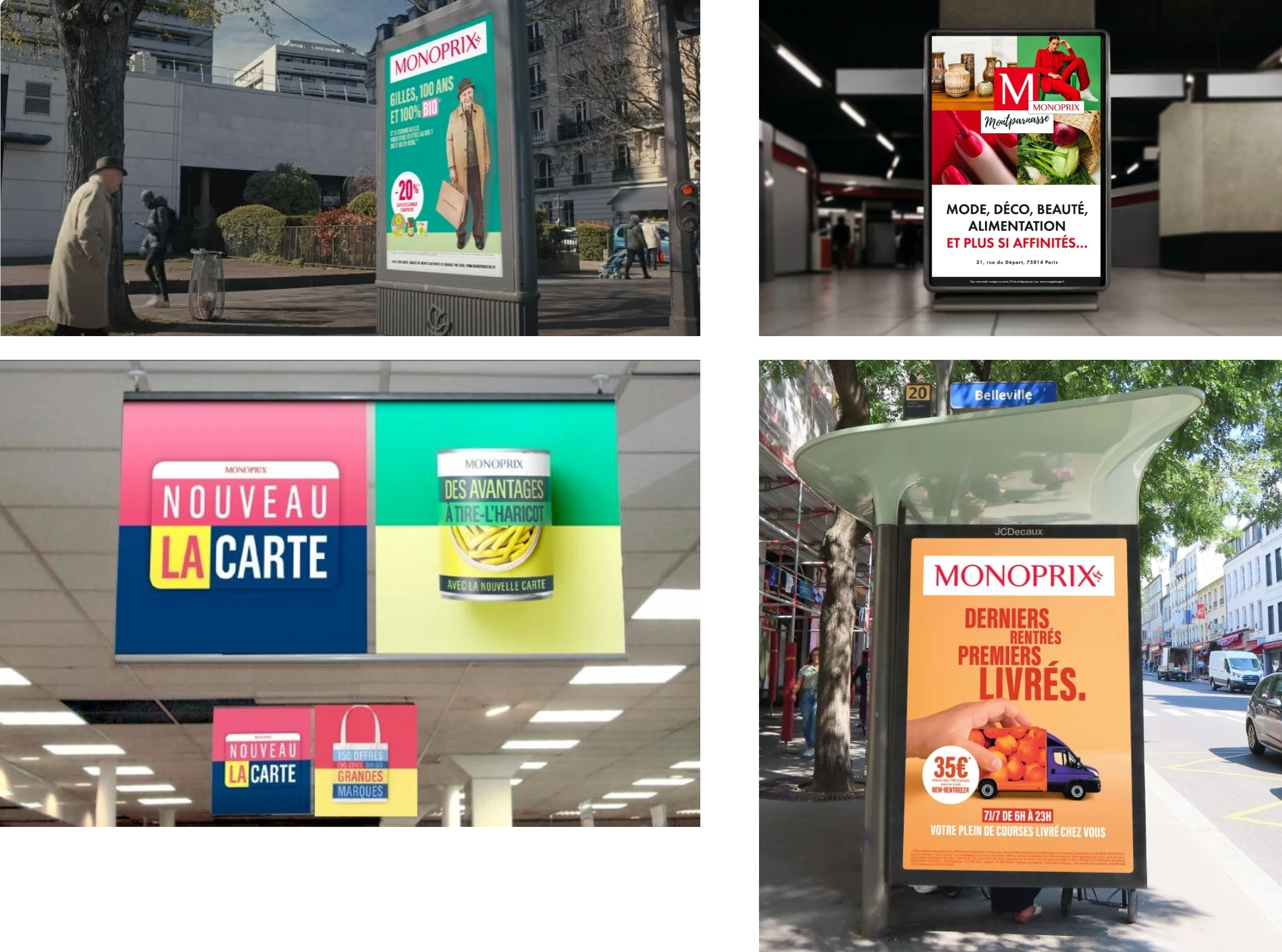
Example of Monoprix's walk-to-store strategy
For the past five years, Corentin has supported more than 200 sales teams, making him one of the longest-serving members of the company. He has seen the product evolve alongside the industries he supports, giving him a deep understanding of actual use cases. Between onboarding calls and training sessions, he has built up rare, hands-on expertise: knowing exactly what saves teams time.
See also

Artificial intelligence and field professions: what our 2026 studies reveal
Adoption, barriers, use cases: discover what our three studies reveal about the role of AI among sector managers, sales representatives, and foodservice sales reps.

CHR and RHF Sales Representatives: portrait of a relationship-driven profession in the era of data
Equipment, productivity, AI: discover the major trends for the HORECA and food service sales profession in 2026 through our field study.

Pharmaceutical Sales Representative in France: Portrait of a Field Job Under Pressure
Compensation, aspirations, AI usage: discover the major trends in the pharmaceutical sales representative profession in 2026 through our field study.

Area Sales Managers in France: who are they and how is the profession evolving in 2026?
Compensation, aspirations, AI usage: discover the major trends in the field sales representative profession in 2026 through our field study.
The area manager professions in 2026
Discover the trends, the challenges, and the key figures.