

Distribution strategy for dummies: definitions and examples
Intensive, selective, or exclusive distribution: definitions, differences, and concrete examples to help you choose the right distribution strategy for your brand and markets.

In short
6 min read
The distribution strategy is a planned approach to organize the marketing of products in order to maximize results.
The distribution policy defines the operational terms (pricing, contracts, logistics) necessary for the deployment of the strategy.
Direct selling consists of selling without an intermediary, while indirect selling relies on third parties (wholesalers, retailers, agents).
A distribution channel represents the entire path of a product, from the manufacturer to the final consumer, including logistics and storage.
The B2B model refers to business-to-business transactions, B2C to sales to individuals, and B2B2C to passing through an intermediary to reach the consumer.
The choice of a distribution method is based on an analysis of the advantages and disadvantages of each channel according to the product and the target market.
The retail and distribution landscape is rich in terminology, and it can sometimes be difficult to name things correctly: channels, routes, networks, or even distribution policy are all terms we tend to use interchangeably, for better or for worse!
So, let's head back to school for a few minutes and agree on the terminology.
By the end of this article, you will be using each term correctly and can thus begin to build (or improve) your distribution strategy.
But let's start at the beginning…
What is a distribution strategy?
A distribution strategy is the planned approach used by a company to organize and manage the distribution of its products or services in the market to maximize its results.
Its objective is notably to determine:
The most appropriate distribution channels;
The selection of the most suitable business partners;
The design of the appropriate logistics networks;
The implementation of suitable pricing and promotional policies to maximize the visibility and accessibility of products or services to target consumers.
The distribution strategy thus aims to ensure an efficient and profitable distribution of the company's products or services by responding optimally to the needs and expectations of the end customers.
While the distribution strategy sets the company's distribution objectives, the distribution policy defines the methods for deploying this strategy. Thus, the distribution policy brings together all the decisions and actions taken by a company to effectively implement and manage the distribution of its products or services in the market, including, for example, distribution agreements, pricing terms governing partnerships, or even the management of retail prices by channel type. Finally, let’s note that distribution strategy and policy are part of the marketing mix.
Why use distribution?
Before going any further, it is important to understand what is at stake in distribution. And for that, let's recall what direct and indirect sales are.
Direct and indirect sales
There are two ways to address a market:
Direct sales: a company's products or services are sold directly to end consumers, without going through third-party intermediaries such as retailers, distributors, or wholesalers. In this model, the company is responsible for all stages of the sales process, from the production or sourcing of products to their marketing, distribution, and sale to customers;
Indirect sales: a company's products or services are distributed and sold through third-party intermediaries, rather than directly by the company itself to end consumers. These third parties can be resellers, distributors, wholesalers, agents, affiliate partners, or other distribution channels. In this model, the manufacturing company (referred to as the supplier in the commercial relationship) sells its products in bulk to intermediary partners, who then handle the distribution, marketing, and sales of the products to the end consumers.
To choose a distribution model, companies must weigh the pros and cons of each model. We offer a summary below.
Direct sales | Indirect sales | |
|---|---|---|
Advantages | Better profit margins / Direct relationship with customers / Better traceability / Opportunity for competitive pricing | Extended geographical coverage / Access to established distribution channels / Reduced logistical burden / Ability to focus on production |
Disadvantages | Initial investment / Logistical complexity / Limited geographical reach / Additional workload | Loss of control over distribution / Reduced margins / Less visibility over end customers / Dependence on distribution partners |
Now that these concepts are clear, we need to explore three crucial terms to understand the world of distribution:
The distribution channel is the specific pathway through which a company's products or services are routed from the producer to the end consumer, encompassing all the intermediaries and steps necessary to reach the market;
The distribution route groups all the channels used by a company to distribute its products or services, including both direct and indirect channels, from the producer to the end consumer;
The type of distribution: the distribution strategy can be intensive, selective, or exclusive: this consists of defining the type and number of partners that will distribute the products in alignment with the brand’s strategic objectives.
Let us now go into detail for each of these points.
1) What is a distribution channel?
A distribution channel is the path taken by a product from the manufacturer to the end consumer, including all intermediaries (wholesalers, retailers, logistics). It can be direct or indirect depending on the number of intermediaries.
Depending on the product and the market, the distribution channel can vary in complexity and length. It can be direct, when the producer sells directly to the consumer, or indirect, involving several intermediaries. Each link in this channel plays an essential role in the product's availability, accessibility, and visibility in the market.
The different players in a distribution channel
Manufacturer / Producer: designs and produces the goods before making them available on the market;
Wholesaler: buys products in bulk from manufacturers to resell them to retailers;
Retailer: the final point of sale where consumers buy the products;
Distributor: the entity responsible for the logistics and delivery of products from the manufacturer to the points of sale. Sometimes it is itself a point of sale or a network of points of sale (e.g., mass retail);
Franchisor: owner of a brand or commercial business model who grants licenses to franchisees to operate business units under its brand.
The boom in e-commerce has also seen the emergence of new players such as marketplaces like Amazon or eBay, applications that provide an infrastructure to buy and sell products online.
Examples of distribution channels
To illustrate what has just been said, here are some quite common examples of distribution channels.
Type of distribution channel | Description | Examples |
|---|---|---|
Direct sales | The manufacturer sells directly to consumers without any intermediaries. | Online sales on the manufacturer's website. |
Retail sales | Products are sold to consumers by physical or online retailers. | Retail stores, supermarkets, online shops. |
Wholesale | Products are sold in large quantities to resellers or professional users. | Cash and carry, specialized wholesalers. |
Franchise distribution | The franchisor grants licenses to franchisees to operate business units under its brand. | McDonald's, Subway, Century 21. |
Sales agent distribution | Independent agents are mandated to sell products on behalf of the manufacturer. | Sales representation agencies. |
Distributor distribution | Distributors are responsible for the logistics and delivery of products from the manufacturer to the points of sale. | Logistics and transport companies. |
E-commerce platform sales | Products are sold on third-party online platforms. | Amazon, eBay, Etsy. |
Social media sales | Products are promoted and sold directly on social media networks. | Facebook Marketplace, Instagram Shops. |
A distribution channel can involve different players, which is to say a chain of independent actors playing their role in turn, for example: manufacturer → wholesaler → retailer → end consumer.
Furthermore, when a company uses only one type of distribution channel, its distribution is classified as single-channel. In contrast, if different types of channels are used, it is referred to as multi-channel distribution (not to be confused with multi-channel marketing).
🤔 But then, what is the difference with a distribution route?
2) Distribution route: the combination of channels
The distribution route brings together all the channels that a company uses to distribute its products, whether direct or indirect. A brand has a single route, made up of several channels.
Indeed, a company's distribution route is often composed of several channels. For example, a manufacturer can sell its products simultaneously:
Online via an e-commerce site;
Via a network of national retailers;
By going through resellers for export.
Length of the route
We also refer to the length of the distribution route. Three descriptors are generally used:
Ultra-short route (or direct sales): the producer sells directly to consumers without any intermediaries;
Short route: a single intermediary (like a retailer) between the producer and the consumer;
Long route: several intermediaries such as brokers, retailers, or wholesalers to reach consumers.
💡 When a farmer sells their lettuce at the market, it is a direct route, and not a short route, because there is no intermediary! But if a grocery store buys that same lettuce from them to resell it to neighborhood residents, then it is correct to speak of a short route!
Distribution network
One must also differentiate between the distribution route and the distribution network, which corresponds to a global and holistic view of how products travel from production to sale, meaning including all the intermediaries and actual points of sale between the company concerned and its end customers.
Schematically, it’s a bit like putting labels (company names) on each participant of your route (all pathways combined), which is itself made up of various channels (each individual pathway).
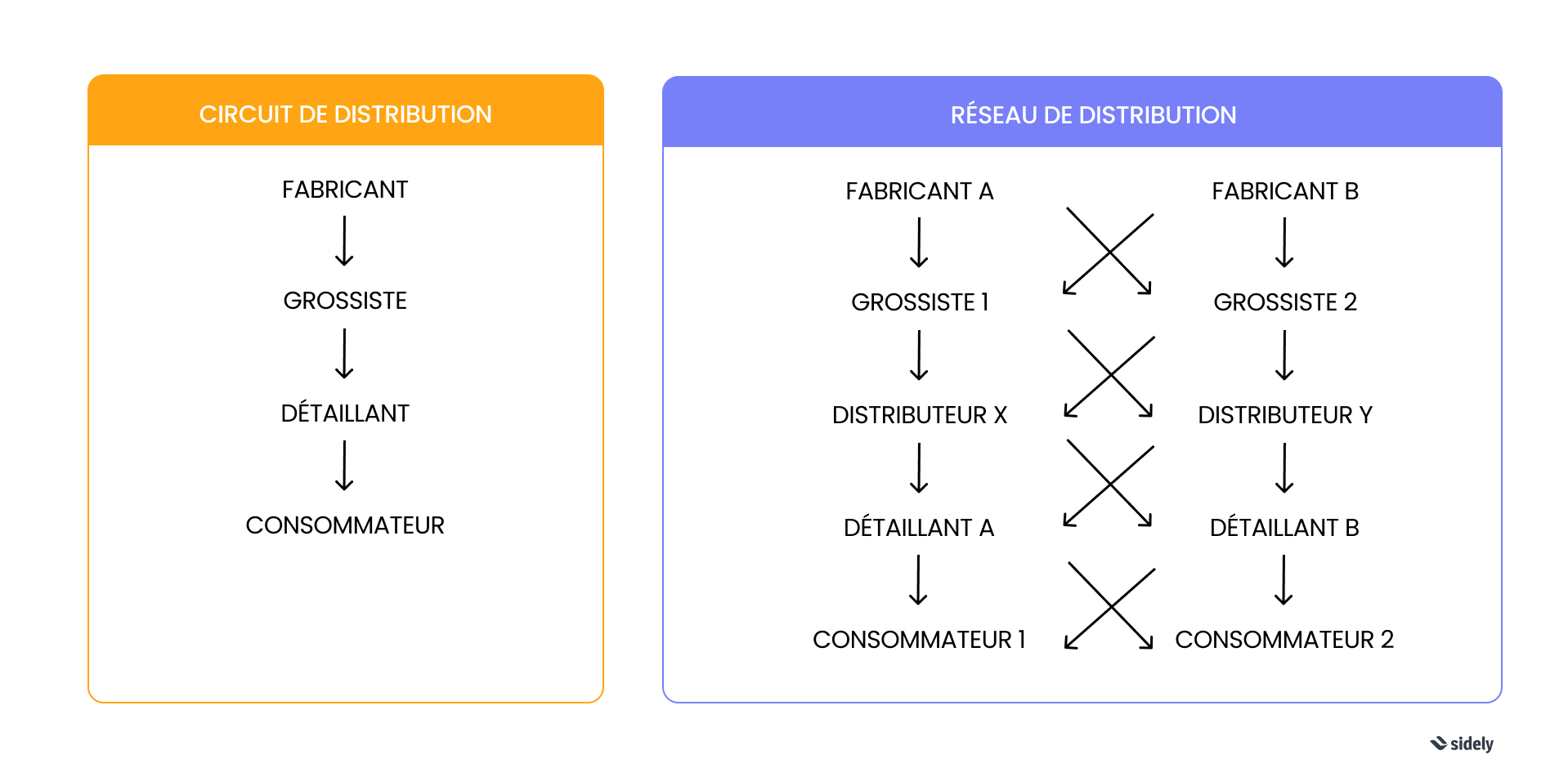
Distribution route vs. distribution network: the differences
3) Type of distribution: intensive, selective, or exclusive
Implementing a distribution strategy necessarily involves defining choices regarding partners. Three main approaches are generally recognized:
Intensive distribution consists of making a product available in the maximum number of outlets possible in order to reach a wide audience;
Exclusive distribution involves limiting a product's availability to a restricted number of selected outlets, sometimes through an exclusivity agreement with a partner (for example: a specific major retail chain);
Selective distribution involves choosing a limited number of outlets to distribute a product, based on specific criteria. This option is often chosen for luxury items or highly technical products.
To go further into this subject, discover how to choose between intensive, selective, and exclusive distribution.
How to build your distribution strategy in 6 steps
Now that the terminology is established, let's put it into practice! Here is the process to follow to build (or revise) a distribution strategy:
1. Define your distribution objectives
Before choosing any channel, ask yourself what you are trying to achieve. What level of shelf presence are you aiming for? In which geographical area do you want to be present? What share of shelf space do you hope to gain, and for what level of volume or margin? These answers set the direction, and will then be translated into measurable indicators (see step 6).
2. Analyze your target and your market
Where do your customers actually buy? A mass-consumption food product is not distributed like a premium cosmetic. Map out your target's buying habits, the dominant routes in your sector, and the players already in place.
3. Choose your distribution type
Intensive, selective, or exclusive: this choice directly stems from positioning. A snacking brand will aim for intensive distribution (maximum number of points of sale) while a premium brand will prefer selective distribution.
4. Select your routes and channels
This is where your strategy takes concrete shape. Combine the most relevant channels to reach your target (supermarkets, e-commerce, wholesalers, Horeca, direct sales) in line with the type of distribution chosen in the previous step. For example, if you launch an energy drink, you will likely target supermarkets for volume, Horeca (bars, gyms) for brand image and on-premise consumption, and e-commerce to directly reach your most loyal customers. This is also the time to decide between a single-channel and a multi-channel approach: the latter broadens your presence but complicates logistics and requires price and image consistency across channels.
5. Choose and negotiate with your partners
Buying groups, retail chains, wholesalers: you select the intermediaries, you negotiate the terms (listing, pricing conditions, shelf space agreements) and you formalize it all through your distribution policy.
6. Monitor and measure in the field
A strategy is only as good as its implementation in the stores. Measure your numeric distribution (ND), your weighted distribution (WD), your out-of-stock rate, and your share of shelf space, then adjust. This is where your field teams (area managers, sales reps) become decisive.
Let’s look at a real-world case. JDE (Jacobs Douwe Egberts), the group behind L'Or and Senseo, noticed that some of its items, even though listed centrally with E.Leclerc, were not being ordered by many drive-through pick-up services and were therefore absent online. A classic gap between what is negotiated at the central level and what is actually available to the customer in the store.
There were too many individual outlets for sales reps to visit one by one. JDE launched a remote follow-up campaign by phone, focusing on its top 25 selling products. Within ten days, 93% of the targeted drive-through services had been contacted, and product presence on shelves went back up (Districom).
The JDE case illustrates the importance of monitoring. Securing a central listing is not enough; you still need to ensure that the product is actually present point of sale by point of sale. A central agreement never guarantees actual shelf presence. This is the main challenge behind the field sales representative profession (and the importance of being equipped with a good field CRM): spotting listing gaps, tracking real ND store by store, and directing efforts where the gap to the target is widest.

Douwe Egberts
Distribution models designated by type of actors
Finally, in marketing language, it is common to use the letters B and C to represent the players and distribution channels.
B refers to businesses;
C refers to consumers. This category actually refers to individuals (households), contrasted with businesses.
We can thus represent the different ways of addressing a market by combining these letters.
BtoB
BtoB, or "Business to Business," refers to commercial transactions between companies. This includes the sale of goods or services from one company to another for use in its business operations or for resale.
🔎 Examples: selling construction materials to contractors, supplying management software to businesses, or providing consulting services to other corporations.
BtoC
BtoC, or "Business to Consumer," refers to commercial transactions between a company and end consumers. This includes the sale of goods or services directly to individuals for personal use.
🔎 Examples: selling clothes in a retail store, providing video streaming services to individual subscribers, or selling food products in a supermarket (from the retailers’ perspective).
BtoBtoC
"BtoBtoC" refers to a business model in which a company sells products or services to other businesses, which then resell them to end consumers. This creates an indirect channel between the business and the consumer.
🔎 Examples: an electronics manufacturer selling its products to retailers who then offer them to consumers, an online platform connecting service providers with consumers, or selling food products in a supermarket (from the national brands’ perspective).
BtoB and BtoC fall under direct sales, and BtoBtoC under indirect sales.
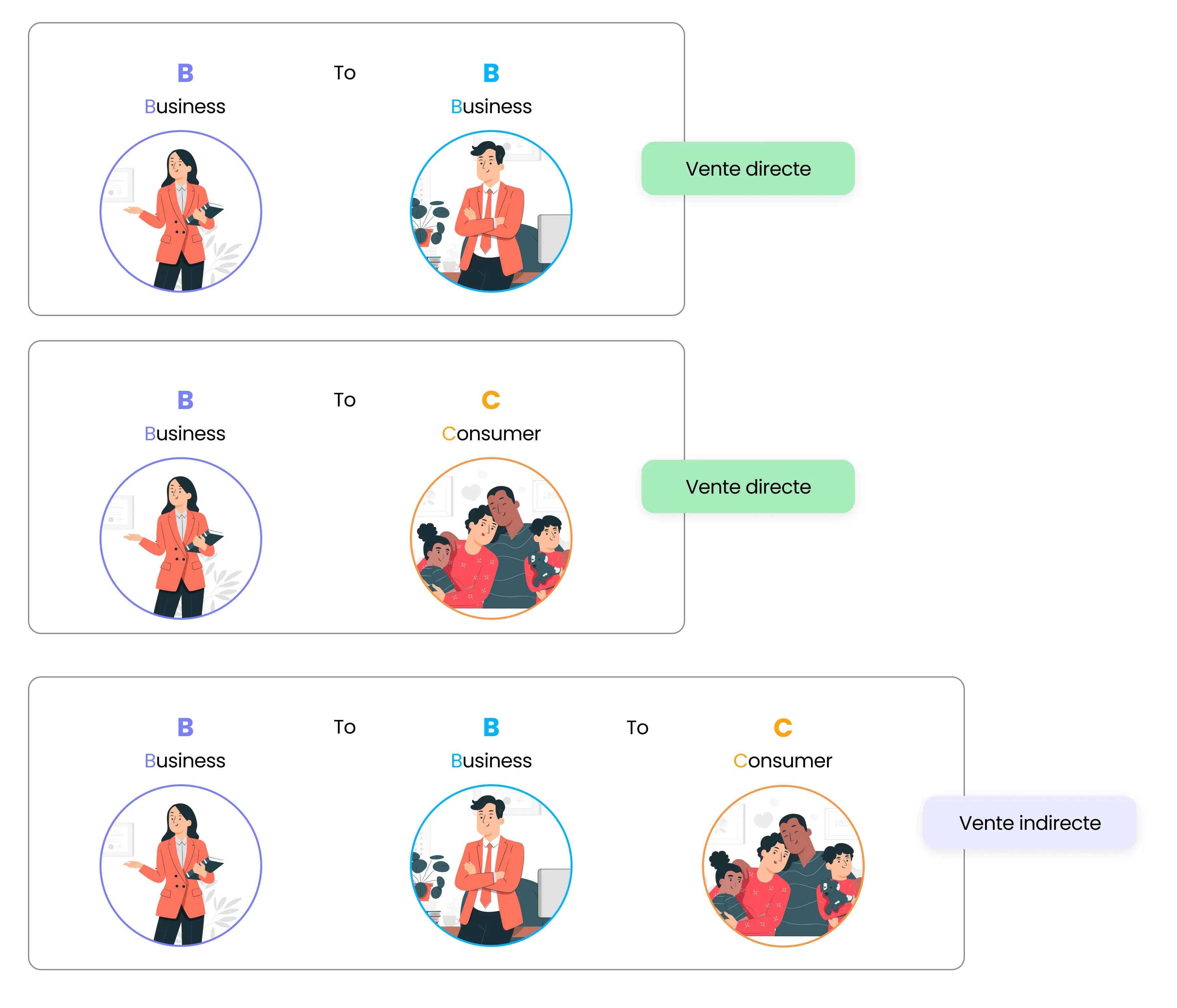
Additionally, in practice, "to" is sometimes replaced by "2":
BtoB = B2B;
BtoC = B2C;
BtoBtoC = B2B2C.
One might consider BtoBtoC and indirect sales to be one and the same thing. However, there is a subtle distinction regarding transactions. In a BtoBtoC model, the intermediary company has purchased the product or service upfront before selling it to the individual.
In this sense, some indirect sales models, such as consignment sales or other forms of commerce like affiliate marketing, are not necessarily BtoBtoC strictly speaking.
Finally, if company Y processes the product of company X to sell a new product to Z, this is simply not BtoBtoC (indirect sales), but rather two consecutive models: BtoB, then BtoC.
💡 Useful resources for selling in major retail chains
If you plan to sell your products in major retail chains, you will likely want to understand everything about selling in mass retail, or know how to get listed by the chains.
What is the difference between a distribution channel and a distribution route?
What is the difference between a distribution route and a distribution network?
What are the types of distribution strategies?
What is a long distribution route?
Margot has been working in Tech and SaaS for 8 years, with a multi-product experience that has given her a unique understanding of business challenges. On a daily basis, she analyzes, relentlessly tests, and relies on facts to shed light on market trends and help sales teams move forward.
See also

Artificial intelligence and field professions: what our 2026 studies reveal
Adoption, barriers, use cases: discover what our three studies reveal about the role of AI among sector managers, sales representatives, and foodservice sales reps.

CHR and RHF Sales Representatives: portrait of a relationship-driven profession in the era of data
Equipment, productivity, AI: discover the major trends for the HORECA and food service sales profession in 2026 through our field study.

Pharmaceutical Sales Representative in France: Portrait of a Field Job Under Pressure
Compensation, aspirations, AI usage: discover the major trends in the pharmaceutical sales representative profession in 2026 through our field study.

Area Sales Managers in France: who are they and how is the profession evolving in 2026?
Compensation, aspirations, AI usage: discover the major trends in the field sales representative profession in 2026 through our field study.
The area manager professions in 2026
Discover the trends, the challenges, and the key figures.