

Energy drinks in France: players, consumers and new rules of the game
Who consumes energy drinks in France? Discover the market figures, the industry leaders, and the arrival of content creators.

In short
8 min read
A booming market: energy drinks account for approximately 685 million euros in annual revenue and are growing by more than 11% in volume, while non-alcoholic beverages as a whole are declining (NielsenIQ, 2025).
An ultra-dominant trio: Red Bull (nearly 60% of sales by value) leads Monster (30%) and Crazy Tiger (7%); new entrants fight over the crumbs (Xerfi, 2025).
A young target audience: 18-35 year olds alone account for half of the market, with consumption now commonplace, far beyond athletes.
The battle is fought on the shelves: the number of items in hypermarkets has almost doubled between 2021 and 2024, in one of the most profitable segments of the aisle (≈ €3.60/L compared to €1.29 for colas).
Immense potential remains: per capita consumption is still twice lower than the European average and eight times lower than that of colas.
Creators are entering the game: following Prime or Feastables, Ciao Energy (Squeezie, Léna Situations, Inoxtag) illustrates the sudden emergence of influencer brands on store shelves.
In just a few years, energy drinks have gone from being a marginal product, long viewed with suspicion, to the locomotive of the beverage aisle. While most soft drink families are stagnating or declining, this category is posting double-digit growth that shows no signs of slowing down: over 1 year, energy drinks progressed by more than 11% in volume while all non-alcoholic beverages declined, according to Nielsen IQ. How did a segment once banned from sale in France become one of the main drivers of growth in retail?
From the product definition to the strategies of new entrants, by way of consumers, distribution, and health issues, we take a look at a sector in full reorganization.
Energy drink, isotonic drink: what are we talking about?
First of all, a confusion needs to be cleared up. An energy drink (stimulant) has nothing to do with an isotonic drink (for physical effort). The former is a stimulating beverage, generally carbonated, whose effect relies on a cocktail of caffeine, taurine, guarana, B vitamins, and sugars or sweeteners: these are the Red Bull, Monster or Crazy Tiger found in supermarkets, convenience stores, or vending machines. The latter, often isotonic, is formulated to support physical effort and the recovery of athletes: we think of brands like Isostar, Overstim.s or Powerade, sold in sports stores like Decathlon, pharmacies, or specialized nutrition aisles.
The energy drink market is now structured around several sub-segments: classic cans, sugar-free versions, which are growing strongly under the influence of health concerns, and energy shots, these small concentrated formats designed for rapid, on-the-go consumption.
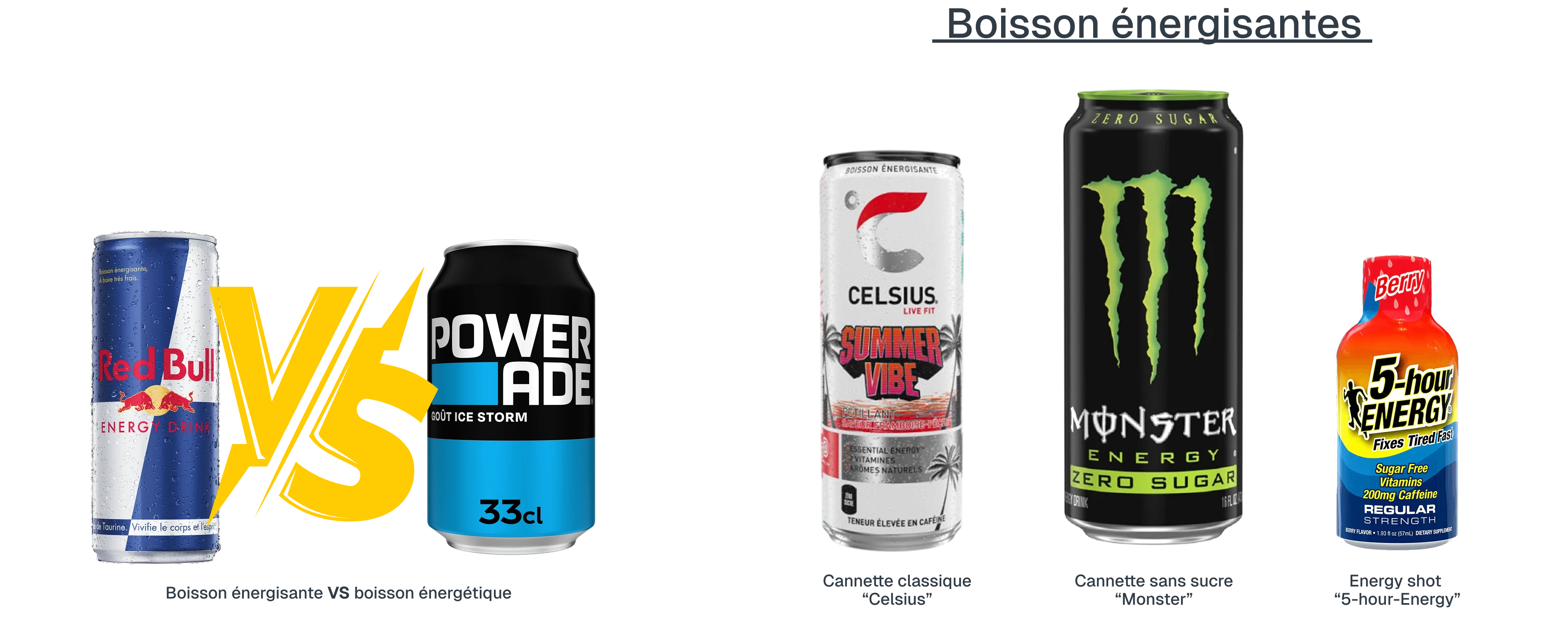
A concentrated and high-value market
The economic weight of the category is considerable compared to its volumes: it represents around 685 million euros in turnover over twelve months (Nielsen IQ, 2025), and is among the fast-moving consumer goods families that contribute the most to the sector's growth, according to Rayon Boissons in 2025. In other words, the category sells few liters, but each liter sells for a high price: low volume for high value.
The market remains, however, extremely concentrated. Red Bull is the undisputed leader with nearly 60% of sales in value, ahead of Monster (30%) and Crazy Tiger (7%), according to Xerfi (2026). This dominance is explained first by history: Red Bull is the drink that launched the entire industry. Its arrival in France was nevertheless late and stormy, an unfavorable opinion in 1996 targeting taurine having delayed its commercialization until its final authorization on July 15, 2008, according to France24. But history is not everything: the brand built its supremacy on image marketing (boldness, sports sponsorship, events) which transformed its head-start into lasting dominance. It is precisely this established power that forces new entrants to bet on differentiation (by price, composition, or community) to hope to find a place.
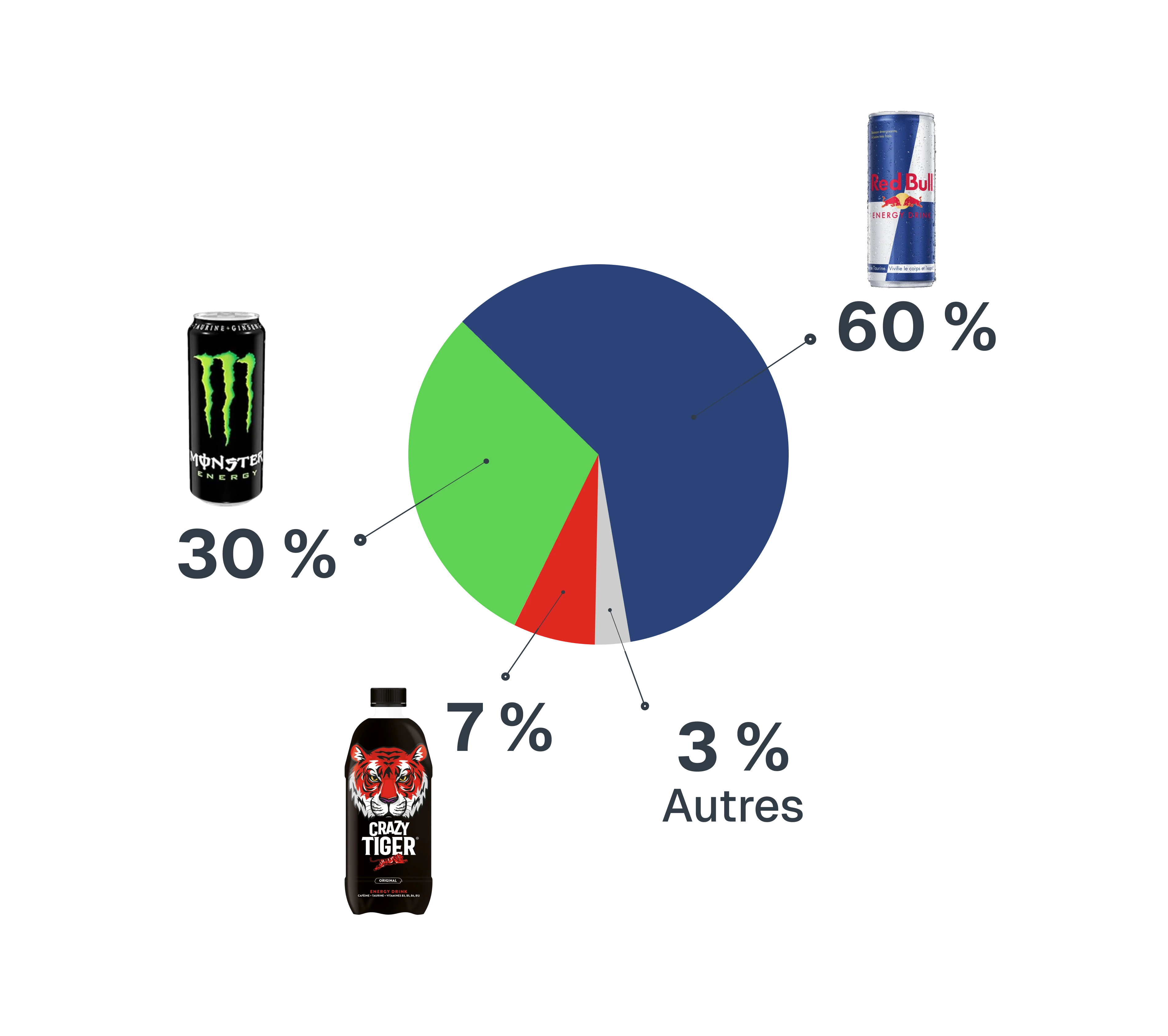
Energy drink market, percentage of sales by value
Who consumes energy drinks?
The core target is unambiguously youth: 18-35 year olds represent half of the market alone. But consumption is now widely spilling over to the sports public, a sign of actual mainstreaming.
The typical profile is that of the young urban adult on the move (student, delivery driver, driver, freelancer) looking for a quick and convenient energy boost. To this functional dimension is added a strong identity aspect: energy drinks are associated with gaming, e-sports, and extreme sports, universes that brands nurture with sponsorships and spectacular events. Bodybuilding, in full boom among 18-25 year olds, has become another favorite playground: many divert the classic energy drink from its primary use to make it a "booster" before training, seeking an energy surge to gain intensity and lift heavier, where athletes would turn instead to dedicated products like pre-workouts.
When the brand becomes the event: the Red Bull BC One
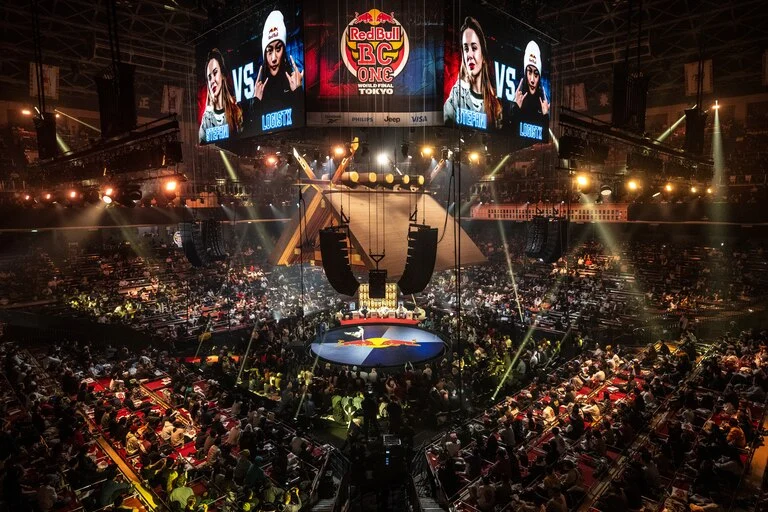
Source: DH Les sports
All channels mobilized
Large retail (hypermarkets and supermarkets) constitutes the dominant channel in volume, where the rise of private labels (PL) accompanies purchasing power issues. But the category also thrives on channels where impulse buying is king: convenience stores, gas stations, and vending machines, where a can is grabbed without premeditation.
The On-Trade (cafes-hotels-restaurants), like bars, nightclubs, or even event venues, remains a strategic channel, historically key in Red Bull's brand awareness: it is in nightclubs, via the famous Vodka-Red Bull cocktail, that the brand established itself among young adults long before reigning on the shelves. At the other end of the spectrum, e-commerce, click-and-collect, and stores specialized in sports and nutrition further broaden the reach, while presence at major sporting and e-sports events remains a powerful visibility lever.
In the same logic, Red Bull has made campus marketing one of its favorite playgrounds. Since its inception, the brand has directly targeted students through free distribution and the recruitment of on-site ambassadors, the "Student Marketeers". A strategy that is still relevant: in 2025, an investigation by France Télévisions identified more than thirty student associations supplied with free cans, Red Bull in the lead. The mechanism is well-oiled: no contract or money, but guidelines to respect under penalty of being "banned". A document from the brand thus details the rules to follow for event photos: highlight the venue and the atmosphere, but above all, no competing drink brand or any other consumption than Red Bull visible in the shots. Objective: build loyalty among young consumers as early as possible, where habits are formed.
The battle of the shelf
The category's rise can be read directly on the shelves. The average number of products offered in hypermarkets almost doubled between 2021 and 2024, showing a multiplication of brands, flavors, and formats (Nielsen IQ). Above all, energy drinks stand out as one of the most profitable segments of the beverage aisle: with an average price around €3.60 per liter compared to €1.29 for colas (LSA, 2024), it features among the top contributors to soft drink growth considering its weight. In other words, every inch of shelf space brings in big money, which intensifies the fight for space. And the potential remains immense: as of late May 2025, energy drinks weigh only 10% of sales by value of the non-alcoholic beverages aisle (excluding water) in France, compared to 25% in the United Kingdom and 21% in Germany (NielsenIQ). A gap that delineates real growth margins for the category.
Facing and the power of bottlers
The main nerve of war is facing : the number of cans visible on the front of the shelf. The more space a brand occupies, the more visible it is, and the more sales it captures. In this category, the battle is all the rougher as it pits heavyweights with deep pockets against each other: behind the brands, power dynamics are played out between bottlers, Coca-Cola Europacific Partners distributing Monster against a Red Bull that manages its own distribution. For a new entrant, securing a few additional facings during annual negotiations with the retailer can make all the difference between a brand taking off and a brand staying confined to the bottom of the shelf.
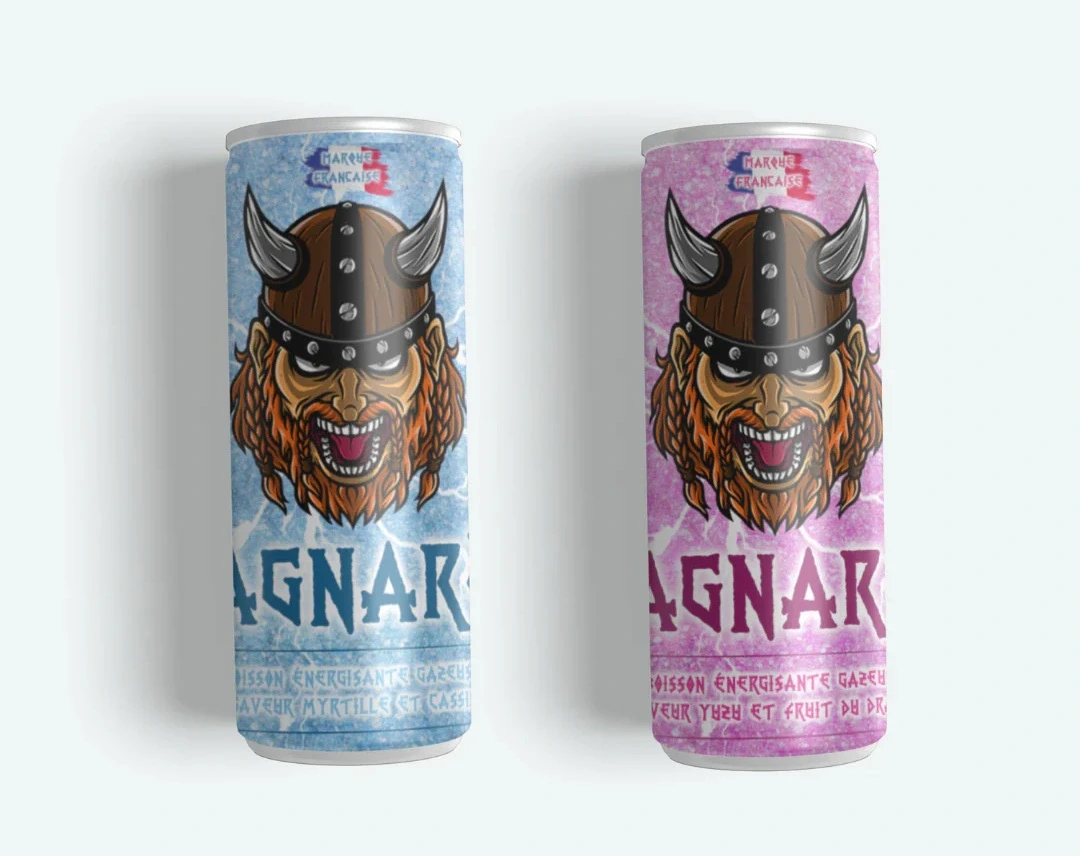
Source: Food innovation monitoring
Location and impulse buying
Not all locations are created equal, and energy drinks are the ultimate impulse product, consumed chilled. Presence in the main non-alcoholic beverages (NAB) section is a core requirement, but it is often the secondary placements that make the difference: refrigerated tubs near checkout lines, end caps, and high-traffic display stands. Individual cans sold cold, ready to be drunk immediately, do not address the same consumption occasion as multi-packs stored at home, hence the importance of cold storage, which is particularly decisive in this category where consumption climbs during beautiful days and heatwaves. This also explains the diversity of formats: each brand chooses its battle. Red Bull established itself with its compact 25 cl can, while Monster made the large 50 cl format its signature, two biases that meet different moments and consumption profiles.
The boom of "varieties," the aisle's new playground
The big recent mutation is the explosion of flavored recipes. Long confined to "classic" taste, energy drinks are now available in ever-increasing fruity flavors, a segment that drives the aisle's growth: fruity tastes today represent 30% of volumes and 44% of the category's product list, according to NielsenIQ (2025), relayed by LSA. Nearly one in two products on the shelf is therefore now a fruity flavor, designed to recruit new consumer profiles. Crazy Tiger illustrates this strategy well with its colorful cans with flavors close to sodas. For category management, this profusion is a double-edged sword: well-managed, segmentation by flavors and formats (on-the-go sleek can, family format, energy shots) allows all buyer profiles to be covered; poorly controlled, it saturates the shelf and causes products to cannibalize each other.
Listing and out-of-stocks: lasting over time
Finally, winning your place is not enough: you still have to hold it. Two indicators are decisive here. The numerical distribution (ND) rate measures how many points of sale a product is actually present in; a good national listing is worthless if it is not supported in labs. And out-of-stocks are the number one enemy of a very high-turnover category: a can missing from the cold tub on a summer Saturday afternoon is an impulse sale definitively lost and, eventually, the risk of seeing your facing reclaimed by a competitor. Restocking monitoring and store audits become strategic, because it is on this field of execution that a brand's real daily performance is played out. The dynamic is indeed real: seven million French households bought energy drinks in the last twelve months, which is 300,000 more than a year earlier, according to Rayon Boissons.
This is precisely where new entrants must prove themselves: without the media firepower of a Red Bull, they convince retailers on margin, product innovation, or an already established consumer demand, as illustrated by the arrival of creator brands literally requested in stores.
Ciao Energy: why Squeezie, Léna Situations, and Inoxtag are launching into energy drinks
At the end of May 2026, the three creators unveiled Ciao Energy, commercialized starting June 1st in French supermarkets, in addition to the Ciao Kombucha launched a year earlier by Squeezie. Beyond the media sensation (the launch video exceeded 20 million views in less than 24 hours), the project responds to a thought-out logic.
- Capturing value, and no longer just ad revenue. The motivation is first and foremost economic. Creators have understood that a percentage of sales is no longer enough: they want the brand, the market shares, and the presence on shelves. Content then becomes the promotion channel for their own product.
- A promising but stagnant market. Squeezie justifies his choice with a realization: according to him, no brand had previously offered an energy drink that was both "quality" and natural, without being saturated with sugars or sweeteners. A space to occupy in a dynamic sector.
- An audience perfectly fitted for the target. The energy drink market, known to 15-35 year olds, overlaps almost perfectly with Squeezie's audience. Together, the three creators merge the worlds of gaming, fashion, adventure, and entertainment, mechanically widening the potential consumer base.
- A brand strategy designed to last. Ciao is not a simple marketing stunt: the brand is designed as an umbrella brand, capable of branching out from one category to another and, ultimately, living without its creator. Behind the scenes, the studio Banger Ventures (already behind Ciao Kombucha and the chips of McFly and Carlito) pilots industrialization and distribution.

Source: Youtube
Regulation and health: a closely monitored product
The French history of energy drinks is turbulent. Banned from sale in France in 1996, they were only authorized twelve years later, while remaining under close surveillance. This heritage continues to weigh on the product's perception.
On the fiscal front, changes to the "soda tax" increase the price of search beverages and fuel debates about more targeted taxation. On the health side, the warning points are well-known: caffeine content, consumption among minors, risks linked to mixing with alcohol. ANSES opinions are the reference here and deserve to be mentioned for any serious treatment of the subject.
The highly aggressive marketing of brands toward youth (free distribution on campuses, partnerships with student associations) accentuates these concerns at a time when consumption has become normalized even in lecture halls.
Toward a healthier market... and driven by creators
Two dynamics are reshaping the sector. The first is the wave of the clean label and the second, more structural, is the surge of creator brands.
The clean label wave
The quest for clean label corresponds to less sugar, more natural ingredients, and transparent compositions. Concretely, in this category, this translates to a reduction in sugar levels, the use of natural sweeteners like stevia, plant-based caffeine (green coffee, guarana), discarding synthetic dyes, and higher label legibility. This trend fits into a wider convergence with sports nutrition and functional beverages: kombucha, kefir, adaptogenic drinks.
The surge of creator brands
The second dynamic is the arrival of creator brands. The phenomenon is not unique to France: "Prime Drinks", launched by two American creators, became in a few years a true business phenomenon across the Atlantic; MrBeast's "Feastables" in the US, as well as Tibo InShape, McFly and Carlito, or Sissy Mua in France, paved the way. Two questions remain unanswered, however: will these creator brands last once the novelty effect wears off? And is the regulation, already strict, not likely to tighten even further?
The energy drink market embodies a fertile paradox: young, fast-growing, and highly valued, it is "premiumizing" and diversifying while remaining under regulatory and health tension. The arrival of players from the creator economy, capable of rallying entire communities in a matter of hours, might well permanently reshuffle the cards, and transform an aisle long locked by a handful of giants.
Taina left her position as Area Manager at AB InBev for marketing and communications, a true career choice. Having experienced the reality of the sales force from the inside, she writes about the profession without ever distorting it. She doesn't just talk about the field; she comes from it. Outside the office, she tracks down the best tables in town: finding the right spot is a serious business.
See also

Artificial intelligence and field professions: what our 2026 studies reveal
Adoption, barriers, use cases: discover what our three studies reveal about the role of AI among sector managers, sales representatives, and foodservice sales reps.

CHR and RHF Sales Representatives: portrait of a relationship-driven profession in the era of data
Equipment, productivity, AI: discover the major trends for the HORECA and food service sales profession in 2026 through our field study.

Pharmaceutical Sales Representative in France: Portrait of a Field Job Under Pressure
Compensation, aspirations, AI usage: discover the major trends in the pharmaceutical sales representative profession in 2026 through our field study.

Area Sales Managers in France: who are they and how is the profession evolving in 2026?
Compensation, aspirations, AI usage: discover the major trends in the field sales representative profession in 2026 through our field study.
The area manager professions in 2026
Discover the trends, the challenges, and the key figures.