
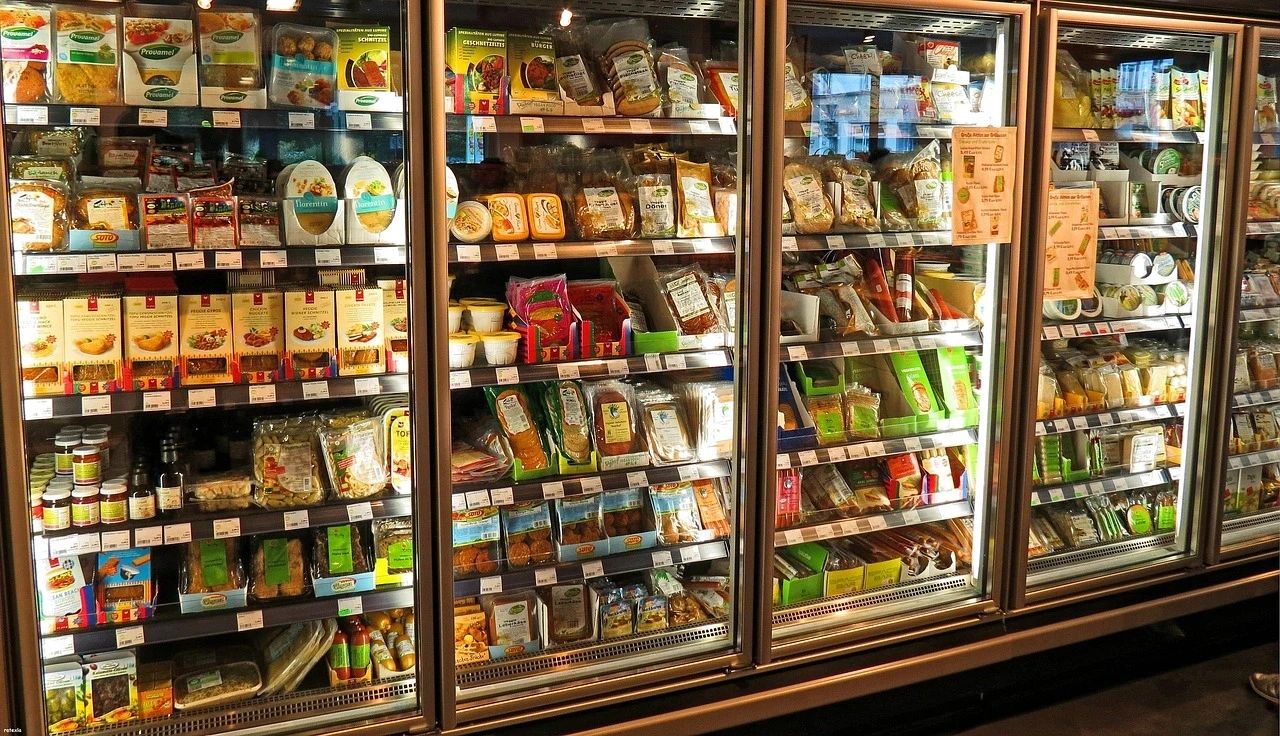
Shelf auditing: 8 benefits for your brand
What is a shelf audit and why implement it? 8 concrete benefits for brands in supermarkets: tracking facings, numeric distribution, out-of-stocks, and merchandising compliance.

In short
7 min read
Measure product visibility and actual shelf presence (facings, linear feet).
Verify compliance of product placement with commercial agreements made with retailers.
Analyze share of shelf and positioning relative to the competition.
Detect logistical issues, out-of-stock items, or ordering errors in stores.
Optimize commercial relations with distributors by highlighting promotional materials (POSM).
Identify the causes of a performance drop to adapt the sales strategy.
Centralize reliable data to refine route planning and field strategy.
If you sell your products in supermarkets and hypermarkets, you know how crucial it is to optimize your presence on the shelves. The shelf check is a key tool for monitoring your products' visibility and improving your merchandising. However, it is often underutilized or poorly structured, which reduces its effectiveness.
At Sidely, our mission is to boost your sales in supermarkets. Thanks to our sales CRM, your field teams can collect and analyze data in-store in just a few clicks, ensuring better sales execution.
In this article, we explain what a shelf check is, how to effectively integrate it into your strategy, and above all, we reveal the 8 major benefits that your brand can gain from it.
Ready to optimize your in-store presence? Follow the guide!
What is a shelf check?
The shelf check, also called a store check, is a field operation carried out by brands to measure the presence and visibility of their products on the shelves. It allows the collection of strategic data on product placement, prices charged, the share of shelf space occupied, and promotional displays.
Checking shelves makes it possible to evaluate compliance with negotiated agreements and analyze competition in the aisle. Shelf checks can be carried out by:
The brand's sales teams (sales promoters, area managers, etc.);
Specialized providers in field audits and checks or auxiliary sales forces as reinforcements;
Crowdsourcing solutions, where individuals carry out the checks on behalf of providers.
The shelf check is based on the analysis of quantitative data (number of facings, length of shelf space occupied, price, etc.) and qualitative data (promotional display, shelf appeal, presence of POS materials, etc.). It is a key lever for adjusting distribution strategies and maximizing sales performance in mass retail. It is particularly useful for brands with strong competition on the shelves.
The objectives of shelf checks
It serves to analyze the brand's visual market share (space taken on the shelf) and to optimize its merchandising:
Check if products are well-placed and comply with agreements negotiated with the retailer.
Verify the number of facings for each reference.
Calculate the share of shelf space
Compare shelf presence against competitors.
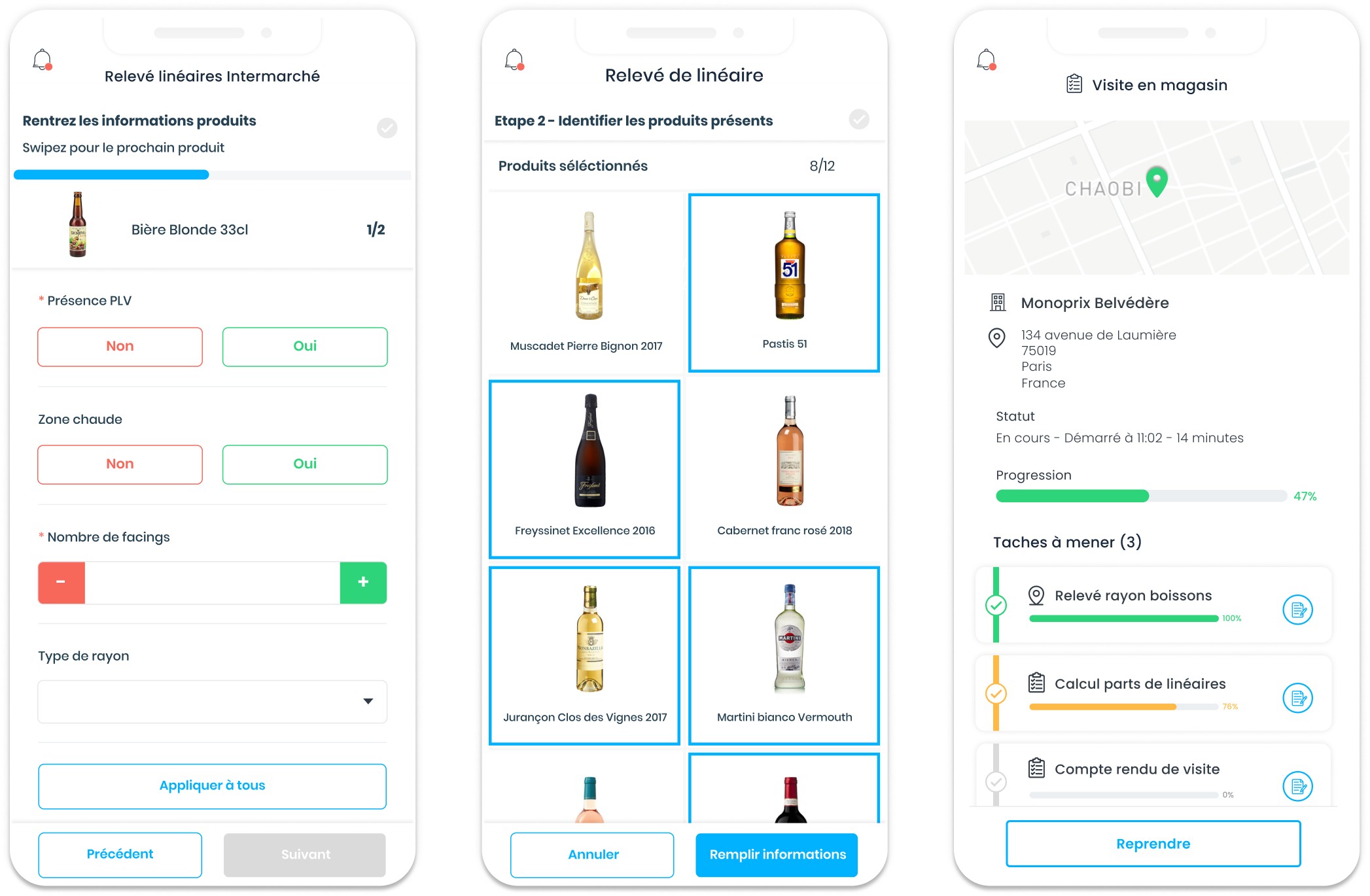
Example of a shelf check
Why carry out a shelf check?
A shelf check allows brands distributed in supermarkets to:
Evaluate their visibility in-store: the more facings a product has, the easier it is for consumers to spot.
Verify the implementation of commercial agreements: ensure that retailers respect commitments regarding the number of references and their prominent positioning.
Identify optimization opportunities: identify stores where placement is weak in order to negotiate better exposure.
Compare their positioning with the competition: Understand how other brands are positioned and identify areas for improvement.
We will look at all the benefits of shelf checks in the second part of this article.
What data is collected during a shelf check?
As an area manager, your primary objective during visits to supermarket retailers is the presence check. As you know very well, your distribution agreements do not mean that all the products concerned will be systematically integrated into your retailers' assortments.
💡 Difference between a presence check and a shelf check
A shelf check evaluates the space occupied by a product on the shelf. It allows analyzing the brand's visibility and optimizing its merchandising. A presence check, on the other hand, simply verifies whether a product is listed and available in the store.
These two checks complement each other to monitor product performance in stores. A shelf check necessarily includes a presence check (since a product must be present to be measured), but the reverse is not always true. A presence check can be limited to indicating whether a product is on the shelf, without detailing its placement (number of facings, share of shelf space, promotional displays, etc.).
The shelf check thus allows you to determine your product listing rate. This corresponds to the number of references present compared to the number scheduled by the contract. 4 products out of 5 correspond to a rate of 80%. 6 products present compared to 5 in the assortment give a listing rate of... 120%.
Number of mandatory products present | Number of additional products present | Number of products in the mandatory assortment | Listing rate |
|---|---|---|---|
4 | 2 | 5 | 120% |
5 | 0 | 6 | 80% |
2 | 3 | 7 | 71% |
The shelf check is therefore a crucial step to evaluate the factors impacting your brand's performance in your retailers' points of sale. You will want to record as many points as possible, such as:
Number of products in the range;
Number of missing products from the assortment;
Number of products present outside of the assortment;
Presence and size of the product location (no product = out of stock);
Presence of product and price tags;
Product prices;
Prices of competing products;
Facing reserved for the product;
Shelf level;
Type of aisle (e.g., organic);
Type of zone (hot, cold);
Type of promotional display.
How to conduct a shelf check?
The most efficient way to carry out a shelf check is to use a sales CRM or a specialized solution, accessible on mobile or tablet. This guarantees fast and reliable data collection in stores.
With Sidely, create and fill out your shelf checks in just a few clicks. All field data is centralized in one place, offering sales teams significant time savings and better efficiency in the field.

Simplified example of a shelf check
The 8 benefits of shelf checks in supermarkets
The benefits that your brand can derive from a well-structured, complete shelf check integrated into your sales software are multiple.
We will now review them!
1) Verify compliance with agreements made with the purchasing hub
The agreements that bind you to your retailers can include many criteria. As an area manager, your responsibility is to check that these are respected by your partner. Here are a few:
Are the elements negotiated in the sales contract being respected?
Is your product present?
In what quantity?
Are all the products in the assortment on display?
Do the prices correspond to what was discussed?
Is the facing correct?
Are the displays provided by the brand being used?
Are the promised promotions and product highlights being carried out? etc.
2) Improve your presence in points of sale
It is in your best interest to compare data relating to different points of sale in the same geographical area. Verifying the presence of your product in each store indeed allows you to calculate your numeric distribution rate (ND), which is the number of stores in which your product is distributed over a given area.
This analysis should be complemented by calculating the weighted distribution rate (WD), which corresponds to the market share of the points of sale in which your products are distributed.
ND should be analyzed based on two elements: are the right products in the right place? Are my products present in the stores that sell the most? To do this, it is important to compare WD and ND rates. We refer to the “20/80 store rule”: 80% of sales are generated by 20% of stores. This ratio may differ in reality, but the principle remains the same. Where should I focus my presence efforts? This element is essential and will help you determine your sales front, i.e., the stores you will focus on to maintain the relationship and increase their profitability.
By remaining attentive to the presence - or absence - of competing products at retailers, you will be able to determine the positioning and market shares of your product compared to your competitors. This overview of the competition then helps define your commercial strategy, optimize your route planning, and revise your sales objectives.
3) Advise your retailers to increase sell-out
On the other hand, using data from shelf checks helps to understand increases and decreases in sales. By linking the shelf check data with the sell-out (or cash register sales) in each store, you can draw connections between means and results.
For example, a visit to a point of sale may reveal factors contributing to the underperformance of your products:
The shelf space reserved for your product is almost empty;
Price tag is missing;
Shelf is not visible enough;
Product is in a cold zone along the customer's shopping path
Basically: you understand what drives sales, or what prevents them.
Collecting, comparing, and analyzing shelf check data then gives you arguments to better advise your retailers and thus increase sales. Beyond the checks, it is also interesting to take into account IRI and Nielsen data, which project the market share of your range and your brand.
Let's take a concrete example: you are a ham brand. The market share of ham in supermarkets, in the deli aisle, is 30%, and your brand's market share is 15%. During your visit, you realize that only 10% of the aisle is dedicated to hams. This negatively impacts the sales volume of ham, and therefore the profitability of the aisle. Based on these reports, advise the department manager to change the layout of the aisle, raising ham representation from 10 to 30% of the deli aisle. One good turn deserves another: negotiate to be positioned at eye level in the aisle, and of course, that your brand represents 15% of the aisle.
The ideal is then to use the data collected in other points of sale to increase the impact of your pitch to the retailer concerned by the lack of results. Indeed, if you have found that another point of sale in the same sector has implemented other practices, such as promotional displays, price levels, facing, or even the type of aisle, these are all factual arguments that you can use to convince the department manager to better showcase your products. Especially when the sales of the other points of sale have increased accordingly.
Remember, the department manager needs you to help them increase their revenue!
Here is a second example: you notice - backed by figures - that your organic product sells better when it is not in the organic aisle! Its placement in a standard food aisle might be counter-intuitive, but it's the results that interest you first and foremost. Your data then allows you to guide your strategy, but also to convince your partner. In such a case, you could advise them to place your product in a standard food aisle, but with an ORGANIC label, as well as an adjusted price. If another point of sale achieves a 40% higher revenue by selling the product for 15% less, the argument is unbeatable!
4) Track the average observed price
When you go through purchasing hubs, for example with Monoprix, retail rounds are generally an opportunity to discover at what price the points of sale are offering your products. This is the famous observed price.
This is a vital element for your business: indeed, consumers can be deterred by a retail price deemed too high, and your retailer may have ignored your recommended retail price to increase their margin. In this case, use the shelf checks of other points of sale to show that a lower retail price sometimes leads to higher results, including in terms of profitability!
5) Strengthen commercial relationships with retailers who value your products
When one of your retailers highlights your product, you owe it to yourself to pay special attention to the commercial relationship. You will then want to increase the frequency of visits to monitor the impact of the actions put in place. Your goal will thus be to contribute to the performance of POS (point of sale promotion), by proposing, for example, to add an in-store demo so that sales take off. Warning: if the operation is a failure, your retailer risks no longer listing this product...
It's up to you to pamper the supermarkets that give excellent visibility to the product, especially in an exclusive distribution model.
6) Detect potential bottlenecks in ordering and supply
When you notice missing products on the shelf, you must quickly discuss it with the department manager to determine the cause:
Is the space reserved for the product empty because there is a restocking problem?
Is the problem logistical?
Is it an out-of-stock situation?
Are orders taking too long to arrive?
Did the department manager forget to place the order?
Are orders too low compared to sales?
Are sales too low compared to competing products?
All of these explanations allow you to provide solutions by escalating the issue to the relevant people in the company.
7) Verify product alignment with consumer expectations
A shelf check is also an opportunity to investigate a lack of performance related to the product/demand match. Whether it is a slowdown of the range in general or a stronger appeal of competing products, do not neglect "market" criteria in your analysis.
Thus, take advantage of your visits to points of sale to talk with the department manager in order to adapt the sales strategy and thus revive sales, for example through demos or promotions. Report blocking points to the marketing department so that they can adjust their messaging in order to keep their customer base, and try to adapt to their new expectations.
8) Cross-reference data to refine your sales strategy
As we have seen, shelf checks bring you a wealth of crucial data in-store. By collecting them via a mobile CRM designed for retail, you allow your brand to align all these marketing and commercial actions:
Identify the factors that actually impact sales in the field;
Re-energize sales by implementing corrective actions;
Become a consulting force for the department manager who appreciates being able to rely on your data and analysis;
Better plan your sales routes;
Report logistics or marketing problems that hinder sales performance;
Determine a strategy across an entire sector by centralizing data related to different points of sale and competitors' actions.
Thus, developing and then defending your placement in a point of sale starts with a good shelf check with an efficient tool that facilitates its analysis. The reward? Winning market share in your territory and driving the overall performance of your brand based on the analysis of real data.
Sidely wishes you great sales!
Margot has been working in Tech and SaaS for 8 years, with a multi-product experience that has given her a unique understanding of business challenges. On a daily basis, she analyzes, relentlessly tests, and relies on facts to shed light on market trends and help sales teams move forward.
See also

Artificial intelligence and field professions: what our 2026 studies reveal
Adoption, barriers, use cases: discover what our three studies reveal about the role of AI among sector managers, sales representatives, and foodservice sales reps.

CHR and RHF Sales Representatives: portrait of a relationship-driven profession in the era of data
Equipment, productivity, AI: discover the major trends for the HORECA and food service sales profession in 2026 through our field study.

Pharmaceutical Sales Representative in France: Portrait of a Field Job Under Pressure
Compensation, aspirations, AI usage: discover the major trends in the pharmaceutical sales representative profession in 2026 through our field study.

Area Sales Managers in France: who are they and how is the profession evolving in 2026?
Compensation, aspirations, AI usage: discover the major trends in the field sales representative profession in 2026 through our field study.
The area manager professions in 2026
Discover the trends, the challenges, and the key figures.