

POS Advertising: How to Differentiate Your Brand in Large Retail Stores
What is POS (point-of-sale) advertising? Types of displays, design rules, and strategies to differentiate your brand in supermarkets and hypermarkets.

In short
9 min read
POS marketing acts as a key lever for differentiation in supermarkets, faced with the multiplication of brands.
There are three main types of POS marketing: permanent in-shelf POS, promotional POS, and temporary non-promotional POS.
The distinction is clear: POS (Point of Sale) promotes a product to trigger a purchase, while POI (Point of Information) provides educational, often permanent, information.
Phygital retail integrates digital elements into POS marketing (QR codes, kiosks, NFC) to enrich the customer experience and capture their attention.
POS displays range from classic posters and totems to immersive technological setups like augmented reality.
Mastering the conversion rate is essential for evaluating the actual chemical effectiveness of POS campaigns on sales volume.
Large-scale distribution is subject to an increasingly strong competitive environment, with the number of brands growing faster than the number of points of sale. Companies are thus faced with the need to stand out from their competitors (and private labels) so that customers buy their products. Point-of-sale advertising (POS advertising) has emerged as an essential lever in achieving this differentiation objective.
This article invites you to look at traditional as well as innovative strategies, to identify winning methods to implement with your distributors, and finally to review the best performance analysis methods for your POS advertising.
Point-of-sale advertising: the fundamentals
What does POS advertising correspond to?
Point-of-sale advertising (POS advertising) groups together all commercial communication media placed in-store to capture consumers' attention, direct their gaze toward a specific product, and thereby increase sales volumes.
What are the different types of POS advertising?
There are three main types of POS advertising:
Shelf POS advertising, which can be permanent. Its purpose is to add visibility to the shelves. It is therefore not linked to promotions. Examples include shelf talkers or "shelf strips";
Promotional POS advertising, which is temporary;
Temporary non-promotional POS advertising, such as end-cap displays.
What is the difference between POS advertising and POS information?
POS information (or in-store information) has an informative purpose. Its objective is to communicate educational details about a product or brand, whereas the goal of POS advertising is to promote a product in-store.
While POS advertising draws the consumer's attention to a product to spark their desire to discover it, POS information provides the consumer with elements of understanding to trigger the purchasing decision.
Generally, POS advertising is intended for temporary use, for example during a promotional marketing campaign. On the other hand, POS information is often permanent. Indeed, POS information outlines characteristics that tend not to change, as opposed to promotional offers.
This implies different materials depending on whether it is POS information or POS advertising.
Finally, it is possible to implement materials where both POS information and POS advertising are present and complement each other to create a better customer experience.
What are the main materials in POS advertising?
POS advertising can take various forms:
Posters ;
Promotional and/or modular displays : racks can be modular to adapt to inventory and available space. Placed on an end-cap, they can help double sales;
Totems : large cylindrical and vertical panels fixed to the floor, usually made of cardboard;
Shelf-talkers: signage elements to be placed in the aisles;
A-frame signs: also called pavement signs or poster holders, these POS materials are generally placed in front of a store, on a sidewalk, but can also be used in supermarket aisles;
Kakemonos : vertical posters suspended or on a stand.
Ballot boxes : elements to use when setting up promotional activities such as contests;
Advertising adhesives / window graphics;
Billboards;
Flags;
Boxes;
Arches;
Poles;
Hostess desks.
These materials are effective tools for capturing consumers' attention in retail outlets. They can be small or massive, depending on the events, periods, or promotions that justify their use. These are the traditional tools of on-site (in-store) advertising, and most brands use them. However, the emergence of new technologies has allowed the rise of more modern POS advertising, which enables brands to project a more current image.
Finally, it is possible to combine different types of POS advertising. In the example below, Maped combines kakemonos, banners, and cases...
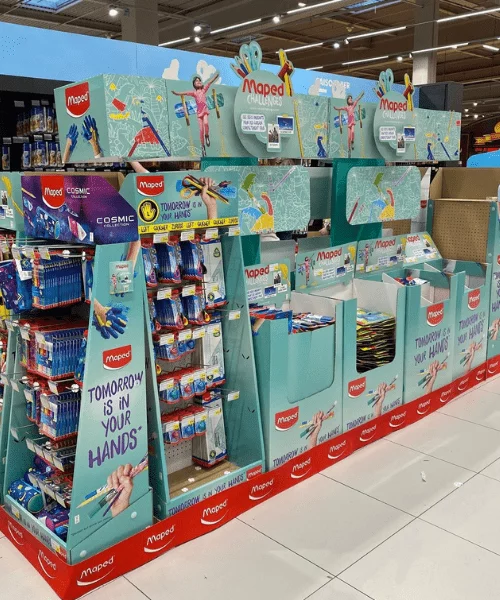
Credit Toutankarton
Innovative technology and POS advertising
POS advertising trends in supermarkets are constantly evolving to align with changes in customer behavior and technological advancements. To stand out, a brand can capitalize on the appeal that cutting-edge technologies hold for consumers by using innovative communication media. This is known as phygitalisation.
What is phygitalisation in POS advertising?
Phygitalisation, a fusion of "physical" and "digital," refers to the use of digital technologies coupled with physical media in the commercial communication system at points of sale, with the goal of enriching the customer experience.
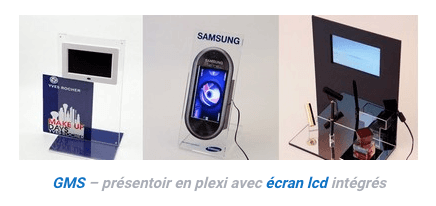
For example, customers can find a QR code to scan on a display that will give them discounts when buying a new product. Interactive kiosks are also highly popular. These devices make it possible to integrate a screen used either in informative mode (broadcasting videos) or in interactive mode (clickable menu to explore different features of a product, for example).
Immersive experience in supermarkets
The integration of augmented reality (AR) or virtual reality (VR) opens the door to creating unique customer experiences. The use of these tools will be particularly relevant for specific products, where an interactive and immersive experience will offer a more detailed visualization of product use. This approach aims to favorably influence the consumer, encouraging them to make a purchase.
For the moment, examples in supermarkets remain limited. An example in specialized retail is fashion brands. Zara and Ralph Lauren have set up fitting rooms equipped with interactive mirrors in some of their stores. They allow the customer to see what the clothing looks like without trying it on, to order other sizes, or even to choose other colors. This keeps them from leaving the cubicle, saves time for the customer, and reduces waiting times.
Interactive screens in supermarkets
With the same immersive experience objective in mind, interactive videos, 3D models, or simulations can be set up on interactive screens (interactive displays) so that consumers can view products from all angles.
It is then important to set up posters to show consumers how to use these new sales tools. Furthermore, it will sometimes be necessary to train an ambassador to present these new tools and encourage customers to use them. To improve the impact of these innovative sales devices, brands focus on promoting the benefits of the virtual product experience across different channels (brand website, social networks, etc.).
Credit Pop PLV
NFC and QR Code
Finally, NFC and QR Codes can be used separately or together to set up connected POS advertising.
What is NFC?
NFC, Near Field Communication, is a derivative of RFID. NFC is a wireless communication technology between 2 elements within a distance of 10 cm.
It is possible to integrate NFC tags directly onto products, but also in various locations at the point of sale, such as displays or posters.
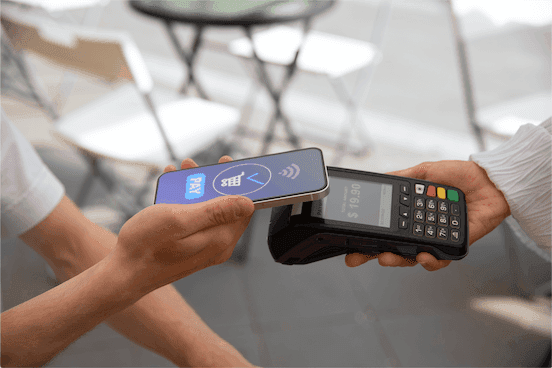
NFC tags act as interactive digital portals. Consumers only need to bring their smartphone close to the NFC tag to establish an instant connection.
With this simple action, consumers can access:
Additional and relevant information regarding a product;
Demonstration videos;
Customer reviews;
Promotional codes;
Contests.
© Image by Freepik
What is a QR code?
A QR Code, or Quick Response code, refers to a type of 2D barcode that can contain text or other types of data, such as web addresses that facilitate access to information via a smartphone.
In practice, QR Codes are integrated onto the product itself or on in-store materials. They link to dynamic content that can be updated regularly, such as promotions or product information.
In the context of launching a new product in a range, using a QR Code can allow you to create interactive and informative web pages, which will enable customers to visualize themselves using the product, thereby increasing sales.
Imagine that a competitor's product has just suffered bad press, and you are afraid your sales might suffer: why not use the QR code to direct your customers to a page featuring customer reviews.
NFC | QR Code | |
|---|---|---|
Range | Up to 10 cm | Several meters |
Usage | No app required, already present on the vast majority of smartphones | Flashcode reader integrated into the smartphone's camera |
Reading speed | Very fast (a few seconds) | More or less fast (depending on lighting and distance to the code) |
Deployment method | To make a medium "contactless," a Tag (sticker) must be applied to it | Simple printing of the code's visual... consequently extremely simple |
Cost | Low (implementation of an NFC chip on the order of a few cents) | Very low (printing the QR code is sufficient) |
6 techniques to plan and monitor your POS advertising campaigns with retailers successfully
In order to get maximum performance, it is important to know how to sell your POS advertising. Indeed, the objectives of your physical advertising devices and the type of network targeted (independent, integrated, etc.) will lead you to approach different interlocutors.
Knowing who and how to sell your POS advertising to
Type of POS advertising | Target interlocutor |
|---|---|
Permanent POS advertising | Department manager. |
Promotional POS advertising (and pirate promotions) | Department manager / Area manager / In-store Director-manager. |
Catalog promotion | Buyer or designated contact within the framework of annual negotiations |
Once you have opted for the right point-of-sale advertising devices and succeeded in selling / validating them with the contacts mentioned above, you must ensure that they are actually and correctly integrated into the points of sale concerned.
Establish a joint plan
Work with your distributors on a joint plan to implement the POS advertising. To do this, determine the campaign goals for each party as well as the common objectives.
Distributors and field managers know the most coveted locations, so the goal is to find common ground!
Choose which product to highlight
Taking into account your assortment strategy, identify which product(s) maximize overall revenue. With this objective in mind, discuss all aspects that will best attract potential customers' attention. The various challenges of POS advertising will be central to the discussions in order to position a product with a design that stands out in a crowded space, optimize space, and adapt the POS advertising to the product's faster or slower rotation.
As a general rule, manufacturers highlight an innovative or new product, but their choice sometimes falls on a product that guarantees good rotation with traditional POS advertising. A final case concerns promotional POS advertising, which often involves discounting products to clear stock.
Optimize logistics
The logistical aspect is important to ensure that the in-store setup is indeed the one determined beforehand. During their commercial tours, your area managers must carry out checks to make sure. You can thus use POS advertising elements in the form of modules that best adapt to the available space or volume constraints in each point of sale. Remember to ensure correct installation.
Train the staff in charge of implementing the POS advertising
The next step is to train your area managers. They must know the types of POS advertising your brand offers, how and when to sell them, what is offered, what is paid, and above all, the right arguments that will allow them to sell these advertising devices.
But it doesn't stop there! You then need to proceed with training the in-store staff, especially when technological elements are involved. You may sometimes need to recruit external store ambassadors.
Communicate before, during, and after the implementation of POS advertising
For permanent POS advertising, monitoring is carried out by area managers during field visits. Merchandising elements are indeed among the points to watch regarding presentation. The shelf check must therefore take them into account.
Regarding specific campaigns, the brand and its distributor must maintain constant communication. During and/or at the end of the campaign, an analysis phase begins, allowing you to study the performance of the POS advertising, thanks to sales data and consumer behavior. This evaluation allows you to adjust the strategy of your future campaigns and capitalize on lessons learned from the experience.
Analyzing the impact of point-of-sale advertising
Monitoring POS performance serves in particular to evaluate the effectiveness of the installed POS materials, but also of marketing campaigns for promotional POS advertising. If applicable, implementing QR codes and NFC tags will allow real-time data collection. However, analysis generally requires access to checkout data and conducting your shelf audits with the help of a CRM application dedicated to performance in supermarkets.
Your area managers can then install the POS advertising and check it during each store visit to see if it is still there and properly set up. This helps in understanding if the device had an impact on sales. When this is the case, the department manager validates the presence of the advertising equipment on the shelf for an extended period. It is also important to ask them for feedback on this occasion. They can take a picture of the aisle for visual analysis.
During the studied period, it is also possible to analyze sell-in to evaluate the increase in orders in relation to the actions implemented in the point of sale.
Tests before national rollout of POS advertising
Furthermore, investing in communication media at the point of sale must be justified by an increase in profits, but success is not always guaranteed! This is why conducting a POS test will limit financial risk-taking and identify areas for improvement.
This pre-test will evaluate several POS tools, examining both their content and their form.
Different methods are possible:
Creation of a panel representative of the product or brand target:
Individual presentation of different designs;
Presentation within roundtables of different designs: during which exchanges between panel members can take place;
Conducting qualitative surveys:
Setting up an online forum;
In-store survey, with a parallel contest to encourage feedback;
Setting up real-life tests with the presentation of different POS options (design, type of POS, location of the POS in-store) in distinct sales locations to compare the results obtained.
Measuring the impact of POS advertising using checkout data
To analyze the repercussions of tests or the actual implementation of POS advertising, it is essential to obtain checkout data from your retailers. Indeed, unlike sell-in, which evaluates the order level by the central office, sell-out (checkout data) gives you results by retail outlet. Checkout data is therefore the best way to compare sales before and after the deployment of your point-of-sale advertising.
Measuring the return on investment (ROI) of POS advertising
This checkout data will be used to determine the ROI.
As a reminder, ROI (return on investment) is calculated as follows:
ROI = (Investment Gains - Investment Costs) / Investment Costs x 100
Investment gains correspond to the profits generated thanks to the POS advertising.
Investment costs group together those associated with the design, manufacturing, and setup of this POS advertising.
The ROI will determine the financial profitability of the investment made in the POS advertising. Thus, it is possible to identify which communication media were the most profitable. This will help direct the brand's marketing budgets toward the most effective tools.
Conversion rate
The conversion rate when implementing POS advertising is essential for effective marketing campaign management.
In the context of POS advertising, the conversion rate is calculated as follows:
Conversion rate = (Number of conversions / Number of visitors exposed to the POS advertising) x 100
The number of conversions corresponds to the number of purchases made by customers exposed to this POS advertising over a given period.
The number of visitors exposed to the POS advertising groups the total number of potential customers exposed to this same POS advertising during the studied period.
The conversion rate indicator monitors the effectiveness of POS advertising in the purchasing process.
We have thus seen the crucial importance of differentiation in the retail sector, characterized by intense competition among brands in the same sector. Point-of-Sale (POS) advertising is an indispensable tool for standing out, and phygitalisation is a strong lever for differentiation. Furthermore, close collaboration with distributors is essential, and the analysis of sales data is a key aspect of this collaboration. Monitoring performance indeed allows for adjusting strategies for future campaigns.
Margot has been working in Tech and SaaS for 8 years, with a multi-product experience that has given her a unique understanding of business challenges. On a daily basis, she analyzes, relentlessly tests, and relies on facts to shed light on market trends and help sales teams move forward.
See also

Artificial intelligence and field professions: what our 2026 studies reveal
Adoption, barriers, use cases: discover what our three studies reveal about the role of AI among sector managers, sales representatives, and foodservice sales reps.

CHR and RHF Sales Representatives: portrait of a relationship-driven profession in the era of data
Equipment, productivity, AI: discover the major trends for the HORECA and food service sales profession in 2026 through our field study.

Pharmaceutical Sales Representative in France: Portrait of a Field Job Under Pressure
Compensation, aspirations, AI usage: discover the major trends in the pharmaceutical sales representative profession in 2026 through our field study.

Area Sales Managers in France: who are they and how is the profession evolving in 2026?
Compensation, aspirations, AI usage: discover the major trends in the field sales representative profession in 2026 through our field study.
The area manager professions in 2026
Discover the trends, the challenges, and the key figures.