

7 Practices for Improving the Customer Experience
Discover 7 field practices to strengthen the relationship with your stores, anticipate their needs, and remain indispensable on the shelf.

In short
4 min read
Optimizing the customer experience is crucial, as retaining a customer costs significantly less than acquiring a new one and increases profitability.
The emotional aspect (trust, connection) at the heart of the sales process makes it possible to create a unique purchasing moment and strengthen loyalty.
Marketing and sales forces must be aligned, using digital tools, to ensure continuity and personalization throughout the customer journey.
It is essential to properly qualify customer expectations, which are often poorly expressed, through an active questioning process rather than relying on pre-made arguments.
Active listening is the key skill: it makes it possible to move beyond the salesperson's objectives to focus on the customer's real needs and establish an expert advisor relationship.
Rigorous information management (quick reporting, use of a mobile CRM) is necessary to avoid loss of knowledge and maintain a consistent quality of exchange.
Acquiring a new customer costs 5 to 25 times more than retaining an existing one, according to a study by the Harvard Business Review. This highlights the crucial importance of optimizing the customer experience to not only retain but also increase customer loyalty.
Furthermore, a 5% increase in customer retention rate can increase profits by 25% to 95%. This fact highlights the need to optimizing the customer experience and retaining customers, in order to sustain business activity and increase profitability.
In B2B, the hunt for the customer experience aims above all to retain customer loyalty in the long term in order to guarantee recurring revenues and reduce annual acquisition efforts.
This customer experience is defined by creating a unique moment of exchange between your sales force and the customer.
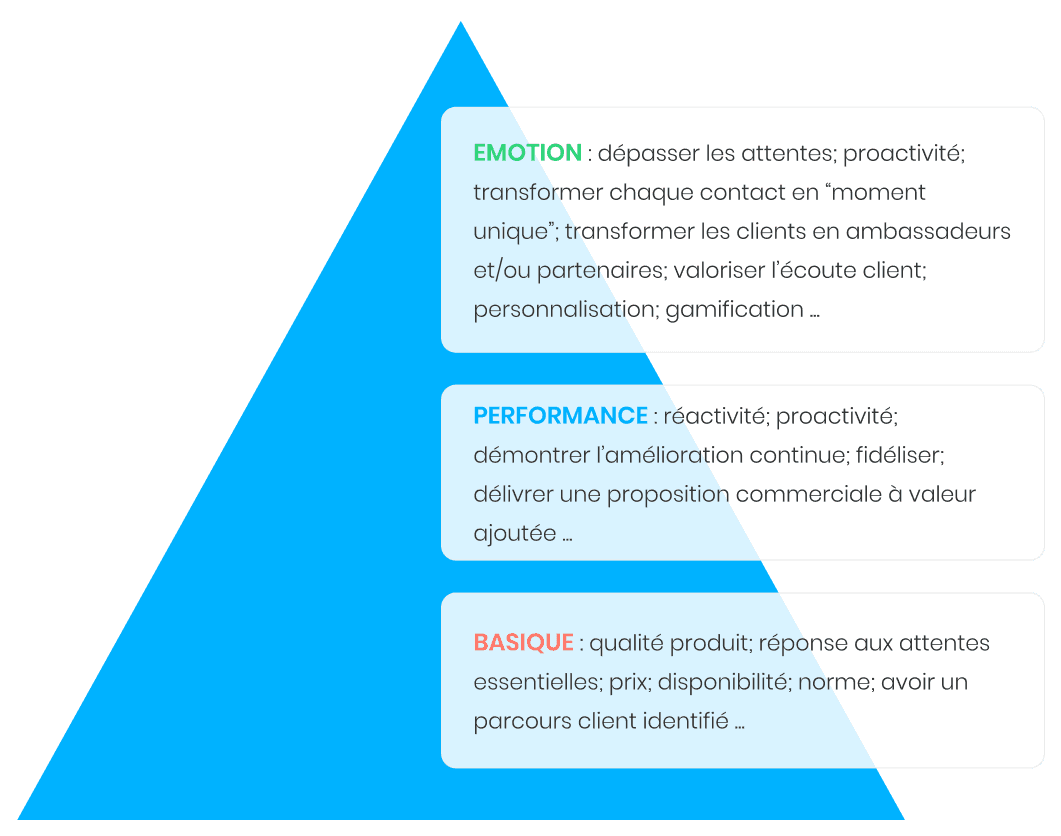
And the creation of this moment starts long before the meeting between the customer and the sales representative. It is imagined and designed by marketing teams working on writing communication materials and language adapted, before being presented by your sales force in the field.
This initial preparation is crucial to establish a solid foundation that will then be enriched and personalized by your sales force. This is why it is essential to align marketing efforts with those of field sales reps. By training and using the right digital tools, they will be able to convey the right messages.
Purchasing decisions are often influenced by emotional factors, such as trust, satisfaction, and a sense of personal connection. It is therefore by putting emotion at the heart of your sales process that you will create a unique buying moment, increase sales opportunities, and retain your customers.
7 basic rules for improving the customer experience
Offering an exceptional customer experience can become your greatest advantage, allowing you to better position your products on the shelves. In supermarkets, everything hinges on the relationship your brand maintains with its banners and stores. Let's discover 7 basic principles together for offering a good experience and developing a long-lasting customer relationship.
Making a good first impression
The customer experience is multi-channel and starts with the very first interaction. The first impression is crucial in the customer journey. According to a Salesforce study, 75% of customers expect a consistent experience, regardless of the channel they use. It is therefore essential to preserve this continuity during subsequent exchanges and not lose any information about the customer's journey during their buying process.
Well identifying customer expectations
The priority of a sales representative is to understand their customer's expectations in order to offer them personalized support. But very often, the latter does not know exactly what they want, for three main reasons:
They have not verbalized their problem;
They are not familiar with the solution your sales rep is proposing;
They are focused on their problem and not on its resolution.
If the sales rep does not take the steps to identify the customer's expectations through a series of personalized and consistent questions, the customer will steer the conversation and focus on what they want to know with a strong cognitive bias.
Their topics will revolve around the price, the service, and the quality of the solution.
The sales rep will find themselves blocked by their lack of qualification and will be forced to develop a value proposition, a list of arguments, and answers to the buyer's standard questions.
Standard questions = Standard answers = Standard customer experience
This is why it is vital to set up an effective sales and qualification process, and learn how to ask the right questions. This helps to identify customer expectations without pre-made questions.
Reaching the customer's goals, not yours
Prospect and customer expectations have become increasingly high since they gained access to information. As a result, it is considered that 57% of B2B buyers' purchasing process is already completed before contacting a salesperson. This shift in the buying process forces sales reps to deliver responses that are as close as possible to the customer's expectations, which is already a significant challenge for sales departments.
By attempting to exceed the buyer's expectations, the sales rep suggests options that are inappropriate for the customer, thinking they are differentiating themselves. The message gets garbled, and the buyer no longer sees how their goal aligns with your product/service.
Consequently, the salesperson degrades the customer experience in pursuit of a sale, becoming too salesperson-like and not enough of an advisor.
This is why you must train your sales reps to listen. By directing the discussion while letting the customer speak, they will better understand their expectations and goals. Remember that customers are often very similar. In any given industry, they generally want to address the same objectives and challenges. Therefore, take your experience, your successes and failures, and turn this knowledge into an ideal customer experience.
Respecting the customer's complexity
It is essential for the salesperson to adapt their questions and answers to the structural challenges of the customer, and not take a simplistic approach to the customer's complexity. Thus, through a series of questions, the salesperson must understand the customer's decision-making process and the complexity of that decision. This purchase is tied to other issues unknown to the salesperson.
This approach makes it possible to build a personalized sales plan with the customer that matches their expectations, which will consequently be harder to refuse and will significantly enhance the buying experience.
Challenging the customer's ideas
Believing that a good customer experience consists of constantly saying "yes" to your customer is a misconception. ("Start with no" Jim Camp)
A successful interaction with the customer does not always mean agreeing with them. Sometimes, it is necessary to challenge the customer's ideas. But beware, you must challenge your customer’s ideas with tact and intelligence, meaning by asking questions.
Your customer wants to build a relationship with an intelligent person who understands their problems and has the ability to take them to another level of thinking.
To advise your customers in the best possible way, it is essential to rely on both your internal data and external data (IRI, Nielsen...). Combining this data - if analyzed well - will allow you to stand out from market trends. Let’s take a concrete example: assume you launched a promotional campaign that was highly successful in a specific supermarket. Your category managers can then suggest the same operation to other stores in your network with similar characteristics (size, tier, customer type), using solid evidence. The goal is to develop a proactive sales approach, offering solutions even before potential problems arise. This strategy positions your salespeople and your brand as expert references in their field, thereby reinforcing their credibility and value-add with customers.
Hearing is not listening
Buyers believe that sales reps do not listen enough and are too self-centered on their sales. This is why the primary quality of a top-performing salesperson is their ability to listen.
Listening does not mean letting the customer talk while following the flow of the conversation with varying levels of interest. It means seeking customer engagement, being attentive to what they say, asking questions, and taking an interest in the problems they face, their organization, their strategy, their own customers, and their other suppliers.
Understanding your customer through listening and personalizing the customer experience are at the heart of loyalty.
Not losing any part of the exchange
According to the Ebbinghaus curve, 80% of information is forgotten after one week. How many field sales reps only write their reports at the end of the week, thus losing the valuable insights gained? Meeting reports must be completed as soon as possible. Doing so reinforces active listening and allows them to interact more effectively with their prospect next time.
In addition to suitable training, providing a mobile CRM is a particularly effective way to help field sales reps drastically improve customer experience due to permanent access to interaction history and information shared with a customer.
Alexis co-founded Sidely after several years of service as a sales director. To understand what builds, or breaks, a salesperson's performance, he conducted more than 100 telephone interviews with field sales representatives. At Sidely, he transforms this raw knowledge into concrete support, based on facts rather than assumptions.
See also

Artificial intelligence and field professions: what our 2026 studies reveal
Adoption, barriers, use cases: discover what our three studies reveal about the role of AI among sector managers, sales representatives, and foodservice sales reps.

CHR and RHF Sales Representatives: portrait of a relationship-driven profession in the era of data
Equipment, productivity, AI: discover the major trends for the HORECA and food service sales profession in 2026 through our field study.

Pharmaceutical Sales Representative in France: Portrait of a Field Job Under Pressure
Compensation, aspirations, AI usage: discover the major trends in the pharmaceutical sales representative profession in 2026 through our field study.

Area Sales Managers in France: who are they and how is the profession evolving in 2026?
Compensation, aspirations, AI usage: discover the major trends in the field sales representative profession in 2026 through our field study.
The area manager professions in 2026
Discover the trends, the challenges, and the key figures.