

Customer scoring: how to identify your high-priority customers for field visits?
What is lead scoring and how do you implement it? Criteria, calculation methods, and concrete examples to prioritize your field visits.

In short
6 min read
Customer scoring assigns a factual rating to each point of sale to help field sales representatives focus their efforts on the most strategic customers.
It is based on crossed operational data: sales (sell-in/sell-out), visit history, and strategic stakes such as product launches or management objectives.
It is a decision-making tool that structures field activity without removing the representative's expertise, allowing them to better prepare their visits and action levers.
For management, it makes it possible to disseminate consistent priorities, align efforts with business stakes, and manage activity without micro-management.
The effective method consists of defining measurable criteria, weighting them, and segmenting customers into priority levels to adapt the frequency of visits.
A good scoring is dynamic: it updates automatically after each visit to reflect the reality of the field and continuously adjust the next rounds.
Between the lack of time, pressure from targets, and the increasing number of points of sale to manage, prioritizing field visits remains one of the main challenges for traveling sales reps.
Customer scoring provides a concrete solution to this problem: it makes it possible to clearly identify which customers to visit as a priority, based on objective data.
In this article, we explain what customer scoring is, what purpose it serves in the field, and how to use it effectively to organize your sales routes.
What is customer scoring?
Customer scoring in a CRM for traveling sales reps consists of assigning a score to each point of sale (which are customers) in order to indicate where to focus field efforts as a priority.
It helps the sales rep know which customers to visit, when, and why, relying on factual data rather than intuition alone.
The principle of customer scoring
Each customer is assigned a global score, calculated based on several criteria defined by the company.
The higher the score, the more the customer is deemed a priority for a visit, a sales action, or specific follow-up.
This score is visible directly in the CRM, often on the customer file, the map, or the route.
The criteria used in a field CRM
For traveling sales reps (supermarkets, food service, hospitality, specialized retail, etc.), scoring generally relies on very operational data, such as:
Sales and commercial data: sell-in, sell-out, sales trends, estimated potential of the point of sale, market share, shelf share...
Visit and field data: actual frequency of visits, date of the last visit, execution quality (shelf presence, compliance, merchandising), results of the latest actions (promotions, product displays, negotiation)...
Strategic and situational data: store type (key, secondary, opportunity), store status (active, passive, top customer), current priorities (product launch, numeric distribution catch-up, network animation), targets set by headquarters or management...
Each criterion can be weighted, depending on what matters most to your strategy.
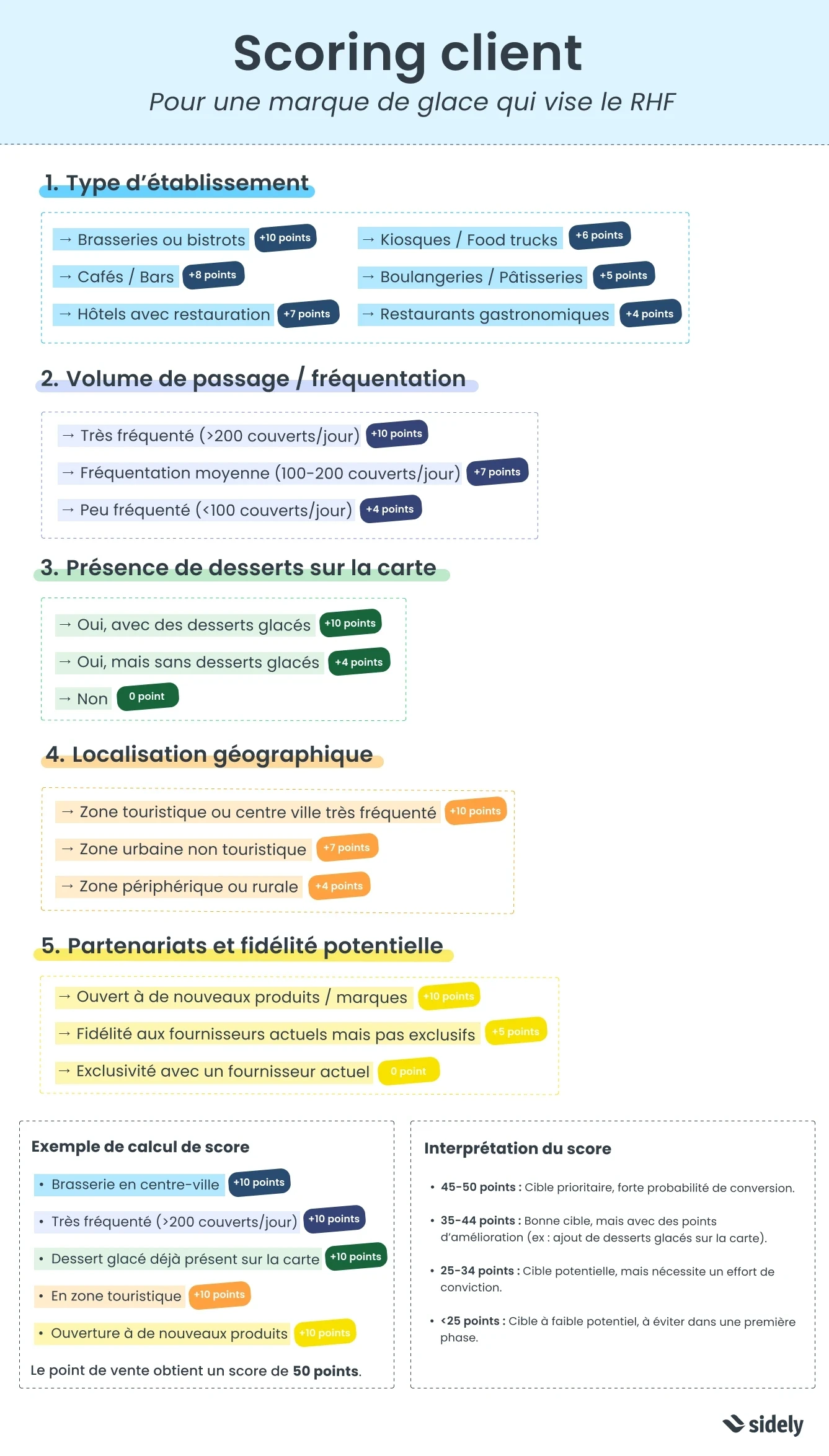
Example of customer scoring for the food service network
How does scoring help a traveling sales rep?
Prioritize visits
Scoring makes it possible to quickly identify:
points of sale with high potential
those that require corrective action
those that can be visited less often
This results in a more logical and efficient route.
Better prepare each visit
Before arriving at a store, the sales rep knows:
why this point of sale is a priority
which levers to activate (order, visibility, negotiation)
what concrete target to pursue
Avoid dispersion
Without scoring, visits are often dictated by:
habit
geographical proximity
ease
Scoring brings business logic back into field organization. Keep in mind, it does not replace the sales rep's experience; it structures it.
How does scoring help sales management?
For managers and sales directors, customer scoring allows them to:
disseminate clear and consistent priorities.
align field visits with business challenges
analyze network coverage and the efforts actually deployed
It is also a valuable tool for monitoring activity, without micro-management.
How to use it to identify priority customers for field visits?
To identify priority customers for field visits, customer scoring must be used as a decision-support tool, integrated directly into route preparation and organization.
Here is a clear and operational method, designed for traveling sales reps.
Define what a “priority customer” is
A priority customer is not necessarily the one that generates the most revenue. It is a point of sale that meets at least one specific business target, such as a "decline in performance to be corrected," "key point of sale for an ongoing campaign," or "development opportunity (new range, listing, visibility)."
Scoring serves precisely to translate these challenges into measurable criteria.
Build a clear and actionable score
To be useful in the field, the score must answer a simple question: "Should I visit this customer now?" / "Is it useful for me to visit this customer now?".
If the answer is yes, then they are a priority. If not, you can probably remove them from your next route.
To know if the answer is "yes" or "no," you must base it on tangible criteria that meet your targets, such as potential vs. generated revenue, sales trends over the past few weeks, or actions to be launched.
Each criterion receives a weight.
The final score makes it possible to classify customers into priority levels.
Segment customers by priority level
At Sidely, we advocate the 80-20 principle, known as Pareto's Law. "Acting on 20% of causes resolves 80% of the problem," or according to Sidely, "Acting on 20% of your customers allows you to retain 80% of your revenue." In other words, we advise you to prioritize those who bring in the most revenue.
Next, operate by sales targets. Rather than a raw score, the ideal is to work by clear categories:
Priority 1: to be visited quickly
Priority 2: to be included in the route if possible
Priority 3: lighter or occasional follow-up
Use scoring to prepare your route
Before heading out into the field, sales reps can filter their customers by score level, visualize priorities on a map, and build a route that combines business challenges and geographical optimization. We advise you to create views for each sales rep that take scoring into account. For example, you can build a "priority visits" view or a "customers to visit for the Christmas campaign" view, which allows your sales reps to know which list to choose.
Each sales rep has their personalized view, according to their sector and needs. This segmentation makes it possible to build a logical route, make easy trade-offs when time is short, and justify visit choices.
Adapt visit frequency based on the score
Scoring is also used to define how many times to visit a customer:
high score → more frequent and targeted visits
intermediate score → regular follow-up
low score → spaced out or opportunistic visits
This avoids over-visiting low-strategy points of sale or under-exploiting high-potential customers.
Continuously reassess priorities
A good field scoring system is never set in stone.
It evolves with:
data collected during visits
the results of actions taken
current commercial priorities
After each visit, the information entered into the CRM updates the score, which automatically adjusts the next priorities.
Alexis co-founded Sidely after several years of service as a sales director. To understand what builds, or breaks, a salesperson's performance, he conducted more than 100 telephone interviews with field sales representatives. At Sidely, he transforms this raw knowledge into concrete support, based on facts rather than assumptions.
See also

Artificial intelligence and field professions: what our 2026 studies reveal
Adoption, barriers, use cases: discover what our three studies reveal about the role of AI among sector managers, sales representatives, and foodservice sales reps.

CHR and RHF Sales Representatives: portrait of a relationship-driven profession in the era of data
Equipment, productivity, AI: discover the major trends for the HORECA and food service sales profession in 2026 through our field study.

Pharmaceutical Sales Representative in France: Portrait of a Field Job Under Pressure
Compensation, aspirations, AI usage: discover the major trends in the pharmaceutical sales representative profession in 2026 through our field study.

Area Sales Managers in France: who are they and how is the profession evolving in 2026?
Compensation, aspirations, AI usage: discover the major trends in the field sales representative profession in 2026 through our field study.
The area manager professions in 2026
Discover the trends, the challenges, and the key figures.