

HORECA: presentation of the sector and its challenges for brands
Cafés, Hotels, Restaurants: what is the CHR sector, how much does it weigh, and how can you distribute your products in it? A complete guide for brands wanting to enter the market.

In short
15 min read
Definition and scope of the CHR (Cafes, Hotels, Restaurants) sector.
Analysis of the economic importance and weight of the CHR market.
Logistical and operational challenges for product distribution.
Effective entry strategies for brands wishing to establish themselves.
Current trends and growth levers in the out-of-home dining sector.
Does your food or beverage brand want to develop its sales in the On-Trade (CHR) market ?
It makes perfect sense! This sector is a real economic engine for France and is full of business opportunities. To help you understand this market, which is as rich as it is complex, Sidely offers an overview of its organization and the commercial challenges surrounding it for the agri-food industries.
We will start by reviewing the major trends and key figures of the CHR sector in France, and then we will look at its specific characteristics in terms of distribution and sales development.
📚 Warning: long format, we are going back to the school bench for about fifteen minutes 🤓
1. Introduction to the CHR sector
CHR, an acronym for Café, Hôtel, Restaurant, is an essential sector of the French economy.
The variety of establishments that make up this sector makes it difficult to establish global figures, but the commercial catering sector alone represents no less than 179,000 establishments, with nearly 500,000 employees.
As for tourism, it represents 7.5% of the French GDP, giving an idea of the importance of the hotel sector in the French economy. We can thus estimate that the CHR exceeds one million employees, a figure that is still insufficient since many establishments still struggle to recruit. A real achievement for a sector that showed a lot of resilience coming out of the COVID-19 pandemic.
At the origin of this maintenance, technological innovations and new consumer expectations pushing the sector to evolve continuously, opening up new commercial opportunities for brands wishing to venture into it!
Agri-food manufacturers indeed consider the CHR as an extremely strategic market. For example, the sector represents 25% of beer sales in the French market (compared to 75% for the food retail sector).
💡 Acronym time
You might also hear the acronyms HCR, CHRD, HORECA, or even CAHORE, or CHRD depending on the language or region. All of this refers to CHR!
For the complete list (OOH, CHD, F&B, etc.), discover out-of-home catering.
2. The cafes and bars segment
Cafés and bars play a central role in social and cultural life in France. In 2019, the country had about 45,000 cafés and bars, and the turnover of drinking establishments would be around 5 billion euros. These establishments are places of conviviality and meeting, symbolic of the French lifestyle. Brands know it: consumption in these spaces is associated with relaxation and conviviality. It is therefore a strategic location for sensory marketing!
Evolution and typologies
Cafés and bars in France have evolved over the years to meet the changing needs and tastes of consumers:
Traditional cafés: with their warm and welcoming atmosphere, these establishments are places of relaxation where you can enjoy a coffee, read a newspaper, or chat with friends.
Cocktail bars: specializing in the preparation of craft cocktails, these bars attract a clientele looking for innovative and quality drinks.
Literary and artistic cafés: providing a setting for cultural events, intellectual discussions, and art exhibitions.
Wine and beer bars: highlighting selections of wines and beers, often local and artisanal, for lovers of these beverages.
To these "traditional" formulas are added newer and, above all, more adapted models to new consumer expectations. We are speaking in particular of eco-responsible cafés, highlighting sustainable practices, such as the use of organic products, waste reduction, and recycling, as well as hybrid concepts, combining shared work spaces (coworking), bookshops, or art galleries, designed to offer a "multifunctional" experience. In major cities, the trend is therefore towards third places in which several activities occur (activities for children, exhibitions, cafés, restaurants...) at the same time. New consumption patterns are developing around brunch and coffee shops or mixed venues (such as the café/hair salon of YouTube star Natoo). The trend is therefore to create places where people do more than just have a meal or a coffee.
While the long term seems to outline a decline in the sector (France had no less than 200,000 establishments in the 60s!🍷), the café and bar sector in France remains dynamic, innovative, and above all culturally important for French people, its social dimension having clearly reclaimed its place coming out of Covid!
3. The catering segment
The catering sector is just as diverse and dynamic, with a variety of options for all tastes and budgets. In 2019, it had about 175,000 establishments, generating a turnover of nearly 57 billion euros (twice as much as collective catering!). This figure has exploded since then, but largely under the effect of recent inflation, with demand being substantially identical, or even slightly down, also due to the cost of living.
Type of restaurants
France is known for its culinary diversity, with restaurants ranging from small local brasseries to prestigious Michelin-starred establishments.
Among them you can find:
Gourmet restaurants: offering refined and often innovative cuisine, these establishments are recognized for the quality of their service and dishes.
Bistros and brasseries: more casual, they offer traditional French dishes in a friendly atmosphere.
Themed and ethnic restaurants: reflecting cultural diversity, these restaurants offer cuisines from all over the world.
Street food and food trucks: in full expansion, they respond to a growing demand for fast, affordable, and high-quality meals.
Current trends
The restaurant sector is constantly evolving to meet new consumer expectations. Here are some major trends:
Organic and local food: more and more restaurants prioritize organic and local products, responding to a growing demand for healthy and responsible food.
Digitalization: the use of technology, such as meal delivery apps, online reservations, and digital menus, has developed heavily.
Sustainability and eco-responsibility: restaurateurs seek to reduce their ecological footprint by adopting sustainable practices, such as reducing food waste and using recyclable materials.
Unique culinary experiences: restaurants innovate to offer immersive and memorable experiences, such as themed dinners and open kitchens.
Takeaway and home delivery: this is the most radical change since Covid. The delivery revenue amounted to 7 billion euros in 2023 and is expected to reach 9.2 billion in 2026!
The restaurant sector continues to reinvent itself to appeal to a diverse and demanding clientele, while remaining faithful to its rich gastronomic heritage.
4. The hotel segment
The hotel sector is a pillar of the French tourism economy, with a diverse offering that attracts millions of visitors every year. In 2023, France had about 17,000 hotels with 650,000 rooms. 80% of these establishments are independent, contrary to the image of a highly consolidated market that one might have. They represented a turnover of 21 billion euros and nearly 180,000 jobs before the Covid crisis.
Hotel Classification
Tourist hotels can obtain a star classification (from 1 to 5), regardless of the number of rooms they have. This classification is optional, but almost all hotel operators request it, as this evaluation concept is highly expected by customers.
The allocation of stars is based on criteria divided into four categories:
Quality of comfort of equipment;
Quality of services offered to customers;
Good practices in respecting the environment;
Good practices for welcoming customers with disabilities.
For brands aiming to distribute their products in hotels, this classification constitutes an obvious way to build marketing segments corresponding to the targeted type of customers (habits, purchasing power, values, etc.).
Types of accommodation
In addition to traditional hotels, our beloved country has a diverse range of accommodations:
Inns and guest houses: offering a more intimate and often more authentic experience.
Tourist residences: suitable for extended stays, with services similar to those of hotels.
Vacation rentals: increasingly popular, notably via platforms like Airbnb.
Boutique hotels: small, charming establishments, often located in unique places, offering personalized experiences.
Innovation and trends
The hotel sector is evolving to meet new customer expectations:
Eco-hotels: environmentally friendly, they adopt sustainable practices to minimize their ecological impact.
Technology and digitalization: integration of modern digital systems such as digital keys, concierge services via applications, and automated check-ins.
Immersive experiences: hotels seek to offer unique stays, with specific themes, cultural activities, and exclusive services.
The hotel sector in France continues to adapt and innovate to maintain its attractiveness and offer memorable stays to its clients, thereby contributing to France's reputation as a top tourist destination.
In terms of marketing and communication, this target has the peculiarity of confronting the brand with an international audience. The "discovery" dimension can be an opportunity as well as a barrier.
5. Challenges and opportunities
Despite its vitality and capacity for innovation, the CHR sector faces major structural difficulties. The Covid-19 pandemic did not help the shortage of human resources that the sector has experienced for a long time. It is complicated to recruit, train, and retain employees in food trades, and this difficulty limits the development of many establishments.
Furthermore, the increase in costs of raw materials, energy, and rents weighs on the profitability of businesses in the sector. The cost of gas and electricity in particular has weakened many establishments.
Digitalization, however, offers significant opportunities to improve operational efficiency and customer experience. Online ordering applications, integrated management systems, and contactless payment technologies are increasingly being adopted. They represent a partial but effective response to the human resource deficit in the sector.
Among the major trends impacting the CHR, we should also mention ecology and sustainability, but also local turism, which is also more eco-friendly and generally based on authenticity and the appreciation of cultural heritage.
📚 A survey conducted by NielsenIQ in December 2023 on the theme of purchasing power and its impact on the CHR sector identifies various trends:
Nearly one in two French citizens limit their outings;
Against the trend, those under 35 are increasing their attendance in the CHR sector;
The French are going out less, but are not sacrificing quality;
Inflation has a direct impact on the levels of alcohol consumption in the CHR sector;
Purchasing power is obstacle number 1;
Pleasure is the primary motivation for going out;
56% justify the choice of a place by a good quality/price ratio (+27%!);
71% of Gen Z visits the CHR sector every week, with new expectations, such as no alcohol / low alcohol;
The youngest heavily use digital tools to research before going out.
Scope: That's the overview of the sector.
But for a brand that wants to accelerate its development in the CHR sector, what is there to know about the industry?
→ We will now address the theme of distribution, before venturing into the world of commercial development!
6. Distribution in the CHR sector
For agri-food manufacturers, the CHR sector represents a specific market. Compared to the food retail sector, this distribution channel will require you to have larger sales teams, for three main reasons.
The distribution network is much more fragmented;
The number of target establishments is larger;
20% of establishments are not under contract with a distributor.
Added to this is an establishment turnover of around 10%, which requires your sales force to canvas them again. This creates new opportunities but also the permanent update of your database!).
Finally, competition is no less fierce there than elsewhere, and major players are often in a position of strength. We will see that below.
Distributors
A distributor in the CHR sector is a company specialized in providing products and services intended for the hotel, restaurant, or café sector. This intermediary plays a crucial role by facilitating the supply of establishments and offering adapted logistics solutions. It helps optimize costs and ensure continuity in service operations, thereby contributing to the satisfaction of the customers of the establishment concerned.
Finally, the distributor generally handles invoicing on behalf of its supplier (the brand, therefore), as well as the promotion of its products. This last point, however, should be contextualized, as many observers consider that distributors are not active enough in this field.
The French CHR market has many national and international distributors, such as France Bières Groupe, CHR Boissons, Sysco France, EuroCHR, C10, or Distriboissons.
In most markets, "specialist" players are also in place. For example, there are large beer suppliers and distributors, such as Taffanel, France Boissons, or Pernod Ricard. As distributors of their own brands, these giants enjoy a substantial strategic advantage to ensure client follow-up and guarantee low pricing. They also have highly comprehensive product catalogs and ranges, allowing CHR managers to order only from them. For the establishment, this considerably reduces administration burdens.
Furthermore, funds are unlocked to help new venues start (generally, via target volume contracts). Finally, some beverages like Coca-Cola are a must-have for bars and cafés, which cannot do without.
To benefit from these substantial advantages, establishments will most often have to agree to sign a target volume contract committing them to major and, above all, regular order volumes. If you are looking to build customer loyalty and generate more regular revenue with the CHR, discover everything you need to know about target volume contracts.
But the presence of these very powerful actors should not overshadow three fundamental points when approaching prospecting in the CHR world:
Very many points of sale are not under contract with distributors;
Distribution contracts are not always exclusive;
There are also small, or at least regional, distributors.
Brands therefore generally have several distributors, as well as—if this is part of their strategy—end customers addressed directly (establishments that are not under contract with distributors).
7. Sales development: challenges for brands
The customer lifecycle in the CHR sector generally follows the logical order below:
Suspect (or unqualified prospect): company identified on the internet or during a field tour;
Qualified prospect: in the target for the product, distributor in place, decision maker identified, etc.;
Hot prospect: after a first meeting with or without the distributor, a tasting has taken place, etc.;
Client: starting often takes the form of a first order to test the new product with the clientele;
Active client: a client is considered active when they place orders themselves and commercial work is no longer mandatory to keep them;
Loyal client: under contract (often multi-year) with volume commitments, and opportunity for cross-selling, expanding the assortment, etc.

The commercial efficiency in the CHR sector therefore relies on a structured organization that maximizes results at each step of this theoretical customer journey.
Commercial prospecting in the CHR sector
In the CHR field, commerce includes some specific jobs, such as the CHR area manager (like larger retail) or CHR salesperson, but also the brand ambassador, who represents the values of the brand and acts as a product expert.
Faced with the complexity of the market, CHR sales representatives must juggle among a multitude of tasks: performing blind field tours to identify new targets, qualifying target points of sale and businesses upon unannounced visits or from the web, setting client appointments and organizing tastings, etc...
Qualification is an indispensable step to evaluate the relevance of targets. For example, beer brands take into account the number of taps or kegs sold to identify the best sales potential. In other industries, it is the number of table settings that is proof, etc. To each their own business challenges!
Most importantly, it is fundamental to qualify beforehand the potential presence of a distributor. If the brand is under contract with the latter, it is in a favorable position to place its products, and prospecting can also be targeted at the appropriate distributor. Trade-partner tours can also be organized between the distributor and the brand, often with the brand ambassador. The whole challenge for brands wishing to enter the CHR sector is therefore to have qualified databases.
The first order is sometimes hard to trigger, and buyers do not hesitate to ask for significant efforts in return for their "risk-taking". As a result, brands generally grant discounts or offer sales challenges. They can thus incentive their clients, for example by conditioning a future discount on a volume of products sold. This notion of challenge tends to motivate teams at the bar and on the floor.
But price is not everything! The customer must first perceive the product's value and its coherence with the menu, targeted clientele, etc.
In France, the sale of alcohol is subject to numerous taxes, such as excise duty, VAT, or social security taxes. A specificity that can complicate order taking and invoicing, pushing most brands to equip themselves with a CRM designed for the CHR sector and integrate it into their ERP, as well as their distributors.
Customer loyalty
But signing a contract is only the beginning of the adventure! One of the main challenges for brands in the CHR sector is to develop loyalty while mastering commercial costs, the objective being that customers remember them and reorder without systematically being prompted by the sales representative.
But this situation corresponds to a perfect world. In reality, one must deal with fluctuating turnout and consumption levels, and especially competitors lying in wait to win back customers whom the brand does not support enough.
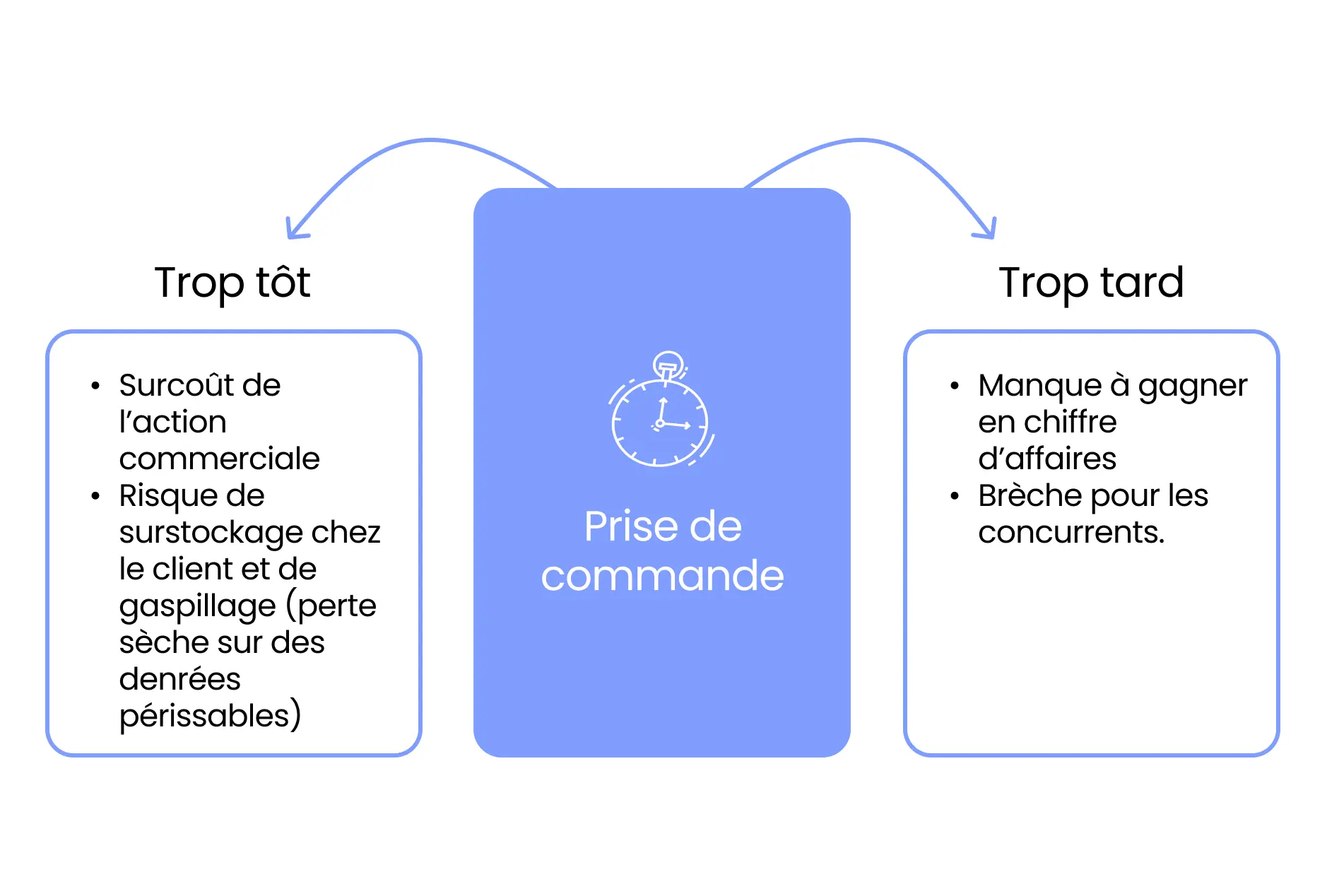
Furthermore, the CHR sector is particularly subject to the concept of the target frequency book, i.e., the frequency of ordering. Indeed, receiving the order too early can limit sales volumes and create an overstocking effect at the client's premises. And receiving it too late can result in a loss of revenue, or the opportunity for the client to place an order elsewhere.
Here again, CRM greatly contributes to consolidating and increasing sales value by anticipating strategic visiting and reordering times through a scoring and client knowledge system (venue characteristics, order history, etc.). CHR area managers thus avoid making useless trips (the famous empty visits) and brands maximize the return on investment of their sales actions.
The use of commercial software to model order frequencies also enables the detection of client risks by automatically alerting on missed deadlines. Usually, 5 missed orders mean the client is lost.
However, whether reordering occurs spontaneously or not, customer visits remain crucial for at least two reasons:
Verify the layout of POS equipment (or check that you are on the menu!);
Try additional sales actions or upsells (moving upmarket).
Collaboration with distributors
Another central aspect of commercial development in the CHR sector is obviously collaboration with distributors.
Indeed, choosing to attack the market indirectly implies coordinating commercial activity with trade partners, who must be sent the purchase order, and who on their part will handle invoicing. The integration of tool types CRM / ERP resolves a large part of these challenges.
It is also very common to coordinate sales tours jointly. The brand then sends its brand ambassador alongside the distributor's representative. These encounters make it possible to perform a more comprehensive and personalized sale, as the brand ambassador knows the characteristics of each product, and can therefore support and advise end customers in choosing products. Finally, it is the best way to present new releases and thus forge a solid connection with the customer, who feels privileged.
As in most industries, certain clients or distributors are considered key accounts and undergo more intense and coordinated commercial action in relation to their weight in the company's revenue. They are sometimes managed by leaders, who ensure the maintenance of solid and durable relationships with them, and intervene in resolving potential problems and disputes.
Marketing objectives of brands selling in the CHR sector
Let us finish this guided tour with an overview of marketing challenges for brands distributing their products in the CHR sector.
Objective | Mission | Action |
|---|---|---|
Increase in Market Share | Geographic expansion | Expand presence into new geographic markets, whether domestically or internationally. |
Increase in market penetration | Increase the share of products in existing CHR/RHF establishments. | |
Strengthening Brand Awareness | Advertising campaigns | Increase visibility and recognition in the sector. |
Presence at professional events | Participation in trade shows, exhibitions, and industry events to position as market leaders. | |
Product Innovation | Development of new products | Research and development to launch innovative products that respond to new trends and customer needs. |
Improvement of existing products | Improve the quality, presentation, and features of current products. | |
Customer Loyalty | Loyalty programs | Encourage customers to repeat purchases and remain loyal to the brand. |
Support and after-sales service | Ensure customers are satisfied and ready to recommend the brand. |
Has this article strengthened your desire to enter the CHR market? Discover how Sidely can help accelerate your sales development by requesting a demo online!
Alexis co-founded Sidely after several years of service as a sales director. To understand what builds, or breaks, a salesperson's performance, he conducted more than 100 telephone interviews with field sales representatives. At Sidely, he transforms this raw knowledge into concrete support, based on facts rather than assumptions.
See also

Artificial intelligence and field professions: what our 2026 studies reveal
Adoption, barriers, use cases: discover what our three studies reveal about the role of AI among sector managers, sales representatives, and foodservice sales reps.

CHR and RHF Sales Representatives: portrait of a relationship-driven profession in the era of data
Equipment, productivity, AI: discover the major trends for the HORECA and food service sales profession in 2026 through our field study.

Pharmaceutical Sales Representative in France: Portrait of a Field Job Under Pressure
Compensation, aspirations, AI usage: discover the major trends in the pharmaceutical sales representative profession in 2026 through our field study.

Area Sales Managers in France: who are they and how is the profession evolving in 2026?
Compensation, aspirations, AI usage: discover the major trends in the field sales representative profession in 2026 through our field study.
The area manager professions in 2026
Discover the trends, the challenges, and the key figures.