

Route optimization software: principles, benefits, and use cases
Algorithms, schedule constraints, customer scoring... Route optimization software programs are not all created equal. We explain how they work and compare the solutions on the market.

In short
9 min read
Route optimization software automatically plans the trips of field teams to reduce travel time and increase their productivity.
These tools use advanced algorithms, like the Travelling Salesperson Problem (TSP), to calculate the most efficient route in a matter of seconds.
Performance is based on the analysis of numerous constraints (location, schedules, priorities, availability) coupled with reliable field data.
Use cases vary by sector: large-scale delivery, complex technical interventions, or strategic sales routes.
Solutions can be integrated directly into the CRM (for sales representatives) or function as external tools (for logistics), with essential continuity between web planning and mobile usage.
A route optimization software is a tool designed to automatically plan the travel of field teams in order to reduce travel times, improve the organization of visits, and increase team productivity. Today, these solutions are used in many sectors such as logistics, technical maintenance, commercial distribution, or even merchandising.
To achieve this, a commercial route optimization tool takes into account numerous parameters such as customer locations, time constraints, sales priorities, or travel times.
In many companies, routes are still built manually. This approach may work on a small scale, but it quickly becomes inefficient as the number of visit points increases.
Route optimization software today relies on advanced planning algorithms, capable of calculating the most efficient routes in a matter of seconds. They thus make it possible to reduce the miles driven, increase the number of visits per day, and improve the productivity of field teams.
In this article, we will see what route optimization software is, how it works, what benefits it brings, and in which contexts it becomes indispensable.
What is route optimization software?
A route optimization software is a solution that allows to plan and optimize the travel of field teams in order to minimize travel times, maximize the number of visits, and improve geographic coverage.
It automatically analyzes several variables:
customer location,
travel time,
time constraints,
visit priorities,
frequency of visits,
capacity or availability of teams,
The objective is to produce the most efficient visit order possible and to optimize travel over a given geographical area.
Route optimization software is used in various contexts: delivery, technical maintenance, field intervention, or organization of sales visits.
The majority of route optimization tools are coupled with a route planning tool. Together, they help prepare route plans and properly schedule travel.
How does route optimization work?
Route optimization software relies on algorithms capable of simultaneously analyzing numerous constraints.
The process generally takes place in three steps.
Field data collection
A route optimization software can only work effectively if it has reliable and up-to-date field data. It is this information that allows the algorithm to calculate relevant routes adapted to the operational reality.
Two setups are generally possible.
In some cases, the route optimization software is an external tool. It must then be connected to the company's CRM in order to retrieve customer data, visit information, or operational constraints.
In other situations, route optimization is directly integrated into the CRM. The tool can then leverage commercial and field data already available in the platform, which simplifies visit planning and limits data exchanges between multiple systems.
In both cases, the software relies on several types of information.
Among the most commonly used data:
the geolocation of customers or visit points
the estimated duration of visits or interventions
the availability of field teams
the time constraints or opening hours
the desired frequency of visits
the data collected on the field by the teams
This information allows to build a realistic model of field activity. The software can then transform this data into operational recommendations for organizing routes.
For example, field data analysis allows for quick identification of high-priority sales points or locations requiring a visit. Routes can then be planned according to different strategic criteria: sales points in difficulty, high-potential stores, drop in numeric distribution (ND), or visit frequency to be respected.
The calculation of the optimal route
The route planning software then applies optimization algorithms from operations research. One of the most famous mathematical models for this type of problem is the Traveling Salesman Problem (TSP).
The Traveling Salesman Problem, or TSP, consists in determining the shortest route that allows visiting a series of points exactly once before returning to the starting point. In other words, it answers the following question: what is the order of customer visits that minimizes the distance or travel time?
In the context of sales routes, this problem directly corresponds to the reality on the ground:
a sales representative must visit several customers in a day while minimizing travel between each appointment.
a delivery driver must be able to deliver all their packages in a day while minimizing travel between each delivery point.
a technician must be able to reach their customers as quickly as possible to troubleshoot them within a given time limit.
Route optimization software therefore uses variations of the TSP capable of integrating several parameters, such as:
travel time between two points
visit duration
time constraints
priorities of certain customers
These calculations make it possible to determine the most efficient order of visits.
Automatic generation of routes
Once the calculation is done, the software automatically generates:
a visit schedule
an optimized order of passage
a travel route
This schedule can then be adjusted by the manager or by the field teams if necessary.
In some organizations, the selection of visit points is defined in advance. The customers or sales points to visit are then already identified according to commercial or operational criteria. In this case, the person in charge of the route mainly needs to optimize the order of their travel to reduce travel times between each visit.
Moreover, route organization can vary depending on the nature of the activity and the workload. Some companies plan travel on a day-to-day basis, while others prefer to organize routes on a weekly or even monthly basis. This planning generally depends on the number of visits to be made, the frequency of visits to customers, and the commercial or operational objectives set.
💡 Key steps to optimize your commercial route
1. Map customers by geographical area
2. Define an appropriate visit frequency
3. Prioritize strategic accounts
4. Group visits by sector
5. Calculate the most efficient routes
The main use cases for route optimization
The term route optimization software actually covers very different uses. Planning needs vary greatly depending on the profession and the nature of the interventions carried out in the field.
The duration of visits, the number of points to cover, or operational constraints are not the same for a delivery driver, a technician, or a traveling sales representative. For example, delivery activities require managing many short stops, while technicians and sales reps must integrate more complex operational constraints.
For this reason, route optimization software is often specialized by type of activity.
Understanding these differences helps in choosing a tool truly suited to field operations.
Delivery and logistics
In logistics, the goal is to maximize the number of points served while reducing the distances traveled.
Drivers can make dozens of deliveries a day, because each stop is generally short.
Software used in this context must be able to:
calculate routes with many points
manage delivery slots
optimize trips on a large scale
take traffic constraints into account
This is one of the historic uses of routing algorithms.
Technical intervention and maintenance
In maintenance or field service activities, routes include fewer stops but longer interventions.
The software must then take into account:
estimated intervention times
required skills
priority levels
availability of technicians
The challenge is to plan interventions efficiently while respecting technical constraints. Optimization is also a customer satisfaction challenge, since the shorter the response times, the faster clients will be helped/equipped.
Traveling sales forces
For field sales teams, the route follows a different logic. A sales representative generally makes between 4 and 8 customer visits per day, as each meeting involves a deep commercial discussion.
The objective is not only to reduce travel, but also to maximize the commercial value of the visits.
The tools used must make it possible to:
plan customer visits
organize routes by geographic zone
prioritize strategic accounts
track field sales activity
In this context, route optimization is often integrated directly into a CRM designed for field sales forces.
What features should you expect from route optimization software?
Features can vary depending on the solutions, but certain capabilities are generally common.
Automatic route planning
The software must be able to automatically generate:
A visit schedule
The optimal order of visits
The travel routes
h3 id="114">Map visualization
Mapping allows to:
Visualize customers on a map
Identify high-density areas
Spot opportunities for grouping visits
Map visualization
Management of field constraints
A good software must integrate:
The constraints of the clients or prospects to visit (store opening hours, specific needs, personal specifications...)
Visit frequencies
Customer priorities
Meeting durations
Multi-device software
Preparing a route is often more comfortable on a wide screen. A good route optimization software must therefore allow to plan and organize routes from a web interface, accessible on a computer. Managers or sales reps can thus prepare their routes more efficiently before heading out into the field.
Once in the field, teams must be able to consult their route directly from their smartphone or tablet. Visualizing scheduled visits for the day, accessing customer information, tracking route progress, or reorganizing the route plan if an unexpected event occurs... These are all actions that are simpler to carry out on a mobile application than on a web application.
This continuity between desktop planning and mobile use facilitates the work of traveling teams.
Synchronization with sales tools
For sales teams, route optimization is often directly integrated into the CRM.
This allows to:
Plan visits based on the client portfolio
Record meeting reports after appointments
Track field sales activity
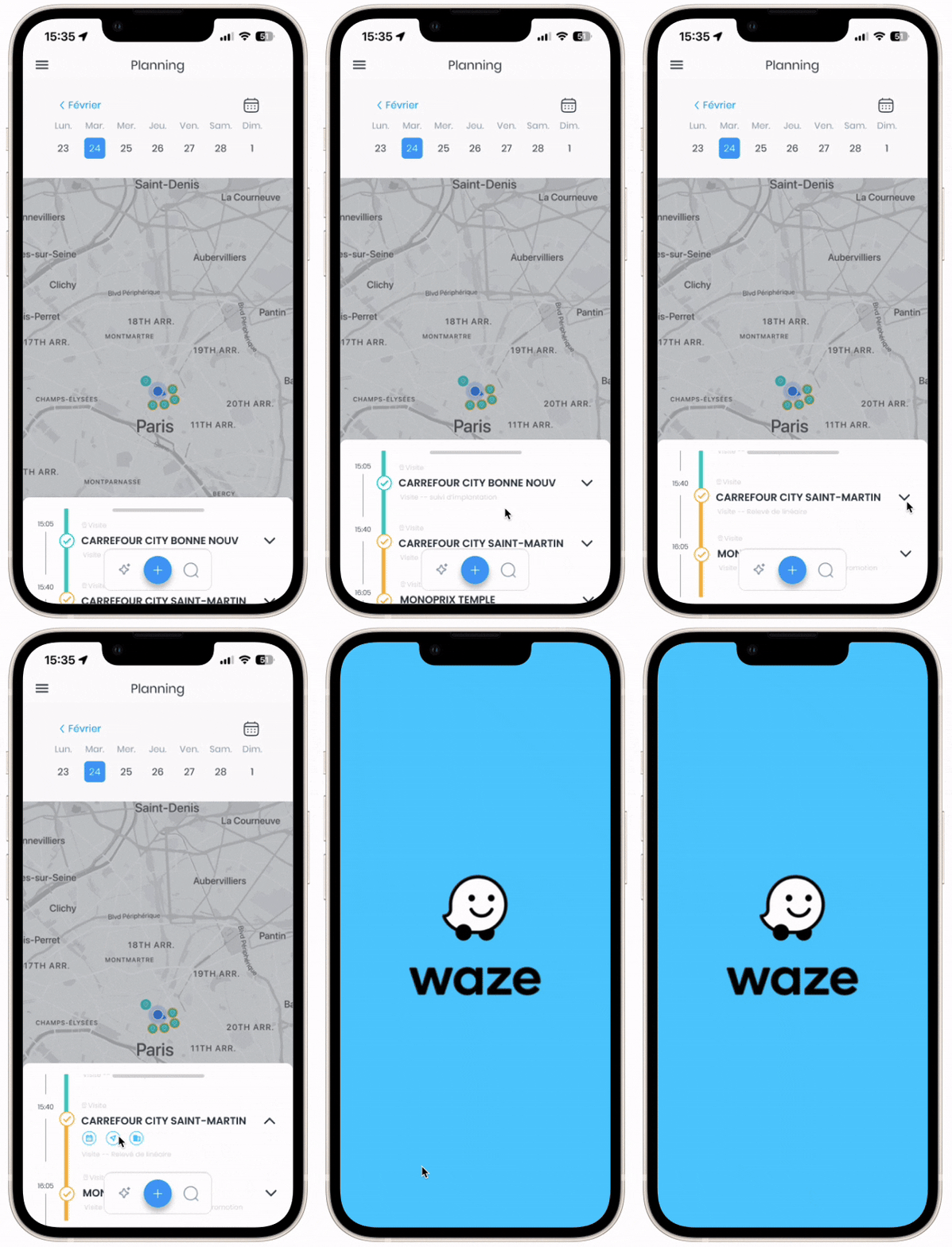
Integration with GPS applications
A route optimization software must also facilitate navigation between different visit points.
The most efficient solutions allow to directly open the route in a GPS application (such as Google Maps or Waze) from the app.
Concretely, the user can simply click on the next appointment to launch navigation, which reduces the mental load associated with organizing travel: the user no longer needs to manually search for addresses or reconfigure their route between each visit.
Comparison of route optimization software
The market for route optimization software is relatively large. Some solutions specialize in logistics and fleet management, while others are designed for field sales teams.
These tools all rely on similar optimization principles, but they differ in their positioning, functional scope, and target audience.
To better understand the differences in approach, here is a comparison of three well-known solutions.
Sidely: route optimization integrated into CRM
Sidely is a CRM designed for field sales forces that directly integrates a sales route planning and optimization feature: store management, selection and prioritization of sales points, selection using the lasso tool, map or calendar visualization, visit planning, route optimization, field activity tracking.
This approach allows teams to prepare their routes directly from CRM data: customer location, visit frequency, sales performance, or account prioritization.
Optimization relies in particular on Traveling Salesman Problem (TSP) algorithms to determine the most efficient order of visits.
Once the route is planned on the web interface, the sales rep can follow it directly from the mobile app and access customer information during their travels.
Nomadia TourSolver: an optimization solution for logistics and services
TourSolver is a solution developed by Nomadia, specializing in optimizing professional travel.
The tool is used in several sectors such as logistics and distribution, technical maintenance, or sales visits.
TourSolver allows to plan routes while taking into account many constraints such as time slots, delivery volumes, or mission priorities.
The solution is particularly suited to organizations with large vehicle fleets or complex schedules.
It is often used to optimize routes involving multiple field workers and a large number of visit points.
Portatour: software specialized in commercial route optimization
Portatour is a solution specialized in route optimization. The software focuses mainly on the automatic planning of customer visits.
Based on customer location and the desired visit frequency, Portatour automatically generates optimized routes to improve sales coverage of a territory.
The solution is particularly known for its automatic optimization engine, which generates visit plans over several weeks or months.
Unlike a full CRM, Portatour is mainly dedicated to route planning and can be used to complement a commercial management tool.
Comparison table of route optimization software
Software | Positioning | Main use case | Special features |
|---|---|---|---|
Sidely | CRM for field sales forces | Planning, optimization, and tracking of sales visits | Route optimization integrated into CRM |
Tour Solver | Logistics optimization solution | Fleet management and complex planning | Advanced management of operational constraints |
Portatour | Specialized sales route software | Customer visit planning | Automatic optimization of route plans |
Which route optimization software to choose?
The choice of software depends above all on the operational needs of the company and the type of field activity. The main criteria to analyze are:
the number of daily visits
the average duration of interventions
specific business constraints
the mobility of field teams
integration with existing tools
Logistics or maintenance companies will often favor solutions capable of managing numerous visit points and complex operational constraints.
Organizations with mobile sales teams will find it more beneficial to use a tool that links visit planning, customer data, and sales tracking.
In this context, integrating route optimization directly into the CRM allows to centralize the organization of visits and the steering of commercial performance in a single tool.
A route optimization software allows companies to organize their field teams' travel more efficiently. By automating visit and route planning, these tools reduce travel times, improve territorial coverage, and increase productivity.
Today, they are used in many sectors, including logistics, technical services, and mobile sales forces. However, the choice of solution highly depends on the context. Delivery companies will often prefer software specialized in logistics planning. Organizations with field sales teams will find it more beneficial to integrate route optimization directly into their CRM.
This approach allows to connect visit planning, commercial tracking, and performance steering in a single tool.
If your goal is to improve the organization of customer visits and the productivity of your field teams, it may be appropriate to evaluate a solution combining CRM and route optimization.
Alexis co-founded Sidely after several years of service as a sales director. To understand what builds, or breaks, a salesperson's performance, he conducted more than 100 telephone interviews with field sales representatives. At Sidely, he transforms this raw knowledge into concrete support, based on facts rather than assumptions.
See also

Artificial intelligence and field professions: what our 2026 studies reveal
Adoption, barriers, use cases: discover what our three studies reveal about the role of AI among sector managers, sales representatives, and foodservice sales reps.

CHR and RHF Sales Representatives: portrait of a relationship-driven profession in the era of data
Equipment, productivity, AI: discover the major trends for the HORECA and food service sales profession in 2026 through our field study.

Pharmaceutical Sales Representative in France: Portrait of a Field Job Under Pressure
Compensation, aspirations, AI usage: discover the major trends in the pharmaceutical sales representative profession in 2026 through our field study.

Area Sales Managers in France: who are they and how is the profession evolving in 2026?
Compensation, aspirations, AI usage: discover the major trends in the field sales representative profession in 2026 through our field study.
The area manager professions in 2026
Discover the trends, the challenges, and the key figures.