
Discover out-of-home foodservice (OOH)
What is out-of-home (OOH) dining? Market size, players, trends, and challenges for food brands looking to develop this channel.

In short
8 min read
Out-of-home forestry (OOH) represents a strategic sector in France with a turnover of 120 billion euros in 2023.
The sector is divided into two main segments: commercial catering and institutional catering.
Commercial catering includes various forms such as fast food, traditional, gourmet, or themed, generating about ¾ of the sector's turnover.
The HoReCa (Hotel-Restaurant-Café) channel constitutes a key distribution network for many food and beverage brands.
OOH professionals face major challenges: labor shortages, persistent inflation, and rising energy costs.
Digitalization and technology are becoming essential, both to optimize operational efficiency in the kitchen and to adapt to customer expectations, especially Gen Z.
With a total revenue of 120 billion euros for the year 2023, out-of-home dining is an extremely strategic sector in France. It carries a variety of ambitions and specifics, ranging from the excellence of French gastronomy to job creation, and including the sustainability goals set by the country or the constantly changing consumer trends!
If you are considering out-of-home food service (OOH) as a market to prospect, you must first understand the complexity of its tree structure, as the OOH designation actually encompasses a multitude of sectors with diverse realities and legislations: CHD, RHF, CHR, F&B, commercial or institutional catering, self-managed or concession...
Welcome to this guided tour designed to help you more easily grasp this sector, which is as varied as it is exciting.
What is meant by "out-of-home dining (OOH)"
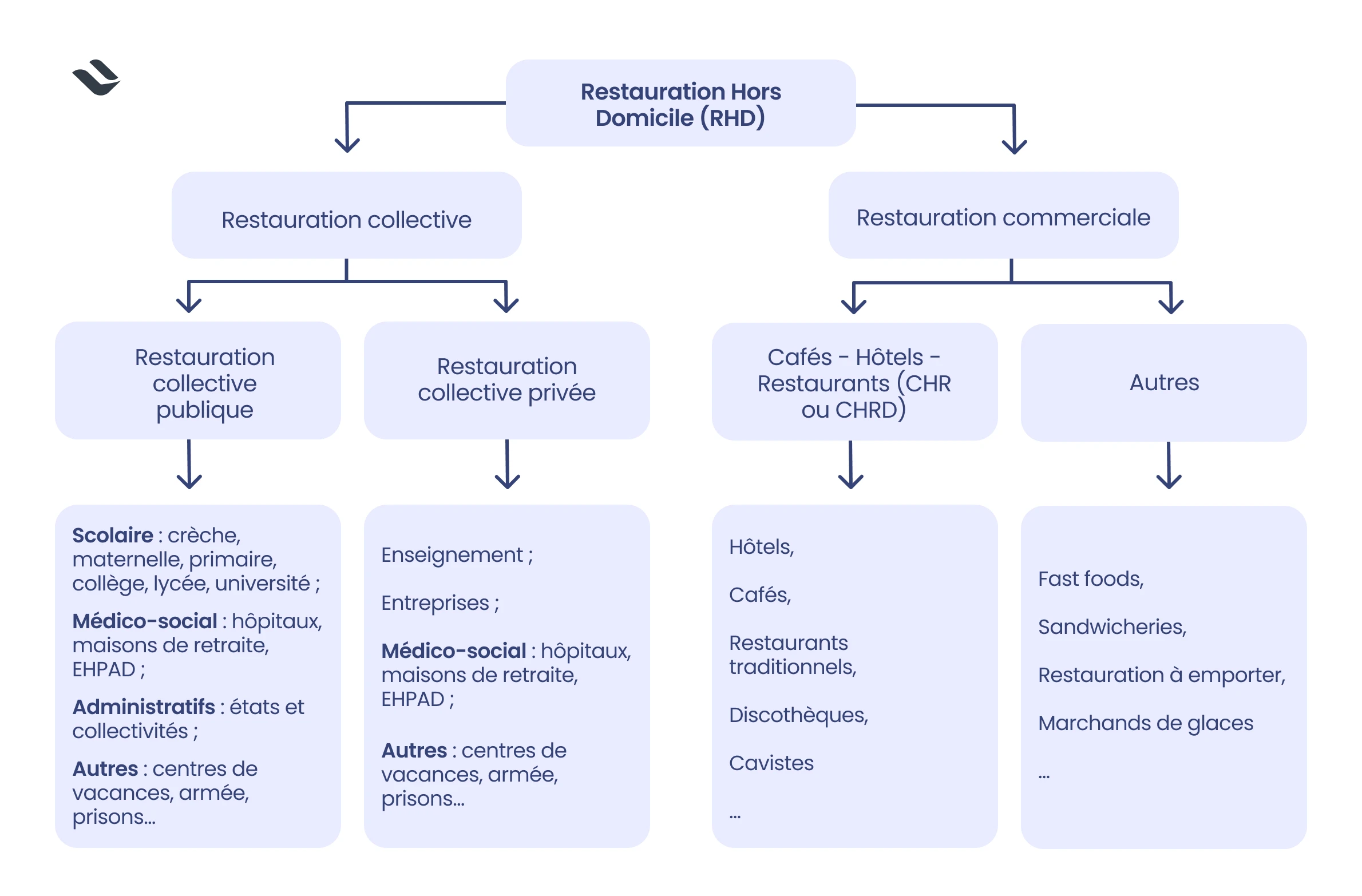
Out-of-home dining (OOH) is an economic sector that encompasses all dining activities allowing consumers to have meals or drinks outside their private homes. It is also referred to as RHF (catering out of home) or CHD (out-of-home consumption).
OOH dining includes a wide range of services and establishments, such as traditional restaurants, school cafeterias, sandwich shops, bars, or even food trucks.
The OOH dining sector is divided into two segments: commercial catering and institutional catering.
Segment | Institutional catering | Commercial catering |
|---|---|---|
Examples of establishments | School cafeterias, corporate restaurants, nursing home or hospital cafeterias, etc. | Cafes, fast food, traditional dining, inns, hotels, food trucks, etc. |
Purpose | Social character: to serve a large number of meals at a moderate price | Profit character: to generate profit |
Revenue - (Insee 2019) * | €25 billion | €56 billion |
Weight in OOH dining | 31% | 69% |
BFM, however, announces a total figure of 120 billion euros in 2023, which would be largely driven by inflation.
Both institutional catering and commercial catering are in turn divided into different market segments.
Institutional catering
Institutional catering includes various categories of establishments:
Education: day care, nursery school, primary school, middle school, high school, university;
Medico-social (hospitals, retirement homes);
Corporate: administrative and company restaurants;
Others: holiday centers, army, prisons, etc.
Depending on whether the establishment is linked to a local authority (or to the State and its administrations) or to a private company, institutional catering is referred to as public or private.
In all cases, it is defined by its social character (proposing meals at an affordable price), in contrast to commercial catering, whose objective is profitability. This substantial difference leads to financial models and financing methods specific to institutional catering, such as the family quotient in education, or the local authority covering part of the meal price.
Institutional catering is a major lever for driving health and regional development policies. The EGAlim law forces institutional restaurants to deploy more sustainable procurement strategies, increase the share of organic foods in menus, or gradually eliminate the use of plastic.
Although it contributes only 30% to the overall revenue of OOH dining, institutional catering represents more than 7 billion meals per year, a volume very similar to that of commercial catering.
Contracted catering or direct management
Furthermore, the institutional catering service can be directly managed, meaning that the community or company to which the dining facility belongs prepares and serves the meals itself, or it can be delegated to a service provider, known as a food service management company (FSMC). This industry includes large national and international companies such as Elior, Compass, or Sodexo. Their market share is significant (one in three schools works with a concession catering company).
Centralized or decentralized kitchen
Finally, just like in the field of commercial catering, institutional catering can be organized around a central kitchen that handles procurement and meal production, and satellite kitchens whose activity is limited to reheating the dishes and welcoming guests.
Commercial catering
Commercial catering encompasses all private out-of-home dining establishments outside of institutional catering. This can include traditional restaurants, hotels, cafeterias, or even takeouts.
As pointed out by Nelinkia, commercial catering can be categorized by concepts:
Traditional and fine dining;
Fast food, dine-in or takeout;
Themed dining: creperies, seafood;
Ethnic dining: Chinese, Italian, Moroccan;
Inns, lodges, farms: offering local regional products;
Takeout: food trucks.
Commercial catering represents about half of the meals eaten outside the home, but nearly ¾ of the total revenue.
The different types of meals in commercial catering
Consumers' eating habits can be classified into three main categories:
The nutrition meal: the consumer primarily seeks to meet their physical needs through a quick meal, such as a lunch break;
The business meal: it accounts for 1% of the meals served in commercial catering and typically takes place in prestigious restaurants for professional purposes.
The leisure meal: this is the main source of income for the sector, representing 40% of meals served in commercial catering. It corresponds to private outings, with friends or family, and is characterized by a more friendly and relaxed aspect.
Cafes - Hotels - Restaurants (CHR)
CHR is the acronym for Cafe - Hotel - Restaurant. Bars and nightclubs are part of this market segment, and sometimes a B and a D are added to the CHR acronym. Anglo-Saxons use the term HORECA (for Hotels, Restaurants and Catering).
Other types of establishments like bowling alleys or thalassotherapy centers can also be included. In short, this sector incorporates establishments where meal preparation is not always the primary activity. This does not prevent CHR from most often featuring a gastronomic focus.
For many food or beverage brands, CHR (café, hotel, restaurant) is considered a distribution network, not just a market. You can explore this topic by discovering how to prospect CHR accounts.
What is the difference between CHR and commercial catering?
Some commercial catering businesses are not part of CHR and are therefore not governed by the same collective bargaining agreement. These companies are usually registered under the French APE code 56.10 C, which covers the over-the-counter supply of food and drinks to be consumed on-site or taken away, and presented in disposable packaging. The most common examples are fast-food joints, sandwich shops, takeout pizzerias, food trucks, ice cream parlors, or meal prep in markets.
Food & beverage (F&B)
Finally, in commercial catering, the term F&B, an acronym for Food & Beverage, is often used to designate all activities related to the production, distribution, and consumption of food and drinks. The term can therefore encompass a wide range of establishments and services, such as restaurants, cafes, bars, hotels, or caterers.
The term is very popular in the hotel, tourism, and event industries, which constantly seek to increase profits related to the customer experience through service, products, or the venue's atmosphere. The term is never used in public institutional catering, as it relates more to strategic activities to generate profitability.
Key trends in out-of-home dining
Determining trends in out-of-home dining is complex because, as you have understood from reading the above, the sector is composed of extremely varied players; a village school cafeteria does not necessarily share the same issues as a McDonald’s in the heart of Paris!
However, numerous studies and statistics produced in recent years have highlighted trends that are transforming the culinary professions and the different sectors that depend on them.
FranceAgriMer helps us, for example, identify three typical consumer profiles (excluding institutional catering).
Consumer Profile | Young and active urbanites | Families | Elderly |
|---|---|---|---|
Establishments visited | This group regularly visits OOH establishments, often seeking quick and convenient options due to their dynamic lifestyle. | Families prefer places that offer kid-friendly menus and welcoming environments. | This group prefers traditional restaurants and establishments that offer a quiet and comfortable setting. |
Frequency and Types of Visits | Frequent visits, often several times a week, mostly to fast-food restaurants and cafes for quick meals. | More occasional outings, often on weekends or for special occasions, favoring restaurants with varied menus. | Less frequent visits, preferring traditional restaurants for full meals. |
This segmentation already provides an important entry key to approach this vast and complex market.
But let’s move on to the other notorious trends that have emerged in recent years.
Impact of Covid on business models
A major event of this early century, the COVID-19 pandemic has had a significant impact on out-of-home dining. Lockdowns and health constraints changed French consumption habits deeply, running with a very strong increase in demand for delivery services and takeout meals. We have thus seen a real explosion in take away (takeout meals). Home delivery is not lagging, with the all-out development of meal ordering apps.
The food service industry had to adapt quickly. While convenience—or necessity—led many establishments to list themselves on online ordering platforms, the most audacious are developing their own delivery business, allowing them to protect their profit margins, albeit at the cost of financial efforts to adapt their online ordering tools and handle the necessary communication.
Note that institutional catering is rarely affected by these new models, which are unsuited for meals consumed in a living or accommodation facility (hospitals, nursing homes) or in a restaurant attached to education.
New consumer expectations
However, what is infusing into all styles of dining, albeit to varying degrees, are consumer expectations, subject to multiple upheavals in recent years, which find their origins as much in pandemic episodes as in socio-cultural developments.
Product quality and responsible consumption
Supported by the government and its EGAlim law, the demand for fresh, local, and organic products is experiencing an impressive boom, even though establishments often find it difficult to combine these organic purchases with their available budgets. Indeed, 75% of French consumers in CHR believe that all CHR establishments should offer environmentally friendly options on their menus.
The consumption of vegetarian and vegan menus continues to grow nonetheless, and restaurateurs are adapting their menus, for better or worse, to include more eco-friendly and "ethical" options, wrapping themselves in an eco-responsible dimension. A majority of French people ask above all for "more local products or products of French origin" (54%) and "homemade" dishes made from fresh ingredients (53%), according to FranceAgriMer.
Responsible consumption is also manifested by a trend among many French people to reduce their alcohol consumption.
Intolerances and specific diets
Dining establishments must also adapt to consumers who are increasingly demanding about the products they avoid eating. Thus, there is a clear rise in "declarations" of allergies, and gluten-free orders are flourishing, as are many other varieties of specific diets and special requests in the dining room.
Many establishments have to adapt their dishes in the kitchen to take these requests into account, risking their operations getting disrupted by the multiplicity of special cases. Another approach consists of eliminating products subject to recurring modification requests. This second approach questions the purpose of restaurants, which are supposed to be forces of discovery and creation.
As for public institutional dining, the approach is rather relative to the profile of the guests, and the government has designed a program for this purpose called GEMRCN, which allows adapting portion sizes and the frequency of foods to the population using the restaurant (France is France!).
Staff Shortage
Another trend that continues to hit the OOH industry hard (and limit the growth of some establishments), recruitment is still as difficult in food service. The trend has even worsened since Covid, with employees who often had the opportunity to try other professions, or returned to the kitchen with new demands (not working weekends, or having their evenings free).
Attracting and convincing recruits remains an ordeal for many public institutional restaurants, due to largely insufficient budgets. To avoid these issues, some communities choose the central kitchen model, which allows concentrating the production of several establishments in a single site.
Energy crisis and inflation
Finally, the war in Ukraine and the growth of the world population have generated extremely striking phenomena of inflation in recent years, as well as a very sharp rise in energy costs. With an increase in energy costs exceeding 100% in a few years, and financial aid to small businesses that is rarely enough to offset gas and electricity bills, many establishments are experiencing serious cash flow problems. Moreover, the price of energy has a significant impact on the number of bankruptcies. Some restaurants have therefore decided to raise their prices accordingly, risking the loss of customers.
Inflation also affects raw materials, the cost of which is often passed on to the price of dishes and drinks. Faced with this rise in prices, many French people have reduced their budget for going out. However, when they do go out, they look for quality first and foremost and want to get their money's worth. CHR has thus become a "pleasure expense".
Digitalization and technology
Faced with the recurring recruitment problem, the food service industry is gradually equipping itself with tools to optimize the time of available resources. Online ordering tools or payment via apps often help free up some time so that employees can focus on their real job.
Automation is becoming a central topic, whether in stock management or meal preparation assistance. While the United States seems very advanced on the subject, French companies with multiple sites also claim to increase their profitability after investing in automation. But not all commercial catering is capable of investing. And of course, municipal budgets are not intended to boost innovation in public cafeterias.
The digitalization of the experience is also on the customers' side, driven by Gen Z, the population that visits CHR the most (71% visit this sector weekly). According to NielsenIQ, 70% of Gen Z bought a drink or food in CHR after seeing it on social media. This is twice the French average (31%). Young people born after 1995 look for places or dishes and drinks that are "Instagrammable" above all. Online reviews and menus are also very important, since French people are increasingly planning their outings to CHR: 41% consult online reviews or menus to decide where they will go.
A challenging period that holds opportunities
Between the decline in French purchasing power, deeply changing consumer habits, and the emergence of new delivery and takeout players, restaurants are facing a market in full transition.
To come out ahead, they must try to bet on all fronts:
Innovation;
Communication (especially online);
Quality;
Sustainability;
Customer experience.
Furthermore, following the example of their American counterparts, some French restaurateurs are making bold choices by developing new offerings, such as retail product sales, cooking classes, or the creation of exceptional or immersive experiences by incorporating technology into the meal.
Margot has been working in Tech and SaaS for 8 years, with a multi-product experience that has given her a unique understanding of business challenges. On a daily basis, she analyzes, relentlessly tests, and relies on facts to shed light on market trends and help sales teams move forward.
See also

Artificial intelligence and field professions: what our 2026 studies reveal
Adoption, barriers, use cases: discover what our three studies reveal about the role of AI among sector managers, sales representatives, and foodservice sales reps.

CHR and RHF Sales Representatives: portrait of a relationship-driven profession in the era of data
Equipment, productivity, AI: discover the major trends for the HORECA and food service sales profession in 2026 through our field study.

Pharmaceutical Sales Representative in France: Portrait of a Field Job Under Pressure
Compensation, aspirations, AI usage: discover the major trends in the pharmaceutical sales representative profession in 2026 through our field study.

Area Sales Managers in France: who are they and how is the profession evolving in 2026?
Compensation, aspirations, AI usage: discover the major trends in the field sales representative profession in 2026 through our field study.
The area manager professions in 2026
Discover the trends, the challenges, and the key figures.