

Discount: network specifics and challenges for manufacturers
Discount network in major retailers: players, constraints, and strategic challenges for manufacturers wishing to distribute their products.

In short
10 min read
Discount retail accounts for 12% of food distribution in France, shaking up traditional banners with a strategy focused on value for money.
The model relies on a limited assortment (1,500 to 3,000 SKUs) and a predominance of private label products, which make up to 90% of the offering.
For manufacturers, the discount network offers opportunities for massive volumes and immediate visibility, but imposes significant pricing pressure and reduced margins.
Distribution within this network requires streamlined production, simplified logistics (pallets, shelf-ready packaging), and often a specific adaptation of the offering compared to traditional product ranges.
The choice to enter the discount channel carries brand image risks; manufacturers must ensure that their low-cost positioning does not harm how they are perceived by conventional retailers.
The breakthrough of discount in France is undisputed: the channel is in full growth and represents 12% of food retail in 2024. Lidl's network comprises 1,600 stores, and Aldi's 1,300.
But these figures hide a more global evolution of the large food retail sector. Initially perceived as a peripheral and low-cost business model, discount is gradually encroaching on the positioning of traditional brands, which are retaliating with very aggressive entry-level price strategies and private labels.
Retail is thus increasingly focusing on value for money, imposing new rules of the game on manufacturers, who may see this as new industrial and commercial opportunities, but also as considerable risks.
This is why Sidely offers you an immersion into the world of discount: we will look at its main characteristics, its major economic developments, and the stakes for manufacturers planning to deploy in this network.
What is discount mass retail
The term discount refers to a retail business method aimed at permanently offering cheaper products than the competition, by using financial optimization techniques and limiting corporate services.
Pushed to the extreme, the optimization of assortments, merchandising, the supply chain, and above all, pricing policy, led to the adoption of the term hard discount.
🇫🇷 In French, discount is translated as discompte, and hard discount as maxidiscompte.
These self-service stores are sometimes called box store(s). They are characterized by an area of between 400 and 800 m², a minimalist layout, and products stored directly in boxes or simple shelves, often made of pallets and metal racks.
The hard discount offer is dominated by food, with a reduced assortment (sometimes only one reference per product) and a very clear over-representation of private labels (pl). Everything is designed for cost reduction: layout, decoration, lighting, storage, etc.
≠ Clearance
One should not confuse discount, a permanent low-price offer, with outlet and other clearance models, which consist of clearing unsold stock or end-of-series items at reduced prices, often for the purpose of inventory liquidation.
Key players on the French market
The German giants Aldi and especially Lidl are the main players on the French market. The third essential name is Netto (Les Mousquetaires). On another scale, we can also mention the German Norma, mostly present in the east of France, and not to be confused with the Danish Normal, the Spanish Primaprix whose French venture only started in 2022, or even Supeco (Carrefour Group).
Lidl France does not directly communicate its financial performance, but its parent company, the Schwarz Group, recorded a net revenue of €81.8B for the fiscal year 2023, with a growth of +8.5%. Netto is also in strong growth, with a turnover of around €1.5B. The American Costco stands at around €220M in revenue but experiences significant growth. And Carrefour fully intends to develop its Brazilian discount brand Atacadao.
For its part, Aldi France is experiencing major financial difficulties, representing €1.4B in losses over three consecutive fiscal years, following — notably — the takeover of Leader Price stores.
Finally, the use of the term discount can be extended to non-food retail, with brands like Stokomani or Action, as well as online sales (sometimes referred to as e-discount), with Cdiscount for example.
Hard discount business model
The emergence of discount is explained by an increasing demand for competitive prices from consumers: some customer segments are looking for the best value for money, a criterion that comes before the brand, and even before national brands for them.
Cost reduction is at the heart of discount retailers' strategy. The model relies on extreme optimization of logistics and commercial processes, and promotes rapid adaptation to market transformations.
Discounters minimize staff, marketing, point-of-sale advertising, as well as packaging (manufacturers sometimes deliver products ready for the shelf).
Margins per product are low, and the profitability of the model is based on high sales volume and rapid inventory turnover. This is why it is important to negotiate them well.
Type of optimization | Optimization |
|---|---|
Maximum logistics optimization | - Automated warehouses |
Aggressive purchasing strategy | - Very tight price negotiations |
Presentation cost reduction | - Minimal sales display furniture |
The discount assortment
The assortment of discount retailers is distinguished by two key characteristics that allow them to offer low prices while optimizing their profitability: a limited choice of products, and the omnipresence of private labels.
1) A limited number of product references
The assortment of discount retailers is narrow and shallow: it generally includes between 1,500 and 3,000 references (compared to 20,000 in a traditional supermarket). This tighter selection reduces logistics and storage costs, and maximizes the sales volume per reference, which improves purchase conditions from suppliers.
Assortments are optimized to meet everyday consumption needs, with a strong presence of food and hygiene products. It mainly consists of fresh and frozen products, dry groceries, and hygiene and household cleaning products. References are chosen to maximize inventory turnover and avoid unsold items.
Unlike traditional supermarkets that sometimes adapt their assortment by region, discounters favor a uniform assortment in France, which simplifies logistics and reduces costs.
2) A predominance of private labels (PL)
Discount brands rely heavily on their own brands, which represent up to 90% of their offer. These products, designed directly with industrial manufacturers under strict specifications, make it possible to control costs and margins, and limit dependence on major national brands.
Examples of private labels:
Lidl: Deluxe, ChanteSel, Milbona.
Aldi: Tandil, Milfina, Bio Nature.
Over the last decade, research firms Nielsen, Kantar TNS, and IRI have abandoned the term “discounter” and prefer the following acronyms:
EDMP: Enseigne à Dominante Marque Propre (Private Label Dominant Retailer);
SDMP: Supermarchés à Dominante Marque Propre (Private Label Dominant Supermarkets).
Discounters still include certain national brands (NB) in their assortment, in limited quantities and often as loss leaders (e.g.: Coca-Cola, Kinder, Kellogg's). This helps attract hesitant consumers and improve their image.
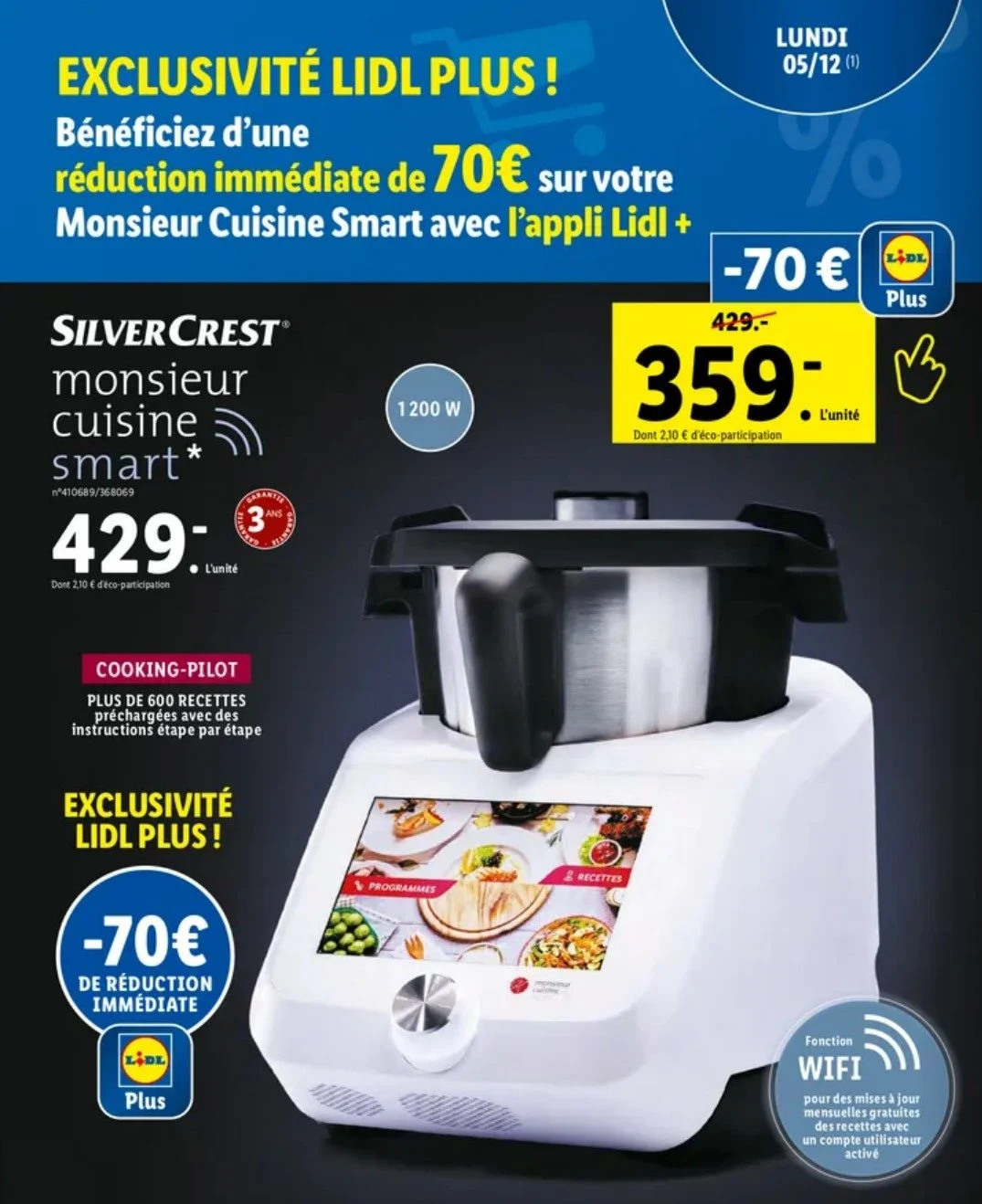
⏳ Temporary products: discounters play on the scarcity effect by regularly offering temporary products, often in non-food categories (e.g., textiles, household appliances, DIY). Lidl and Aldi, for example, launch special offers every week that drive store traffic. These offers help boost traffic at points of sale and acquire new customers.
© Lidl
Genesis and historical evolution of the discount model
Discount was born in Germany in the 1980s, where the founders of Aldi, the Albrecht brothers, devised a radical model to drastically reduce costs and offer rock-bottom prices. Their founding principles were simple but revolutionary:
Minimal sales floor space;
Very restricted assortment;
Fast inventory turnover;
Hyper-optimized logistics;
Standardized packaging;
Simplified shelving.
The arrival of Lidl and Aldi in France in the early 1990s was initially met with skepticism, as the French did not have the same relationship to consumption as the Germans, for whom hard discount still represents 40% of the market today, compared to 12% in France.
Furthermore, French consumers have a privileged relationship with national brands, which represented a significant obstacle for discounters, whose profitability is based on white-label products.
But the model eventually succeeded, thanks to a methodical penetration strategy:
Gradual establishment in suburban areas;
Initial target: low-income consumers;
Communication centered on value for money;
Targeted real estate investments.
For a time, the two German giants could have been described as "sharks" because of their aggressive commercial policy. New entrants who adopted similar strategies but with an innovative or more aggressive approach were then called "baby sharks".
Historically more present in regions where incomes are below the national average, discount brands now tend to increase the density of their network due to increased price sensitivity.
General transformation of mass retail towards affordability
In response to this growing threat, traditional retailers intensified their private label strategy. Marques Repère (Leclerc), Auchan Essentiel, and Top Budget (Intermarché) are designed to withstand the rise of discounters and gain market share in the low-cost segment. In the case of Leclerc and Intermarché, the price war drives the entire commercial strategy.
But the French giants are not the only ones evolving; discount brands have also begun transforming their historical model. For the past ten years, Lidl no longer presents itself as a hard discount brand and has repositioned itself by setting up in more premium areas with an expanded offer.
We now speak of soft discount to describe this new mix, a strategy that goes as far as local sourcing, organic products, and, generally speaking, an overall response to household consumption challenges.
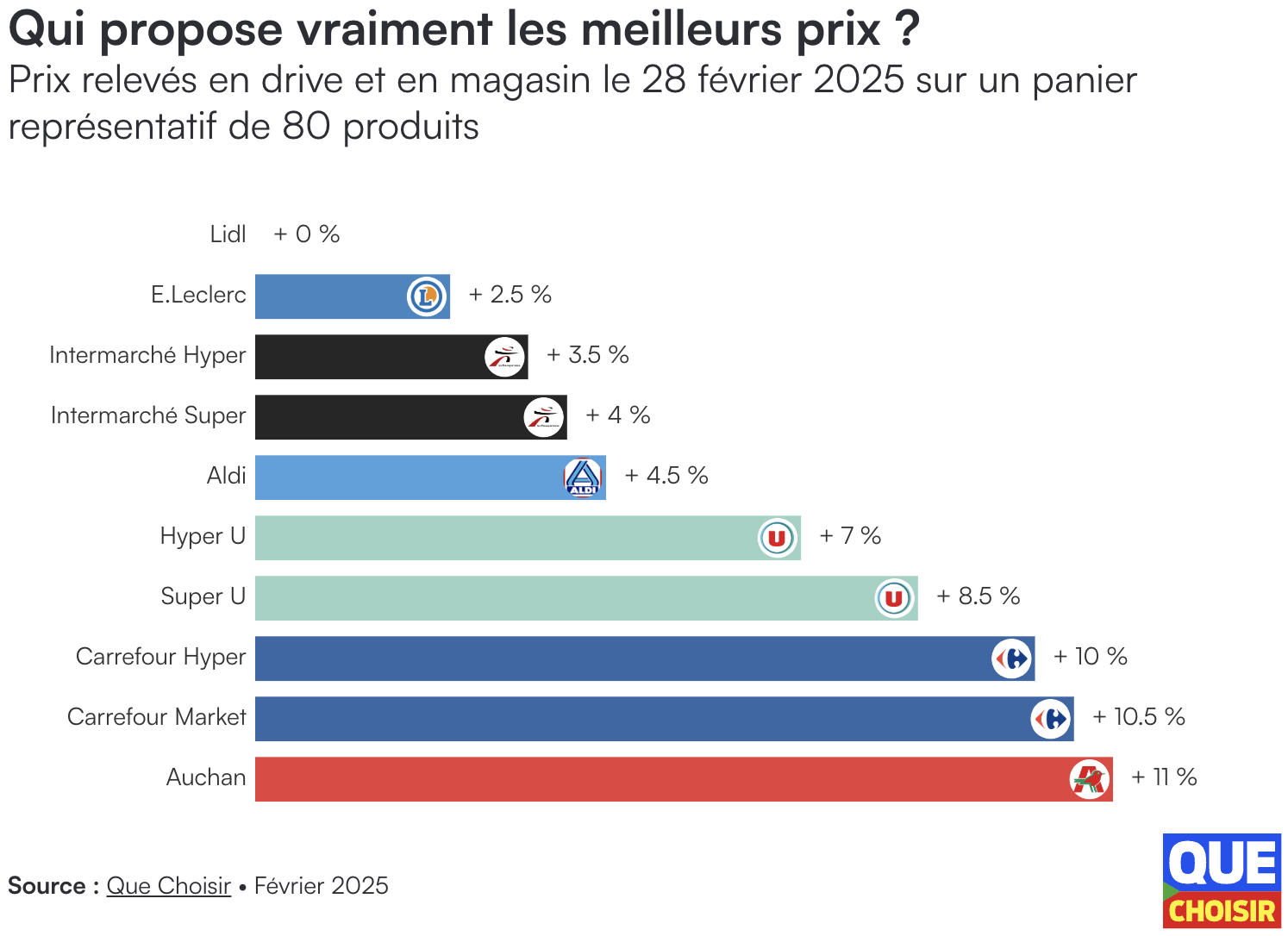
If Lidl set the tone, Aldi is following suit. In fact, the entire mass retail sector is transforming, and the line between hard discount and traditional retail is increasingly thin. A finding corroborated by figures from UFC / Que Choisir: while Lidl is indeed the cheapest brand in France, Intermarché and Leclerc are more economical than Aldi!
© UFC - Que Choisir
💡Lidl also presents itself as the only brand in France to practice uniform pricing, meaning strictly identical pricing across all 1,600 stores in the national network. The German brand generally offers bulk formats to reduce the price per kilo, especially for its private labels.
This market tension led to numerous corporate acquisitions (Netto bought by Les Mousquetaires, Leader Price by Aldi, etc.) and brand closures: ED, Dia, Prixbas, etc. The list of defunct brands speaks volumes about the turbulence of the sector.
Manufacturers facing discount distribution
To successfully distribute their products in the discount network, manufacturers must deal with the specificity of an assortment relying essentially on white labels and a handpicked selection of national brands.
National brands: listing strategy and marketing challenges
National brands occupy a unique place in this model. Brands like Smarties (Nestlé), Ferrero Rocher, or Lego manage to establish themselves through their popularity, their ability to activate certain target segments, or simply because substitute products generate lower revenues for discounters.
However, not all discount brands have the same development strategy. As we have seen, Lidl is no longer locked into hard discount. It is therefore crucial to target the retailers that best suit the brand's marketing mix.
Sometimes, it will be possible to start with a limited listing or a specific product before expanding distribution to the entire network.
Strategic interest for brands
For manufacturers opting for an intensive distribution strategy, discount allows them to reach a specific target, which is more sensitive to price than the brand, and of which a portion does not visit other store formats at all.
This additional channel therefore allows taking advantage of specific traffic generated by the discount brands themselves, and sometimes involves testing new markets or formats, for example by launching specific ranges adapted to discount.
Adapting the offer
Discount brands look for products with an optimized cost price, simplified logistics, and packaging adapted to store storage (for example, products directly arranged in shelf-ready boxes).
This generally drives manufacturers to rationalize their production and optimize their offer:
Simplify product lines: reduce the number of references to focus on best-sellers and avoid cost dispersion;
Design specific products: differentiate the discount offer from the traditional range to avoid any confusion with classic distribution;
Adapt packaging: simplified packaging, elimination of superfluous elements, budget formats, packaging suitable for in-store storage;
Aggressive pricing strategy: extremely tense commercial negotiations, acceptance of reduced margins.
In return for this adaptation of their strategy, manufacturers can expect large volumes. As negotiations with discount retailers are often more direct and less complex than in classic mass retail, manufacturers can also reduce their commercial and marketing expenses.
Image risks and differentiation strategy
The discount network can potentially create image and consistency issues if consumers start associating the brand with low-cost. On their side, traditional retailers may hesitate to list a very popular product in the discount network, fearing that it will tarnish the perception of the retailer and its positioning.
In the latter case, marketing departments sometimes choose to package a distinct offer for the discount network, so as not to harm the rest of their distribution channel. A highly aggressive promotion by the discounter then has less impact on the rest of the network because the products are not the same.
White labels and private labels: industrial strategies
By offering only 10% of national brands, discount gives pride of place to specialized manufacturers and promotes the industrial and commercial model of the white label.
For medium-sized manufacturers, this is often the only entry point into the discount universe. Although synonymous with low margins, this strategy generates massive sales and can therefore lead to:
A rapid inventory clearance, ideal for products with limited shelf-life or for optimizing production capacity;
A mass production, which reduces unit cost and amortizes fixed charges, synonymous with economies of scale;
A stable and lasting partnership with the discount retailer, ensuring continuity of orders and guaranteed volumes;
Making production lines profitable, by manufacturing both for its own ranges and for discount private labels;
An immediate visibility for a virtually zero marketing investment.
A strategy carrying industrial and logistical challenges
Of course, succeeding in private label also imposes strict prerequisites:
Perfect control of production costs, which often involves the automation and modernization of production lines;
Constant quality and repeatability, even on very large volumes;
Maximum operational flexibility: pallet deliveries, ready-to-sell packaging, and adaptability of shipped volumes;
Ability to absorb significant price pressure.
⚠️ International competition: it remains to be seen whether discount players will be open to listing new French suppliers, because cost rationalization and economies of scale often lead them to limit service providers to a European scale. For example, Parkside (Lidl) brand tools are manufactured by various companies contracted with the retailer, such as Einhell, Grizzly Tools, and Kompernass, all three being German companies.
So it is not all just about price: discount brands have a multidimensional approach that takes into account supplier reliability, supply regularity, or even logistics flexibility.
Discount has disrupted the landscape of food retail in France. Historical players in hard discount are evolving their offer to capture market share from traditional retailers, which are reacting by intensifying their entry-level strategy.
The entire organization of the market is transformed as a result. For manufacturers, this ecosystem can represent major opportunities.
But, whether it is to list existing ranges or win white-label contracts, this strategy also represents numerous challenges, such as structuring the production chain and adapting the product and marketing strategy.
Discount is therefore a channel to be approached with a differentiated strategy, while monitoring the evolution of the retail sector as a whole.
For the past five years, Corentin has supported more than 200 sales teams, making him one of the longest-serving members of the company. He has seen the product evolve alongside the industries he supports, giving him a deep understanding of actual use cases. Between onboarding calls and training sessions, he has built up rare, hands-on expertise: knowing exactly what saves teams time.
See also

Artificial intelligence and field professions: what our 2026 studies reveal
Adoption, barriers, use cases: discover what our three studies reveal about the role of AI among sector managers, sales representatives, and foodservice sales reps.

CHR and RHF Sales Representatives: portrait of a relationship-driven profession in the era of data
Equipment, productivity, AI: discover the major trends for the HORECA and food service sales profession in 2026 through our field study.

Pharmaceutical Sales Representative in France: Portrait of a Field Job Under Pressure
Compensation, aspirations, AI usage: discover the major trends in the pharmaceutical sales representative profession in 2026 through our field study.

Area Sales Managers in France: who are they and how is the profession evolving in 2026?
Compensation, aspirations, AI usage: discover the major trends in the field sales representative profession in 2026 through our field study.
The area manager professions in 2026
Discover the trends, the challenges, and the key figures.