

Price elasticity: how your brand can leverage it in supermarkets
What is price elasticity? How do you calculate and leverage it to optimize your brand's pricing strategy in supermarkets?

In short
7 min read
Price elasticity measures the sensitivity of demand in response to price changes of a product, an essential indicator for maximizing profits in mass retail.
Demand is said to be elastic when it reacts to price changes, and inelastic when it remains stable, such as for staple goods (Giffen effect).
There are three types of elasticity: positive (luxury goods or ‘Veblen goods’), null (exceptional and rigid cases), and negative (classic law of demand for ‘normal goods’).
Mastery of this indicator allows manufacturers to adjust their pricing strategy, anticipate the impacts of inflation, and assess the threat of substitute products.
Cross-price elasticity helps to understand the impact of your competitors' prices on your own sales, thereby identifying substitute or complementary products.
Brand image and customer loyalty (Love Brand) can reduce price elasticity, making consumers less sensitive to price increases.
Whether to increase profits or to stay competitive, all companies eventually need to revise their pricing. But how can you be sure that a change in pricing will have a positive impact on turnover or sales volume? And how can you measure this estimated result?
An essential element of pricing strategy, price elasticity is a must for any manufacturer wishing to maximize profits. More specifically, brands selling their products in supermarkets and grocery stores need to master this valuable indicator to perfect their marketing strategy.
Today, Sidely invites you to dive into the heart of price elasticity: we will go over its key concepts and calculation methods, and then offer a set of best practices on how to put it into practice in the retail sector.
Elastic and Inelastic Demand
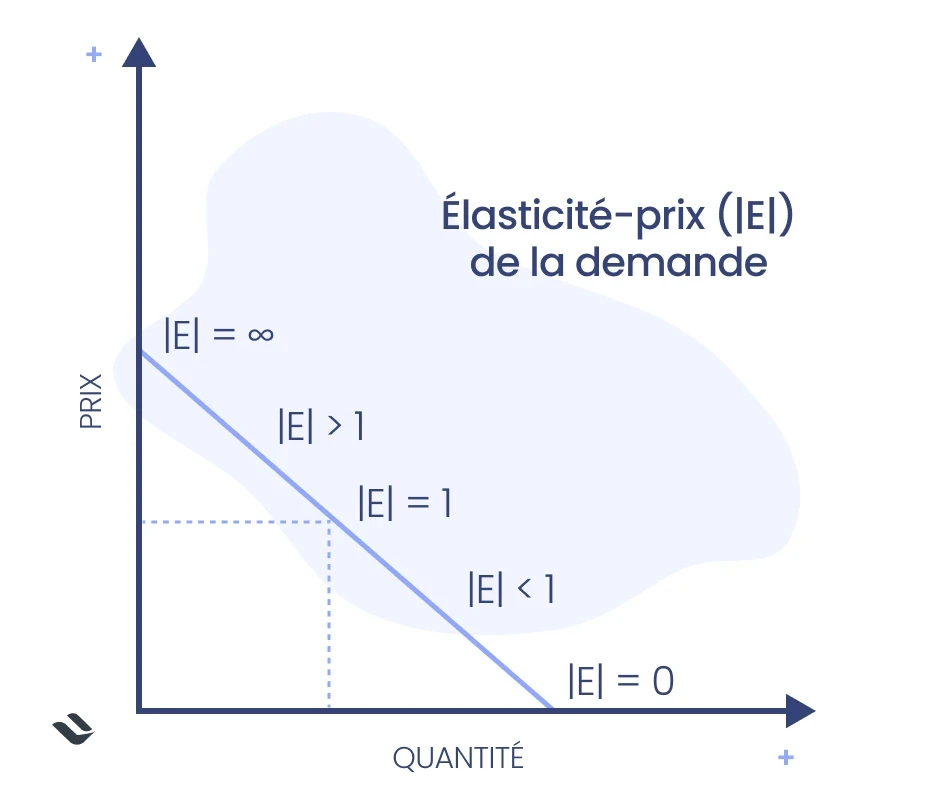
Although the term "price elasticity" is commonly used, it is actually the demand that is elastic or inelastic.
An elastic demand means that demand reacts to price variations. Except in special cases, when the price of a product increases, the demand for that same product decreases, and vice versa. Price elasticity allows you to measure the impact of a change in a product's price on its sales.
Price elasticity is a crucial tool in determining your pricing strategy, and therefore your marketing mix. Indeed, if demand is not very sensitive to a price increase, you have the opportunity to increase your turnover and your margin by raising your pricing.
On the other hand, if a price increase is followed by a significant drop in sales, then you will have to find the right balance between price and volume, i.e., the price that allows you to - ultimately - maximize margin.
This phenomenon is notably based on the positioning of the brand and/or its product. For example, the success of loss leaders relies heavily on their price, and demand for them is often highly elastic. This is also the case for basic necessities, whose price increase is often penalized by the selection of a substitute product.
In mass retail, price elasticity is decisive. This is why many brands now resort to shrinkflation, a technique that consists of reducing the quantity without lowering the unit price.
Formula for Calculating Price Elasticity
Calculating price elasticity is very simple:
Price elasticity = percentage change in demand / percentage change in price.
This yields an indicator below, equal to, or above 0 (see the example further down).
Interpretation of Price Elasticity
Three types of results can be observed when measuring price elasticity.
The first two are relatively rare.
1) Positive Elastic Demand (E > 0)
Sometimes a price increase leads to an increase in sales. In this case, high pricing conveys an image of prestige, which increases demand for this product. This is referred to as a "Veblen good", and it is most commonly found in the luxury sector. This is the famous "snob effect".
A product that responds to the snob effect is luxury perfume.
Consumers often perceive luxury products as having higher value when they are more expensive. Thus, a price increase can lead to an increase in demand, as consumers associate the high price with higher social status or exceptional quality.
2) Inelastic or Rigid Demand (E = 0)
Even rarer, zero elasticity (i.e. = 0) means that the price change has no impact on sales volumes. This scenario is exceptionally found in two situations:
A basic necessity product, and one that is not replaceable by another;
A consumer good where all market players change their prices simultaneously, making replacement by a third-party product impossible (note that such an agreement, if voluntary, would be considered anti-competitive by law and therefore prohibited).
This is known as the Giffen effect.
A product that responds to the Giffen effect is medicine. Take the example of an essential medicine for treating a chronic illness, such as insulin for diabetics. This medicine cannot be easily replaced by an alternative, and patients need it regardless of the price. Thus, even if the price of insulin increases, the quantity demanded remains relatively stable because patients have no other options.
3) Negative Elastic Demand (E < 0)
This is the most common case, which obeys the generally observed law: when the price increases, demand decreases, and vice versa. This is why these are referred to as "normal goods".
Flat-screen TVs are a telling example of negative elasticity. Suppose that in 2023, a brand of flat-screen TVs increases its prices. Generally, for non-essential goods like electronic devices, a price increase leads to a drop in demand. Consumers may postpone their purchase, look for cheaper alternatives, or decide that they do not need the item immediately. Thus, an increase in the price of flat-screen TVs in 2024 could lead to a drop in sales.
To begin with, let us imagine that you increased the selling price of a product between 2023 and 2024, and noticed a drop in sales.
Year | Selling Price | Sales Volume |
|---|---|---|
2023 | $4 | 1000 |
2024 | $5 | 700 |
Change | +25% | -30% |
In this example, the price elasticity of demand is therefore equal to: -30% / 25% = -1.20.
The result is not zero, which means that demand is price elastic.
Furthermore, the negative result indicates that the price increase does not compensate for the drop in sales. It can be seen as an obstacle to purchasing. In other words, the price change turns out to be insufficient, or even counterproductive.
Faced with this situation, you will need to re-evaluate the price increase downwards (for example, applying a rate of 10% on the initial price, rather than 25%), and then repeat the same calculation.
Pricing Strategy and Profitability
If demand varies greatly depending on the price, this indicates that the consumer exercises critical thinking during the act of purchase. This signal means that they are sensitive to their perception of your product's value. In this case, you have levers to modify this impact (advertising, packaging, labeling, eco-responsibility, etc.). In short, while high elasticity sometimes scares brands, it actually indicates that they can influence how customers view the product, and thereby increase their revenue.
Contrariwise, when rigid elasticity is observed, it can be considered that customers are insensitive to the intrinsic qualities of the product. Indeed, customer volatility is manifested by their propensity to switch products or brands based purely on price (as opposed to a product they would continue to buy even if its price increases). In this situation, a brand wishing to increase its revenue must activate levers that do not relate to the products, such as the choice of distribution channels, marketing, or point-of-sale advertising, etc.).
The ideal pricing strategy in modern trade is to charge the highest price possible without being disqualified in its category, while optimizing all other parameters (choice of supermarket chains, advertising, production and logistics costs, etc.).
This is the topic we will now explore in more detail, with a list of strategic points that all brands operating in supermarkets and grocery stores should know.
Price Elasticity and Retail: 12 Key Points to Master
Price elasticity in mass retail involves many strategic aspects. We have selected those with the greatest impact to perfect your brand's strategy.
1) Maximizing Profits
Many brands determine their sales price using the wrong entry points:
Calculating their unit production cost and applying a reasonable margin rate;
Validating the purchase price that the distributor is willing to pay.
In marketing, maximizing value involves analyzing customer perception. We start from the final maximum amount to establish pricing policy.
Price elasticity is therefore closely linked to the psychological price, or acceptability price, which represents the value a customer instinctively attributes to a product or service. This is the maximum price they would agree to spend to buy it. To analyze demand, marketing must therefore focus on understanding the customer’s perception of an offer, and the expenditure they are prepared to agree to.
For brands selling their products in retail, this analysis is vital because they must deal with the margin rates applied by the stores themselves. Thus, when negotiating with your retailers, it is important to know the psychological price of your products, as this determines the caps to be respected on your respective margins.
2) Confirming or Refuting the Product's Life Cycle Phase
Price elasticity can help you contrast your intuitions with market reality.
If the price variation has no effect on sales volumes, you can rule out the hypothesis of a pricing issue and look at other causes, such as a product reaching the end of its life, or an image or utility issue.
It is generally accepted that price elasticity can vary at different stages of a product's life cycle. For example, low elasticity is often observed during launch due to the desire to test a new product. As competing products arrive, elasticity increases progressively up to the so-called maturity stage of the market. Finally, the decline phase is quite variable, if not unpredictable, as it is marked by radical strategic decisions, such as competitors abandoning the product, or consumers losing interest in it.
3) Panel Testing: Measuring Price Elasticity Without Compromising Sales Revenue
If your products are present on the shelves of French supermarkets and hypermarkets, prices are generally set for 12 months during annual negotiations. Therefore, it can be difficult to run test periods, and annual commitments are obviously not to be taken lightly. In such a situation, you might seek to evaluate price elasticity through a channel you own, for example, your e-commerce site.
Another option is to set up a test panel, in agreement with one of your partners. You could, for example, limit the price change to a small number of retail locations. In this case, opt for a selection of varied but representative stores in your network (locations, demographics, competition, etc.) in order to observe consistency or, on the contrary, disparity in the results.
4) Purchase Memory and Perception of Changes
Another challenge is to know how well your customers have memorized the price of your products in the past. In this regard, brands offering products that are purchased more sporadically enjoy a clear advantage: while customers can compare their prices with those of neighboring products, they cannot compare them with those in force during a purchase made 3 years earlier! This scenario is, however, quite rare with everyday consumer goods, where the frequency of purchase helps customers memorize pricing levels.
The trick then is to review the product's placement with the shelf manager, placing it, for example, next to a more expensive product. In this way, you will attempt to modify the customer's perception, who will compare your new price, not to the old one, but to that of the neighboring product. Once again, shelf placement proves to be of utmost importance!
5) Assortment Strategy: Thinking Globally
For brands present in retail, the pricing strategy is built across the assortment scale, so that a loss leader can generate less margin, and a complementary product can position itself more naturally. Price elasticity must therefore be put into this context: you will sometimes refrain from raising a price if you believe the overall strategy would suffer.
6) Reporting of Promotional Operations
Price elasticity is a good tool for measuring the effectiveness of your promotions and commercial operations in general. Indeed, if the exceptional prices charged during these short periods are intended to build volume and clear out stock, they also allow you to measure the importance of the price point in your acquisition and retention strategy.
7) Pricing Policy and Trade Marketing
In the context of tight negotiations with distributors, do not make the mistake of accepting just any purchase price: measuring price elasticity beforehand can thus help to establish the ceilings not to be crossed to preserve your profitability knowingly.
8) Anticipating Inflationary Phenomena
Evaluating price elasticity allows you to anticipate the effect of price changes in response to inflationary phenomena. If you see the cost of your raw materials rise, you will be tempted to increase your prices. Price elasticity lets you know how far you can go!
9) Data Analysis
In direct distribution networks, remember to negotiate sell-out data: scanner data allows you to analyze your results by retail location and by store chain. This level of detail is essential for analyzing price elasticity at the local level.
If, on the contrary, you distribute via independent retailers, remember to increase your shelf audits to know how your partners are passing on your price increases to theirs.
10) Measuring Substitutability
As we have seen, price increases tend to trigger the search for substitute products. On supermarket shelves, the abundance and proximity of competing products often discourage brands from raising their prices.
During their field visits, it is vital that your area managers, through competitive and price intelligence, identify the substitute products available on the same shelf in order to understand the threats to your strategy. The good news is that these are sometimes opportunities waiting for you.
And there is an extremely valuable tool for measuring them: cross-price elasticity.
11) Cross-Price Elasticity: Benefiting from Your Environment
Increasing your prices can benefit your competitors, and vice versa. Therefore, it is advisable to measure the impact of a product’s price change on sales of other substitute products.
Cross elasticity = percentage change in demand for Product A / Percentage change in price of Product B.
Let's take an example: in 2024, your competitor A increased their price by 10%, and you saw sales of your product B increase by 15%.
Product A (competitor) | Product B (you) | |
|---|---|---|
Observed change in price between 2023 and 2024 | 10% | 0% |
Known change in sales between 2023 and 2024 | Unknown | 15% |
CE = 15% / 10% = 1.5.
The cross elasticity is positive, and you can measure the impact of your competitor's new pricing on your sales.
This is not just a commercial win: you have also just received confirmation that your product serves as a substitute for a competitor's product. It is up to you to draw the necessary conclusions.
But beware, this analysis can have more complex repercussions, as listed below.
Result | CE greater than 0 | CE less than 0 | CE = 0 |
|---|---|---|---|
Relationship between products | Substitution | Complementarity | Independence |
12) Love Brand and Price Increases in Retail
Finally, let’s remember that it's not all just calculations! When your customers love your brand, they accept your price increases more easily and are less likely to turn to substitute products. Retention is therefore facilitated by the emotional connection your brand builds with its target audience. Your brand's positioning in the market and its brand image are therefore variables that can reduce price elasticity.
Now that price elasticity holds no secrets for you, you can consolidate your marketing vision with sound and convincing analyses. But do not forget that your results always depend on the in-store environment: you will therefore need to prioritize visits to retail locations to identify all the factors impacting your sales volumes.
The ultimate reward? The success of your brand in mass retail.
It was by observing the still-fledgling digitalization of sales forces that Arthur envisioned Sidely. A graduate of EM Lyon and Le Wagon, he combines a rare commercial rigor with a true product culture. This dual expertise allows him to decipher the shifts in the profession and build a product that truly speaks to sales teams.
See also

Artificial intelligence and field professions: what our 2026 studies reveal
Adoption, barriers, use cases: discover what our three studies reveal about the role of AI among sector managers, sales representatives, and foodservice sales reps.

CHR and RHF Sales Representatives: portrait of a relationship-driven profession in the era of data
Equipment, productivity, AI: discover the major trends for the HORECA and food service sales profession in 2026 through our field study.

Pharmaceutical Sales Representative in France: Portrait of a Field Job Under Pressure
Compensation, aspirations, AI usage: discover the major trends in the pharmaceutical sales representative profession in 2026 through our field study.

Area Sales Managers in France: who are they and how is the profession evolving in 2026?
Compensation, aspirations, AI usage: discover the major trends in the field sales representative profession in 2026 through our field study.
The area manager professions in 2026
Discover the trends, the challenges, and the key figures.