

Trade marketing: challenges and techniques for brands in distribution networks
What is trade marketing? Promotions, merchandising, events, sell-in/sell-out: key techniques and examples to boost your sales in the retail network.

In short
7 min read
Trade marketing is a B2B strategy based on cooperation between suppliers and distributors to maximize performance at points of sale.
It allows replacing a relationship of confrontation with an exchange of strategic information and a co-design of operational systems (assortment, price, inventory).
It relies on five major levers: replenishment, assortment, promotion, merchandising, and new product launches.
Success requires technological integration (data sharing, EDI) and currently extends to digital (retail media, e-retail) to optimize the omnichannel customer experience.
More than a technique, trade marketing represents a change in corporate culture aiming to sustainably transform commercial relations into a mutually profitable collaboration.
For brands present in a retail network, maximizing sales in stores managed by third-party retailers is a significant challenge. Often, relationships between suppliers and distributors turn adversarial, as their interests systematically clash.
However, a wind of change has been blowing through retail for several decades. Its name: trade marketing. This tool is designed to address the challenges faced by companies looking for growth levers within a distribution network, who would benefit from collaborating effectively with their contacts on the distribution, retailer, and point-of-sale side.
It is therefore about rethinking the business relationship framework to build a win-win cooperation with partners in order to increase profits for each party.
Sidely takes you to discover a key discipline for performing in retail distribution.
Trade marketing: definition and historical context
Trade marketing can be understood as the marketing of distribution or trade.
Its general principle is cooperation between supplier and distributor; by defusing the logic of opposition, the parties exchange strategic information and co-design operational initiatives to increase the turnover and/or profitability of all actors involved.
The actions created and deployed jointly then make it possible to meet common challenges, such as boosting an area within a store, finding the right retail price for a product, or optimizing inventory management.
Unlike retail marketing, which is BtoC-oriented, trade marketing focuses on the distribution channel; it is therefore BtoB marketing. Nonetheless, the consumer is implicitly involved, because collaboration reduces the impact of tensions between manufacturers and retailers on the shopping experience. Thus, whether it is choices on the shelves, price image, or information at points of sale, the customer benefits from a better-defined value proposition.
Moving from confrontation to cooperation
Relationships between suppliers and distributors are often marked by conflicting objectives. The former wants to sell high, the latter wants to buy at the best price. Each believes that the other's margin hurts their own. One needs cash flow to finance production, while the other prefers to pay as late as possible to pay its partners once it has hit its numbers. Finally, every brand wants to get the best spot on the best shelf, while the distributor seeks the optimal assortment by aligning supply with demand.
The relationship therefore seems to naturally lean towards a showdown. And yet, it is in both parties' best interest to collaborate to make sales soar. By sharing strategic information, manufacturers and retailers discover a considerable potential that can stem from their cooperation. Trade marketing then allows suspicion to turn into trust, retention into exchange, and lost revenue into growth opportunities.
The origins of distribution marketing
Trade marketing was born in the United States in the 1980s. As retailers took power over FMCG brands and imposed their conditions, some key players revised their strategic approach to break the deadlock of cutthroat negotiations. For example, retail giant Wal-Mart designed an IT platform that allowed suppliers like Procter & Gamble to track sales and inventory in real-time, store by store.
In France, the arrival of trade marketing (which could be called associated marketing) came a bit later, but also established itself to address the overwhelming dominance of supermarket chains over their suppliers. In the grocery retail world, the word cooperation is far from trivial; historically, cooperation agreements govern the services funded by the supplier to have their products highlighted in the partner network's retail outlets.
Although born in the world of large-scale food retail, trade marketing is also found in the pharmaceutical industry, and all other distribution fields, such as on-trade and off-trade distribution in HoReCa (CHR). As long as there is a BtoBtoC channel, there is a need to build a collaboration based on the search for mutual benefits between manufacturers and points of sale. This logic of reciprocity drives the implementation of operational solutions to maximize sales.
Impact on company organization
Trade marketing relies on several essential levers to optimize performance at the point of sale:
Effective replenishment: forecasting demand to avoid stockouts and overstocks. Collaboration with the distributor and the use of computerized order management tools optimize responsiveness.
Effective assortment: adapting the product offering to consumer expectations and the distributor's universe, to strengthen commercial consistency and maximize sales.
Effective promotion: designing joint operations (loyalty programs, product launches, clearance sales, etc.) to stimulate sales and analyze performance using checkout data.
Effective merchandising: highlighting products in-store through a strategic presentation (POS materials, shelving, product display theater) that encourages purchase and strengthens the brand.
Effective introduction of new products: coordinating product launches with the distributor (training, communication, logistics, KPIs) to ensure a successful start and adjust in real-time.
🥇 Trade marketing produces effects that go far beyond just sales. Effective cooperation with distributors improves forecasting management, calibrates production, and optimizes logistics. The entire financial and operational performance of the company is involved.
From theory to operations
On the sales promotion side, many practices are transformed by trade marketing. At the forefront, we naturally find merchandising and special promotional campaigns. Although the manufacturer still usually finances the product highlighting and display theater alone, setting up strategic meetings with retail counterparts transforms the vision of in-store marketing.
It is now about exchanging strategic information that was previously internal — not to say secret — in order to invent the best retail promotions together. Strategic calendar, competitors' performance, packaging, back margins... Any topic can potentially be part of the discussion as long as the distributor and supplier manage to reinvent the customer experience on the shelf and boost sales of a product or category.
Data-sharing and technological integration
The success of trade marketing actions also depends on the quality of data shared between brands and distributors. Setting up EDI (Electronic Data Interchange) links automates the transmission of strategic information: inventory, orders, deliveries, or even sell-out data.
The latter is particularly valuable: it allows manufacturers to analyze actual performance at the point of sale, manage their initiatives more finely (promotions, assortments, replenishments), and adjust their strategy in near real-time.
Structuring these information flows, which are often integrated into shared tools (supplier portals, connected ERPs, collaborative dashboards), becomes a decisive lever for improving responsiveness, transparency, and joint performance.
Trade marketing and retail execution
In parallel, companies continue to rely on themselves; during their field visits, sales representatives and other mobile sales forces use a retail execution CRM to structure and speed up shelf audits, place orders right from the aisles, and calculate numeric distribution. By instantly sending field data back to headquarters, sales forces enable marketing to bridge the gap with key account teams to realign the brand's shelf presence and merchandising in-store.
💻 Digital trade marketing
Digital trade marketing refers to adapting trade marketing principles to digital environments, especially those of online retailers (e-retailers) or physical chains with a digital presence and e-commerce websites.
This covers online product visibility (e.g., product pages), digital promotions, digital data sharing (clicks, shopping carts, customer reviews, etc.), co-branded content (recipes, tutorials, guides, etc.), or retail media advertising (Carrefour Links, Leclerc Retail Media, etc.).
Parallel with category management
It is difficult to talk about trade marketing without mentioning a related discipline, which is category management; this technique aims to analyze sales performance by product universe, in order to identify improvement opportunities that would not have appeared by comparing brand against brand.
Example: A department manager in a large supermarket notices that sales in the "savory snacks" category are starting to stagnate. He then analyzes the performance of each sub-segment and finds that certain chip references have slow turnover. In parallel, the consumption of seeds and nuts (almonds, cashews, party mixes) is growing strongly. He then decides to remove the underperforming duplicates and increases the shelf space dedicated to these growing products. To encourage impulse purchases and increase average basket size, complementary products (dipping sauces, non-alcoholic drinks, etc.) are placed nearby. Result: a more consistent offering, a clearer shelf display, and a category that records an 8% increase in sales in record time.
In this example, if you are a supplier to this store, the stakes are huge; you risk being delisted (chips), or missing out on a great opportunity (sauce), simply because you are not in the good graces of the department manager concerned. On the other hand, by working hand-in-hand with the distributor, you could have been at the forefront of reorganizing the shelf, by alerting your counterpart, suggesting product assortments, or proposing an operation to revitalize the area.
Category management is therefore a flagship technique of trade marketing, just like anything that increases value by exchanging with the distributor.
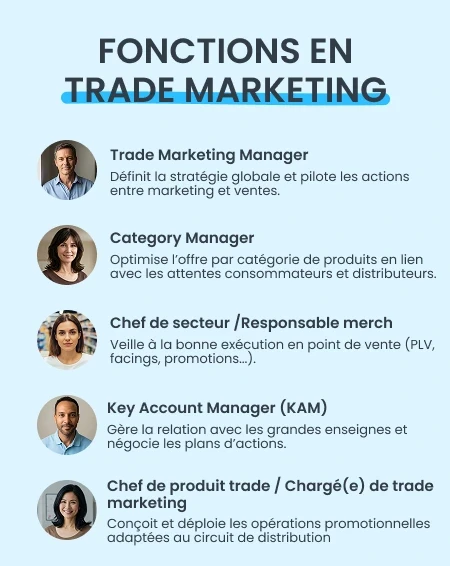
💡 Trade marketing and corporate culture
In the business world, proponents and initiators of trade marketing generally try to instill a dynamic at the corporate culture level. Indeed, moving from a confrontational mode to a collaborative mode can have a huge impact on mindsets, and usually requires intense communication, training, and support campaigns to align employees with the organization's new direction.
Trade marketing can thus encompass countless actions and practices. This is why we can talk about culture as much as technique. Its implementation requires a significant investment from management to successfully shift mindsets internally and manage to change distributor relationships deeply and sustainably.
When this change is carried out properly, the entire organization converges toward a new type of in-store performance, based on sharing and transparency with retail chains and points of sale.
Very common in the large-scale retail sector, trade marketing is gradually establishing itself in other sectors, as companies realize that they cannot remain in permanent opposition with their partners, and that each party possesses crucial information for the other.
It is give-and-take, and then win-win!
Margot has been working in Tech and SaaS for 8 years, with a multi-product experience that has given her a unique understanding of business challenges. On a daily basis, she analyzes, relentlessly tests, and relies on facts to shed light on market trends and help sales teams move forward.
See also

Artificial intelligence and field professions: what our 2026 studies reveal
Adoption, barriers, use cases: discover what our three studies reveal about the role of AI among sector managers, sales representatives, and foodservice sales reps.

CHR and RHF Sales Representatives: portrait of a relationship-driven profession in the era of data
Equipment, productivity, AI: discover the major trends for the HORECA and food service sales profession in 2026 through our field study.

Pharmaceutical Sales Representative in France: Portrait of a Field Job Under Pressure
Compensation, aspirations, AI usage: discover the major trends in the pharmaceutical sales representative profession in 2026 through our field study.

Area Sales Managers in France: who are they and how is the profession evolving in 2026?
Compensation, aspirations, AI usage: discover the major trends in the field sales representative profession in 2026 through our field study.
The area manager professions in 2026
Discover the trends, the challenges, and the key figures.