
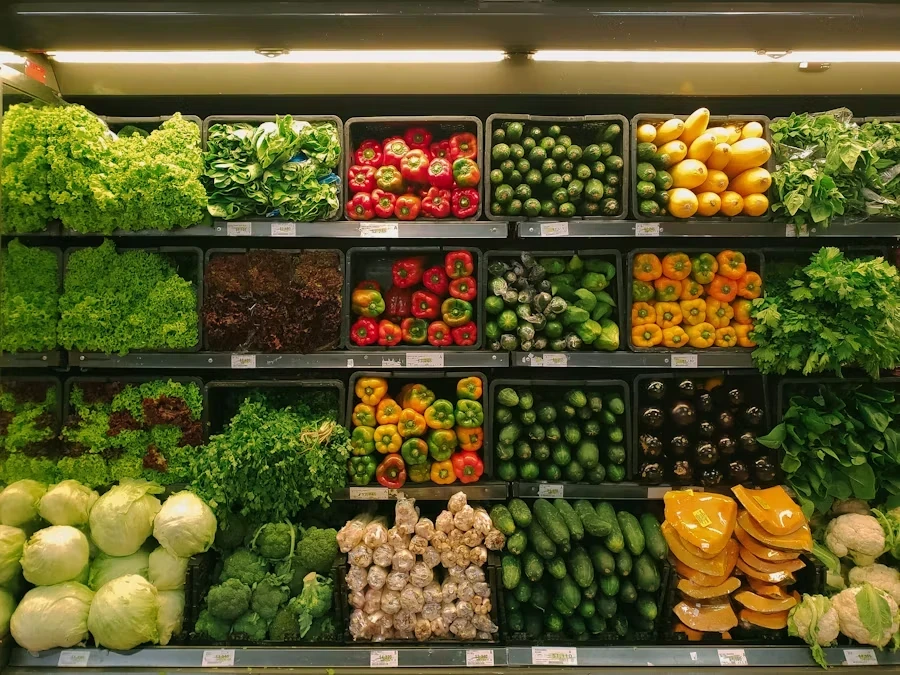
The fruit and vegetable market in France
Discover the fruit and vegetable sector in France: consumption, distribution channels, challenges, and strategies to optimize your sales

In short
12 min read
A market under pressure: despite strong interest in "healthy eating" and plant-based foods, the consumption of fresh fruits and vegetables is decreasing in volume due to the effects of inflation.
A complex and organized sector: the industry relies on a chain of interdependent players ranging from 57,500 producers and producer organizations to wholesalers (distributing 40% of volumes) and distributors.
Economic and sustainable challenges: producers are facing strong pressure on prices, receiving only about a quarter of the final price, while the industry must intensify its traceability and ecological transition efforts in the face of waste.
The rise of local and convenience: 79% of French people favor products of French origin, while the growth of fresh-cut and ready-to-use products meets a growing need for speed among urban consumers.
In-store commercial performance: biological field audits, including monitoring of assortments and prices, have become strategic for industry players in order to maintain their competitiveness against major retailers.
“Eat at least five fruits and vegetables per day.” For more than 15 years, this message has been anchored in the French media landscape. And it has borne fruit: today, 79% of French people consider it important to consume at least five portions of fruits and vegetables per day.
Interest in a more plant-based diet continues to grow. According to IFOP, 68% of French people believe that adopting a more plant-based diet would be beneficial for health, while 64% see it as a lever to reduce environmental impact.
Yet, despite this enthusiasm, the consumption of fresh fruits and vegetables is decreasing. According to Le Monde, in 2024, French people reduced their purchases by 2% in volume, due to inflation and changing food habits. According to La France Agricole, between 2019 and 2024, the consumption of fresh vegetables and fruits decreased by 11% and 13% respectively.
This situation raises an essential question: how to maintain and strengthen the place of fruits and vegetables in the French diet, despite economic constraints? Shifted between new consumer expectations, evolving distribution channels, and production challenges, the fruit and vegetable market in France is undergoing a major transformation.
In this article:
The organization of the fruit and vegetable sector in France
The challenges and issues of the fruit and vegetable sector
Consumer trends
Fruit and vegetable distribution channels in France
The sale of fruits and vegetables in out-of-home catering (RHF)
The sale of fruits and vegetables in specialized channels
The sale of fruits and vegetables in supermarkets (GMS)
The challenges of product assortments
Monitoring the presence and proper presentation of products
The fruit and vegetable market in France
Fruits and vegetables occupy a central place in the French diet: a household consumes an average of 160 kg of fresh fruits and vegetables per year, according to Kantar. Yet, in recent years, purchasing behaviors have evolved under the influence of economic, societal, and environmental factors. Faced with budget, time constraints, and new consumption trends, some households are turning more towards ultra-processed products, to the detriment of fresh. An evolution that raises major challenges for players in the sector.
The organization of the fruit and vegetable sector in France
The fruit and vegetable sector in France relies on a well-organized structure, involving several key players at every step, from production to distribution.
The producers
France has 57,500 farms specialized in growing fruits and vegetables, covering a total area of 362,000 hectares (INRAE).
Producer organizations (POs)
Producer organizations, such as Blue Whale, Sicoly, or Prince de Bretagne, bring together several farmers to pool resources, optimize production, and improve marketing. They play a strategic role by facilitating crop planning and securing sales outlets. There are about 200 recognized POs in France.
Shippers and cooperatives
They handle the collection, packaging, and distribution of fruits and vegetables to the various marketing channels. Their role is essential to ensure efficient logistics and an offer adapted to market expectations, while maintaining product freshness.
Wholesalers
A fruit and vegetable wholesaler buys large volumes directly from producers, cooperatives, or importers, and then resells these goods to retailers and catering professionals.
As Interfel explains, the wholesaler plays a key role by guaranteeing “the right product, at the right time, in the right place.” They distribute 40% of fresh fruits and vegetables in France, making them a key player in the sector.
Distributors or retailers
The chain ends with distribution to consumers, which goes through various channels: supermarkets, open-air markets and greengrocers, organic and specialized shops, as well as direct farm sales or short food supply chains.

The challenges and issues of the fruit and vegetable sector
Having so many intermediaries between the field and the plate raises several major challenges.
The impact on prices and farmers' compensation
Fruit and vegetable producers are faced with constant price pressure. With the multiplication of intermediaries, the share of the final price that comes back to them often remains too low. On average, a producer receives only 20% to 25% of the price paid by the consumer in supermarkets.
Take the example of Pink Lady apples sold loose at Carrefour for €3.79 per kilo. This means that only 75 cents go back to the producer. To earn a gross minimum wage (SMIC), a French orchardist must sell nearly 2,400 kilos of apples every month.
To address this issue, several initiatives have emerged:
The EGALIM laws: set up to ensure a fairer purchase price for farmers, although their effectiveness is debated.
The development of short supply chains, which limit intermediaries and allow better compensation for producers.
The rise of producer brands in supermarkets, which value their work and improve their visibility among consumers.
Price is also felt at the other end of the chain: at the consumer level. Prices have risen by an average of 20%. The purchase price remains one of the major barriers and therefore explanation for the drop in volume sold in supermarkets. According to Fresh Plaza, 70% of French people declare of limiting their fruit and vegetable purchases because of the cost.
Product traceability
Consumers increasingly want to know where the products they eat come from. However, the presence of many intermediaries complexifies the tracking of fruits and vegetables throughout the supply chain.
This lack of transparency can harm buyer confidence and influence their purchasing decisions. To address this, the industry is moving towards:
Digital tools to improve traceability, notably via QR codes on packaging.
Quality labels (organic, HVE, Zero Pesticide Residue) to reassure consumers.
B2B platforms directly connecting producers and buyers to ensure better visibility of product origin and prices.
Sustainability and ecological transition
With increasingly unstable weather conditions and limited water resources, the fruit and vegetable sector must adapt to ensure more sustainable production.
The main environmental challenges are:
Food waste: about 30% of fruits and vegetables are lost before even reaching the consumer, often because of aesthetic standards imposed by supermarkets.
Logistics optimization: to reduce the carbon footprint of transport and improve inventory management.
Better water and soil management: faced with episodes of drought, producers are adopting more water-efficient irrigation systems.
Short supply chains: a booming alternative
Faced with these challenges, short supply chains are becoming increasingly attractive. By reducing the number of intermediaries, they allow:
Fairer compensation for producers
More competitive prices for consumers
Better product traceability
A reduction in the carbon footprint related to transportation
However, despite their rise, short supply chains still remain marginal in the consumption habits of the French, with supermarkets retaining a majority market share.
Consumer trends
When it comes to buying fruits and vegetables, seasonality remains the primary choice criterion for 65% of consumers, closely followed by origin.
Price remains a key factor, all the more so in a context of inflation. Faced with rising costs, 1 in 2 French people favored cheaper products in 2023, adjusting their habits to preserve their purchasing power. This phenomenon, called "downtrading," translates into shifting to more accessible products, often to the detriment of premium or organic lines. Nevertheless, fresh produce and particularly fruits and vegetables are among the consumer goods that experience a rebound once inflation stabilizes. As Emily Mayer, Business Insights Director of Circana, explained on the podcast Je bosse en grande distribution, traditional fresh goods correspond for the French to "eating well, consuming well." "It is a positive signal of a return of reinvestment in better consumption."
Spending also varies by generation. Those aged 65 and over spend an average of €108 per month on fruits and vegetables, showing a priority given to quality and diversity. Conversely, younger consumers, subject to tighter budget constraints, allocate only €46 monthly, favoring more occasional consumption. On average, French people spend €79 per month on these products, according to a Propulse by CA study.
Organic: between enthusiasm and slowing down
The rise of organic food has deeply transformed the fruit and vegetable market, driven by consumers' desire to choose a healthier and more environmentally friendly diet. However, after years of strong growth, the sector has experienced a slowdown since 2023, mainly due to rising prices. On average, organic fruits and vegetables cost 30% to 50% more than their conventional equivalents, which slows down their adoption.

Supermarket margins between a conventional apple and an organic apple (source: UFC que choisir)
Despite this slowdown, fruits and vegetables remain pillars of the organic market. In 2022, they represented 8% of organic vegetable purchases and 7% of organic fruit purchases. According to the Agence Bio, 91% of organic products are consumed at home.
However, supermarkets are struggling to keep up. Specialized distribution remains the leading sales channel in value (€399 million for fruits and €371 million for vegetables), whereas supermarkets only come in second place for organic fruits (€355 million), despite a much higher volume of sales. For organic vegetables, direct sales even take precedence over supermarkets, generating €314 million.
This is largely due to the reduction of the organic offer in favor of alternative labels like "Zero Pesticide Residue" or "High Environmental Value" (HVE), which are deemed more accessible. This strategy reflects a refocusing on more affordable products, in line with French budgetary expectations. The consequence? Consumers committed to organic food are turning more towards specialized stores, which recorded an average sales increase of 7% between January and April 2024.

Organic farming figures in France. (Source: Ministry of Agriculture)
Changes in consumption: between convenience and speed
Faced with an acceleration in the pace of life, convenience has become a decisive purchasing criterion for consumers. This need for speed and simplicity is particularly found among 35-49 year olds living in urban areas. They spend an average of €436 per year on fresh fruits and vegetables, which is 8% more than the national average (€401), with €13 dedicated to fresh-cut products.
Several consumption trends are emerging:
Bagged salads and ready-to-use mixes: a market that exceeds €600 million in turnover in France.
Cut fruits and vegetables: available in trays or individual portions, they appeal to those looking for a healthy and quick alternative for their meals.
Frozen or canned vegetables (vacuum-packed): popular for their long shelf life and daily convenience.
At the same time, the quest for a healthy and balanced diet continues to gain ground. Consumers are increasingly turning to superfoods like goji berries, kale, or avocado, renowned for their nutritional benefits.
Preference for local and "made in France"
Local consumption is emerging as one of the major food trends of 2025, and fruits and vegetables are no exception. According to a study conducted by Interfel, 79% of French people prioritize food of French origin, a figure that climbs to over 85% among consumers who are most sensitive to environmental issues and supporting local producers.
This enthusiasm for "made in France" is mainly driven by the ecological argument (limiting the carbon footprint related to transport), a desire to support the local economy, and an attachment to local terroir.
Despite this stated preference for local, some challenges remain. More than 50% of the fruits consumed in metropolitan France are imported, notably bananas, oranges, and kiwis. To overcome this dependency and meet demand year-round, the sector is exploring solutions like greenhouse production or local crop diversification.
The distribution of fruits and vegetables in France
Fruit and vegetable distribution channels in France
The retail market for fruits and vegetables in France is largely dominated by supermarkets, which capture more than 65% of sales of fresh fruits and vegetables. However, short supply chains are gaining ground, with a 13% market share, thanks to a growing demand for local products and better traceability.

Selling fruits and vegetables to catering professionals
Out-of-Home Catering (RHF), also called Out-of-Home Dining (RHD), group matches all meals consumed outside the home. This sector includes both institutional catering (school cafeterias, corporate restaurants, healthcare facilities) and commercial catering (restaurants, cafes, hotels).
This is a key segment of the fruit and vegetable market in France, representing about 10% of total consumption volume. According to Interfel, this corresponds to about 0.8 million tonnes of fresh fruits and vegetables consumed each year in RHF, generating an estimated turnover of €1.5 billion.
Sales breakdown in RHF
66% of fruits consumed in RHF are destined for institutional catering.
58% of vegetables are sold through commercial catering.
Specific features of institutional catering
The RHF sector has unique needs that influence sourcing strategies:
Adapted formats: restaurants, cafeterias, and fast-food outlets often favor pre-cut, peeled, or even vacuum-packed products to reduce kitchen labor.
Consistency and quality requirements: professionals seek suppliers capable of guaranteeing a steady supply in terms of size, taste, and shelf life.
Demanding sanitary standards: compliance with hygiene and traceability standards is paramount, with special attention paid to certifications such as Organic Agriculture or environmental labels.
The rise of processing: processed fruits and vegetables (purees, sauces, frozen vegetables) are growing strongly to meet the needs of chefs and agribusiness companies.
Key distribution players in RHF
Several specialized wholesalers play a major role in supplying caterers.
TerreAzur: a reference supplier of fresh fruits, vegetables, and seafood, TerreAzur offers more than 1,500 references, including certified organic products and goods sourced from local producers.
Transgourmet: with a specialized subsidiary based at the Rungis International Market, Transgourmet distributes more than 500 varieties of fresh fruits and vegetables, meeting caterers' expectations for quality and logistics.
PVM: specialized in the distribution of fresh fruits and vegetables, PVM offers 800 references for institutional catering, with a wide range certified AB (organic), HVE, and Eco-Responsible Orchards.
Current industry challenges and trends
Out-of-home catering is evolving in response to several trends and regulations influencing fruit and vegetable distribution:
The EGALIM law requires school cafeterias to have 50% sustainable and quality products, including 20% organic. This pushes distributors to adapt and integrate more local and organic farming products. For example, Norabio offers a 100% organic range for institutional and commercial catering.
Caterers increasingly favor local producers, thus reducing intermediaries and boosting traceability. This movement meets a growing consumer demand for fresh and sustainable food.
Catering professionals today must ensure total transparency regarding product origin. This requirement pushes distributors to improve their traceability systems and offer products with quality labels.
The sale of fruits and vegetables in specialized stores
Stores specializing in fruit and vegetable retail play a key role in the French food distribution landscape, generating an average annual turnover of €6 billion. This is far from E.Leclerc (€61 billion) and Intermarché (€40 billion), but the sum represents a significant weight. Especially since they differentiate themselves from supermarkets by focusing instead on a premium offer, with a wide choice of varieties, a highlighting of local heritage, and an immersive shopping experience.
There are several types of specialized stores in the fruit and vegetable sector:
Multi-fresh networks, representing 5% of the total fruit and vegetable market, such as Grand Frais, L’Heure du Marché, Provenç’halles, Prim’Fruits, Cœur de Frais…
Specialized organic chains: with the rise of organic food and environmental labels, some chains have chosen to offer a 100% organic range, appealing to health-conscious and ecologically-minded consumers, such as La Vie Claire or Les Comptoirs de la BIO.
Independent greengrocers and local markets which, in the face of supermarkets, focus on differentiation with better quality products and expert advice.
The sale of fruits and vegetables in supermarkets
If one had to summarize the sale of fruits and vegetables in supermarkets in one sentence, it would be this: without a fruit and vegetable department, there would be no supermarket. And for good reason: it is the store's showcase. “Clearly, it is the freshness image of a point of sale,” shares Stéphane Paul, a professional trainer specialized in fruit and vegetable professions, with Je bosse en grande distribution. It is what drives the consumer to walk through the door. According to OpinionWay, 87% of French people declare that the quality and freshness of the fruit and vegetable assortment influences their choice of store. This is confirmed by Eric Wanaverbecq, an employee in the fruit and vegetable department at Carrefour Wasquehal, speaking to Je bosse en grande distribution: “If you want customers to return, you must constantly check freshness, origins, traceability.” According to him, this is “what makes all the difference between a department that just runs and one that builds loyalty.”
The weight of retail banners
Carrefour, Leclerc, Intermarché, and Super U capture about 70% of industry sales because they position themselves on an extensive range of fruits and vegetables at competitive prices, generally supported by private labels (MDD). Their presence across the entire territory facilitates supplies and thus the quantity of fruits and vegetables offered, sometimes to the detriment of quality. Product standardization can deter some consumers. This is why, recently, supermarkets are making extra efforts to revalue their products:
Renovation of fresh and food service aisles;
Development of specific ranges and labels, like “Act for Food” at Carrefour;
Marketing initiatives to revalue products, like Intermarché's campaign for ugly fruits and vegetables;

Intermarché campaign for ugly fruits and vegetables
Highlighting local producers through direct partnerships, once again with Intermarché and its “Producteurs d’ICI” approach.
The weight of the department
The profitability of the fruit and vegetable department is well-established.
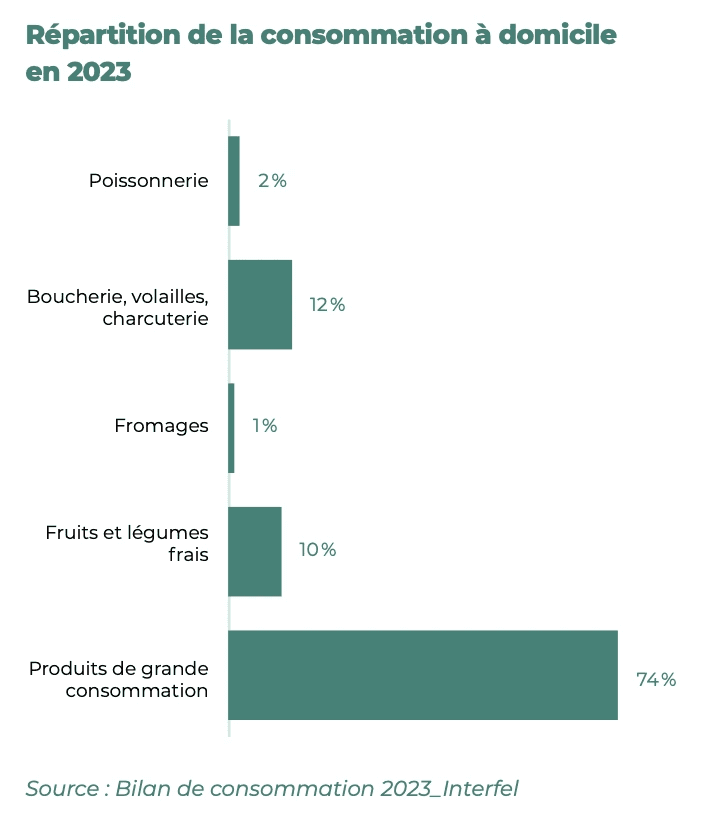
In 2023, French households spent about €21 billion on fresh fruits and vegetables. In 2022, fruits and vegetables (FLEG) accounted for 36.7% of the turnover of fresh produce.
According to Je bosse en grande distribution, “in hypermarket formats, the turnover of the fruit and vegetable department […] can represent 6% of the store's total turnover, and even up to 8.5% in spring”. It is interesting to note that in large retail stores, 20 products account for 80% of the department's turnover. Pareto's law is therefore everywhere. According to Kantar, the fruits most consumed by the French are bananas and apples.
Display and staging of fruits and vegetables in supermarkets
The fruit and vegetable department is one of the most important in retail. It has an average of 350 references and constitutes a real point of differentiation for a store. Its success relies mainly on product freshness, attractive presentation, and clear information for the consumer. Staging is important because it boosts the turnover and sales volume of the fruit and vegetable department. “Just placing fruits and vegetables on shelves doesn't spark excitement. You have to make people want to return,” explains Eric Wanaverbecq, an employee in the fruit and vegetable department of Carrefour Wasquehal, speaking to Je bosse en grande distribution.
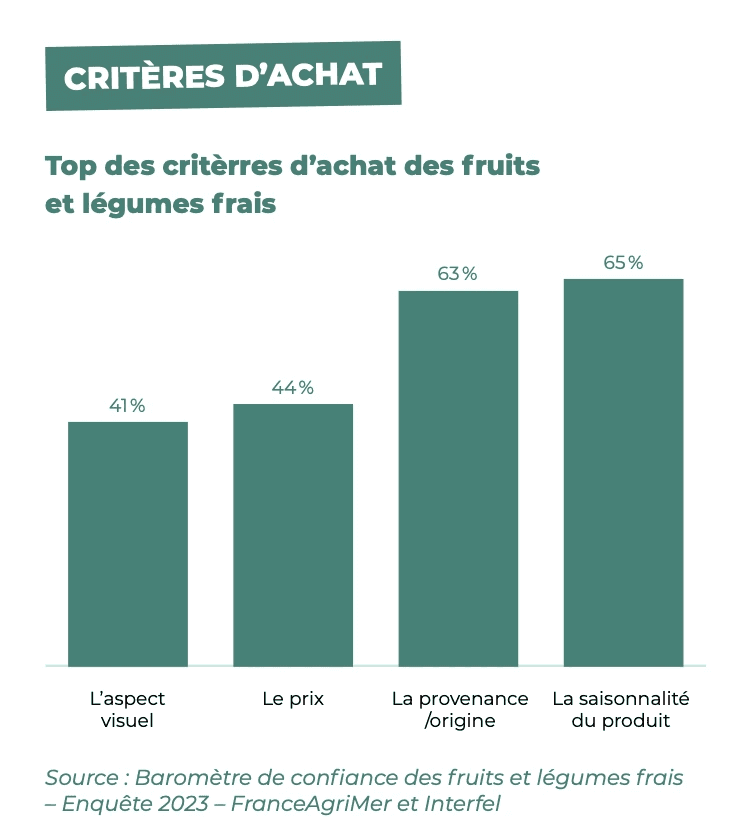
This barometer from FranceAgriMer confirms the words of Eric Wanaverbecq: “A setup might look beautiful in a photo, but if it doesn't sell, that's not the goal.” The department must therefore be well laid out and decorated, but beautiful aesthetics will never replace facing, good department management, product and origin selection, as well as seasonality. This last point continues to evolve strongly between ecological awareness, economic constraints, and modern consumption habits: 64% of French people declare that seasonality is a priority purchasing criterion for fruits and vegetables, almost at the same level as product origin. In fact, 87% of them wish that supermarkets only offered in-season (and environmentally friendly) fruits and vegetables. Nearly 9 out of 10 French people expect a more seasonal and local offer in supermarkets. Clear displays (origin, season, production method) directly influence choices in the aisle.
To guarantee freshness, it is essential to ensure frequent deliveries, ideally daily, to limit stock levels and avoid shrink. Also, advise the department manager to avoid creating high mounds of fruit. This presentation damages products and accelerates their deterioration. It is better to opt for a well-proportioned and well-organized display, with frequent restocking.
The layout of the aisle is indeed very important to drive better sales. It facilitates the readability of the range for the final customer, notably thanks to:
A clear separation of fruits and vegetables.
A sub-category structure: basic vegetables together (potatoes, carrots, onions), salads and raw veggies aside, and the possibility of cross-merchandising complementary products (e.g., vegetables for ratatouille: tomatoes, eggplants, peppers, zucchini).
A play of colors to energize the aisle and reassure on freshness (an intense green inspires confidence).
💡 Vertical facing is easier for the customer to scan, while careful lighting enhances the products and their quality.
A thoughtful staging: some brands replicate traditional market stalls, while others highlight the origin of their products. It is also important to create themed set designs according to seasonal periods (“Citrus Festival”, “Local Products Week”, “Organic Month”).
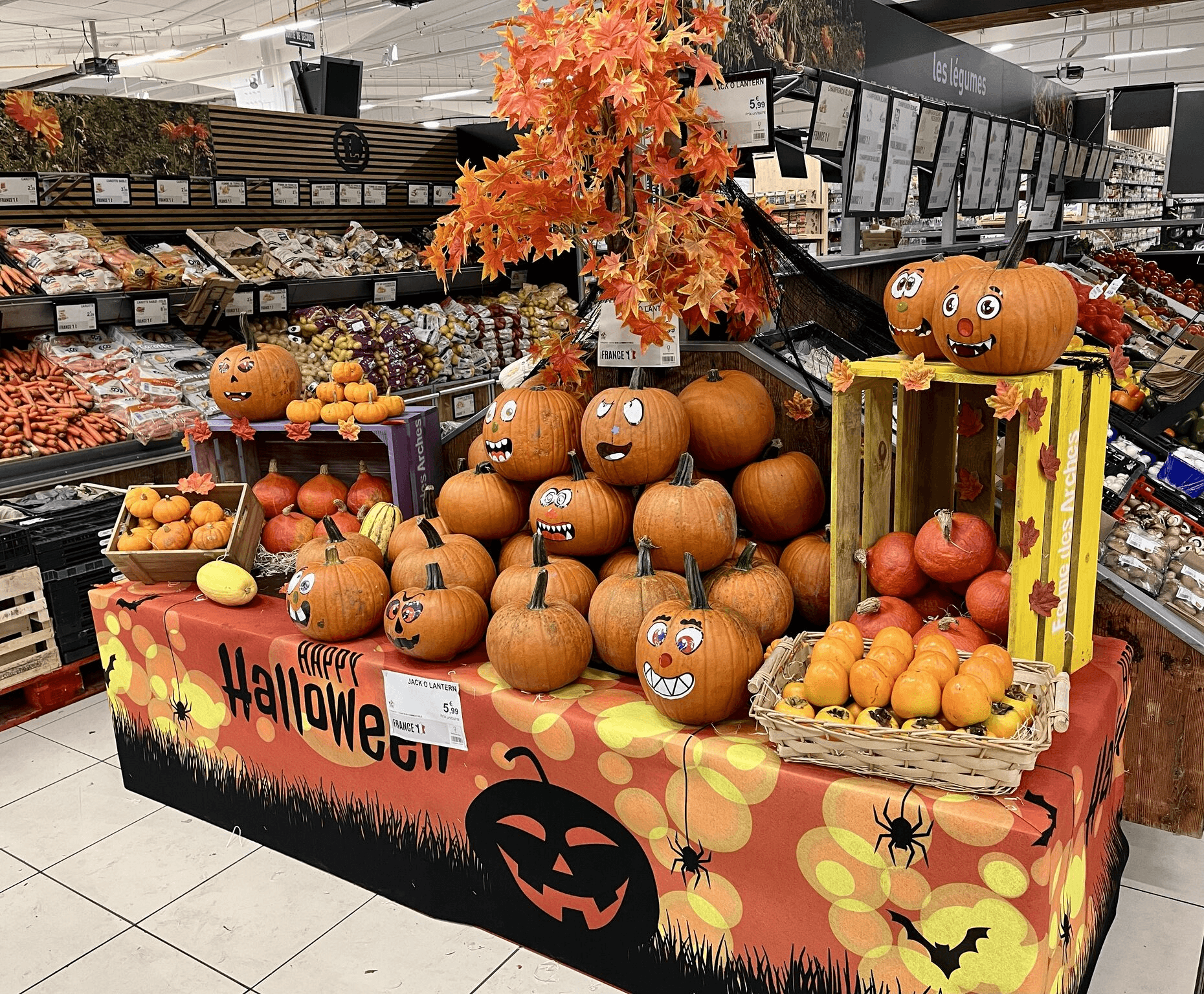
Example of a Halloween-themed display staging
The staging of fruits and vegetables must remain effective throughout the day. A customer shopping at 10 AM, 3 PM, or 6 PM should find an aisle that is equally attractive and engaging, without giving the impression of stockouts or disorganization.
The area manager plays a key role in this balance. Their guidance for department managers ensures a consistent and impactful presentation. They make sure to:
Train teams in best practices for shelving and stock management.
Ensure compliance with merchandising principles: readability, accessibility, and product rotation.
Monitor the implementation of display staging strategies and adjust if necessary to optimize sales.
A well-managed department is based on rigorous monitoring and efficient organization. The area manager brings this expertise and assists department managers in this process.
To go deeper into the subject, I invite you to discover 7 techniques for supermarket display staging to sell more.
Markdown and shrink
The fruit and vegetable department is one of the most delicate in retail. With fresh and perishable products, it experiences a particularly high food shrink rate, reaching 6%, compared to an average of about 1.5% in other departments, according to Smartway. Shrink and unknown loss are among the main barriers to profitability in this department.
And waste has become a major purchasing criterion for French people, especially for fruits and vegetables sold loose. According to OpinionWay, reducing waste is just as important as price in consumer purchasing decisions.
Understanding shrink and unknown loss
Shrink (known waste) corresponds to damaged or expired products that can no longer be sold. It can be caused by customer handling, staff, or simply natural deterioration. The department manager must quantify, anticipate, and integrate it into stock management.
Unknown loss, which is harder to identify, encompasses losses related to inventory errors, theft, or discrepancies between receipts and sales. In food retail, its average rate is around 1%.
Known shrink can be minimized through proper order and stock management.
Anti-waste baskets: the answer to all problems?
Faced with unavoidable losses, anti-waste baskets are an alternative increasingly used by retail chains. “We also limit waste through donations, Too Good To Go, and smart price adjustments,” explains Eric Wanaverbecq, an employee in the fruit and vegetable department at Carrefour Wasquehal, to Je Bosse en grande distribution.
However, their implementation remains inconsistent and poorly sustained in-store, particularly because it acts as a constraint for teams and requires time they do not always have. Added to this is a poor perception by customers. A poorly assembled basket with unappealing products will not find a buyer. It is therefore important to promote it via effective POS advertising and attractive prices. It is crucial to be transparent about what is inside to avoid disappointment.
In-store events and animations
Commercial events are a powerful lever to boost sales and improve the customer experience. They can take several forms: parking lot sales, highlighted displays, tastings... The goal is to create an interaction with consumers, showcase the products, and encourage them to buy.
Effective cross-merchandising and promotion rely on several elements:
An attractive presentation with POS materials that catch the eye.
Associated recipe cards to inspire customers and suggest ideas.
A tasting to allow consumers to experience the taste of the product—a key element in convincing them.
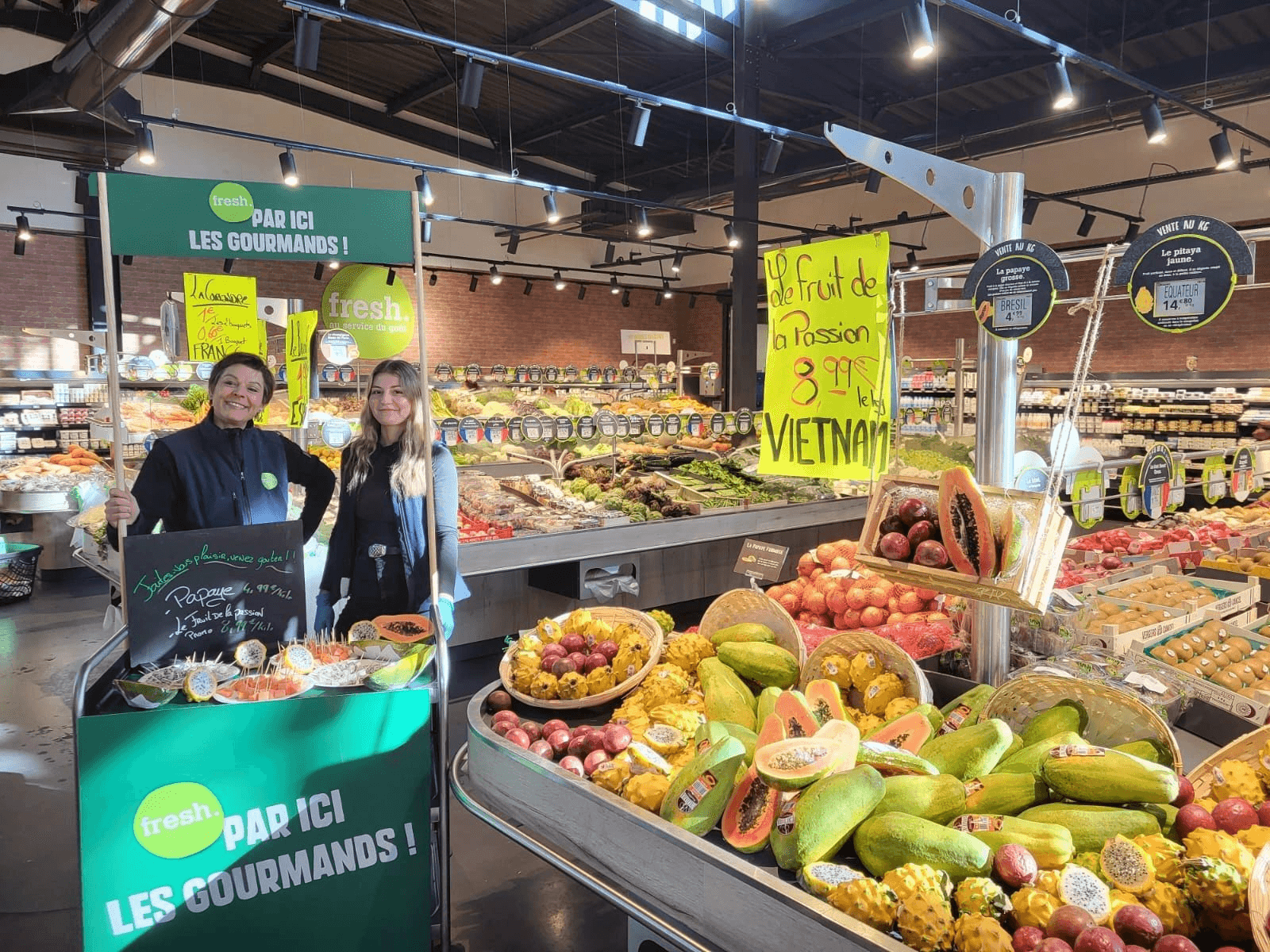
Example of a demonstration event in the fruit and vegetable department
Selling forgotten fruits or vegetables?
Certain fruits and vegetables, once staples, have gradually disappeared from eating habits. Yet, they are making a strong comeback, driven by growing demand for authentic and seasonal products. However, their success in stores relies on effective presentation and an educational approach.
To give these products a real chance, a simple shelf presence is not enough. You must make them visible and attractive:
Bet on quantity: a single box is likely to go unnoticed. A larger order ensures a genuine visual highlight.
Adapt your packaging and message: print easy recipes on your packaging (if not loose) or display them. - Offer ready-to-use kits showcasing a specific recipe (e.g., wok vegetables, soups, salads).
Create a dedicated event: adapt the timing of the in-store event based on your target audience.
On weekdays, a “fruits and vegetables of my childhood” approach will appeal to retirees.
On weekends, a “eat French, eat something new” theme will attract a broader clientele.
On Wednesdays, prioritize easy recipes for kids, ideal for families looking for ideas.
By combining these actions, you increase the success rate of these products and diversify your assortment while meeting the needs of consumers seeking authenticity.
The challenge of product assortments
The fruit and vegetable department stands out due to an assortment managed on a just-in-time basis, linked to fluctuations in supply and demand. Unlike other product categories where trade negotiations occur once or twice a year, fruit and vegetable negotiations happen every time a line item is opened.
Daily and local negotiation
Fruit and vegetable prices evolve on a day-to-day basis. This is why negotiations are not conducted directly in-store by area managers, but rather by desk-bound sales representatives. They deal daily with cooperatives and producers within regional purchase and commercial buying groups.
SKUs can be opened or closed weekly, depending on product availability. When an agreement is reached on a product line, it is reviewed weekly, just like for other fresh products (meat, fish, etc.).
An assortment that tracks the seasons
The store offering must constantly adapt to seasons and production cycles. Certain products must be activated or deactivated based on their harvest window to ensure a relevant selection and maximize sales.
Each banner sets its own promotional cycles according to consumer expectations and sector specificities. This optimizes product display and ensures an offering always in sync with seasonality.
Structure of fruit and vegetable assortments in supermarkets
Building an effective assortment relies on a deep knowledge of your clientele. Understanding their expectations, consumption habits, and purchasing power is essential to offer a tailored range in terms of choice, price, and quality. Consider the depth and breadth of your assortment.
The analysis of the catchment area and competitors also helps define a sales potential, translating into an optimized assortment and adapted equipment.
The basics of a fruit and vegetable assortment
A fruit and vegetable department must respect certain fundamental rules. Among them is a minimum of 40 references, ensuring a wide enough offer to meet customer expectations.
The assortment is based on two types of products:
The staples: about 60 varieties available year-round (20 fruits and 40 vegetables), considered permanent references. They form the foundation of the department and reflect the store's expertise.
Seasonal products: to be integrated according to the time of year to complete the offer and energize sales.
In the consumer's mind, certain fruits and vegetables are perceived as available year-round (salads, onions), while others are clearly identified as seasonal. This perception must be factored in when building the assortment.
Adapting sales formats
Packaging plays a key role in the purchasing experience. Some products are sold exclusively loose, others in multi-packs, and some require specific packaging based on their nature and usage.
Apples, onions, shallots, garlic: available loose and in bags.
Salads: sold individually.
Mushrooms: offered in small containers (200 to 400 g).
Fresh herbs: packaged in very small portions (20 to 40 g).
Chicory, tomatoes, carrots: available loose and in bags.
By adjusting the offer to demand and respecting these sales formats, a wholesaler can better structure their assortment and respond effectively to customer expectations.
Tracking your product assortments as a wholesaler
Once your assortments are defined and negotiated, they still need to be properly tracked. This is where Sidely comes in, assisting cooperatives and wholesalers in managing their products through an adapted commercial CRM.
Your fruits and vegetables must be listed in your CRM and accessible to your area managers. The CRM thus becomes the bedrock of your sales data, ensuring centralized, reliable, and up-to-date information. It is even more essential if you are a cooperative or a wholesaler working with multiple partner companies that negotiate prices on your behalf.
In this sector, assortments and prices vary weekly depending on supply and demand. Seasonality also impacts your catalog, requiring constant oversight. Sidely allows you to automate and optimize this management, saving you time and helping you track your picking products (if you use them).
If your external service providers need to consult or modify their assortments, a permissions and roles system allows them to access only the information relevant to them. Thus, each brand or client sees only their own assortments and documents without interfering with others.
The goal is to involve your partners in managing their assortments, allowing them to modify their own data without you having to manage everything manually. You retain overall visibility and total control over all information.
Creating and managing assortments efficiently
With Sidely, assortment management is simple and flexible:
Import your products with clear criteria: brand, category, format, weight...
Create assortments from your product catalog. We recommend structuring them by product category (e.g., apples, tomatoes, salads) rather than by store banner. This facilitates tracking and analysis in in-store audits and reports.
Modify your assortments at any time, with bulk edits possible.
Take an example: if you sell apples, you create an assortment named “Apples”, grouping all your varieties and sizes. This approach ensures better organization and simplifies field tracking.
Monitoring the presence and presentation of products
Visiting the right points of sale
Supporting your sales force starts with good route planning. This implies setting clear goals for store visits and prospecting.
For example, a flagship store should be visited roughly every four weeks, while prospecting, depending on the banner, is done once every two or three months. To structure these visits, you can set up visit frequencies directly in your CRM.
Promotional events must also be factored in. It is essential to anticipate which events are taking place, on which banners, and when, order to effectively plan sales pitches and the necessary visits.
Analyzing in-store audit data helps optimize routes by identifying stores requiring special attention. For instance, if your audit reveals that a key product like Pink Lady—a best-seller in your range—is missing, returning to that store to resolve the issue becomes a priority.
Streamlining organization with dynamic views
To save time, it is recommended to structure your CRM by creating dynamic views that adapt based on criteria and recent sales actions. Let's look at a simple example with a cyclical workflow, organized around four main views:
Your high-priority stores
Your active promotions
Your stores at risk
Your prospects and overdue stores
Each area manager only needs to click on the view corresponding to their objectives to display the targeted stores.
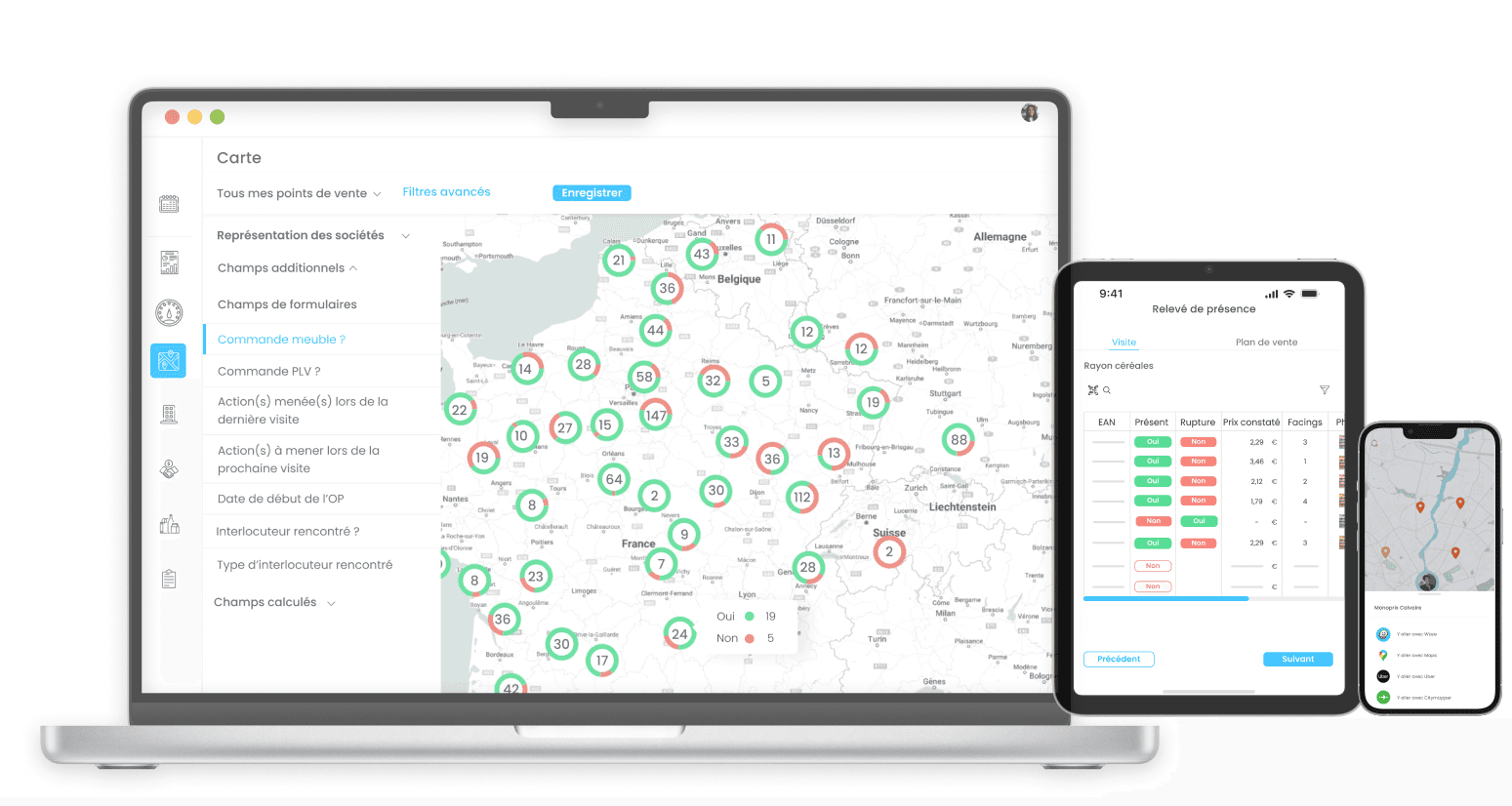
Views are dynamic, meaning they update over time. Look at the last view: “Your prospects and overdue stores”. If a non-priority store has not been visited within three months, even though it should be visited every two months, it will automatically be added to the overdue list. Once the visit is logged, it disappears from the list the following month. Once stores are targeted, it's time for store audits. Thanks to optimized routing, your area managers can collect essential data to improve the visibility and performance of your products at the point of sale. That is exactly what we will cover in the next section.
Audit the right information
An effective retail audit must provide a clear view of the store shelf assortment, taking into account several key parameters:
The format breakdown: share of loose products, trays, and bags on display.
The aisle segmentation: number of SKUs per category and their split between your brand and competing ones.
The product listings: listed products are identified and tracked to measure their presence and progress.
Each area manager must precisely enter the number of SKUs present on shelves for each product category. The goal is to obtain a comprehensive, detailed overview of the aisle, including your brand's share on each segment. This data then allows you to refine your analysis with a specific price audit.
Structuring audits for greater efficiency
We recommend structuring assortments by product to simplify data entry and follow progress easily.
When an audit is created, the retail outlet must be qualified during the first visit:
Selection of products present.
Quantity per format.
Aisle segmentation.
This initial qualification is logged in history. This means that during subsequent visits, if no changes have occurred, the sales rep can go directly to the audit sheet without having to enter all the baseline data again.
An audit aligned with the aisle layout
The audit can be carried out by product, following the actual flow of the store shelves. An area manager can thus track merchandising logically: starting with apples, then moving to pears, and so forth.
To facilitate data collection, your area managers can filter the products they wish to check. If your representative is only tracking promotional items, they can select “promo products only” and only those will appear. This is a real time saver.
Flexibility and real-time updates
If the shelf layout changes—which happens frequently—the area manager can adjust the assortment directly during their audit, ensuring real-time information updates.
If you prefer to maintain full control over these changes, management can be centralized by the manager or CRM administrator. Adjustments made are immediately integrated and impact KPIs (such as numeric distribution), guaranteeing a precise and updated view of in-store performance.
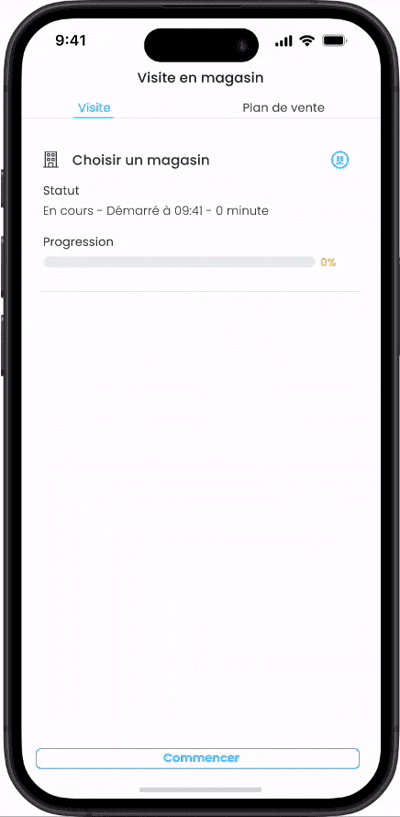
Product assortment example
The fruit and vegetable market in France is at a crossroads. Faced with changing consumer behaviors, the rise of local and plant-based foods, and economic and environmental constraints, industry players must constantly adapt.
The key challenge is to find a balance between profitability, product affordability, and transparency. Producers, wholesalers, distributors, and area managers all have a crucial role to play in meeting consumer expectations while optimizing management. Adopting best practices in assortment monitoring, route planning, and store audit analysis is essential to maximize overall sales performance.
Margot has been working in Tech and SaaS for 8 years, with a multi-product experience that has given her a unique understanding of business challenges. On a daily basis, she analyzes, relentlessly tests, and relies on facts to shed light on market trends and help sales teams move forward.
See also

Artificial intelligence and field professions: what our 2026 studies reveal
Adoption, barriers, use cases: discover what our three studies reveal about the role of AI among sector managers, sales representatives, and foodservice sales reps.

CHR and RHF Sales Representatives: portrait of a relationship-driven profession in the era of data
Equipment, productivity, AI: discover the major trends for the HORECA and food service sales profession in 2026 through our field study.

Pharmaceutical Sales Representative in France: Portrait of a Field Job Under Pressure
Compensation, aspirations, AI usage: discover the major trends in the pharmaceutical sales representative profession in 2026 through our field study.

Area Sales Managers in France: who are they and how is the profession evolving in 2026?
Compensation, aspirations, AI usage: discover the major trends in the field sales representative profession in 2026 through our field study.
The area manager professions in 2026
Discover the trends, the challenges, and the key figures.