

How to grow your food brand in the organic market
Discover the economic context of organic products, best practices for entering this market, and how to organize your organic distribution channel.

In short
10 min read
The organic market in France, following a period of strong growth, has reached a plateau since 2020, marked by a crisis of confidence and image linked to inflation.
Large retailers dominate the sector in terms of volume (50% of market share), but are seeing their sales decline in favor of more selective or local models.
Direct sales (producers, CSA) and specialized stores (GSS) show a more positive growth dynamic in 2024, driven by the search for ethics and transparency.
Manufacturers must navigate between ambitious political goals, such as those of the EGAlim law, and consumer expectations that now prioritize local sourcing and pleasure over the mere organic label.
The distribution strategy has become complex: it requires a precise analysis of physical and digital channels in order to adapt product offerings and logistics to the specific characteristics of each network.
Many brands are considering expanding into the French organic food market. And with good reason; for several years, organic food seemed to be heading toward its golden age, driven by unprecedented government ambition and new eating habits.
Yet, in 2025, the finding is more mixed, and, after several years of inflation, the sector also seems to be affected by a crisis of trust and image.
For manufacturers planning to invest in the organic sector, it is therefore crucial to analyze the market potential and the upheavals it is experiencing, both from economic and societal standpoints.
That is why Sidely offers you an overview of the organic sector.
This article is organized around three main parts:
Organic market: status update and key figures;
Developing the organic market: what brands need to know;
Organizing your organic distribution network.
Organic food market: status update
The French organic food market was worth €12.8 billion in 2023. Organic products are bought in a wide variety of stores, with national food brands and large specialized stores accounting for about 75% of the market.
France ranks in the global top 10 of organic-consuming countries, despite consumption lacking growth since 2020, and the "organic farming" (AB) label is completely understood by consumers, reflecting the maturity of the market.
Indeed, many French people decide to consume natural and pesticide-free products; health issues are compounded by those of sustainable development. Guaranteeing freshness on the shelves of organic stores, local producers are the primary suppliers in the sector, and 83% of the organic products consumed in France are produced locally, excluding tropical products.
But inflation is hitting the sector hard, and we will see below that other factors are impacting its adoption by the general public. Certain markets are particularly suffering, such as organic meat, whose production fell by 20% in 2023.
Ultimately, while the sector had literally doubled since 2015, its overall value is no longer increasing in recent years. The share of organic food in household consumption even declined slightly (5.6% in 2023, compared to 6% in 2022). Furthermore, there is an unprecedented decrease in the number of downstream companies certified for organic activity.
But this stalled growth should not overshadow the interest of the French in organic food, and the market must be considered in its evolution and structural complexity: organic food is full of opportunities for brands, provided they decode its trends and best practices!
Significant performance gaps between distribution channels
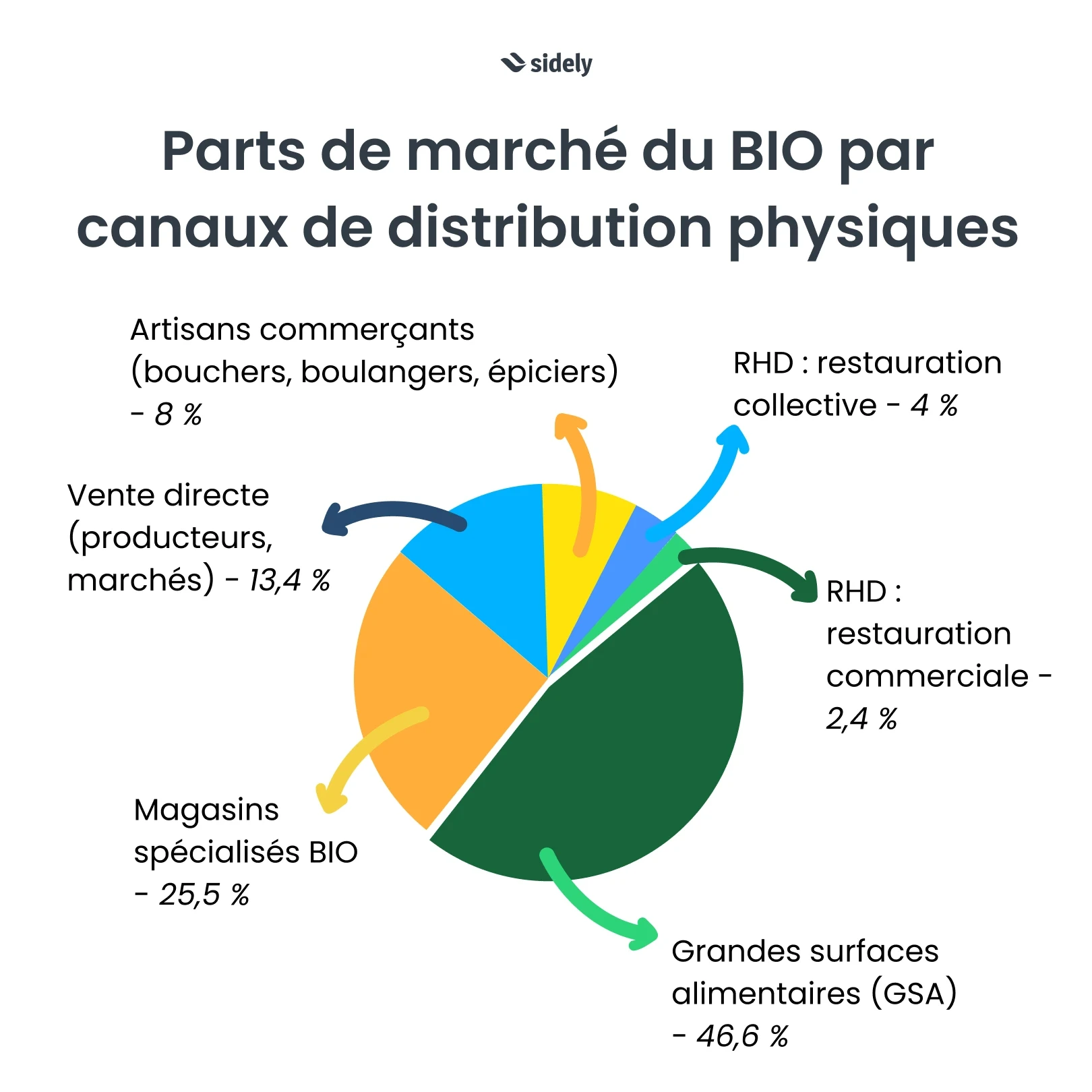
Despite its €6 billion or so in turnover in 2023 and a market share still around 50%, large retailers are the primary victim of inflation (-4% for organic). The value of sales in supermarkets and hypermarkets fell by 5% in the first half of 2024. Large supermarkets are not the only points of sale affected; many organic grocery stores have also experienced difficulties.
Large specialized stores (GSS) make up the second largest channel by volume with 28% of the market. These brands are organized into networks, associations, or franchises, and some have come under the umbrella of large supermarket chains, as we will see below. Some signals suggest that specialized stores regained growth in 2024 (+8.7% in the first half). Bio Linéaires even asserts that stores have once again exceeded €4 billion in turnover in 2024! Franchise networks had already continued to set up stores in 2023, and specialized organic chains (Biocoop, La Vie Claire, etc.) had recorded a 2.2% increase in turnover.
Direct sales come in third place with a turnover of around €1.7 billion. This channel is on the rise: the turnover of local producers, organic farms, markets, and other Associations for the Maintenance of Peasant Agriculture (AMAP) increased by 8.7% in 2023, and this growth continued in the first half of 2024, according to Agence BiO. Direct sales now represent nearly 14% of organic distribution!
Next comes local retail, at around €1 billion. Made up of artisans and shopkeepers, such as greengrocers, wine merchants, butchers, or fishmongers, it is difficult to establish a global status update for these players, whose performance varies.
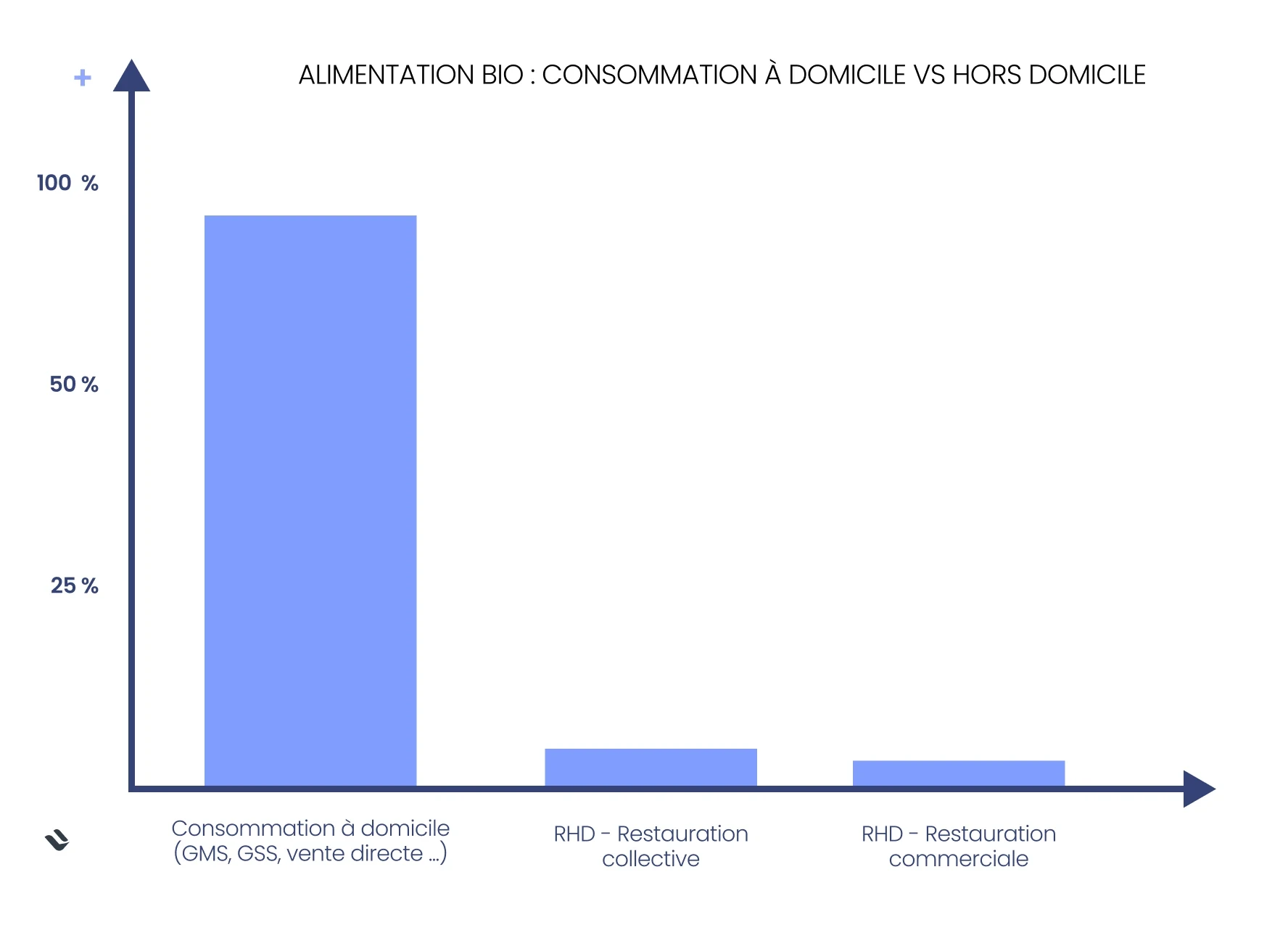
Commercial catering accounts for roughly €300 million in turnover, a rather negligible result compared to the global market. As for institutional catering, it does not exceed half a million, despite political efforts in favor of organic purchasing.
Political action in favor of organic
In Europe, and more particularly in France, organic benefits from a strong political commitment. The European Commission has set an organic land target equal to 25% by 2030. Currently, the French agricultural land converted to organic is slightly above 10%, with more than 14% of French farms engaged in organic farming (representing a 2% increase in number).
In addition, the French EGAlim law sets a purchasing target of 20% in institutional catering. However, this goal is far from being achieved, as institutions deal with limited budgets in the face of an organic sector marked by inflation.
Often presented as a strong adoption lever, institutional catering ultimately accounts for only 4% of organic consumption in France. With its roughly 250,000 restaurants and school cafeterias, out-of-home catering - including cafés, hotels, restaurants (CHR), and corporate catering - accounts for barely 8% of organic sales in France.
Inflation and market reorganization
The primary obstacle to organic consumption in France is inflation, which has affected the agri-food sector for 5 years. Faced with rising prices, many consumers prioritize conventional products, which are often cheaper. This is particularly the case in supermarkets, where households buy price first, then quality.
Furthermore, when their purchasing power allows, consumers tend to turn to direct sales, as evidenced by the success of organic farms, synonymous with transparency and ethical commitment.
We are therefore witnessing a double evolution: on the one hand, a return to conventional options for savings, and on the other hand, the choice of short supply chains for ethical reasons.
Faced with these developments, the supply side is gradually restructuring: after the liquidation of the Les Nouveaux Robinson brand in 2022, the brands L'Eau Vive and NaturéO successfully emerged from their respective safeguard proceedings.
As for supermarkets, they have reduced their organic assortment and are now pushing offers under private labels (PL) and budget prices.
Taking advantage of the organic crisis, retail giants have also filled their shopping carts:
Carrefour acquired Bio c' Bon and So.bio;
Casino bought Naturalia;
Les Mousquetaires took over Les Comptoirs de la Bio.
Organic crisis: price is not the only obstacle
But inflation alone does not explain the stagnation of the organic market in France.
Many consumers favor local and seasonal foods over certified organic ones, as short supply chains and sustainable production align more closely with their ecological and economic principles.
Organic food is also going through a crisis of trust due to the proliferation of labels, which complicates its adoption and is sometimes perceived as opportunistic marketing.
Finally, organic specialized stores face a poor perception of price image; locked into 100% environmental communication, organic stores often forget to promote their low prices or fear it might compromise their image. Yet, when French people are asked about their motivations for buying organic, their health comes before environmental issues and fair compensation for local players.
However, recent surveys show that concern for health and the environment is declining, in favor of pleasure-food. To the dismay of Agence BIO, supermarkets are pulled off a tour de force here to win every time.
How to develop your brand in the organic market
After establishing the current status of the French organic sector, we can now look at the actions to implement for a brand wishing to develop within it.
We will begin by defining what constitutes an organic offering, then we will review best practices in corporate strategy and commercial development to foster your success in this highly specific market.
Finally, the last section of this article will focus on setting up your organic distribution network.
But let's start with the basics!
What is an organic product?
At every stage of its life cycle (production, processing, distribution...), an organic product must respect the organic farming specifications. Throughout the chain, from producer to distributor, regular controls carried out by approved bodies ensure certified quality to the consumer.
Criterion | Key Requirements |
|---|---|
Production methods | Prohibition of synthetic chemical pesticides and fertilizers, absence of GMOs (<0.9% accidental), respect for biodiversity, recycling of organic matter |
Livestock | 100% organic feed, access to the outdoors, veterinary care limiting antibiotics, non-use of ionizing treatments, and use of processes respectful of the ecosystem and non-polluting. |
Processing | Strictly regulated additives and artificial flavors, prohibition of artificial colors and flavor enhancers. |
Certification | Validation by an approved body (Ecocert, Bureau Veritas, Certipaq Bio...). |
Official labels | Euro-leaf (mandatory in the EU), AB Label (French, optional but highly recognized). |
To delve deeper into this topic, visit the Agence BIO website.
Labels and certifications of organic products
Companies converting to organic must notify Agence BIO, then contact an approved certifying body for commercialization.
The AB (Agriculture Biologique) label is the most recognized in France, supervised by Agence Bio and based on European standards, certifying compliance with strict production and processing methods. As part of the certification process, a contract guarantees compliance with the specifications. This is followed by a conversion period ranging from 2 to 3 years. Checks and audits lead to the renewal of the certificate.
There are other labels, some of which can be specific. For example, Demeter is an organic label specific to biodynamics (holistic and ecological agricultural practices).
Strict labeling rules apply (European organic logo, AB label, producer, certifier code, EU / non-EU Agriculture label), as well as detailed documentation ensuring product traceability.
Prospecting the organic trade and distribution networks
To succeed in the organic trade and integrate specialized distribution networks, you will need to adopt a structured approach, combining market analysis, identification of key players, and adaptation to the expectations of organic brands.
Here are some keys to approach this project with confidence.
1. Market analysis and identification of key players
In the last section of this article, we offer a comparative table of the pros and cons of each distribution channel. This tool can help you make your initial strategic choices. You will then need to identify and map out the players corresponding to your targets, using platforms like data.gouv, which allow you to locate operators by department or municipality.
Depending on the chosen channels, draw up detailed specifications detailing the expectations of biological brands: certification (AB, Ecocert, etc.), ethical commitment (traceability, fair trade), product innovation, and environmental respect (eco-designed packaging, short supply chains).
It is also necessary to understand consumer motivations: ethics, traceability, fair trade, local, etc. Constructing your product assortment must follow a logic of clearly identified segments. This is why your market study should pay particular attention to category analysis as well as to target consumer groups and their purchasing habits (channels, psychological prices, etc.).
💡 Finding market data: different sites, such as Circuit bio, LSA, or Linéaires are available for monitoring and documentation. The Agence BIO offers valuable reports and barometers to help you with your 2025-2026 market study.
2. Commercial and marketing strategy
You must then target the right contacts: buyers in purchasing centers (Biocoop, Naturalia), managers of independent stores (e.g., Biomonde, Comptoirs de la Bio), or wholesalers (e.g., Relais Vert) and regional distributors.
For sales prospecting, LinkedIn can prove crucial for contacting buyers and specialized B2B platforms (Circuits Bio). There are also extensions and software that improve prospecting on this famous professional social network, for example, by obtaining the mobile numbers of your target contacts.
Faced with buyers, you will have to convince. To do this, you must build a sales pitch aligned with the values of organic brands, offer attractive terms and eco-responsible POS material, promotions, rapid replenishment, etc. Do not neglect promotions or sampling. Sometimes, it will be better to test your products in pilot points of sale, meaning starting with a few independent stores to generate demand and convince major brands.
Just as wholesalers like Pomona can give you quicker and broader access to professional markets, it is possible to go through sales agencies that can facilitate the entry of brands into the market by pitching their catalog to organic networks.
You could also consider collaborating with local organizations, such as regional structures and professional organizations working in the organic sector (e.g., Chambers of Agriculture, producers' associations, etc.). This will help organize awareness campaigns to encourage organic consumption and develop your brand awareness.
Finally, participating in events such as Natexpo, the Organic Winegrowers Fair, or vendor days organized by retailers can help showcase your offerings and build contacts.
3. Sector monitoring: analyzing trends and outlooks
To put all the chances on your side in a constantly changing market, you must constantly think about the evolution of commercial practices and end-customer expectations.
On the growth driver side for organic networks, we expect, for example, to see the development of e-commerce, either in-house or through partnerships. The creation of stores should also continue, in favor of specialized brands.
Some players will choose to expand their assortments to conventional products, like Naturalia. Large specialized stores should also step up their efforts in terms of sourcing and communication regarding local products and quality. Zero waste is also fashionable, along with bulk purchasing which limits packaging.
The sector will continue to benefit from a favorable political and regulatory climate with the European Green Deal, the "Ambition Bio 2027" program, and in France, the Egalim Law.
These few examples illustrate the need for constant monitoring to capture the major turning points of this buzzing market.
Organic Networks: choosing your brand's distribution channels
Let's now move on to the crucial topic of the distribution channel for your organic products.
We can analyze the organic network according to 6 main physical distribution channels, to which digital is added:
Supermarkets and hypermarkets (GMS);
Large specialized stores (GSS);
Direct sales (e.g., farms);
Artisans and shopkeepers (local retail);
Commercial catering;
Institutional catering (public and private);
E-commerce: online organic pure players.
Large retailers: an essential channel for an intensive strategy
As we have seen, supermarkets and hypermarkets (GSA) such as Carrefour, Auchan, or Leclerc capture roughly 50% of the organic market turnover in France.
Be careful, however, of the fierce competition that rules this channel: Carrefour Bio is not just a store, it is also a brand whose products are present on the shelves of supermarkets and hypermarkets. As for Leclerc, its brand BIO Village (Repère) offers several hundred references available in its general network.
It is obvious, however, that an intensive strategy will lead you toward the major retail chains to integrate the shelves of supermarkets and hypermarkets on a national scale.
Large specialized stores: more selective, more local
In second place are large specialized stores like Biocoop or Naturalia, which represent just under 30% of the market. Large specialized stores, with their highly local and more specific sourcing than large retailers, will correspond to a more selective distribution strategy.
Brand name | Number of points of sale (latest known figure) | Latest known turnover in million EUR | Geographical sector covered | Affiliation |
|---|---|---|---|---|
Biocoop | 700 | 1500 | National | Cooperative |
La Vie Claire | 340 | 331 | National | Independent |
Naturalia | 228 | 357 | National | Casino Group |
Bio c' Bon + So.bio | 143 | 156 | National | Carrefour Group |
Biomonde | 145 | 144 | National | Cooperative |
Les Comptoirs de la Bio | 83 | 118 | National | Les Mousquetaires |
Satoriz | 39 | 168 | Mainly Rhône-Alpes | Independent |
L'Eau Vive | 29 | 26 | Mainly Auvergne-Rhône-Alpes | Independent |
NaturéO | 30 | 139 | National | Independent |
Accord Bio | 227 | 185 | National | Independent (association) |
Marcel et Fils | 63 | 123 | Large South-East quarter | Independent |
Local shops and direct sales: margins at the local level
For a brand with regional ambitions, developing direct sales will mean higher trade margins, but growing the network could take time and energy. Alternative networks like AMAPs or Jardins de Cocagne allow consumers to access organic products through short supply chains, fostering a direct relationship with producers.
E-commerce: a limited channel but with promising potential
Online organic pure players, such as Greenweez, La Fourche, Kazidomi, and Aurore Market, experienced exceptional growth in 2020, in particular due to the Covid health crisis. These platforms successfully attracted consumers through advantageous subscription offers.
Although consumers continue to prefer traditional channels, e-commerce represents a growing share of organic food sales in France. Extremely tight prices will be compensated for by wider reach at a lower cost, which is the hallmark of the Internet.
Note, however, that major generalist and specialized retailers are also present in the e-commerce segment. Your products can therefore be sold online without necessarily going through the pure players mentioned above.
Out-of-home catering: volume at lower cost
Finally, wholesalers and specialized distributors like Pomona, Transgourmet, Metro, or Sysco enable indirect access to institutional and commercial catering. This can be an option to move your products in volume, without investing heavily in marketing and communication.
We outline below the different channels established in the French organic market, with a summary of the pros and cons of each.
Channel | Examples | Pros | Cons |
|---|---|---|---|
Supermarkets & Hypermarkets (GMS) | Carrefour, Leclerc, Auchan, Intermarché, Monoprix | - High sales volume | - Intense competition with organic private labels |
Specialized Organic Stores (GSS) | Biocoop, Naturalia, La Vie Claire, Les Comptoirs de la Bio | - Committed and loyal target audience | - Fewer outlets compared to supermarkets |
Direct Sales & Short Circuits | AMAPs, markets, producer-owned stores, cooperatives, farm sales | - Higher margins | - Limited sales volume |
E-commerce & Marketplaces | Greenweez, La Fourche, Kazidomi, BienManger.com | - Access to the national market with no physical constraints | - High price competition |
Institutional & Commercial Catering | School cafeterias, corporate restaurants, HRI | - Significant bulk volume | - Complex purchasing process |
Wholesalers / Specialized Distributors | Pomona, Transgourmet, Metro, Sysco | - Direct access to numerous professional clients (restaurateurs, institutions) | - Less control over final customer relations |
Alternative Distribution Networks | Bulk sales, zero-waste stores, independent boutiques | - Meets the responsible consumer demand | - Limited sales volumes |
To conclude
The organic sector in France experienced exceptional growth until 2020 and has since stagnated, due to inflation, consumer wariness, but also to a certain form of maturity.
The market has reorganized with changes on the shelves and search for external growth that has allowed major retailers to cannibalize specialized distribution. But direct sales are achieving the best growth rates, echoing the values of consumers whose purchasing power is aligned with organic food.
For brands wishing to expand in this market, you need to finely analyze the potential of each channel, with its pros and cons, and put in place a winning sales and marketing strategy.
Once listed in organic retail points of sale, you can count on the Sidely CRM to boost the sales performance of your products!
It was by observing the still-fledgling digitalization of sales forces that Arthur envisioned Sidely. A graduate of EM Lyon and Le Wagon, he combines a rare commercial rigor with a true product culture. This dual expertise allows him to decipher the shifts in the profession and build a product that truly speaks to sales teams.
See also

Artificial intelligence and field professions: what our 2026 studies reveal
Adoption, barriers, use cases: discover what our three studies reveal about the role of AI among sector managers, sales representatives, and foodservice sales reps.

CHR and RHF Sales Representatives: portrait of a relationship-driven profession in the era of data
Equipment, productivity, AI: discover the major trends for the HORECA and food service sales profession in 2026 through our field study.

Pharmaceutical Sales Representative in France: Portrait of a Field Job Under Pressure
Compensation, aspirations, AI usage: discover the major trends in the pharmaceutical sales representative profession in 2026 through our field study.

Area Sales Managers in France: who are they and how is the profession evolving in 2026?
Compensation, aspirations, AI usage: discover the major trends in the field sales representative profession in 2026 through our field study.
The area manager professions in 2026
Discover the trends, the challenges, and the key figures.