

How to help your sales representatives effectively plan their sales territories
How can you support your sales representatives in planning their sales tours? Tools, prioritization criteria, and best practices for field managers.

In short
9 min read
Sales route planning requires a balanced collaboration where the manager defines a structuring framework without impeding the field's autonomy.
Rigorous market segmentation, based on structural and internal data, allows visit priorities to be defined that are consistent with the company's strategy.
The manager must set clear and temporary priorities, such as launch or promotion periods, to align field actions with commercial challenges.
The use of filtered and dynamic views in the CRM helps sales representatives immediately identify priority visit targets without planning overhead.
It is essential to standardize best practices and common frameworks while preserving operational flexibility to manage daily on-the-field contingencies.
Performance management must focus on the quality of visits and their alignment with strategic priorities rather than on activity volume alone.
The integration of CRM and AI tools transforms field data into a decision-making lever, allowing real opportunities to be targeted instead of relying on intuition.
Like any company with a field sales force, you probably wonder how to optimize your commercial route plans. And with good reason: between planning and travel, your sales reps sometimes struggle to manage their time effectively, generating a substantial loss of earnings in terms of profitability for your business.
How can you support operations without letting costs skyrocket? How do you ensure consistent practices among sales reps while maintaining the necessary flexibility in the field? How should you organize routes to expand your store network, increase order volume, and secure reorders?
Fortunately, solutions exist to optimize your commercial sales routes!
This article is aimed at sales managers and directors who want to structure, support, and improve their teams' route planning, without micro-management.
Why route planning cannot rely solely on sales representatives?
The relationship between a sales director and their reps goes beyond a simple hierarchical reporting line. It relies primarily on a functional partnership, where everyone plays a distinct but complementary role to achieve business goals.
In fact, according to Salesforce, 81% of sales reps say they receive helpful coaching or support from their manager, proving that this supportive role is perceived as essential in the field. It is precisely this ability to structure, guide, and prioritize that creates the right conditions for sales reps to sell more effectively.
Ultimately, the manager's role is clear: set up a structuring framework that helps sales reps plan and organize their routes better, without restricting their autonomy, while allowing the company to gain consistency, clarity, and field efficiency.
The manager's role in organizing commercial sales routes
Even though field sales reps know their sectors inside out, the manager plays an essential structuring role to ensure consistency, fairness, and the overall performance of the brand. Their role is not to organize every single route in place of the reps, but rather to create a clear, shared framework within which routes can be built efficiently.
The manager structures the organization upstream of the routes: they define the foundations (meaning the route plan) that the sales force will rely on. In other words, they adjust territories (at most once a year, unless major changes occur in the team), segment visit points, and define visit frequency rules based on typologies. Without this framework, every sales rep plans according to their own logic, which quickly leads to imbalances, over- or under-covered areas, and a loss of managerial visibility.
The manager also sets the commercial priorities that guide the routes. This is actually their most important role, as it aligns the company's commercial priorities with accomplishments in the field. Notably, they structure routes by defining visit objectives (sales, prospecting, audits, retail activation), identifying key trade events (promotions, launches, specific operations), and prioritizing business goals over a given period.
Finally, the manager monitors. They play a structuring role over the long term, evaluating the quality of the routes and not just their volume. This allows them to analyze the relevance of the visits made, the alignment between priorities and routes, and the evolution of field coverage. On this basis, they adjust future work for their teams.
The limits of total autonomy
Giving autonomy to sales reps is crucial: they know their territory, their customers, and field realities, but most importantly, they must be able to act quickly without waiting for approval every single time.
But leaving complete autonomy over the organization and planning of routes sets structural limits that are linked neither to the skills nor the motivation of the sales reps.
The reason is simple: everyone thinks at their own scale, not at the team's scale. This is simply because it is neither their role nor their scope of responsibility. By nature, sales reps optimize their sector, their clients, and their individual goals.
Added to this is a comfort factor, which can influence decisions. When planning alone, sales reps naturally tend to prioritize visiting clients they know well, replicating routes "that have always worked," or prioritizing geographic or relational proximity. However, this is not the most optimal way to proceed, simply because they (and consequently you) will miss out on new opportunities.
Finally, if everyone thinks on their own scale, it creates major disparities and inconsistencies among sales reps. Everyone plans according to their own logic with their own frequencies, which differ from those of their neighbor. These gaps make monitoring much harder, rendering comparisons less relevant and adjustments more complex.
Concretely, how to help your sales reps organize optimized route plans
To organize an optimized commercial route plan, you must focus on 3 crucial points that maximize the efficiency of their travel.
Give sales reps the right criteria to plan their routes
As a sales director, you are the compass guiding your teams. You therefore have the responsibility to establish a strategic order of priority for the company.
Segment your market
To do this, you must first segment your market. Base this on your structural data, as well as your internal data (store audits, purchase orders...) and external data (sell-out, panels...).
Using structural data, define segments specific to your industry and strategy, such as client types, company size, or history with your brand. Then, classify them based on their sales potential, priority level, or strategic importance according to structural criteria (these may change later, but this already gives you a solid overall view of the store network). Is it an active client? A new client? Is it a local convenience store or a hypermarket? Is the store manager new? Etc.
Here are a few examples of structural data:
The breakdown of targets among suspects, prospects, active clients, and inactive clients;
The breakdown of offers according to their stage in the sales cycle;
The location of the businesses to visit;
Their affiliation with a corporate group or key account;
The decision-making power of the contact person;
Etc.
Once your market is segmented, visits will also depend on commercial data, which is constantly changing.
Clarify commercial priorities
As a sales director, you must set an direction and establish priorities (which can be, and often are, temporary) that help your sales reps make the right trade-offs.
To do this, define the types of visits that are expected: sales, prospecting, sampling workshops, loyalty, audits, shelf setups, retail activations... For each type of visit, your sales reps must clearly understand what is expected of them.
Typically, visit types are selected based on key moments in business activity. Key moments correspond to periods where stakes are higher than usual: promotions, product launches, prospecting periods, commercial highlights (seasonality, national operations, etc.).
You must log this information, usually in the CRM, highlight these periods, explain why they are a priority, and adjust routes accordingly. A route does not follow the same logic during a product launch as it does during a promotional period or a quiet period, and visits do not have the same duration either. The sales tempo is therefore different.
Create filtered views to stop wasting time
Your market is segmented, and we understand you don't want to waste time again. That's why we recommend creating filtered views based on your criteria. These filtered views can be customized for each team and distribution network. Each sales rep has their own views: we recommend one view per commercial objective and/or one view per visit type. Management can also create shared segments to standardize team tracking.
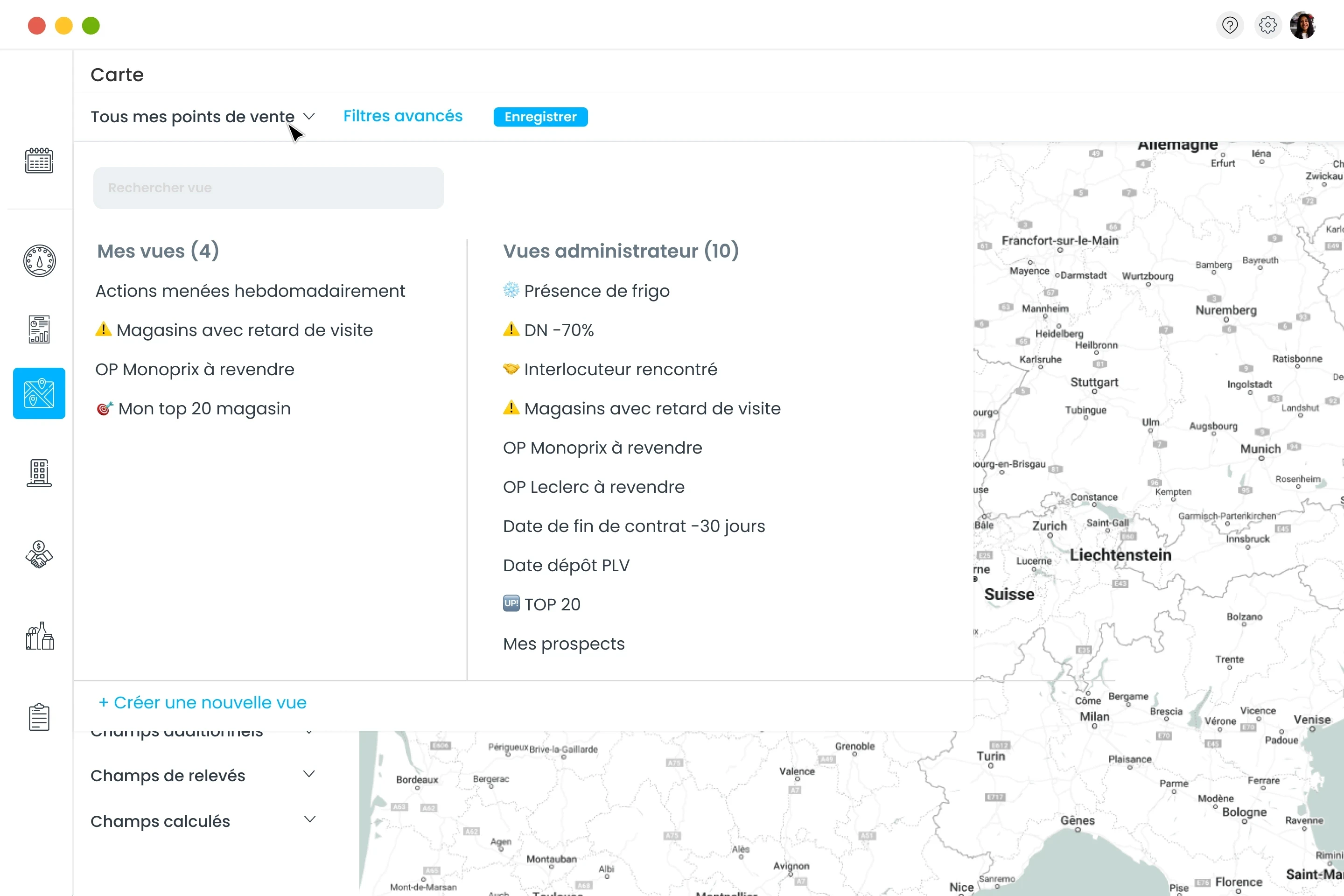
For example, if you want your sales reps to visit active "gold" stores with numerical distribution (ND) below 40%, follow these steps:
Create your view by selecting the "active store" status, the "gold" tag, and set the ND slider to "40% or less."
Save this view as "Next Route" or "Gold Stores / ND < 40%."
Inform your sales team of the criteria for the upcoming route(s) by sharing the filtered view. These views will help your account managers stay organized and be more productive with their route planning.
Rely on CRM data
As mentioned, field data is living data: it constantly evolves with visits and commercial actions. Some routes should even be built almost exclusively based on these recent signals—for example, to identify points of sale that have not placed an order in a while, or those still waiting for a delivery of a past order.
Combined with dynamic views, the information recorded in field audits helps guide planning effectively. They help sales reps—and managers—know which points of sale to visit, when, and for what reason, relying on facts rather than intuition.
The example below illustrates a manager's view of the French territory, grouping the points of sale to visit to verify the correct setup of a display unit. This view can then be filtered or adapted for each sales rep, showing only the points of sale relevant to them.
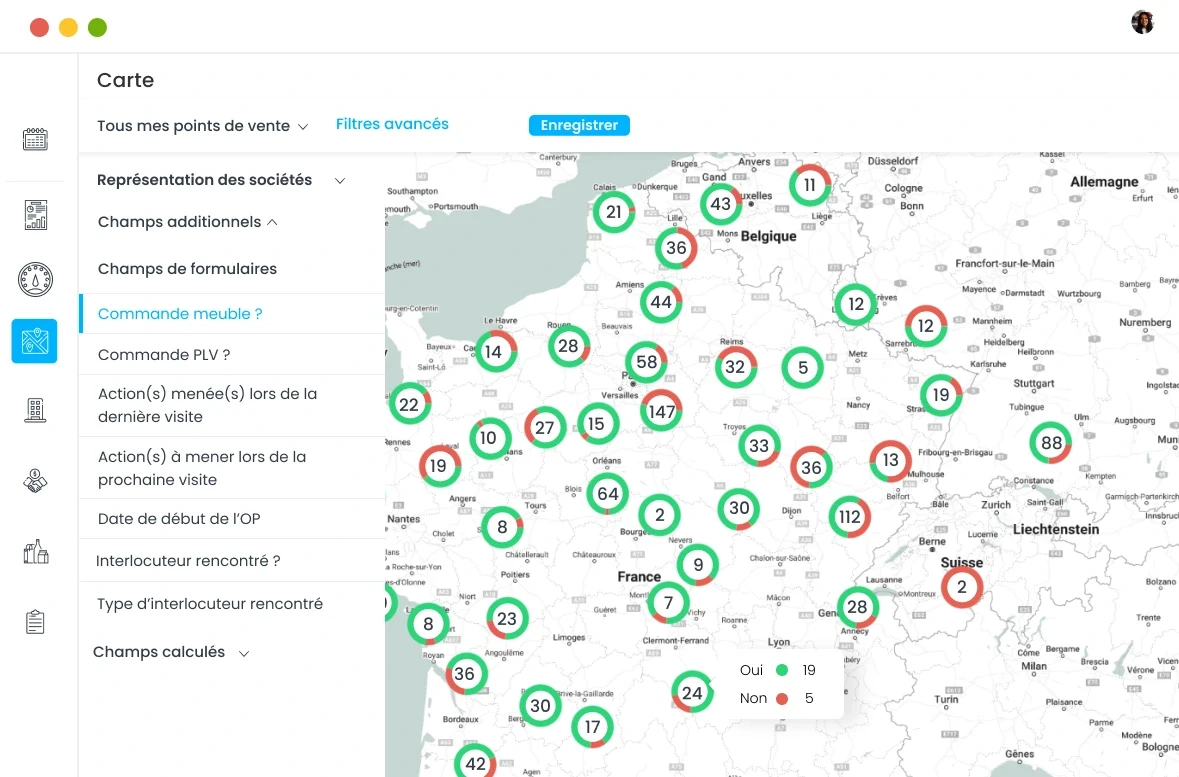
In this specific case, the sales rep immediately sees which stores to visit to ensure that the ordered display units have been properly installed. The route is therefore structured around a clear, operational objective pulled directly from CRM data.
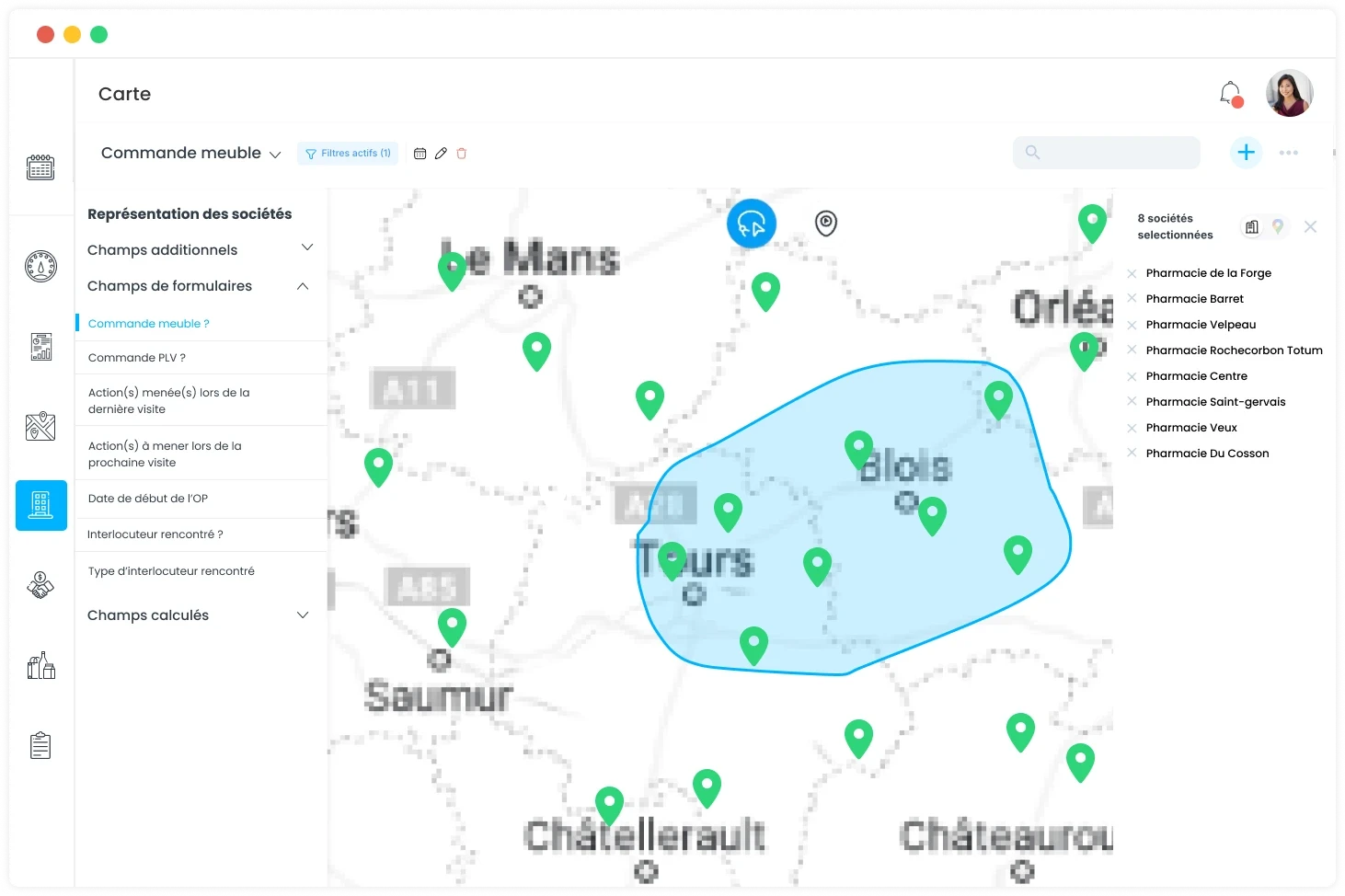
By using this type of view, you help your teams prioritize without micromanaging them. You offer them the autonomy that is often requested and valued, while ensuring objectives are met and tracked.
Standardize routes without making them rigid
The goal here is not to lock in a schedule, but to standardize what needs to be standardized to ensure consistency and efficiency, while giving sales reps the flexibility required by field realities.
Implement shared best practices
Define a core set of shared best practices that each sales rep can rely on to organize their routes.
This includes:
Route templates (weekly, monthly, by mission type),
Shared rules for planning and prioritization,
Common references understood by all.
All of this stored in your CRM's document manager.
Concretely, it is useful to define a target duration for each commercial action:
Merchandising visit
Audit visit
Appointment-based visit
Prospecting call or visit
Order-taking call
Etc.
Incorporate potential delays right from the planning stage, factoring in recurring obstacles (traffic, late contacts, store constraints).
These benchmarks help harmonize practices, making routes more realistic and comparable.
Allow for field flexibility
Standardizing does not mean making things rigid. A sales route is always subject to many unexpected events:
traffic jams,
canceled appointments,
late or unavailable contacts,
last-minute opportunities.
Your teams must have the ability to react, notably by adjusting their route due to traffic, rescheduling a canceled visit, or reorganizing their day without wasting time.
This is why having mobile-friendly tools on a smartphone or tablet is essential, allowing users to update schedules and run optimizations on the go with just a few clicks. This operational flexibility limits wasted time and secures route execution.
Maximize meeting effectiveness
Planning does not stop at organizing travel logistics.
A successful route also depends on meeting preparation.
For each type of sales action, managers can encourage structured practices:
adapting forms and audits to each visit type,
anticipating potential questions and objections,
preparing necessary documents, samples, or materials,
defining a sales strategy tailored to the context and account profile.
📌 Key Takeaways
Two key principles stand out from this approach:
1. There are multiple ways to organize a route, but they must rely on a shared framework.
2. Route preparation and structuring are critical to maximizing field results.
Given the diversity of situations (geography, industry, account types, clients, or prospects), route optimization cannot rely on generic tools alone. It requires using commercial and mapping data to organize routes that are truly aligned with business goals.
Monitor and improve routes over time
The performance of sales routes is built over time, based on field results analysis and gradual organizational adjustments.
This is why you should focus on monitoring the quality of routes (and not just visit volume). Without this, you won't know where your sales reps have had a real impact.
Do the visits align with defined priorities?
Are strategic points of sale actually covered?
Do completed visits generate concrete actions (orders, setups, follow-ups)?
Etc.
Based on the answers, adjust your organization. Analyzing routes helps identify under- or over-burdened sales reps, as well as poorly addressed priorities or under-covered areas. In other words, it helps you steer your teams and act as that guide we discussed earlier.
How tools (and AI) can help managers
The advice in this article depends on the tools you use. Without scheduling software or route optimization tools, you won't be able to support your sales reps.
Equipping your team with the right technologies to prepare sales routes creates a highly effective cycle. Sales reps fill in valuable field information during their visits through audits. This data is then centralized and leveraged in the CRM to qualify and categorize each point of sale and prioritize commercial actions based on real needs.
This prioritization, aligned with the goals of the brand, company, or group, enables managers to better support their teams. It makes segmenting the store network easier, allowing rapid identification of priority points of sale and the organization of routes based on clear criteria: stores in difficulty, high-potential points of sale, dropping ND, visit frequencies requiring adjustment, etc.
Combined with artificial intelligence, CRM and field data go even further. AI automatically identifies high-stakes points of sale or customers by crossing commercial, operational, and contextual data. Together, CRM and AI help sales teams focus their efforts on the right stores, at the right time, relying on factual data rather than habit or intuition.
Alexis co-founded Sidely after several years of service as a sales director. To understand what builds, or breaks, a salesperson's performance, he conducted more than 100 telephone interviews with field sales representatives. At Sidely, he transforms this raw knowledge into concrete support, based on facts rather than assumptions.
See also

Artificial intelligence and field professions: what our 2026 studies reveal
Adoption, barriers, use cases: discover what our three studies reveal about the role of AI among sector managers, sales representatives, and foodservice sales reps.

CHR and RHF Sales Representatives: portrait of a relationship-driven profession in the era of data
Equipment, productivity, AI: discover the major trends for the HORECA and food service sales profession in 2026 through our field study.

Pharmaceutical Sales Representative in France: Portrait of a Field Job Under Pressure
Compensation, aspirations, AI usage: discover the major trends in the pharmaceutical sales representative profession in 2026 through our field study.

Area Sales Managers in France: who are they and how is the profession evolving in 2026?
Compensation, aspirations, AI usage: discover the major trends in the field sales representative profession in 2026 through our field study.
The area manager professions in 2026
Discover the trends, the challenges, and the key figures.