

Product family: definition with examples by sector
Discover the definition of a product family, the criteria for structuring it, and concrete examples by industry.

In short
6 min read
The product family groups articles with common characteristics, making a complex catalog more readable and easier to analyze.
It is distinguished from the reference, range, and category—four concepts that are often confused even though they respond to different logics.
A well-constructed nomenclature of families is based on precise criteria (use, composition, merchandising, regulations) and on a structured method in several steps.
Grouping logics vary greatly by sector, from the aisle in mass retail to the product's function in cosmetics or the hospitality industry (Horeca).
Structuring your catalog by families makes sales reporting more reliable, guides the construction of assortments, and facilitates the daily work of sales representatives in the field.
This organization directly conditions listing negotiations with distributors and the ability of managers to steer commercial activity.
Building a point of sale's assortment involves choosing, from dozens or hundreds of references, those that must actually appear on the shelves. This selection is not made reference by reference: it relies on a broader organization of the catalog, where each product belongs to a coherent set. This is precisely the role of the concept of a product family, which allows items to be grouped according to common criteria.
In the field, an area manager preparing an assortment strategy must think at this level: which families to prioritize according to the format of the point of sale, which ones generate the most rotation, where the gaps lie compared to the competition. We have detailed this approach in our article on assortment strategy in large food retailers, which beforehand requires a clear classification of product families.
This concept, which is central to merchandising, is nevertheless often confused with neighboring terms such as category, range, or segment. However, the distinction matters: it conditions the structuring of product data, sales management, and the preparation of negotiations with distribution.
This article proposes a precise definition of the product family, details the criteria and steps to build it, and then illustrates the concept through concrete examples from several sectors (food, cosmetics, food service, non-food). Finally, it shows how this organization of the catalog directly influences the daily work of field sales representatives and area managers, particularly for sales tracking and assortment management at the point of sale.
What is a product family?
Definition and principles
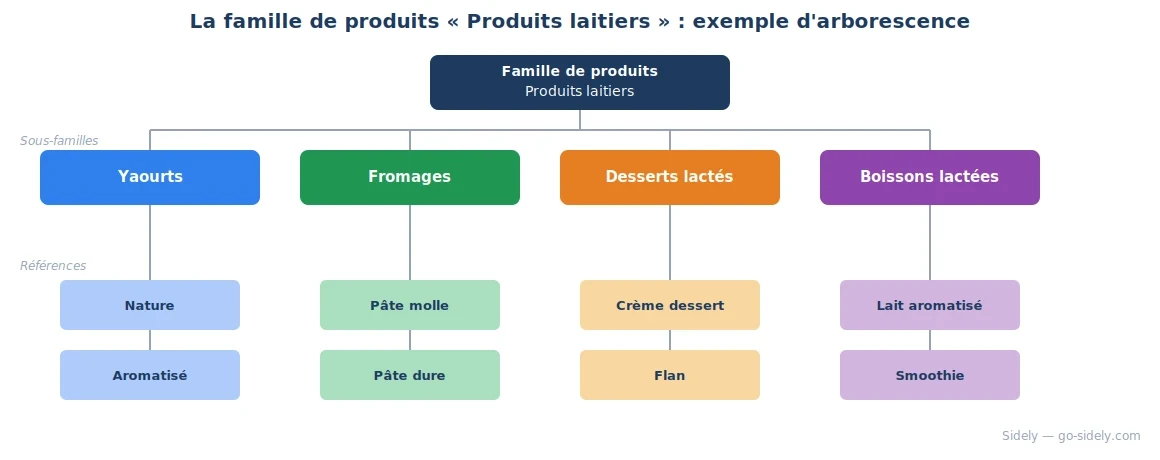
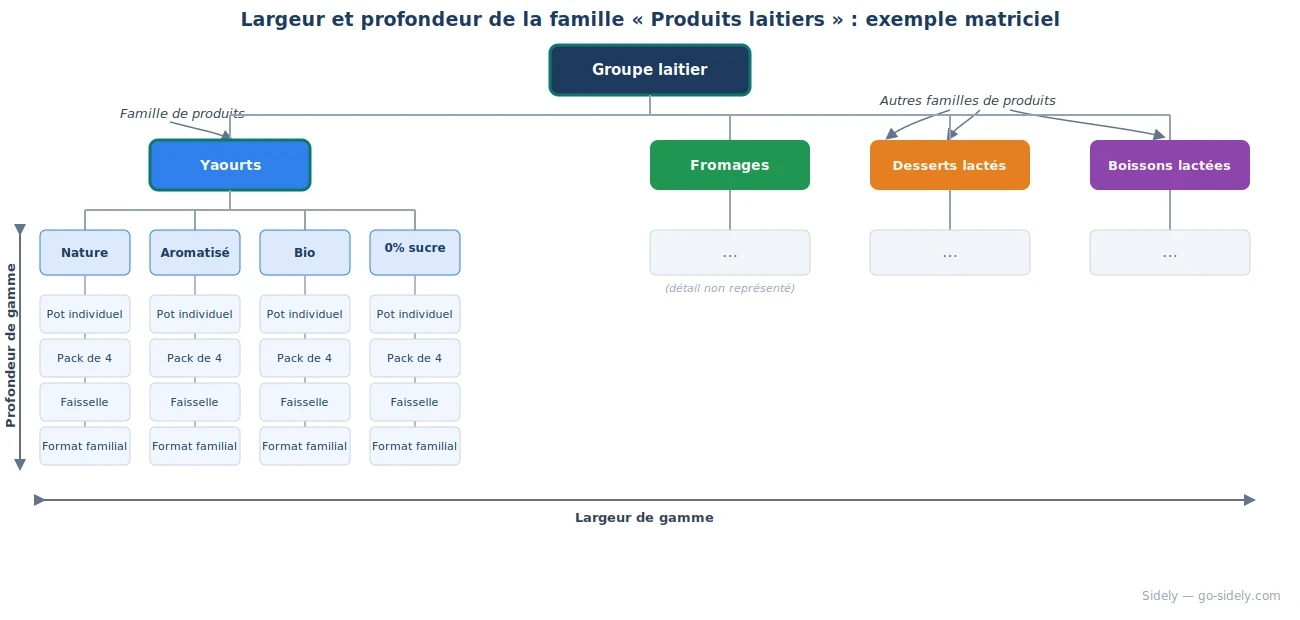
A product family refers to a group of items that share common characteristics strong enough to be grouped and analyzed together. These characteristics can relate to the nature of the product, its use, its composition, or even the customer need it meets. For example, in a dairy products catalog, plain yogurts, flavored yogurts, and fruit yogurts belong to the same family, even if their individual references differ.
This concept is also reflected in international classification standards. The GS1 GPC (Global Product Classification) system, widely used by manufacturers and distributors to exchange product data, organizes its categories according to a four-level hierarchy:
segment,
family,
class,
module.
The product family thus constitutes an intermediate level of grouping, between a very broad vision of the market and the specific product identified by its barcode.
Family, category, range, reference: what are the differences?
These four terms are often used interchangeably, which creates confusion in exchanges between sales, marketing, and logistics teams. To clarify:
The reference (or SKU) refers to a unique product, identified by a code (SKU or GTIN), corresponding to a specific format and packaging.
The range groups references of the same brand built around a common positioning or concept, for example, a range of organic cosmetics.
The product family gathers references with similar functional characteristics, regardless of the brand, like all the shampoos on a shelf.
The category often corresponds to a broader level, grouping several families around the same consumption need, for example, hair hygiene.
This hierarchy is not fixed and varies according to business practices, but it allows for a common language to be established within the company.
Why structure your catalog into product families
Organizing a catalog into product families meets a concrete operational need.
This makes it possible to analyze sales by major area rather than reference by reference, which makes it easier to read sales performance.
It also simplifies the definition of assortments by point of sale, the preparation of field audits, and the construction of sales pitches tailored to each customer typology.
Finally, a clear nomenclature of product families makes data exchange more reliable between sales, marketing teams, and information systems such as ERP or CRM.
Find out how to choose the right solution to manage your assortments with our article on assortment management software.
How to define the product families in your catalog
Building a relevant nomenclature of product families requires a method. It is about finding the right level of granularity: too broad, and the family loses its analytical interest; too narrow, and it multiplies categories and complicates management.
The most common segmentation criteria
Several criteria allow products to be grouped into coherent families:
The functional criterion is based on the use of the product, as in the case of soft drinks or household cleaning products.
The composition criterion groups products according to their nature, for example, dairy products or meat products.
The commercial criterion, on the other hand, is based on merchandising logic specific to the banner or distributor, such as the department or physical shelf placement.
The regulatory criterion is sometimes necessary, especially in the food or pharmaceutical industry, where certain families must comply with specific labeling or traceability requirements.
The steps to build a product family tree
The process generally begins with a complete inventory of existing references, in order to identify commonalities and differences between products.
Next comes the choice of a main segmentation criterion, consistent with the company's business practices and with industry standards if the company exchanges data with distributors.
The tree structure is then tested on a sample of products to verify that no reference is left isolated or poorly classified.
Once validated, this nomenclature must be integrated into the sales management tools, product catalog, ERP, and CRM, to ensure consistency between teams and avoid double entries.
Concrete examples of product families by sector
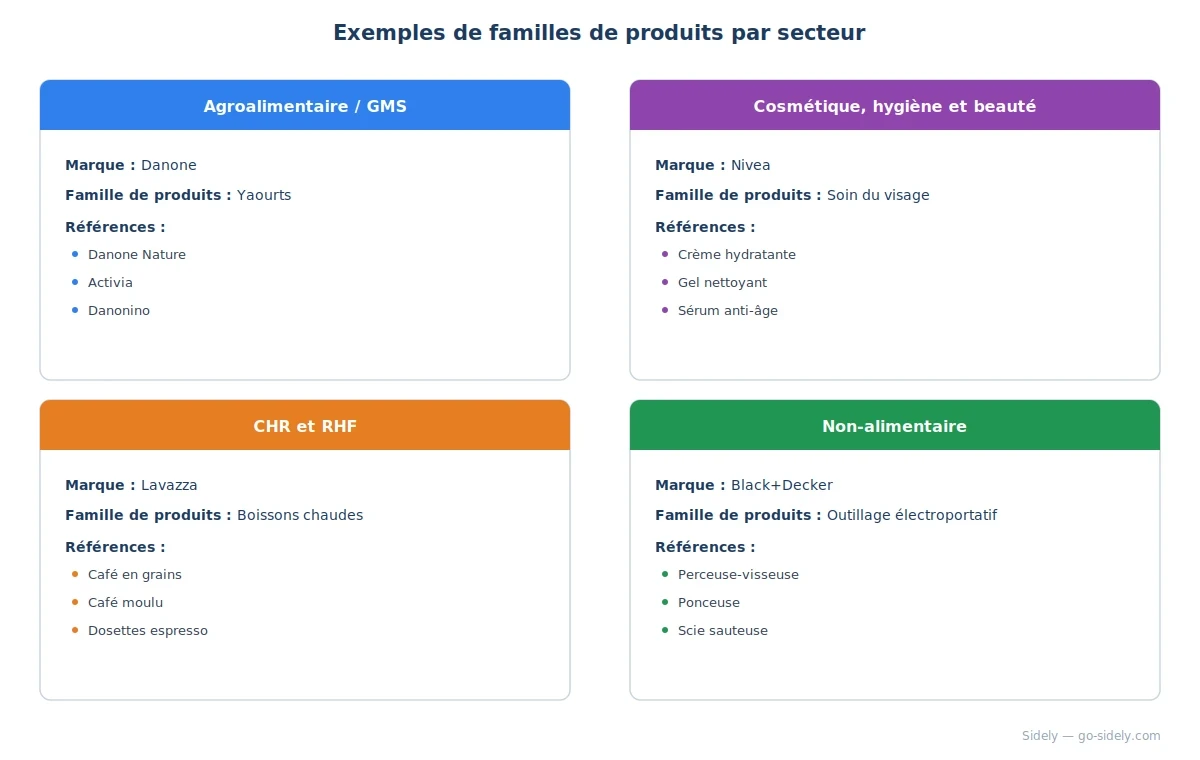
To illustrate the concept of a product family, it is useful to observe it sector by sector, as the logic of grouping varies greatly depending on the markets.
Food and Mass Distribution
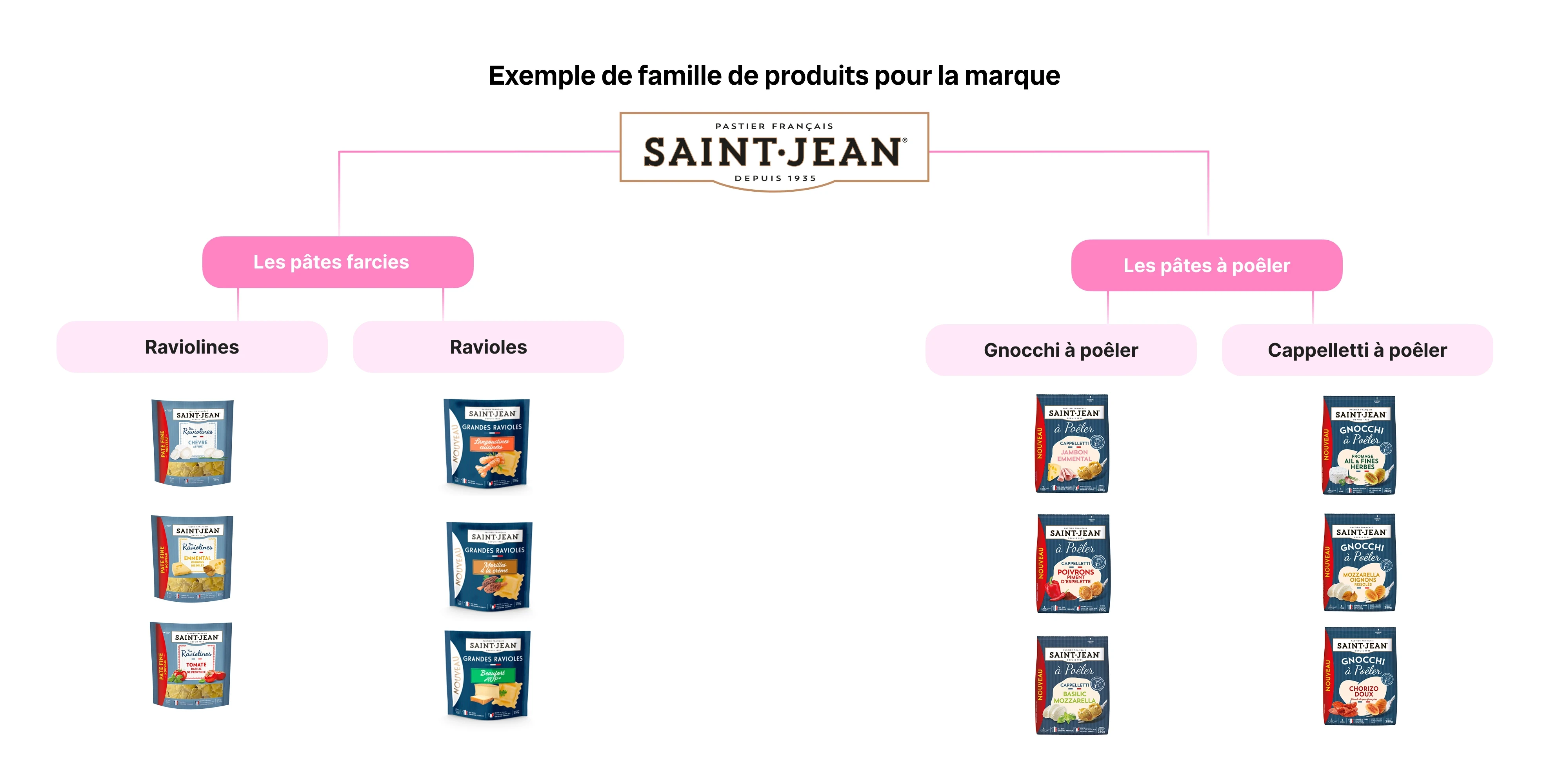
In a consumer goods catalog, product families often correspond to the physical aisles of the store: sweet groceries, savory groceries, beverages, fresh products, or frozen foods.
A manufacturer in the dairy sector will distinguish, for example, the family of yogurts, that of cheeses, and that of dairy desserts, each grouping several ranges of different brands.
Cosmetics, hygiene and beauty
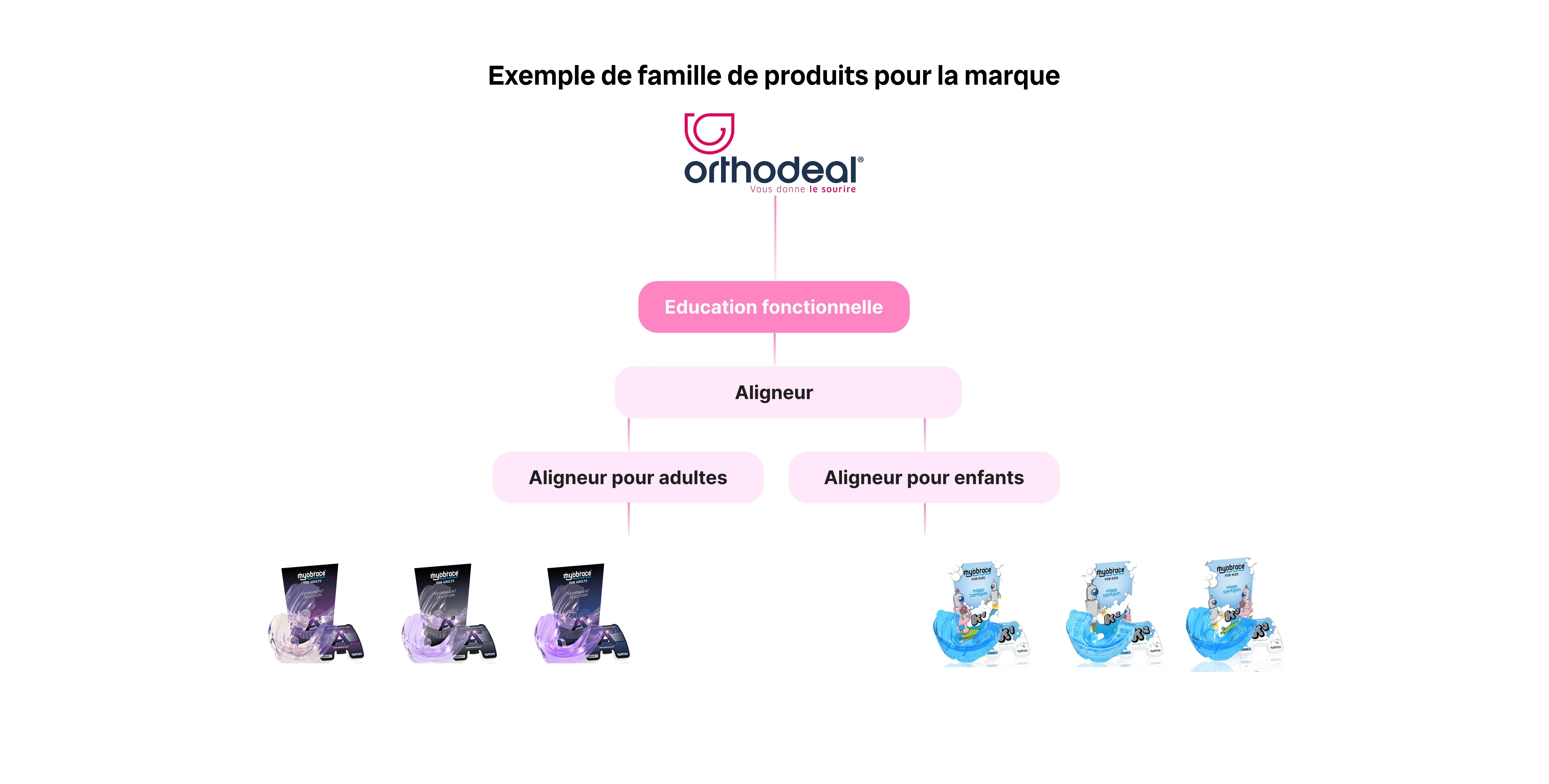
In the beauty sector, product families are generally built around the product's function: facial care, body care, hair care, makeup, or perfumery.
A cosmetics brand can thus track its performance by family to identify which segment (anti-aging care, for example) is driving the overall growth of its catalog.
Food Service and Catering
In commercial and institutional catering, product families are often organized around the time of consumption or the type of service: hot drinks, cold drinks, appetizer products, appetizers, prepared dishes, or cleaning products for professional kitchens.
This segmentation helps sales representatives adapt their sales pitch according to the profile of the establishment visited, whether it is an independent restaurant, a chain, or an institutional catering facility.
Non-food
In the non-food sector, the logic remains comparable but relies on the use of the product: DIY, gardening, stationery, textiles, or childcare, with each universe in turn broken down into several more precise families like hand tools or school supplies.
Sidely adapts to these different business logics thanks to its product and assortment management module, available in our CRM solution.
The role of product families in field sales management
Beyond classification, the concept of a product family has a direct impact on the daily work of sales teams and on activity monitoring.
Reporting and sales tracking by family
Analyzing sales by product family rather than reference by reference allows core trends to be identified more quickly: a family in growth, a segment in decline, or an imbalance between several families within the same point of sale.
This level of analysis also facilitates the definition of sales objectives by family, which are clearer for field teams than a list of individual references.
Assortments and listing in store
The product family often forms the basis for building recommended assortments by store typology. Understand store typology better with our article on store grading.
A small-surface point of sale will not be able to accommodate all the families of a catalog and will have to prioritize those that generate the most rotation. This logic directly guides the listing negotiations between the sales representative and the buyer, who frequently thinks in terms of family or category logic themselves to balance their shelf offer.
Daily impact for sales representatives
In the field, a sales representative who has a clear nomenclature of product families saves valuable time during visits. They identify out-of-stocks or underperformance by family faster, adapt their commercial discourse according to the priorities of the store, and fill out more structured store checks with data that can be directly used for reporting.
This organization also facilitates the training of new sales representatives, who rely on a logic of families rather than on an exhaustive memorization of each reference.
Discover how a CRM designed for the field simplifies data collection by product family and assortment, through our page dedicated to field data collection.
Beyond the theoretical aspect, organization by product family has very concrete consequences on sales management: it structures sales reporting, guides the construction of assortments by point of sale, and facilitates the daily work of area managers in the field. The examples observed in the food industry, cosmetics, food service, or non-food sectors show that the product family logic adapts to each sector, while retaining the same objective: to make a catalog readable and actionable for all teams.
To go further on this topic, the question of managing picking in assortments constitutes a natural extension of this reflection on catalog organization.
Alexis co-founded Sidely after several years of service as a sales director. To understand what builds, or breaks, a salesperson's performance, he conducted more than 100 telephone interviews with field sales representatives. At Sidely, he transforms this raw knowledge into concrete support, based on facts rather than assumptions.
See also

Artificial intelligence and field professions: what our 2026 studies reveal
Adoption, barriers, use cases: discover what our three studies reveal about the role of AI among sector managers, sales representatives, and foodservice sales reps.

CHR and RHF Sales Representatives: portrait of a relationship-driven profession in the era of data
Equipment, productivity, AI: discover the major trends for the HORECA and food service sales profession in 2026 through our field study.

Pharmaceutical Sales Representative in France: Portrait of a Field Job Under Pressure
Compensation, aspirations, AI usage: discover the major trends in the pharmaceutical sales representative profession in 2026 through our field study.

Area Sales Managers in France: who are they and how is the profession evolving in 2026?
Compensation, aspirations, AI usage: discover the major trends in the field sales representative profession in 2026 through our field study.
The area manager professions in 2026
Discover the trends, the challenges, and the key figures.