

The beauty market
Market size, key players, trends, and challenges for brands: everything you need to understand about the beauty and cosmetics market in France.

In short
15 min read
The global beauty market generates more than $500 billion annually, with a steady annual growth of nearly 5%.
Three major trends are transforming the industry: the digitalization of buying journeys, the rise of sustainability, and evolving consumer expectations toward greater transparency.
France occupies a strategic position as the world's leading exporter of cosmetic products, driven by iconic brands and historic expertise in perfumery and luxury.
Consumers now favor 'clean beauty' and natural products, with a strong demand for transparent ingredients and ethical practices.
Distribution is diversifying with the cohabitation of supermarkets, expert specialized retailers, booming e-commerce, and parapharmacy networks focused on dermo-cosmetics.
The sector is integrating new approaches such as 'de-influencing' and responsible consumption models, like refillable packaging or bulk buying, to address ecological challenges.
Today, the beauty market holds a central place in the global economy. Driven by constantly evolving demand, it generates more than $500 billion per year and boasts solid growth of nearly 5% annually. A dynamic sector in perpetual transformation.
Three major trends are currently shaping the landscape of this industry. First, digitalization, which is disrupting consumer habits: online shopping, the influence of social media, augmented reality apps… technology has integrated itself into beauty routines. Second, sustainability: consumers expect more responsible products, eco-friendly packaging, and natural, traceable, environmentally friendly ingredients. Finally, the evolution of expectations: diversity, transparency, personalization… the public demands that brands commit and adapt to their values.
At the intersection of innovation, ethics, and new consumer habits, the beauty market is currently one of the most exciting sectors to watch.
The evolution of the beauty sector internationally and in France
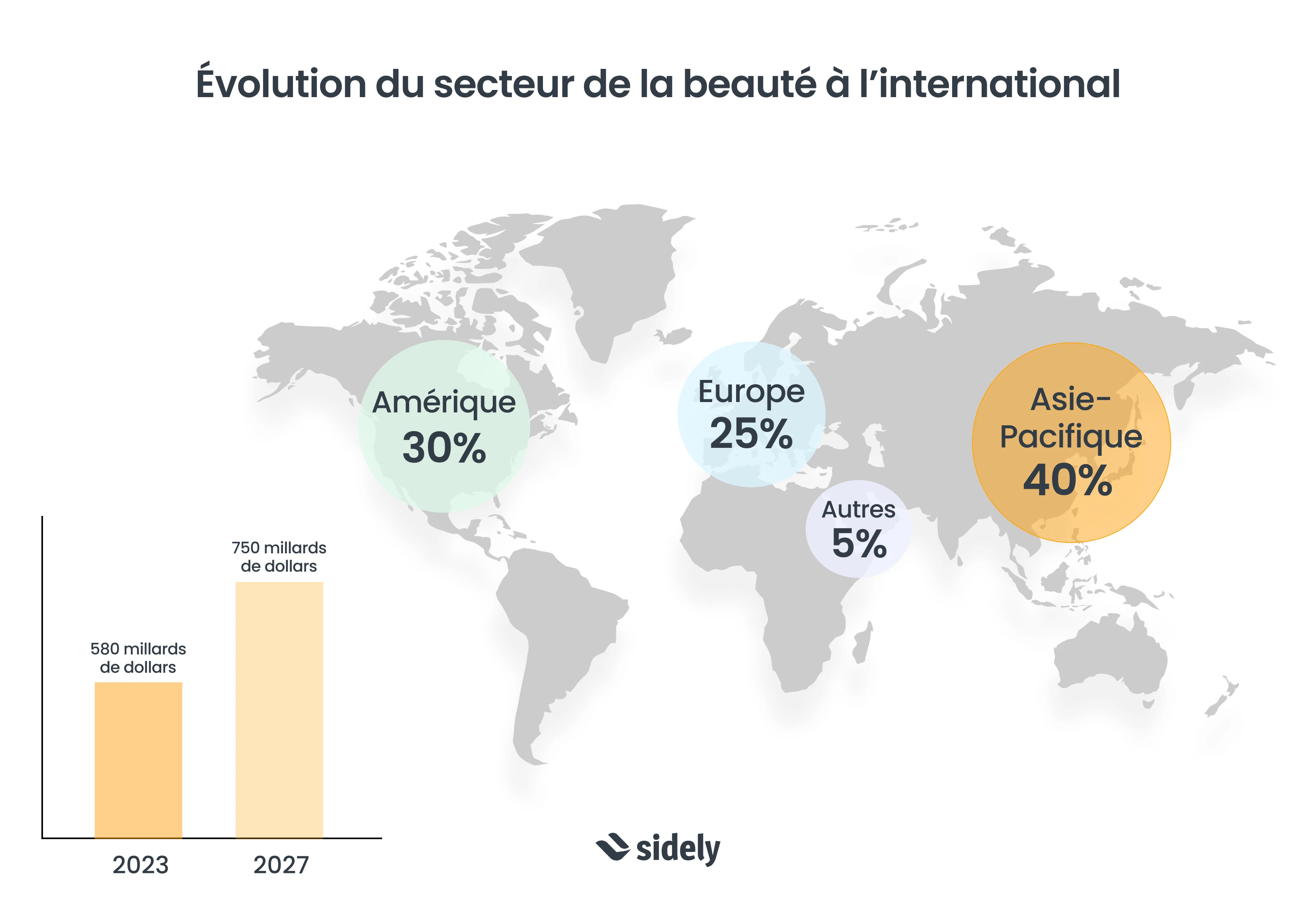
On a global scale, the beauty market is experiencing continuous growth, estimated at an average of +5% per year. In 2023, it crossed the $580 billion mark, and forecasts predict nearly $750 billion by 2027. This expansion is driven by strong demand across several continents.
In Asia-Pacific, which now represents nearly 40% of the global market, China largely dominates, with more than $70 billion in revenue in 2023.
South Korea, with its innovations in K-beauty, also influences global trends.
In North America, the United States remains a major player with nearly $100 billion generated in 2023, thanks to a mature market and a strong culture of innovation.
Europe, though more stable, remains influential, representing about 25% of the global market, driven by the quality and reputation of its products.
France, for its part, holds a strategic position. French exports reached 21.3 billion euros in 2023, making it the world's leading exporter of cosmetic products, ahead of the United States and Germany. Its main asset lies in its iconic brands like L’Oréal, Chanel, Lancôme, and Yves Rocher, which helped it cross the symbolic 20 billion euro mark for the first time in 2023. This is an increase of +10.8% compared to 2022, proving that the French market has no intention of slowing down. Indeed, the French industry relies on its historic expertise, particularly in perfumery and luxury cosmetics, but also on the development of clean beauty and technological innovations to achieve its goals.
But beyond the numbers, changing consumer behavior is profoundly transforming the sector. Today, 78% of buyers state they favor natural or organic products, and 68% say they read the ingredients list before purchasing. The values of authenticity, transparency, and sustainability are no longer optional: they have become central to purchasing decisions and crucial for customer loyalty. Brands must now prove their commitment, whether through cleaner formulas, eco-friendly packaging, or ethical practices at every stage of the supply chain.
The major trends transforming the beauty products market
Clean beauty and transparent formulations
No more unreadable ingredient lists: consumers want to understand what they are applying to their skin. The "clean beauty" movement responds to this expectation by prioritizing shorter formulas, free from controversial substances (parabens, sulfates, silicones, etc.), and often from natural origins. As a result, brands must play the transparency card.
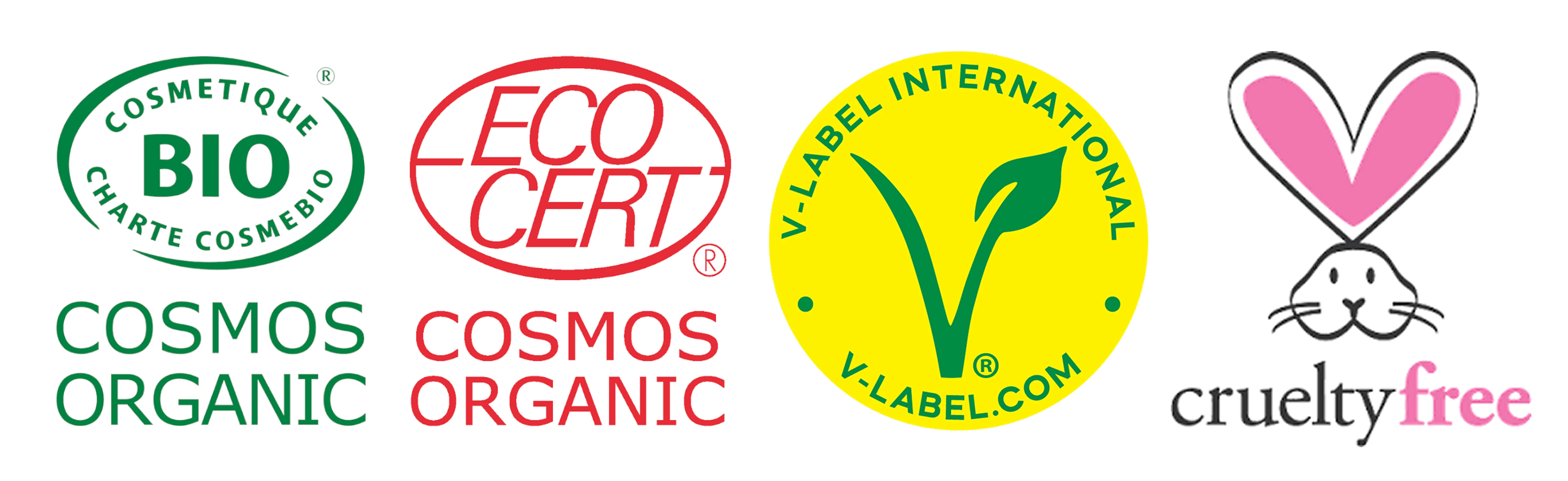
Labels and certifications are becoming essential reference points. For example, the COSMOS Organic label, issued by Ecocert or Cosmébio, guarantees an organic composition with precise requirements. Claims like vegan (no animal-derived ingredients) or cruelty-free (not tested on animals) also reassure buyers, especially younger ones. In France, 59% of 15-to-27-year-olds place importance on the composition of cosmetic products, and 34% prioritize natural or organic ingredients when shopping. These certifications are therefore no longer just marketing arguments; they constitute a real point of differentiation for brands.
Eco-responsibility: towards a greener beauty industry
The ecological transition is pushing the beauty industry to rethink its models, from product formulation to distribution. Out with single-use plastic: in with sustainable packaging, refill systems, or bulk sales. This structural shift is paving the way for a new generation of committed brands that combine innovation, responsibility, and convenience.
Many brands are now investing in eco-designed packaging, built to be recyclable, refillable, or made from sustainable materials. Such is the case for 900.care, a French brand founded in 2019, which offers personal hygiene products (shower gel, toothpaste, deodorant...) in the form of refills to be dissolved at home. The containers are designed to last, and the refills are sent without single-use plastic, in compostable packaging. Driven by more than 235,000 customers and a fundraising round of 21 million euros in 2024, the brand embodies a new way of consuming where convenience goes hand in hand with responsibility.
Other players are focusing on bulk or solid products to completely eliminate superfluous packaging. This is the case for the French brand Unbottled, launched in 2019, and primarily known for its plastic-free solid shampoos. With over 10 million euros in revenue in 2023, the brand illustrates the rise of zero-waste beauty, favored by a young, urban, and committed clientele.
On another scale, brands like Avril, which offers organic cosmetics at affordable prices, prove that combining performance and sustainability is possible. With over 50 stores and a revenue of 37 million euros in 2024, the brand donates 1% of its income to environmental associations. For its part, Origins, an Estée Lauder group brand and a pioneer in recycled packaging and plant-based ingredients, benefits from global visibility within a group that generated $15.9 billion in 2023. These players are redefining standards and pushing the market towards greater responsibility.
The influence of skincare routines from Asia
It is impossible to talk about beauty trends without mentioning the growing influence of Asian cosmetics, particularly K-beauty, originating from South Korea. This approach to skincare relies on multi-step routines—cleansing oil, double cleansing, lotion, essence, serum, mask, cream…—and prioritizes prevention, hydration, and consistency, rather than makeup or corrective treatments.
The global reach of K-beauty has been largely driven by social media platforms like TikTok and Instagram. Beauty influencers, often looking for more natural and skin-friendly rituals, have played a key role in spreading these practices. They have helped popularize a fresh, glowing aesthetic that is less focused on camouflage.
Faced with this enthusiasm, many Western brands have adopted the codes of K-beauty: lightweight textures, gentle yet effective active ingredients (such as centella asiatica or niacinamide), and a sensory dimension to skincare. French brands like Erborian, born from the encounter between Korean tradition and European cosmetics, perfectly embody this fusion of expertise.
The different distribution channels
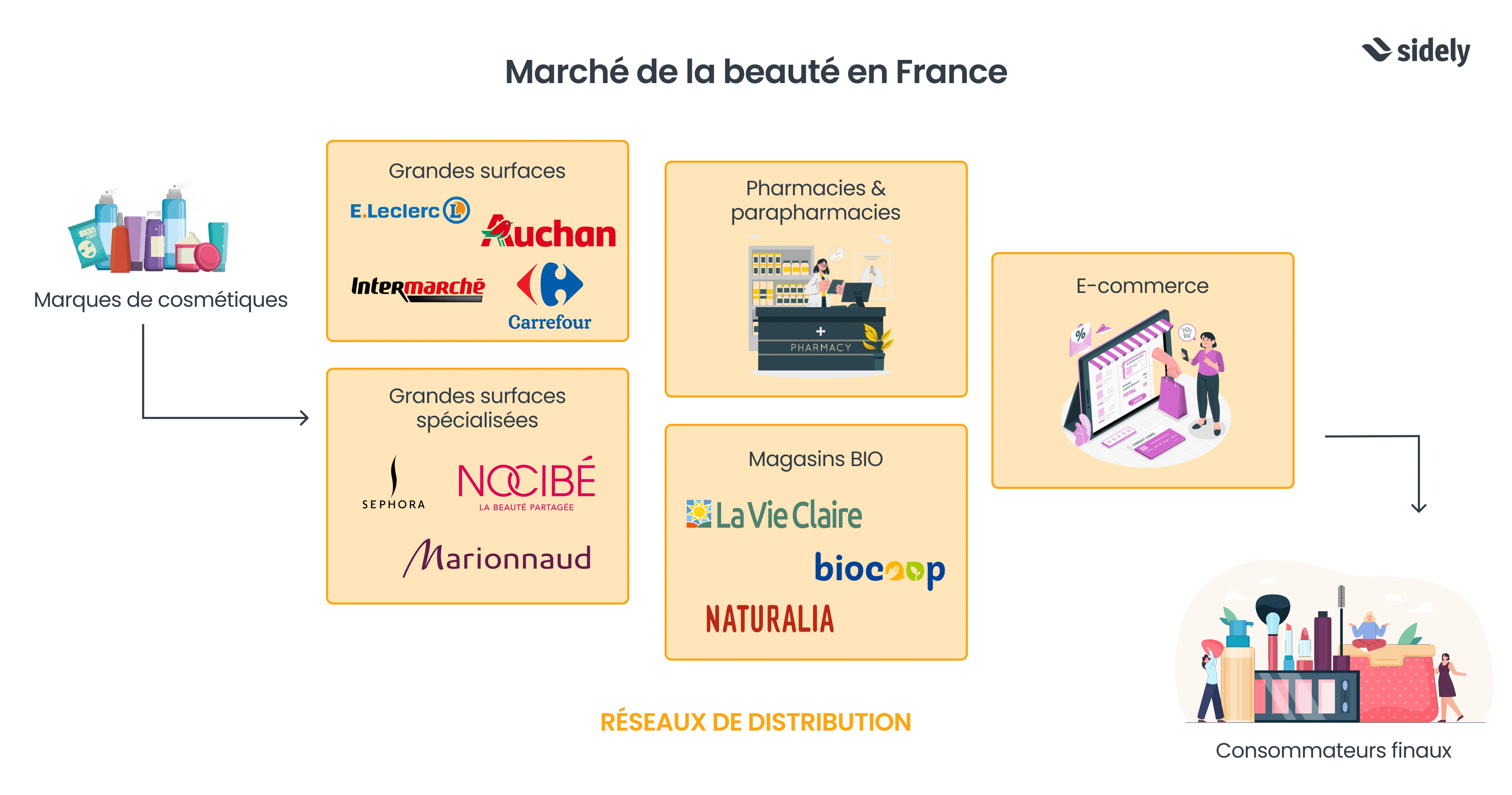
We no longer buy beauty products the way we used to. The sector has seen the emergence of new distribution channels that now coexist with traditional channels. Accessibility, expertise, digitalization, or ethics: each point of sale meets specific expectations. Let's take a look.
Supermarkets: accessibility and mass market
For years, mass retail has played a central role in democratizing cosmetics, making products available everywhere at competitive prices and reaching a broad and diverse public.
This model is embodied by brands like Garnier, L’Oréal Paris, Nivea, and Le Petit Marseillais, which are omnipresent on store shelves. They rely on family sizes, massive advertising campaigns, and high visibility—levers that allow them to remain essential. As a result, mass retail still accounts for a significant share of sales, particularly for hair care, hygiene products, and entry-level cosmetics.
Note that some brands, like Maybelline, make the strategic decision to be distributed exclusively in supermarkets and hypermarkets. This deliberate approach is designed to maximize shelf presence and reach a wide audience. L’Oréal, the brand's parent company, even set up a dedicated entity for the "mass market" to pilot this specific strategy. Consequently, supermarkets continue to represent an important share of sales, especially for hair care, hygiene products, and makeup.
Specialized retailers: Sephora, Marionnaud, Nocibé…
Faced with the rise of digital, specialized retail chains such as Sephora, Nocibé, and Marionnaud have successfully reinvented themselves by focusing on an immersive and distinctive customer experience. Beyond simply selling products, these retailers offer exclusive services: personalized advice provided by professional makeup artists, beauty workshops, in-store treatments, and live demonstrations. All of these elements create added value that cannot be found online or in supermarkets.
Another major asset lies in their exclusivity strategy. For example, Rare Beauty, Selena Gomez's brand, is distributed exclusively at Sephora in France. Similarly, Rihanna's Fenty Beauty, famous for its wide range of inclusive shades, was a Sephora exclusive for a long time, offering products tailored to all skin tones. These exclusive partnerships allow specialized retailers to differentiate themselves and attract customers looking for new arrivals.
Finally, these retailers have developed a solid omnichannel strategy, combining e-commerce, mobile apps, click & collect, and loyalty programs. Sephora, for example, has invested heavily in digital while maintaining a dense network of physical stores, ensuring a seamless transition between online and in-store experiences.
Pharmacies and health & beauty stores: a guarantee of trust and safety
Pharmacies and health & beauty drugstores (parapharmacies) have grown in popularity in recent years, driven by the increasing demand for dermo-cosmetic, natural, and effective products. The promise? Safer skincare, often recommended by healthcare professionals.
Brands like La Roche-Posay, Avène, Bioderma, and Caudalie are highly visible there. Committed young brands are also found here, such as Respire, which offers natural, vegan, and French-made skincare, distributed in drugstores since its inception. This association between natural formulations and medical credibility reassures a growing number of consumers.
E-commerce and social networks: the digital revolution
The digital age has deeply transformed consumer habits in the beauty industry. Today, nearly a third of cosmetics purchases are made online. This channel is particularly appealing to younger generations, drawn by its convenience, the diversity of choices, and immediate access to reviews and recommendations.
In this context, DNVBs (Digital Native Vertical Brands)—brands born online—have successfully carved out a niche. Names like Typology, Yepoda, and The Ordinary have established themselves through minimalist websites, transparent formulations, and a targeted communication strategy on Instagram and TikTok.
Beauty influencers are key players in this evolution. By publishing tutorials, reviews, live demonstrations, or evening routines, they directly influence the buying decisions of their communities. However, a new trend is beginning to emerge: that of de-influencing.
Driven by content creators deemed more authentic and expert, de-influencing encourages more mindful consumption. It invites internet users to think before they buy, to prioritize quality over quantity, and to steer clear of sometimes excessive consumerism.
This change in perspective benefits French brands like La Roche-Posay, Avène, and Estée Lauder, recognized for their effectiveness, simplicity, and high-quality ingredients. Less focused on endless routines, they embody a more sustainable and mindful beauty, in tune with current expectations.
Thus, influencers are no longer just trend-setters: they are becoming the harbingers of a new vision of beauty, one that is more conscious, more transparent, and resolutely focused on the essentials.
Organic supermarkets: the rise of natural and ethical options Finally, organic supermarkets (such as La Vie Claire, Biocoop, Naturalia...) are experiencing a real boom in the beauty sector. They respond to a specific demand: products respect health and the environment, with strong traceability.
These stores offer a wide selection of organic or natural certified cosmetics, often locally produced. Brands like Florame, Coslys, or Douces Angevines attract customers looking for meaning and commitment.
La Vie Claire, for instance, is increasingly developing its beauty offering, leveraging the trust its customers place in its quality and product selection.
How Sidely supports players in the beauty market
In a sector as competitive and dynamic as beauty, commercial structuring and sales force management are essential tools for standing out. Today, it is no longer enough to offer a good product: you must also know how to present it in the right place, at the right time, with the right arguments. This is precisely where Sidely comes in, providing brands with concrete tools to strengthen their field presence and optimize their effectiveness.
Staff training at the point of sale
In drugstores as in specialized retail, training in-store teams is paramount. Brands need to make sure their salespeople and beauty advisors have fully absorbed key product information. Sidely allows brands to track and validate this training, ensuring a smooth and reliable transmission of knowledge at every customer touchpoint.
Performance tracking and data analysis
To effectively manage their field strategy, brands must be able to rely on reliable data. Thanks to its reporting tools, Sidely offers real-time visibility on field activities, allowing brands to analyze results, adjust campaigns, and maximize return on investment.
Optimizing merchandising and point-of-sale materials
Merchandising plays a crucial role in the beauty industry, where purchases are often impulsive. Sidely helps brands plan, deploy, and track the impact of their point-of-sale marketing materials (POS). The tool helps ensure strategic placement (store entrances, checkout lanes, promotional areas) for maximum visibility.
A tool adapted to the specific challenges of the beauty sector
The beauty market requires detailed and highly responsive tracking: diverse distribution networks (supermarkets, pharmacies, beauty salons, concept stores…), a strong field presence, and the ability to keep pace with rapidly changing trends. Sidely adapts to these requirements through:
Advanced customer portfolio management, segmented by channel, volume, or specific need.
Precise tracking of field initiatives (in-store events, visits, promotions) to ensure consistency and continuity in relations with stores.
Visibility over inventory and out-of-stocks, quickly alerting the relevant teams to avoid lost sales.
Optimizing the sales force to boost efficiency
At the heart of the Sidely approach is a CRM solution designed for field teams. With an intuitive interface and advanced features, brands can:
Optimize business routes based on geographical criteria, store potential, or specific priorities.
Centralize customer data for clear tracking of interactions, sales, requests, or order history.
Monitor sales performance in real time, via visual dashboards, customizable KPIs, and automated reporting.
The result: more agile, more productive teams, better equipped to make brands shine in the field.
The beauty market is undergoing a major evolution, caught between strong societal expectations, new digital demands, and competitive pressure. In this context, brands need to rely on tailored tools to remain visible, high-performing, and connected to their customers.
With its CRM solution built for the field, Sidely supports beauty sector players every day toward smoother, more efficient, and more sustainable business management.
See also

Artificial intelligence and field professions: what our 2026 studies reveal
Adoption, barriers, use cases: discover what our three studies reveal about the role of AI among sector managers, sales representatives, and foodservice sales reps.

CHR and RHF Sales Representatives: portrait of a relationship-driven profession in the era of data
Equipment, productivity, AI: discover the major trends for the HORECA and food service sales profession in 2026 through our field study.

Pharmaceutical Sales Representative in France: Portrait of a Field Job Under Pressure
Compensation, aspirations, AI usage: discover the major trends in the pharmaceutical sales representative profession in 2026 through our field study.

Area Sales Managers in France: who are they and how is the profession evolving in 2026?
Compensation, aspirations, AI usage: discover the major trends in the field sales representative profession in 2026 through our field study.
The area manager professions in 2026
Discover the trends, the challenges, and the key figures.