

Business goals: methods, calculations, and best practices
How to set realistic sales targets and calculate them? Revenue, volume, conversion rate, numeric distribution: methods, formulas, and examples for your field teams.

In short
6 min read
Business objectives are specific and measurable results that are crucial for motivating, evaluating, and driving company performance.
Setting objectives requires combining quantitative indicators (revenue) and qualitative indicators (skills, processes) to foster sustainable growth.
It is essential to distinguish objectives from KPIs: the latter serve as monitoring indicators to adjust strategies in real time.
Setting tiered objectives and over-rewarding overperformance helps maintain engagement, regardless of the sales reps' level.
CRM is an indispensable tool for supporting the achievement of objectives, optimizing sales processes, and providing business intelligence analysis.
Individual support, including performance improvement plans where collaborators define their own objectives, promotes regaining confidence and sustainable success.
While management and leadership methods vary from one company to another, there is one point on which everyone agrees: the importance of sales objectives. These are crucial for motivating, uniting, and evaluating.
But setting - and especially achieving - objectives also poses challenges: how do you establish an effective grid? How do you ensure that all salespeople will be motivated by it? How do you communicate and engage around sales objectives? Which tools optimize their management?
This is everything we are going to look at in this comprehensive article on sales objectives.
Table of contents:
Definition and application framework;
How to set your sales objectives;
Human management around objectives;
CRM: the guarantor of sales performance;
Calculation and management of objectives: Sidely's tips.
Sales objectives: the fundamentals
Sales objectives are specific and measurable results that a company, a team, or an employee commits to achieving over a defined period, as part of the organization's sales strategy.
These are clear targets that the company aims for, such as a specific revenue amount or a number of new clients to acquire. Objectives must be quantifiable to allow for an objective evaluation of performance.
A good sales objective is both ambitious and achievable. Communicating it to employees requires finesse and strategy, in order to convert it into motivation and energy.
By combining these best practices, you stand a great chance of sailing towards your marketing and sales horizons, whether it is to increase productivity, improve customer retention, strengthen employer branding, or boost the closing rate.
⛵ As captain of your ship, your mission is to bring the crew safely to port. To do this, you will use a compass (the sales objective) to stay permanently focused on the course to reach.
Sales objectives transform sales strategy into operational reality. Also, to build team spirit while stimulating individual motivation, it is common to combine collective and individual objectives.
Main functions
Setting sales objectives fulfills - at the very least - three functions:
Performance evaluation: tracking the progress of an action plan and measuring the effectiveness of the initiatives implemented;
Motivation: encouraging sales teams by providing them with goals to achieve;
Decision making: helping leaders guide resources and adjust strategies based on observed results.
Timeframe of the objective
Objectives can be short, medium, or long-term. Sales representatives are generally assigned monthly, quarterly, and annual objectives. Certain tasks, like setting phone appointments, can lead to a daily objective.
When should sales objectives be given?
Any sales-related mission comes with performance objectives. These allow employees to understand what is expected of them and thus constitute the contractual foundation of the relationship with the company.
In a sales team, hunters and farmers will not have the same objectives; the former are generally incentivized on sales volume and conversion rate, while the latter are incentivized on renewal rate, customer lifetime value, or upselling.
Quantitative and qualitative objectives
To stimulate and evaluate the performance of teams or systems, numerical objectives, also called quantitative objectives, such as a target revenue, are used.
But an organization can also establish qualitative objectives to activate other performance levers. For example, it would be absurd to count the number of smiles a salesperson makes in a store. On the other hand, training them to convey a warm and reassuring emotion will inevitably have a positive impact on sales.
This is why any company wishing to improve its sales results benefits from setting both numerical objectives and improvement measures for processes and teams.
Criterion | Quantitative Objectives | Qualitative Objectives |
|---|---|---|
Nature | Numerical and measurable | Intangible and subjective |
Examples | Increase sales by 15% | Improve customer satisfaction |
Indicators | Revenue, number of customers | Satisfaction, brand image, employee competence |
Evaluation | Easy, based on numbers | Difficult, requires interviews, surveys |
Importance | Short-term performance tracking | Long-term development and company culture |
Complementarity | Supports operational decisions | Strengthens engagement and overall strategy |
Qualitative objectives related to teamwork are generally the subject of internal events, such as teambuilding.
Difference with performance indicators
Good management requires separating objectives from key performance indicators (KPIs).
Indicators help you see where you stand in pursuing your objectives. When necessary, they support the implementation of corrective actions to get back in position to achieve your sales objectives.
It is therefore necessary to distinguish the end result to be translated into an objective (e.g., revenue growth) from the KPIs (quality of the customer experience, success of the referral program, speed of customer support, etc.).
Criterion | Key Performance Indicator (KPI) | Sales Objective |
|---|---|---|
Definition | Quantifiable measure used to evaluate performance against specific objectives. | Specific result that the company wishes to achieve within a set timeframe. |
Function | Tool for evaluating and tracking progress towards objectives. | Target to be reached to guide sales activities. |
Nature | Based on measurable data and metrics. | Quantitative or qualitative, often formulated in terms of desired results. |
Examples | Conversion rate, number of meetings conducted. | Increase sales by 20%, acquire 100 new customers in one year. |
Use | Adjust strategies and make decisions based on observed performance. | Guides sales teams and justifies short and medium-term actions. |
💻 Usefulness for conversion funnels: KPIs help track indicators related to the stages of a conversion path. Let's take the example of a website: if the sales objective is to increase revenue, you will first need to increase website traffic, then the conversion rate of visitors into inbound leads, and finally the closing rate of those leads. Knowing your funnel (marketing funnel) allows you to break it down into different steps and associate a KPI with each, in order to identify and eliminate friction points to ultimately reach your sales objectives.
💡 Focus on a small number of sales objectives, even if it means multiplying intermediate KPIs.
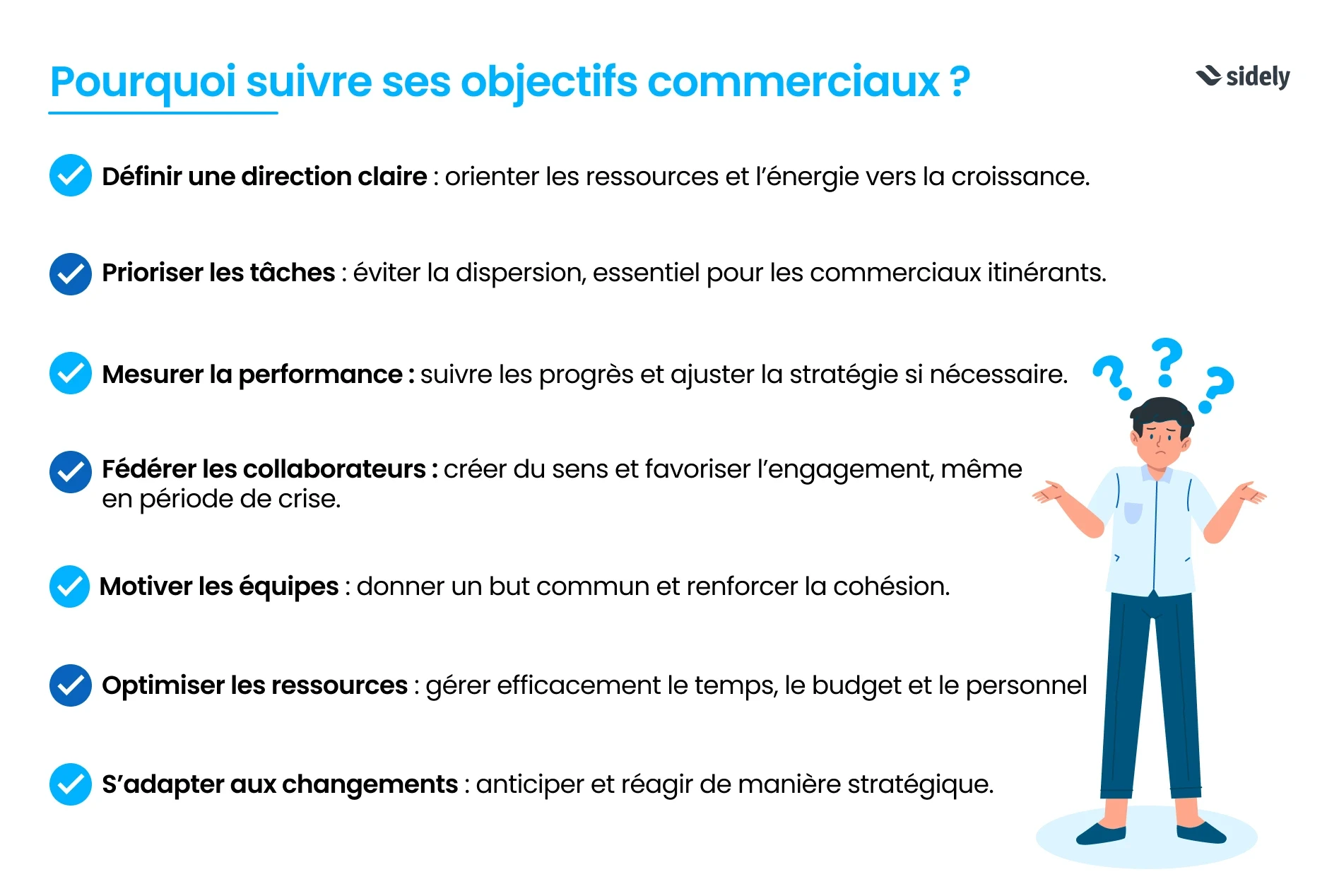
Why are sales objectives so important?
Setting sales objectives is essential and brings numerous benefits:
Strategic direction: defining a clear direction and focusing resources and energy on activities that contribute to growth;
Performance measurement: evaluating progress and adjusting strategy accordingly;
Motivation: stimulating the team with a common goal to achieve, strengthening cohesion;
Engagement: giving meaning to the daily work of the teams, uniting employees around a common mission (resilience in times of crisis);
Task prioritization: avoiding dispersion (fundamental in many professions, such as mobile sales representatives);
Team alignment: developing a shared vision, avoiding misunderstandings, and promoting harmonious collaboration;
Resource management: properly managing resources (time, budget, staff, etc.) and avoiding waste by maximizing operational efficiency;
Adapting to change: reacting to changes strategically rather than reactively.
How to set your sales objectives
To determine efficient sales objectives, it is essential to follow a structured method that guarantees their clarity and relevance.
1. Diagnostic
To begin, an assessment of the current situation helps establish the main guidelines for the company or the relevant department. Various tools help visualize this situation in a synthesized way, such as the SWOT analysis which highlights strengths, weaknesses, opportunities, and threats. Analyzing past performance can provide additional insights.
2. Identify useful and adapted objectives
Next, you need to define a framework so you don't get lost in a multitude of goals to achieve without hierarchy or coherence. Try to identify the most significant pain point, or prioritize projects by objective.
Some classic examples:
Volume: revenue, market share;
Profitability: margins, costs;
Customer satisfaction: loyalty, brand image;
Brand awareness: market presence;
Coverage: numeric and weighted distribution.
3. Define the objectives
Two methods have become particularly popular in companies and inspire leaders, managers, and employees in defining the targets to aim for.
a) SMART method
The SMART method is a framework used to define clear and effective objectives. The acronym stands for: Specific / Measurable / Achievable / Relevant / Time-bound. This tool is used in many fields, such as management, marketing, and project management, to ensure that the objectives set are both ambitious, achievable, and measurable.
→ Discover the SMART method.
b) OKR method
The OKR method, which stands for Objectives and Key Results, is a management framework used to define and track objectives within a company. Based on qualitative goals and quantitative measures, OKRs promote alignment, ambition, and the tracking of an organization's overall objectives.
→ Discover the OKR method.
4. Use of Key Performance Indicators (KPIs)
Define KPIs to track progress toward each objective, such as the conversion rate or customer acquisition cost. You can track as many KPIs as necessary, as long as they improve your management capability.
To ensure that your results measurements are reliable, choose the appropriate tools, for example:
Google Analytics for clicks on your web pages;
Brevo for newsletter open rates;
Sidely for your share of shelf space in points of sale.
5. Tracking and Adjustment
At the end of the day, you have to take stock: is the objective achieved?
Whatever the answer, the reasons must be analyzed (thanks to KPIs!).
Resource management must be realigned based on the results obtained, and new objectives must be set, following the same process we just broke down.

💡 On the importance of carefully thinking through your objectives
Changing objectives mid-course is a bad practice that risks undermining the confidence and morale of the teams. Any change of direction along the way must be justified by a new, unpredictable situation (example: Covid in 2019).
Management: involving and uniting around goals
As shown by the OKR method, a company's objectives are much more than mere theoretical targets to achieve. In an organization that builds genuine ambitions, they are also vectors of culture and identity.
For employees, objectives provide meaning. Believing in them, committing to them, and especially making them one's own, is a sign of good health for a company's culture. It is therefore a pillar of motivation in companies which, like any human organization, are built on shared beliefs.
Thus, whether they are inside or field sales representatives, regional managers or technical-sales representatives, brand ambassadors or key account managers, sales professions have one thing in common: the race for objectives!
Managing a sales team therefore involves establishing healthy and engaging communication. Sales managers and commercial directors must inspire their teams and explain the meaning of the sales objectives.
Engagement rituals
Sales objectives also structure the life of sales teams. It is thanks to these key numbers that managers can run the teams, trigger progress meetings, or end-of-month review meetings.
Salespeople generally declare forecasts at the beginning of the month or quarter, which will serve as a reference point at the end of the period. Feedback and evaluation contribute to a continuous development plan.
Sales challenges
Sales objectives are often the focus of collective and individual challenges. Combining these two dimensions makes it possible to stimulate both collaboration and competition simultaneously.
Challenges typically run over a month or a quarter, and aim to boost the number of sales or successfully carry out special operations such as promotions. They are the ideal tool to incentivize and empower salespeople.
Another virtuous effect is
Margot has been working in Tech and SaaS for 8 years, with a multi-product experience that has given her a unique understanding of business challenges. On a daily basis, she analyzes, relentlessly tests, and relies on facts to shed light on market trends and help sales teams move forward.
See also

Artificial intelligence and field professions: what our 2026 studies reveal
Adoption, barriers, use cases: discover what our three studies reveal about the role of AI among sector managers, sales representatives, and foodservice sales reps.

CHR and RHF Sales Representatives: portrait of a relationship-driven profession in the era of data
Equipment, productivity, AI: discover the major trends for the HORECA and food service sales profession in 2026 through our field study.

Pharmaceutical Sales Representative in France: Portrait of a Field Job Under Pressure
Compensation, aspirations, AI usage: discover the major trends in the pharmaceutical sales representative profession in 2026 through our field study.

Area Sales Managers in France: who are they and how is the profession evolving in 2026?
Compensation, aspirations, AI usage: discover the major trends in the field sales representative profession in 2026 through our field study.
The area manager professions in 2026
Discover the trends, the challenges, and the key figures.