

How to set goals - The SMART method
Specific, Measurable, Achievable, Realistic, Time-bound: how to define SMART goals? Definition with concrete examples for sales teams.

In short
5 min read
The SMART method helps transform productivity into success by providing a structured framework for defining goals.
Each letter of the acronym defines an essential criterion: Specific (clear), Measurable (quantifiable), Achievable (attainable), Realistic (relevant), and Time-bound (deadline).
The precision of the goals allows for effective progress tracking and prevents stagnation or discouragement.
To write a SMART goal, it is crucial to answer key questions related to each criterion and align the goals with the overall strategy.
Using tracking tools and setting intermediate deadlines strengthens team motivation and discipline.
Creating a routine is important for your productivity and that of your employees, but it is your goals that turn it into success. However, for that to be the case, your goals must be well-formulated. If they are too vague, you will not be able to measure them, and you will therefore lose efficiency.
This is what the SMART method is for, created in the 80s to refine your professional goals. A SMART goal is specific, measurable, achievable, relevant, and time-bound: it is the framework that transforms a vague intention, "increase sales", into a course that your team knows exactly how to achieve.
On the ground, the challenge is concrete. A poorly defined goal is not immediately visible: it is paid for in poorly targeted visits and revenue that does not come in, while your district managers chase a result without knowing if they are getting closer to it. To avoid this, this article will present the method in 5 steps, a complete example and a template to copy, followed by the details of each criterion and SMART goals designed for field sales.
What does the acronym SMART stand for?
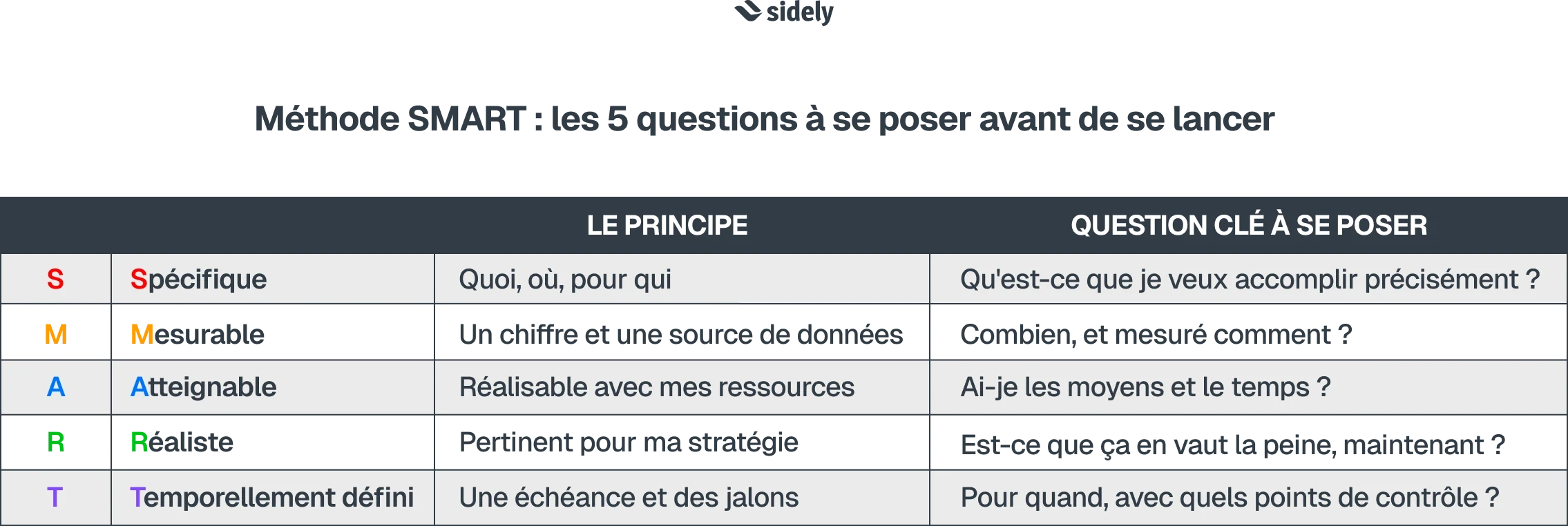
SMART is an acronym: Specific, Measurable, Achievable, Relevant, Time-bound. In French, it designates five criteria that an objective must meet to be well-defined:
Letter | In English | In French | What it means |
|---|---|---|---|
S | Specific | Spécifique | Clearly defined, unambiguous |
M | Measurable | Mesurable | Quantifiable, with a tracking indicator |
A | Achievable | Atteignable | Feasible with your current resources |
R | Relevant | Réaliste | Relevant and aligned with your strategy |
T | Time-bound | Temporellement défini | Accompanied by a clear deadline |
How to set SMART goals in 5 steps
1. Specific: say exactly what, where, and for whom.
"Increase sales" means nothing. "Feature my 20/80 references in Gold stores in the Northwest region" is a goal that can be managed.
2. Measurable: attach a number and a data source.
How much? Measured how? Without an indicator, it is impossible to know if you are making progress. Example: +15%, tracked via checkout data feed into your CRM.
3. Achievable: check that your resources are sufficient.
Visit time, number of district managers, tools available: the goal must be manageable with what you have, or what you decide to add to free up field time.
4. Relevant: make sure it serves your strategy.
An achievable but off-topic goal wastes your time. Is this one worth the effort, and is it the right time?
5. Time-bound: set a deadline and milestones.
A target date creates urgency. Intermediate milestones tell you along the way if you are on time, before it is too late to adjust.
A fictional example of a commercial SMART goal
Starting point, the vague version: "I want to sell more organic products."
Specific → which range, which retailer, which territory? The organic range, at E.Leclerc, in Corrèze.
Measurable → +20%, measured via checkout data integrated into the CRM.
Achievable → by increasing visits to the relevant stores, which is made possible by the time saved on shelf audits.
Relevant → organic demand is rising in the area and the brand is already well-established there.
Time-bound → before the end of Q4, with two milestones: +5% at the end of October, +12% at the end of November.
The final SMART goal:
"Increase sales of the organic range at E.Leclerc in Corrèze by 20% before the end of Q4, by intensifying field visits and tracking progress via CRM checkout data."
The template to write your SMART goal
You have the method and the example: here is the template to copy to write your own goal. Replace each bracketed text with your situation, and you get a complete SMART goal in one sentence, leaving nothing out.
“Reach [numerical indicator] on [product or range] in [retailer / store type] in [geographical area] before [deadline], by [action lever] and by tracking via [data source].”
Each SMART criterion in detail
Here is how to work on each SMART criterion, along with the right questions to ask yourself:
Specific: what needs to be accomplished, by whom, where, and why
A specific goal leaves no room for interpretation. "Sell more" engages no one; "increase the average order value by 10% with my Intermarché customers over the next quarter" designates a target that the team can manage. Same logic for visibility: rather than "be better displayed in-store", aim for "obtain a gondola end for the appetizer range in 30 Carrefour hypermarkets before the summer".
To define it, answer five questions:
What do I want to accomplish?
Why is it important?
Who is involved?
Where?
With what resources or limits?
Measurable: a number and a data source
Without an indicator, there is no tracking, no motivation. A measurable goal sets milestones that can be celebrated when reached and reevaluated when missed. Example: "increase the number of customer visits in the 20 main stores by 10% per month, measured by in-store traffic data".
Three questions to settle:
How much?
Over what period?
How will I know it has been achieved?
Good practice in the field: measure from one quarter to the next, at the retail brand scale, by comparing to data-sharing results, the checkout data that the retailer feeds back into your CRM, rather than relying on an impression.
Achievable: are your resources sufficient?
An achievable goal is sustainable with your current means. Impossible goals motivate for a time, then are abandoned for lack of results. Conversely, they must remain stimulating: finding the right balance requires experience and a good reading of your data.
Example: "train 75% of sales staff in the Southeast region on cross-selling techniques by the end of the year", provided that training time and resources exist. If the goal is not met, ask yourself the right questions: why is it not achievable, a lacks of resources, employees, time? How can this obstacle be removed?
This is often where a sales CRM designed for the field changes everything: when district managers spend less time preparing for their meetings and performing presence and shelf audits, they carry out more visits, and an out-of-reach goal becomes achievable again.
Relevant: is it worth the effort, and is it the right time?
Be careful, "achievable" and "relevant" are not the same thing. Achievable questions feasibility; relevant questions pertinence. A goal can be perfectly feasible and yet off-topic in relation to your strategy.
Example: aim for sales growth in regions where demand for the range is already rising and the brand is already well recognized, rather than pushing into a cold territory. To decide, rely on your internal data, the data your sales reps report from the field, combined with market data of the IRI or Nielsen type, which provide the global vision.
A relevant goal answers yes to:
Is it worth it?
Is it the right time?
Does it serve the needs of the company?
Am I the right person to lead it?
Is it applicable in the current context?
Time-bound: a deadline and milestones
A target date creates the urgency that drives action. Compare: "I want to improve my shelf positioning" triggers nothing. "I want to gain 100 new stores of a retail chain in 6 months" gets you moving, because there is a clock. For the same deadline, it is always the dated goal that is kept.
Even better: a final deadline combined with intermediate milestones tells you along the way if you are on time, before it is too late to correct. On the organic goal from the example above, this would yield a final target (+20% before the end of Q4) and two control milestones: +5% at the end of October, +12% at the end of November.
Questions to ask yourself:
When?
What can I do in six months?
In six weeks?
Today?
SMART goals for a sales force: concrete examples
The SMART method applies to any goal, but it makes perfect sense in field sales, where a vague goal is paid for in poorly targeted visits and revenue that doesn't come in. Here are five common situations and the corresponding SMART goal, for a district manager or a sales director to adapt to their current challenge.
Distribution and listing
"Get my 3 new references listed in 60% of Système U stores in my sector by the end of Q2, prioritizing visits to high-potential points of sale and tracking Distribution Numerical (DN) via the CRM."
A listing goal becomes manageable as soon as you name the targeted references, the retail scope, and the deadline, the rest is just a matter of prioritizing visits.
Shelf share and positioning
"Gain 2 facings on the premium range in 50 hypermarkets of a retail banner before the end of the semester, negotiating during visits and documenting each shelf audit in the field app."
A positioning goal becomes manageable as soon as you quantify the target gain, the scope, and the deadline, rather than aiming for a vague "be better displayed".
Frequency and efficiency of visits
"Increase from 4 to 6 qualified visits per day per district manager over the quarter, by reducing preparation and reporting time using mobile CRM."
Here the lever is explicit: it is not "work more", it is freeing up administrative time to reinvest it in visits.
Reactivation of dormant accounts
"Reactivate 30% of my points of sale without an order for more than 3 months before the end of the quarter, prioritizing visits to high-potential dormant accounts and tracking order resumption in the CRM."
A reactivation goal only holds if the starting point is clear: here, accounts without an order for 3 months, to measure without ambiguity what has truly restarted.
Trade-up / Premiumization
"Shift 25% of my active points of sale from the core range to the premium range by the end of the half-year, by presenting the premium pitch during each visit and tracking the product mix in the CRM."
The lever is not volume but value: tracking the product mix allows you to see the progress of premiumization, store by store.
The common point of all these goals: they are written to be tracked, not just set. This is where field tools make the difference: a measurable goal is only valuable if the data measuring it (DN, audits, checkout data) flows back automatically, without re-entry.
Implementing the SMART method
Implementing SMART goals will allow you to boost your productivity and have a real vision of your progress.
Evaluate your brand's current needs and goals. This involves understanding where you stand relative to your competitors, the market status, consumer trends, and internal challenges.
Identify specific areas needing improvement.
Define clear goals for each identified area, following the method above.
History of the SMART method
The idea of defining clear and measurable goals is not new and has been a basic principle in management and organizational psychology since the beginning of the 20th century. However, the formalization of this concept into a structured method, known as SMART, only took place during the 1980s.
The first known use of the acronym SMART in the context of goal management is attributed to George T. Doran. In 1981, this consultant and former director of corporate planning for the Washington Water Power Company published an article entitled "There's a SMART Way to Write Management's Goals and Objectives", presenting the criteria of SMART goals as a way to improve your chances of achieving your objectives.
In this context, SMART is actually the acronym for specific, measurable, achievable, realistic, and time-bound.
Over time, the acronym SMART has been adapted and modified by various authors and practitioners. For example, some replace "Achievable" with "Ambitious" to encourage more challenging goals, or "Realistic" with "Relevant" to emphasize the importance of aligning goals with overall strategies.
The popularity of the SMART method lies in its simplicity and its effectiveness, offering a clear and easy-to-understand framework for setting and achieving goals.
It was by observing the still-fledgling digitalization of sales forces that Arthur envisioned Sidely. A graduate of EM Lyon and Le Wagon, he combines a rare commercial rigor with a true product culture. This dual expertise allows him to decipher the shifts in the profession and build a product that truly speaks to sales teams.
See also

Artificial intelligence and field professions: what our 2026 studies reveal
Adoption, barriers, use cases: discover what our three studies reveal about the role of AI among sector managers, sales representatives, and foodservice sales reps.

CHR and RHF Sales Representatives: portrait of a relationship-driven profession in the era of data
Equipment, productivity, AI: discover the major trends for the HORECA and food service sales profession in 2026 through our field study.

Pharmaceutical Sales Representative in France: Portrait of a Field Job Under Pressure
Compensation, aspirations, AI usage: discover the major trends in the pharmaceutical sales representative profession in 2026 through our field study.

Area Sales Managers in France: who are they and how is the profession evolving in 2026?
Compensation, aspirations, AI usage: discover the major trends in the field sales representative profession in 2026 through our field study.
The area manager professions in 2026
Discover the trends, the challenges, and the key figures.