

Merchandising plan: tools and methodology
How to build an effective merchandising plan? Key steps, essential tools, and a planogram example to structure your in-store strategy.

In short
6 min read
The merchandising plan is an essential retail strategy to optimize product presentation and maximize in-store sales.
It is distinct from merchandise planning, which is an approach focused on strategic inventory management and product rotation.
For retailers, the plan is a comprehensive implementation tool (planogram, zoning, theatricalization) aimed at improving the customer experience.
For brands, it falls within the scope of retail execution, ensuring compliance with visibility and activation guidelines in partner points of sale.
An effective plan relies on structuring tools: planograms, commercial supporting documents, and control materials for field teams.
The success of a plan requires rigorous monitoring of KPIs (sales, out-of-stocks, planogram compliance) via standardized field reports.
Leveraging digital tools, such as a CRM or an SFA solution, is crucial to automate information feedback and adjust the commercial strategy in real time.
Products that sell themselves... That's the dream shared by manufacturers and distributors alike! And to achieve it, nothing better than merchandising has ever been invented!
But this flagship retail technique requires reflection and data. And that's not all: once you know what to do, you still have to succeed in planning and execution.
That is where the merchandising plan comes in.
In this article, Sidely explores the different facets of the merchandising plan:
Useful definitions and contexts;
Examples of successful merch plans;
How to create a good merchandising plan;
Monitoring and analysis of results.
🔔 Manufacturers and retail outlets use the term “merchandising plan” for different purposes. In the first part, we will provide a general overview of the concept. In the second part, we will focus on the merch plan for brands.
📚
If you are new to merchandising, we have two resources we recommend reading before this article:
Merchandising plan: definitions and contexts
A merchandising plan is a strategy used in retail to optimize the presentation and layout of products in a store to maximize sales.
To do this, the merch plan aims to activate all the levers that enable an enjoyable shopping experience and promote product discovery, notably through visibility and attractiveness.
The merchandising plan stems from the marketing plan and enables the transition from strategy to operational execution.
To understand how to plan merchandising, we must first distinguish the challenges of each stakeholder:
Distributor: global layout strategy to maximize the commercial performance of an outlet or a network of retail outlets;
Brand: formalizing and monitoring a set of practices to optimize the presence and visibility of products in partner retail outlets.
We will now delve deeper into each of these models.
1) Merchandising plan, retail & mass distribution side
For brands and stores, the merchandising plan is generally synonymous with the layout plan.
A store product layout strategy will include at a minimum:
The planogram: visual representation of the product layout on shelves;
Theatricalization: highlighting products via POS displays, endcaps, promotional islands, etc.;
The product assortment (product mix): choice of references offered based on demand and the distributor's strategy;
Store zoning: layout of product categories to optimize the customer journey.
To identify the best merchandising techniques, retailers must analyze the behavior of their target customers. Brands then determine a strategy to maximize the commercial performance of the entire store.
When tied back to commercial strategy, the merch plan includes all actions that impact the user experience and journey in the point of sale: storefront window, layout, sensory marketing, pricing, customer journey, promotions, etc.
For a logical and effective approach to merchandising, many retailers use the AIDA method: Attention, Interest, Desire, and Action.
💡For mass retail brands, the merchandising plan adapts to store segments.
Merchandise planning
Be careful not to confuse the merchandising plan with merchandise planning, or merch planning, a strategic inventory management approach that aims to ensure that the right products are available to customers at the right time, in order to boost the turnover rate and revenue. The merch planner (on the supplier or retailer side) ensures assortment and inventory optimization to maximize revenue. This mission, therefore, does not encompass the merchandising plan.
2) Merchandising plan, FMCG brands & industries side
The objective of brands is to maximize the performance of their products within points of sale.
In their case, the merch plan is associated with retail execution, and groups together all the actions put in place to ensure perfect execution at the point of sale.
The merchandising plan therefore consists of a guide of instructions to be respected by the points of sale regarding product display, as well as methods for monitoring merchandising during sales rounds.
This visibility and product display strategy has generally been negotiated between the brand and the distributors beforehand. It should therefore describe:
Visibility agreements: premium locations on shelves or in stores;
Promotional activations: promotional campaigns, cross-merchandising offers, etc.;
POS materials: specific communication displays for partner stores.
Support for distribution partners
Competition between brands, stimulated by limited shelf space, leads manufacturers to be proactive with retail outlets. The challenge is to ensure that their products benefit from optimal visibility and strategic placement, in line with their business goals.
Each industry recruits business experts responsible for supporting, influencing, and monitoring stores: category managers, pharmaceutical delegates, sell-out managers, brand ambassadors, or visual merchandisers, etc.
Whether the contact point with the final consumer is a bar, a supermarket, a cosmetics boutique, or a fashion store, brand representatives are always present on the ground, even if the final customer is not aware of it. In mass retail, brands even rely on brands to participate in shelf replenishment!
Any brand whose products end up on store shelves must influence its staff by providing help, tools, and methodology: by helping the point of sale sell more, everyone wins! This is the principle of trade marketing.
Examples of successful merchandising plans
The merchandising plan is a pillar of business success for both brands and distributors. Many players have permanently impacted their market by developing an impactful merch strategy.
A few notable examples:
Coca-Cola deploys branded equipment (coolers, digital screens) in strategic locations and intelligently exploits cross-merchandising opportunities;
Red Bull designed custom displays for energy drinks that boosted consumption of the entire category within the Carrefour network;
Maison Tino designed universes that resonate with its branding of family cooking and commitment to regional producers;
L’Oréal designs differentiated merchandising according to distribution channels (supermarkets, pharmacies, perfumeries). The product display includes testers, mirrors, selection guides, and segmentation by need (colored hair, hydration, etc.);
Apple distinguishes itself with an immersive in-store experience featuring a minimalist, interactive layout and merchandising designed for hands-on product discovery;
Sephora invented a beauty hub concept with in-store events, and uses an upselling strategy with small travel sizes at checkout for impulse buys;
Nike relies on storytelling-inspired merchandising with dedicated spaces for athletes and product technologies, and high personalization with customization zones (e.g., Nike By You).
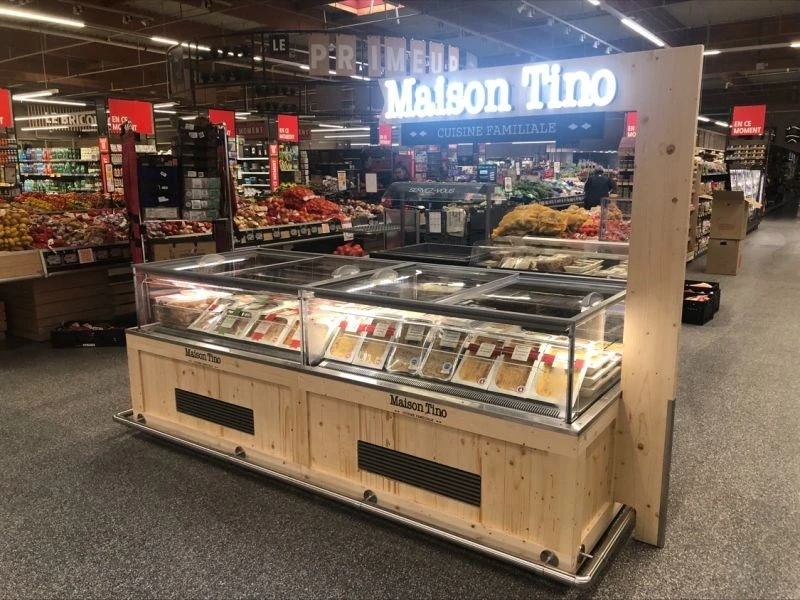
Maison Tino merch display
How to make a merchandising plan?
Based on listing agreements, brands can build their merchandising plan by integrating technical documents such as planograms, merchandising sheets, and a supporting pitch deck.
These merchandising kits structure and justify the optimal placement of references. To be effective, they must rely on quantitative data and precise recommendations.
Although there is no standard structure for a merchandising plan, it must synthesize the strategic and operational decisions related to product placement in store. Brands can thus design various assets aimed at defining their strategy, ensuring its rollout within their network, and evaluating its execution on the ground.
1. Planogram (or layout plan)
This is the visual representation of the shelf or aisle with the precise placement of products (dedicated software exists). The objective is to optimize product visibility, enforce visual merchandising rules, and ensure consistency in store.
The planogram can be accompanied by one or more document(s) detailing general placement principles (number of facings, shelf height, highlighting new arrivals). Use these guides to note recommendations on product layout and organization according to category. These “merchandising sheets” can be used by field teams to train key points of contact in retail outlets.
2. Support pitch deck for distributors
This is a more commercial presentation, which includes arguments and performance data: sales, rotations, shelf share, competitor comparisons. You can integrate recommendations based on shopping behavior and benchmarks. The goal is to convince retailers to adopt the brand's “merch plan.”
3. Monitoring guides for field teams
A practical guide containing merchandising rules and best practices for product placement, accompanied by photos of concrete examples if necessary. This key tool helps guarantee consistency of execution, for example, if a display or window needs to be set up.
Many brands build a checklist of in-store audit points. We explain this in detail in the next section!
4. Tracking and evaluation table
Finally, it is crucial to track your key performance indicators (KPIs): sales before / after product placement, out-of-stock rates, planogram compliance, etc. This sales report can also host data from field audits and reporting tools (CRM, shelf surveys, sell-out analysis), to adjust the merchandising plan based on the observed results.
All of these materials constitute an exhaustive plan for executing the brand's strategic merchandising.
Performance measurement and adjustments
For brands, securing a good listing agreement is only the first step. Once distributed, manufacturers must succeed in having their plans executed, facing competitors with the same ambitions.
However, the density of distribution networks can complicate retail execution: you then need to prioritize the outlets to audit, and plan sales rounds strategically.
A proper analysis of ROI involves combining two key actions:
In-store audits to evaluate retail execution;
Studying sell-out to observe sales performance in a before/after scenario.
Evaluating compliance with the merchandising plan must be done based on objective and measurable criteria, hence the need to set key performance indicators (KPIs).
Visiting the point of sale notably allows verifying availability (numerical distribution, facings), visibility (shelf zones, shelf share, planogram compliance), the presence of price tags, or the final retail price applied by the store.
To save time and standardize reporting, you can build similar surveys across distribution networks. By standardizing data collection (presence on shelf, presence of your POS materials, promotions, prices...) and creating surveys that track your KPIs, you ensure a smooth and actionable transmission of information.
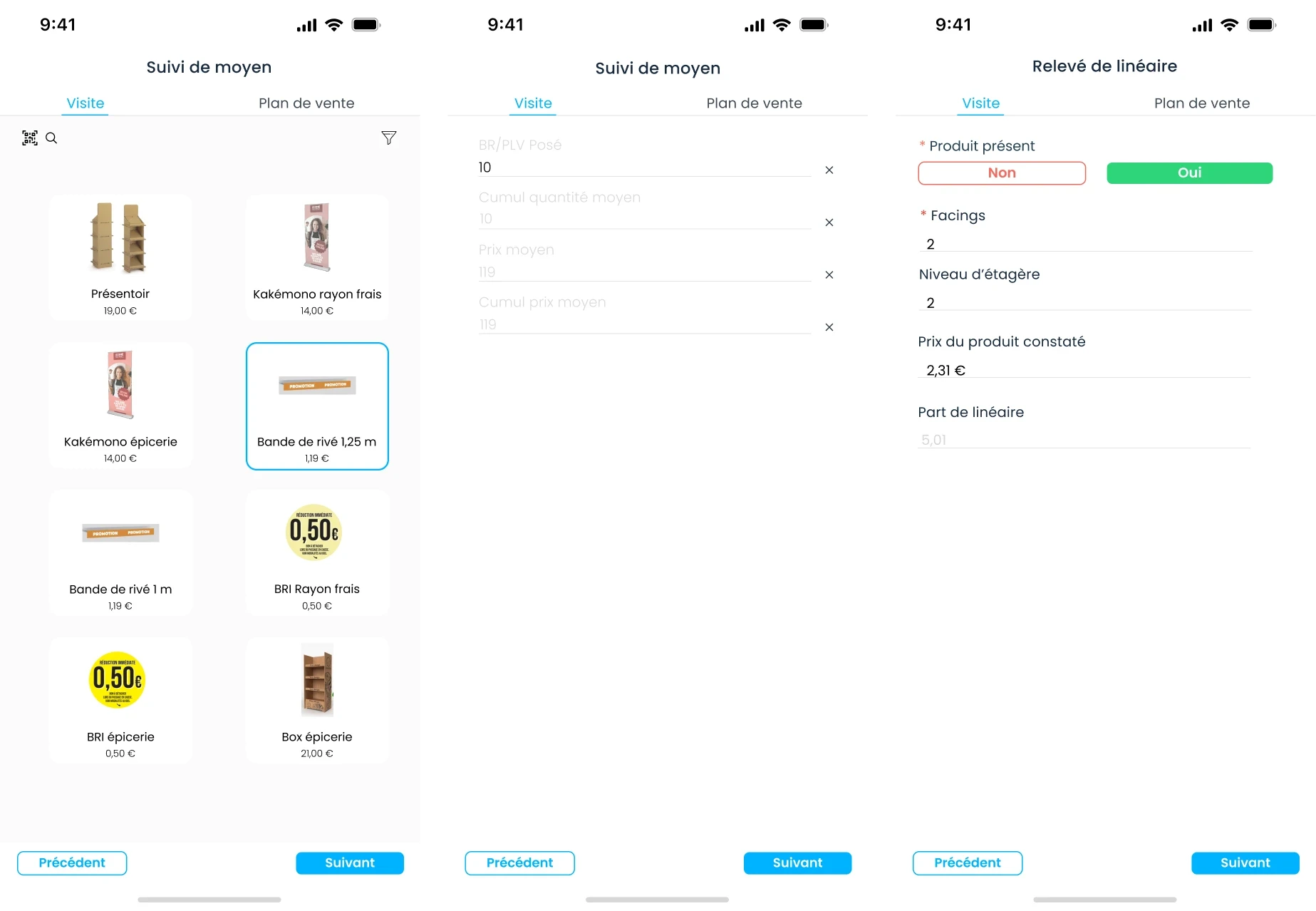
Merch survey with Sidely
This way, brands can have the exact same performance analysis grid for each store and very quickly identify corrective actions to revitalize sales and ensure compliance with the merch plan.
However, there is an even better solution: the Sidely CRM has been designed to automatically manage all your retail performance indicators. By equipping your sales force with our SFA solution, you can boost the execution of your merchandising plan, regardless of your distribution network.
Contact us to learn more!
Alexis co-founded Sidely after several years of service as a sales director. To understand what builds, or breaks, a salesperson's performance, he conducted more than 100 telephone interviews with field sales representatives. At Sidely, he transforms this raw knowledge into concrete support, based on facts rather than assumptions.
See also

Artificial intelligence and field professions: what our 2026 studies reveal
Adoption, barriers, use cases: discover what our three studies reveal about the role of AI among sector managers, sales representatives, and foodservice sales reps.

CHR and RHF Sales Representatives: portrait of a relationship-driven profession in the era of data
Equipment, productivity, AI: discover the major trends for the HORECA and food service sales profession in 2026 through our field study.

Pharmaceutical Sales Representative in France: Portrait of a Field Job Under Pressure
Compensation, aspirations, AI usage: discover the major trends in the pharmaceutical sales representative profession in 2026 through our field study.

Area Sales Managers in France: who are they and how is the profession evolving in 2026?
Compensation, aspirations, AI usage: discover the major trends in the field sales representative profession in 2026 through our field study.
The area manager professions in 2026
Discover the trends, the challenges, and the key figures.