

CRM Specifications: Complete Method and Best Practices
A botched CRM RFP is a project derailed from the start. Structure, questions to ask, selection criteria, common mistakes: the complete guide to writing a true working document.

In short
7 min read
Standard structure of a high-performance CRM specification document
Essential strategic questions to ask internal teams
Objective evaluation criteria for choosing the right CRM solution
Analysis of common mistakes to avoid during drafting
Best practices for transforming the document into an operational working tool
Since the emergence of SaaS software, off-the-shelf CRMs have covered the needs of most businesses, and it has become rare to resort to developing a new CRM from scratch.
Many organizations conclude from this that writing a functional specification document is useless: this is a mistake!
Whether you plan to buy a turnkey solution or develop a unique CRM from scratch, the specification document phase is essential. The "specs" indeed guarantee implementing a CRM adapted to your company and its functional and economic challenges.
In this article:
We describe the purpose and goals of the CRM specification document;
We outline the most suitable plan (based on our own experience in CRM projects);
Finally, we suggest a set of best practices to ensure the success of your specs.
This guide will allow you to build the document that fits your situation:
Either: very concise to choose the best CRM ready to use;
Or: highly detailed to launch a call for tenders to vendors or integrators.
What is a CRM specification document?
A CRM specification document lists all the needs allowing a company to integrate the CRM solution best suited to its business challenges. This preparatory work focused on the organization's goals and processes makes it possible to choose the CRM solution most aligned with its sales and marketing operations, or (more rarely) to launch consultations for a service provider to develop a new software.
With our long years of experience in CRM project management, we will give you all the keys to writing a clear, effective, and actionable document.
The first thing to understand about the CRM specifications is that there is no single possible outline, nor a recommended length.
The plan we recommend fits into 7 to 8 sections, which we will explore in the second part of this guide:
Company;
Project (objectives);
Business processes;
Needs and features;
Technical constraints;
Timeline and budget;
Service provider selection;
Appendices.
The benefits of CRM specifications
Whatever the size of your company or the complexity of the CRM project, writing functional specifications is essential, and brings you the following benefits:
Formalize your need and ensure you choose (or build) an adapted solution;
Engage and unite stakeholders around the project;
Properly plan and budget the implementation of the chosen solution;
Optimize your resources and funds by planning for scalability;
Anticipate risks along with technological or human constraints;
Structure and track the project with a clear roadmap known to all;
Promote user adoption of the new CRM by the teams;
(ultimately), increase productivity and improve operational results.
💡 Ready-to-use does not mean generalist: most CRMs are designed to address one of these three needs:
Sales (SFA software);
Marketing;
Customer support.
Furthermore, some solutions have been thought out for small businesses, others for large groups and multinationals.
→ The methodical drafting of a specification document will answer all these questions.
You now know all the (good) reasons to create a document describing your future customer relationship management software.
However, before breaking down our CRM specifications template, let's briefly clear up a question many of you are asking: do you need an IT background to write CRM specifications?
Functional and technical specifications
In the software world, a distinction is made between functional specifications (FSD), which describe the business and its needs, and technical specifications (TSD), which describe the technologies required to implement them. Although the functional specifications briefly address technical constraints, the resulting technological choices require a completely different expertise. And if your company has assigned you the task of writing the specifications for its future CRM, you must first understand that: Off-the-shelf solutions are customizable and adapted to most needs. The functional specifications are therefore sufficient to choose the right solution, and creating technical specifications is unnecessary. If existing solutions do not meet the functional challenges described in your functional specifications, it will allow you to launch consultations so that a vendor (publisher or integrator) can create your new software. It is this service provider who will create the technical specifications.
We can now move on to the content of your document!
Structuring and writing your CRM specifications
1. Company Presentation
General description: write briefly but in a way that provides a clear overview of the company and its environment: core business, products / services, organizational structure, history, locations, workforce size, revenue, main customer segments, number of clients, etc.
Describe the strategy and positioning of the company in its market. Analyze client acquisition and customer retention channels. The competitive context is highly important.
This introduction also allows addressing industry-specific challenges. Some sectors present unique business characteristics that generalist solutions struggle to adapt to. Retail is a typical example, requiring dedicated vertical CRMs designed for performance in supermarkets or restaurant channels.
Current State Assessment: present customer relationship management in its current state: operations, solutions in use, reporting methods, organization, communication, data sources, etc. An external provider unfamiliar with your company should be able to understand the current situation after reading this section.
Notably, describe the pain points in current workflows that are leading you to want to redesign them.
2. Project Presentation and General Objectives
Objectives and challenges of the CRM project: these are the reasons why the company wants to implement a CRM:
Increase in sales;
Improvement of productivity;
More reliable reporting;
Centralization of customer data;
Automation of marketing processes;
Sales pipeline tracking
Etc.
In agreement with decision-makers, you can add target Key Performance Indicators (KPIs).
Project Team: indicate the name of the project manager, as well as the stakeholders and their area of expertise: sales, marketing, customer service, financial department, administration, etc. Add contact details if necessary.
If applicable, describe how this project team operates, role distribution, and decision-making.
Now that the main goals are introduced, it's time to translate them into processes, then into features.
3. Business Processes (Use Cases)
You are entering the most demanding (and perhaps the most important) part of your specification document.
For each department involved in using the CRM, you must establish a list of typical actions a user has to perform daily or occasionally. These are sometimes called use cases.
A use case is a scenario or situation that describes how a user interacts with a system, application, or product to achieve a specific goal. It usually presents the different steps or actions the user follows to complete a task.
⚠️ It is important to differentiate business processes (use cases) and features (which come in the next section). Keep it generic at this stage.
🕵️ Let's take an example related to social listening
During a workshop, a team member tells you they accidentally came across a LinkedIn comment that was highly critical of your company.
Instantly, the customer service director reacts: "It's really a shame that we can't automatically pull this data in to do something about it on our end."
This allows you to create:
→ A use case: "React quickly to brand mentions on social platforms".
→ A feature: "The system identifies brand mentions on social networks and routes alerts into the CRM or via email to the address xxx@company.com".
You do not worry about the technical feasibility here; the CRMs (or partners) under review will have to offer a suitable solution!
Concrètement, the ideal way is often to start by creating a table listing the objectives by department.
Here is an example you can use for inspiration:
Sales | Marketing | Customer Support | IT | Finance | Executive Management |
|---|---|---|---|---|---|
Optimizing lead and client follow-up | Multi-channel campaign management | Improving response times | Data security | Integrated invoicing | Strategic decision-making |
Automating follow-up reminders | Precise customer segmentation | Centralized ticket tracking | Integration with existing systems | Sales forecasting tracking | Overall performance overview |
Analyzing team performance | Analyzing campaign performance | Self-service portal | CRM customization | Cost reduction | Aligning goals across departments |
Improving lead conversion | Content personalization | Analyzing customer satisfaction | Ease of updates | Margin control | KPI tracking |
💡User stories
Use cases can be written as user stories: in an agile framework, a user story is a concise description of a user's needs or expectations in a simple form. It focuses on what the user wants to accomplish without going into technical details. It is often structured as: "As a [type of user], I want to [goal], so that [benefit]."
🙋 If you feel overwhelmed by the scope of the project, consider calling in a CRM consultant, whose experience will facilitate the diagnostic phase and the structuring of functional needs. This diagnostic phase is often referred to as a business analysis or client-side PMO mission.
CUSTOMER JOURNEY
In the example above (social listening), we can clearly see the strategic importance of mastering your customer journeys to set up efficient processes.
As such, it is useful to map your current acquisition channels and customer journeys, as well as those you want to develop thanks to the new CRM. Reflection workshops around specifications will help you step back and look at your customer acquisition and retention strategies.
Be creative!
4. Features
Once your business processes feel complete, it's time to start describing the resulting features, department by department. You can also group features by module (calendar, invoicing, deals, etc.).
You can list them in a table specifying their priority level (for example: optional / important / critical).
It is up to you to define the level of detail for these feature lists. If the specifications lead to a consultation with external providers, the depth of this section will make development estimation much easier.
It is also possible to score these features, meaning assigning them an importance rating. This will allow you to:
Postpone non-priority developments over time;
Allocate financial resources optimally;
Reach major goals faster.
Ultimately, no one expects you to list every single feature; that is the realm of software engineering, which is not your main job. However, as the project lead (or BA), you must absolutely cover the use cases, otherwise the delivered software will be incomplete or inadequate on an operational level.
Once the CRM is deployed, you can keep the functional specs alive and run new workshops to iterate on new feature developments.
5. Technical Constraints
System Architecture: are you opting for a cloud CRM or on-premise, what about compatibility with existing systems?
Data Hosting and Security: specify your requirements for encryption, access management, GDPR compliance, server geolocation, uptime SLA, etc.
Legacy Data Migration: type, format, and sources of data to be extracted to feed the new CRM. While SaaS solutions generally support Excel imports, unique situations may require custom tasks to cleanse, map, or format data.
IT Environment: Windows / Mac / Linux, supported browsers, importance of mobile usage in your processes (critical for sales representatives and field teams).
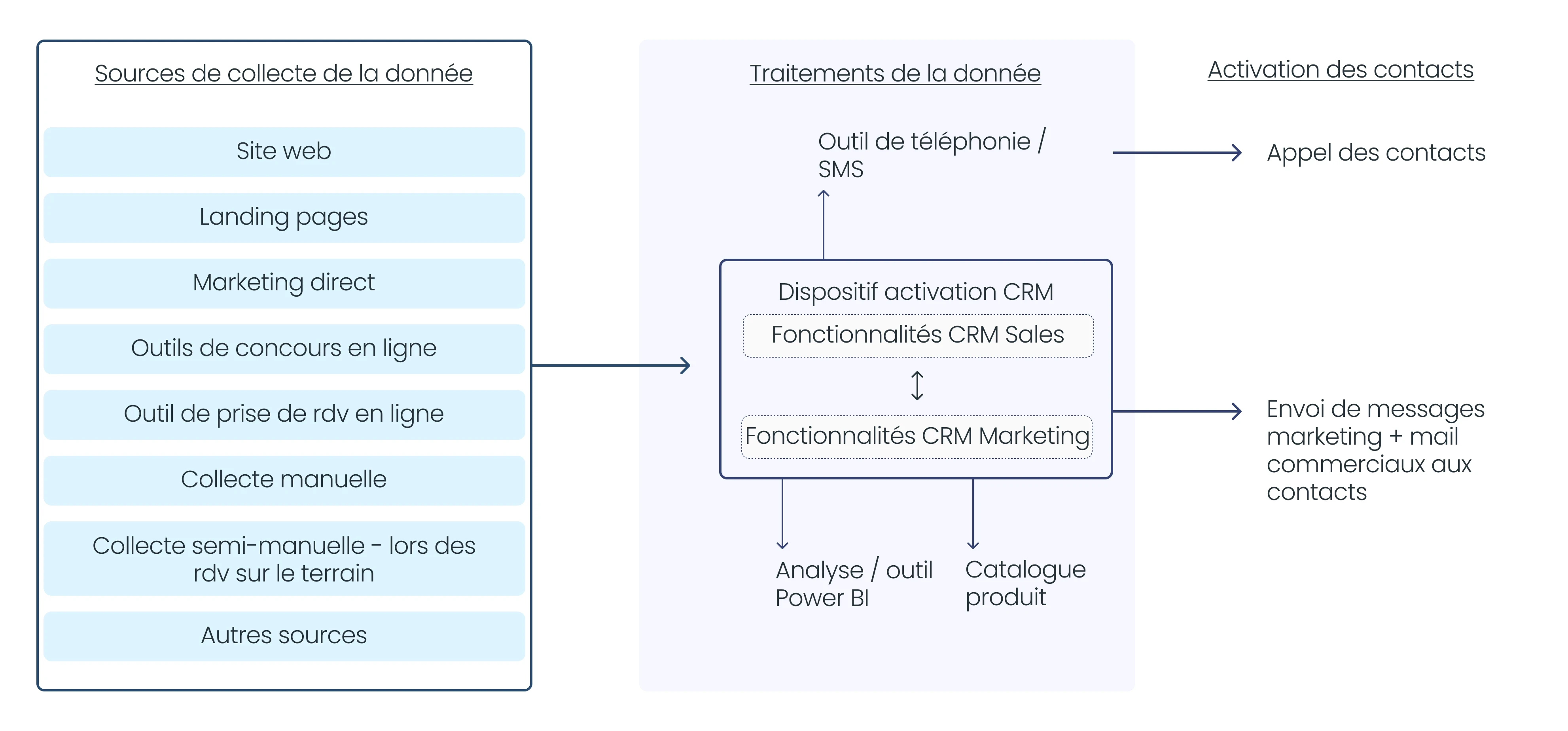
Integrations: describe your IT ecosystem. Map out all the internal and external applications that the CRM must interact with, whether APIs are available or not: email, calendar, office desktop suite, e-commerce platform, invoice software, ERP, bulk emailing service, etc.
An IT team member can handle mapping the system applications and CRM-linked data flow. The goal of this document is to describe interactions with blocks and arrows. This is known as the enterprise IT architecture.
Diagram showing data flows within the company:
To dive deeper into the topic: Understanding the importance of CRM integrations.
6. Timeline and Budget
Time Constraints: detail the deployment roadmap and project phases:
Needs assessment;
Solution selection;
New CRM configuration;
Legacy data migration and processing;
UAT / testing;
Go-live / release;
User training;
Post go-live support.
If you are going for custom development, detail the request-for-proposal timeline (launch of call for tenders, bids review, FSD finalization, then iterative development, etc.).
Budget: detail the expected costs for acquisition, deployment, training, and CRM maintenance. Lay out an implementation investment budget, then a recurring annual budget including support. It is crucial to look ahead in order to keep control of the overall CRM project budget.
7. Partner Selection
This section is aimed at businesses wishing to be supported by an experienced systems integrator providing end-to-end consulting and CRM services.
Here you can list expected services such as consulting, functional and technical training, data cleansing, and migration.
If you are launching an RFP to choose an integrator, you should absolutely include a scorecard listing evaluation criteria, with each assigned a weight or importance score (e.g. 0 to 5). This matrix provides an objective comparison between received proposals. It keeps vendors engaged by guaranteeing a fair and transparent evaluation process.
You can also add other evaluation criteria such as client references or past relevant use cases.
Finally, this is where you outline your requirements regarding SLA and support services (response times, support bundles, channels of communication, etc.).
8. Appendices
You can close out your document with a glossary defining industry jargon, acronyms, or terminology specific to your products and services.
Drafting Specifications: Our Tips for Success
Your objective is to produce a clear, precise, and actionable document that allows any stakeholder to grasp all the project challenges defined above. In theory, the document should be sufficient for an external party to step in and drive the project independently.
To produce a document that answers all central questions concisely and accurately, you will need to involve various stakeholders in the feedback loop: sales reps, marketers, IT department, etc.
This way, you harness collective intelligence and harvest as many relevant suggestions and ideas as possible, while avoiding scope creep and ending up with an over-engineered machine.
a. Thematic Workshops
Gather the team members involved (and key experts) around thematic workshops. Begin by scheduling the meetings, listing the main topics that will be discussed in sequence, and the corresponding employees required for each session.
The agenda and duration must be known in advance.
Announce a typical structure:
Presentation of the project and current issues to solve;
Round table discussions;
Brainstorming;
Summary;
Conclusion.
If the topic is complex and leaves too many critical questions unresolved, schedule another session. In that case, make sure everyone takes time for reflection in between so that the next meeting yields final decisions.
If necessary, adjust your project roadmap and keep key stakeholders informed.
✍️ Plan note-taking. Who will handle it? Have you considered using AI tools that generate meeting summaries? If you're concerned about missing key details, record the workshops (video or audio).
b. Collaboration
Conclude meetings by sharing brief meeting notes. Opt for a simple format using bullet points arranged by topic, ending with validated decisions and remaining open questions.
Notion is highly practical for organizing your centralized resource documentation. You can feed it with schedules, workshop minutes, and all useful assets for external contributors.
If your organization aims to let every team member view the CRM documentation progress in real time, you can build it in Notion as well. Otherwise, an online knowledge base serves just to record exchanges, while the final deliverable format is up to your preference.
c. Wireframes
For those who choose to build a custom CRM from scratch, the functional specifications must describe key UI sections, how different components interact with each other, and what displays on each screen along the user's path!
The specifications for your custom CRM must then include UI wireframes.
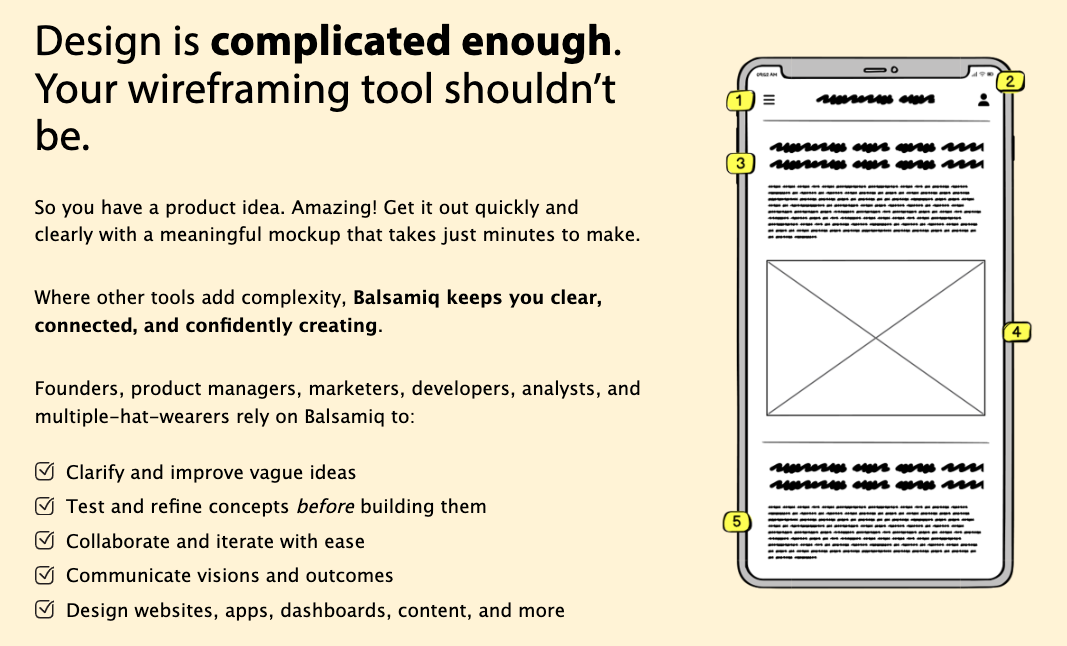
Bear in mind that at this stage, creating polished mockups is premature and unnecessary. Most of the time, hand-drawn scans are more than enough. If you want something cleaner, use an app made specifically for mocking up wireframes (Balsamiq is currently very popular!).
⚠️ Above all, avoid trying to design something gorgeous. It's not your job, and it will inevitably drag out meetings endlessly because everyone will want to pitch in with opinions on visual style.
d. Leadership Impact
Drafting the specifications also has the value of breathing motivation into your teams. Your employees realize that you are committed to a large-scale project that will make a major positive impact on their daily routines.
The CRM manager can also interview employees to gather expectations and better analyze existing operational workflows.
Coming out of CRM workshops, broadcast good news and encourage future users to look forward to this new commercial era in the making! On the other hand, build a protective buffer around technical issues. Software projects always present challenges, but time and collaboration will overcome them!
e. Ongoing Tracking 📅
Once the CRM is live, keeping adoption high is a continuous process. Teams must remain aware of how crucial high-quality data entry is in the CRM. It is also strongly recommended to schedule a CRM steering meeting every quarter or half-year with everyone who took part in drafting the initial specs.
This allows you to benchmark achievements against original targets, and unearth new requirements driven by changes in your company or market.
Ultimately, a CRM specification document acts as an anchor to define core needs, steer partners, manage implementation, and foster software evolution over time.
Still have questions about CRM?
→ Request an online demo from us to get answers!
For the past five years, Corentin has supported more than 200 sales teams, making him one of the longest-serving members of the company. He has seen the product evolve alongside the industries he supports, giving him a deep understanding of actual use cases. Between onboarding calls and training sessions, he has built up rare, hands-on expertise: knowing exactly what saves teams time.
See also

Artificial intelligence and field professions: what our 2026 studies reveal
Adoption, barriers, use cases: discover what our three studies reveal about the role of AI among sector managers, sales representatives, and foodservice sales reps.

CHR and RHF Sales Representatives: portrait of a relationship-driven profession in the era of data
Equipment, productivity, AI: discover the major trends for the HORECA and food service sales profession in 2026 through our field study.

Pharmaceutical Sales Representative in France: Portrait of a Field Job Under Pressure
Compensation, aspirations, AI usage: discover the major trends in the pharmaceutical sales representative profession in 2026 through our field study.

Area Sales Managers in France: who are they and how is the profession evolving in 2026?
Compensation, aspirations, AI usage: discover the major trends in the field sales representative profession in 2026 through our field study.
The area manager professions in 2026
Discover the trends, the challenges, and the key figures.