

Open-source CRM: advantages, limitations, and industry-specific SaaS alternatives
Open-source CRM: definition, benefits, limitations, and comparison with a specialized SaaS CRM for field sales teams.

In short
8 min read
An open-source CRM offers great technical freedom and deep customization, but requires in-house expertise for deployment, maintenance, and security.
Unlike the "turnkey" SaaS model, open source involves increased technical responsibilities for the company (hosting, updates, backups).
For field sales teams, ease of use, mobility, and offline functionality (without a stable connection) are often prioritized over technical flexibility.
The choice between open source and SaaS depends on your structure: opt for open source for highly specific needs with a solid IT department, and SaaS for rapid operational performance.
SaaS or mobile-first business-specific CRMs are often better suited for mobile sales forces because they natively integrate reporting and route management tools essential for sales steering.
An open source CRM is client relationship management software whose source code is freely accessible, modifiable, and distributable. Unlike a proprietary CRM (in SaaS or On-premise mode), open source CRM software offers significant technical freedom, with the ability to adapt features to internal processes.
It is this flexibility, coupled with the promise of reduced costs, that explains the growing interest of many organizations in this type of CRM solution. Indeed, a free open source CRM represents an appealing alternative to monthly subscriptions.
However, behind the cost argument often lies a more complex reality. Technical deployment, maintenance, security, user adoption: choosing an open source CRM involves structuring trade-offs and a team capable of customizing and maintaining it. The initial interest must always be weighed against available resources, the actual usage of the teams, and business objectives.
So, is it really adapted to the reality of field sales teams, who need a simple, mobile, and immediately operational tool? This is the dimension we will analyze.
What is an open source CRM?
An open source CRM software is a CRM tool whose code is publicly accessible, whose license allows modification and redistribution, and where hosting can be internal, self-hosted, or outsourced to a service provider.
In concrete terms, an open source CRM allows you to manage contacts, sales opportunities, quotes, customer follow-up, or even marketing campaigns, while offering great freedom of customization.
This approach often appeals to companies that have internal technical skills and want to maintain total control over their software infrastructure.
How does an open source CRM work?
An open source CRM works on the same principle as a traditional CRM, managing contacts, opportunities, and sales follow-up, but with one major difference: its source code is accessible and modifiable. The company can therefore install, configure, and adapt the solution according to its internal needs.
Its operation is based on three pillars: hosting, customization, and maintenance.
Unlike a SaaS CRM hosted by the publisher, open source CRM software is generally installed on an internal server, deployed on a private cloud, or hosted by an external provider. The company thus retains control over its data and infrastructure. However, this requires technical skills for the initial installation and software updates management.
Most open source CRM solutions rely on a modular architecture, meaning they offer standard features (contact management, opportunity tracking, reporting, etc.) but allow them to be modified and other specific features to be added. A developer can intervene directly in the code to adapt the tool to business processes. This flexibility attracts companies with complex or highly specific needs.
Finally, in an open source model, maintenance is not automatically included. It is up to the company to install updates, fix security vulnerabilities, ensure compatibility with its technical environment, or manage backups and system availability.
What are the differences between an open source CRM and a SaaS CRM?
The main difference between an open source CRM and a SaaS CRM lies in the distribution and management model, which we explained earlier.
Regarding the licensing model: open source CRM reduces licensing costs but increases technical responsibility. SaaS CRM includes the service in the subscription.
Regarding hosting and data management: open source offers complete control, while SaaS prioritizes simplicity and delegation.
Regarding customization: open source software allows for deep customization, whereas SaaS software offers a structured and standardized framework.
Regarding deployment: SaaS CRM allows for a quick start, while open source requires a structured technical project.
Regarding adoption by sales teams: for field sales teams, ease of use and rapid onboarding are often prioritized over technical freedom. SaaS CRM therefore allows for more complete adoption than open source CRM.
Open source CRM | SaaS CRM |
|---|---|
Accessible and modifiable code | Proprietary code |
Internal hosting or self-hosted | Hosting managed by the publisher |
Often low software cost | Monthly subscription |
Maintenance at the expense of the company | Maintenance included |
Open source CRM offers more technical flexibility, while SaaS CRM prioritizes ease of deployment and support.
Known examples of open source CRMs
There are already well-known examples of the best open source CRMs. These solutions share a common point: their source code is accessible and modifiable, but their positioning and complexity levels differ.
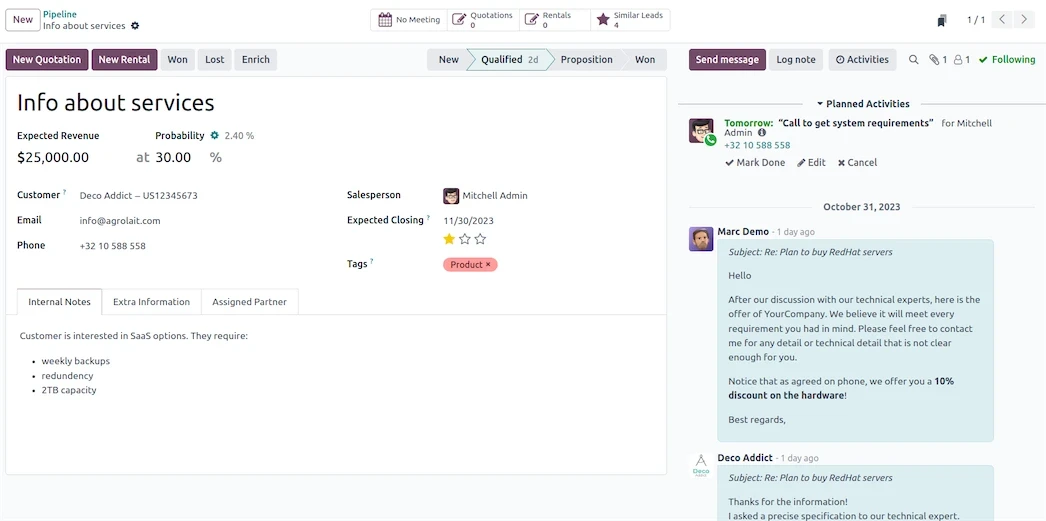
Odoo
Odoo is one of the most famous open source softwares in the world. It was originally a modular ERP integrating a CRM module.
Key points
Free open source Community version
Modular architecture (CRM, invoicing, stock, HR, etc.)
High customization capacity
Good to know
The Enterprise version is proprietary and paid. The open source version often requires an integrator for advanced deployment.
Suite CRM
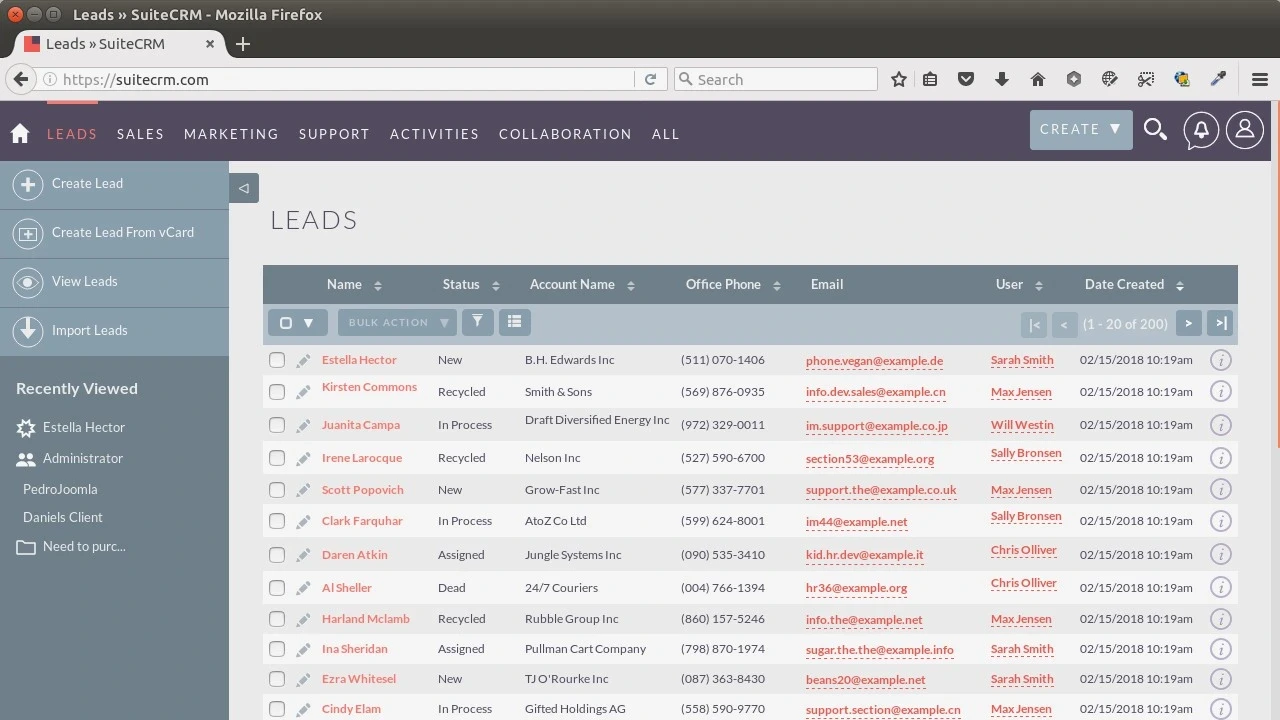
Suite CRM is a solution derived from a fork of SugarCRM. It remains one of the most widely used open source CRMs.
Key points
100% open source solution
Complete CRM features
Strong international community
Good to know
The interface may seem less modern than some recent SaaS CRMs. Customization is often necessary to optimize user experience.
EspoCRM
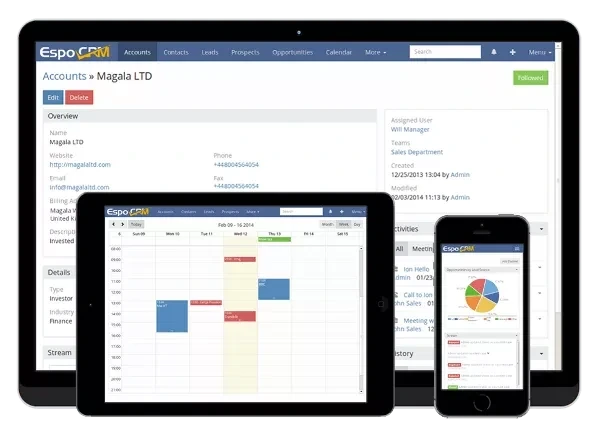
EspoCRM is a French open source CRM suite valued for its simplicity and technical light weight.
Key points
Relatively simple installation
INTERFACE is more modern than some open source competitors
Customization via modules
Good to know
It is often chosen by SMEs looking for a lighter solution than a full ERP.
Dolibarr
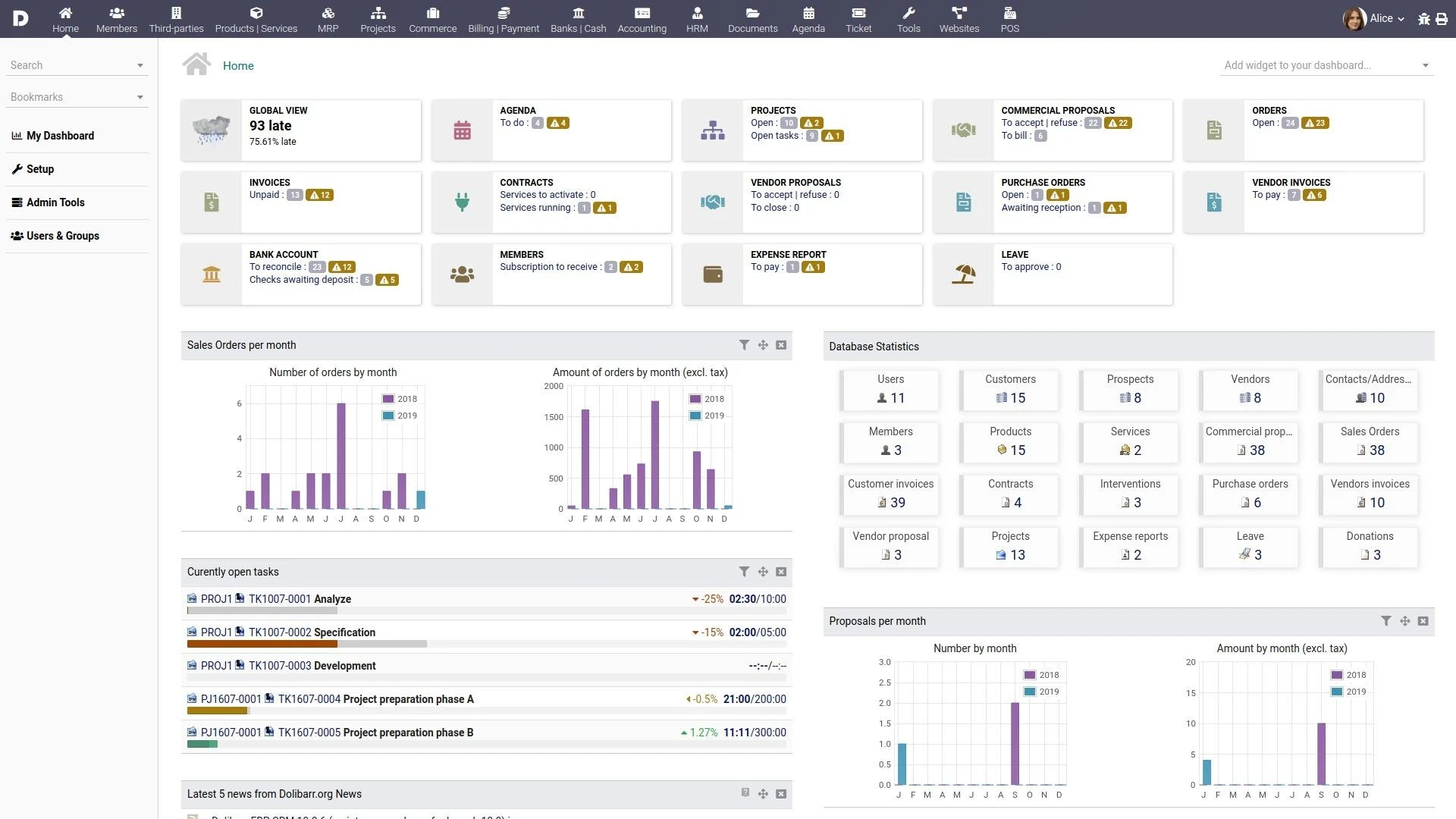
Dolibarr is a French open source solution combining ERP and CRM.
Key points
Complete open source software
Integrated sales management
High adoption in SMEs
Good to know
It is more suitable for structures looking for a global management tool rather than a CRM specialized in sales performance.
Why do companies choose an open source CRM?
In 2026, 91% of companies with more than 10 employees use a CRM to manage their sales, customer interactions, and productivity. So, why do some choose an open source CRM?
An attractive initial cost
The first factor of interest is financial.
An open source CRM is often perceived as free or less expensive than a SaaS CRM with a monthly subscription per user. For SMEs or growing structures, avoiding recurring fees can seem attractive.
Much of the research on free open source CRM is driven by dissatisfaction, particularly with contract lock-in (which is no longer possible in SaaS!) and subscription costs perceived as too high. The open source CRM then appears as a freer and potentially more economical alternative.
Complete freedom of customization
Unlike many standardized SaaS CRMs, an open source CRM allows tailored developments.
This attracts:
Companies with complex sales processes.
Highly specific industries.
Organizations wanting to deeply integrate the CRM into their software ecosystem.
Technological independence
An open source CRM interests companies that want to maintain control over their infrastructure. They can host the solution internally, access the source code, modify features according to their needs, and avoid technological dependency on a single vendor.
This technological independence particularly appeals to organizations with a solid IT team or specific security constraints.
In addition, the open source movement benefits from a positive image: transparency, collaboration, continuous improvement through an active community, and shared innovation. Some companies prioritize this model out of conviction or digital independence strategy.
These benefits are real. But they must be put into perspective with the operational reality of sales teams.
The limitations of an open source CRM in practice
On paper, an open source CRM seems to check all the boxes: freedom, customization, no expensive licensing fees. Yet, not all companies make this choice. The reason rarely lies in the principle of open source itself, but rather in the practical implications in terms of organization, resources, and operational performance.
Hidden costs of open source: development, maintenance, security
"Free" does not mean "without cost."
An open source CRM may be free in terms of licensing, but it generates indirect costs: development and customization, hosting and infrastructure, maintenance and security, or user training.
The cost then depends heavily on the level of customization and available internal resources. And, the total cost of ownership can quickly exceed that of a SaaS CRM, especially if the company does not have a dedicated IT team. Many organizations look for a budget-predictable solution, with a clear and surprise-free subscription.
Implementation complexity
Installing an open source CRM is only a first step. You must then:
Configure it according to sales processes
Develop specific modules
Ensure regular updates
Manage security patches
This requires internal technical skills or hiring an integrator, but above all, it takes a lot of time. Indeed, an open source CRM project is often akin to an IT project: needs analysis, development, testing, training, go-live... Conversely, a SaaS CRM can be operational in a few days or weeks. For companies that want an immediate return on investment, this factor weighs heavily in the decision.
Sometimes low user adoption
Adoption of the CRM by teams is the nerve of war, because a CRM is only useful if it is actually used.
However, open source solutions, when not precisely tailored, can have less intuitive interfaces, a secondary mobile experience (or even non-existent), and often have ergonomics designed more for administration than for field use.
It is important to understand here that the appeal of an open source CRM depends heavily on the context. If you work for a technical startup, a large group with internal developers dedicated to your sales solution, or you need complete control, choosing a self-hosted CRM may be the right choice for you.
On the other hand, for field sales teams who need a mobile, simple, and immediately operational tool, the issue often goes beyond the question of the source code. The priority becomes user adoption, ease of deployment, and sales performance.
Is an open source CRM suitable for field sales teams?
A CRM can be technically powerful without being truly operational in the field. However, traveling sales teams have specific constraints: constant mobility, back-to-back meetings, areas with poor network coverage, and the need to log information quickly.
A typical day of a field sales representative
A salesperson can make between 6 and 10 visits a day. Between two appointments, they have a few minutes to carry out the rest of their tasks.
In this context, the tool must be immediately accessible, fast, and intuitive. An interface initially designed for desktop use, then adapted to mobile, can become restrictive. Every extra click slows down the user and reduces actual adoption.
Real mobility and offline use
In the field, network connection is never guaranteed. Rural areas, warehouses, basement shops: data access can be unstable.
A CRM truly suited to field sales teams must allow for reliable offline operation and automatic data synchronization.
An open source CRM can theoretically integrate these features, but they often require specific developments. They are not always native.
Sales steering and managerial visibility
Beyond individual use, there is the question of steering. A sales director must be able to track territory coverage, number of visits made, performance by region or sector, gaps between targets and achievements, sales at N and N-1...
A CRM focused on technical customization does not automatically guarantee a clear and structured view of field activity. The challenge here is to have a business solution that converts data into actionable indicators to steer sales performance.
An open source CRM can work if the company has the resources to structure these indicators. But it is rarely natively optimized for traveling sales forces.
Open source CRM vs Industry SaaS CRM: how to choose?
The choice between an open source CRM and an industry SaaS CRM depends mainly on where the complexity of your organization lies.
When to choose an open source CRM
An open source CRM is relevant when:
Your company has a solid internal IT department.
Your sales processes are extremely specific.
You need advanced technical integrations.
Your software budget is limited, but your IT budget is available.
In this case, the ability to deeply customize can become a strategic advantage.
When to opt for an industry SaaS CRM
An industry SaaS CRM becomes relevant when the priority is not technical customization, but operational performance.
It is generally more suitable if:
You manage large field sales teams.
You want a rapid deployment.
User adoption is a strategic issue.
You are looking for a quickly measurable return on investment.
An industry SaaS CRM generally integrates features designed for a specific sector or type of team. The goal is not to customize everything, but to be immediately operational.
To go deeper into this reflection, you can consult our checklist for choosing your CRM.
Alternatives to open source CRM for field sales forces
Faced with the potential limitations of an open source CRM for field teams, several alternatives exist.
Generalist SaaS CRM
Generalist SaaS CRMs offer fast implementation and a rich ecosystem. However, they are not always optimized for the specific constraints of field teams, particularly in terms of advanced mobility or territorial management.
Verticalized industry CRM
Some solutions are designed for specific sectors, for example a commercial agent CRM or an agri-food CRM. These tools integrate features adapted to business realities: tour management, assortment tracking, in-store reporting.
Mobile-first CRM
Mobile-first CRMs are designed from the ground up for field use. The interface, inputs, and reporting are designed to be used on the go, with quick access to key data and simplified dashboarding for management.
The choice should not be guided solely by the open source or SaaS model, but by the alignment between the tool and your actual uses.
The open source CRM is neither a miracle solution nor a bad option by principle. It responds above all to a technical and budgetary logic: code control, freedom of customization, and infrastructure control. For companies with solid IT resources and specific needs, it can be a coherent choice.
On the other hand, it is rarely designed natively for the operational constraints of field sales teams, who prioritize mobility, simplicity of use, and speed of execution. The real selection criterion does not lie in the open source or SaaS model, but in the fit between the tool and the actual uses of your sales teams.
If you want to evaluate a CRM truly adapted to your field teams, test Sidely.
Margot has been working in Tech and SaaS for 8 years, with a multi-product experience that has given her a unique understanding of business challenges. On a daily basis, she analyzes, relentlessly tests, and relies on facts to shed light on market trends and help sales teams move forward.
See also

Artificial intelligence and field professions: what our 2026 studies reveal
Adoption, barriers, use cases: discover what our three studies reveal about the role of AI among sector managers, sales representatives, and foodservice sales reps.

CHR and RHF Sales Representatives: portrait of a relationship-driven profession in the era of data
Equipment, productivity, AI: discover the major trends for the HORECA and food service sales profession in 2026 through our field study.

Pharmaceutical Sales Representative in France: Portrait of a Field Job Under Pressure
Compensation, aspirations, AI usage: discover the major trends in the pharmaceutical sales representative profession in 2026 through our field study.

Area Sales Managers in France: who are they and how is the profession evolving in 2026?
Compensation, aspirations, AI usage: discover the major trends in the field sales representative profession in 2026 through our field study.
The area manager professions in 2026
Discover the trends, the challenges, and the key figures.