

SaaS CRM: everything you need to know to make the right choice
What is a SaaS CRM? Benefits of the cloud, differences with on-premise, and criteria for choosing the right SaaS CRM for your sales team.

In short
6 min read
A SaaS CRM is a commercial relationship management software hosted on the provider's servers and accessible via the Internet, generally operating on a subscription basis.
The essential features of a CRM integrate contact management, sales tracking, customer service, marketing automation, analysis tools, and cross-team collaboration.
The SaaS model stands out for its ease of access, quick implementation, automatic updates, and reduced upfront costs compared to on-premise solutions.
Unlike an on-premise solution managed locally, the SaaS CRM decentralizes data hosting onto secure external servers maintained by the provider.
The strategic choice of a SaaS CRM must anticipate integration needs, the scalability of the solution, data security, and specificities related to recurring revenue generation.
A SaaS CRM is a commercial relationship management software hosted on its publisher's servers, which the user client accesses via an internet connection, usually after subscribing to an annual plan. This model has widely established itself in recent years.
Sidely invites you here to explore the specifics - and especially the benefits - of commercial software “on the cloud”. We will start by going through the fundamentals of CRM, and then we will explain the specificities of the SaaS model applied to commercial software.
Finally, we will review the important questions to ask yourself to choose your SaaS CRM wisely.
CRM: A reminder of the fundamentals
The acronym CRM, for Customer Relationship Management, encompasses the strategies, technologies, and practices that companies use to manage and analyze business interactions and customer data throughout their life cycle.
In France, the term is mainly used to refer to commercial relationship management software (GRC). The main objective of CRM is to improve relations with clients, increase satisfaction and loyalty rates, and boost sales and profitability.
Most CRMs can be grouped into one of the following three categories: marketing, sales, and customer support.
Features may vary depending on the type of CRM chosen. But the essential components are usually the following:
Contact management: centralize customer information (names, addresses, phone numbers, emails) and interactions for simplified access to sales and marketing data;
Sales management: track sales opportunities, manage the sales pipeline, and analyze sales team performance to maximize conversions and revenue;
Customer service: provide tools to manage support requests, tickets, and customer service interactions to resolve issues quickly and effectively;
Marketing automation: automate marketing campaigns, segment customers, personalize communications, and track campaign performance to improve return on investment (ROI);
Analytics and reporting: analyze customer data, sales performance, market trends, and customer behaviors to make informed and strategic decisions;
Collaboration: facilitate collaboration among different business teams (sales, marketing, customer service) by sharing information and working together to deliver a consistent customer experience.
There are also industry-specific CRMs, also called “vertical” CRMs because they address specific markets.
CRM has become central for businesses, to the extent that nearly 90% of French companies have already taken the plunge! This massive adoption was notably favored by the development of the economic and technical model known as SaaS; that is what we are going to look at now.
Evolution of CRM as a service
SaaS, or Software as a Service, is a software delivery model in which applications are hosted by a service provider and made available to customers via the Internet. In other words, rather than purchasing and installing software on individual computers, users can access SaaS applications through a web browser.
CRM in SaaS mode is therefore a web software which implies that the client's data is hosted on external servers (data centers), and no longer on those of the company. The hosting infrastructure is said to be decentralized.
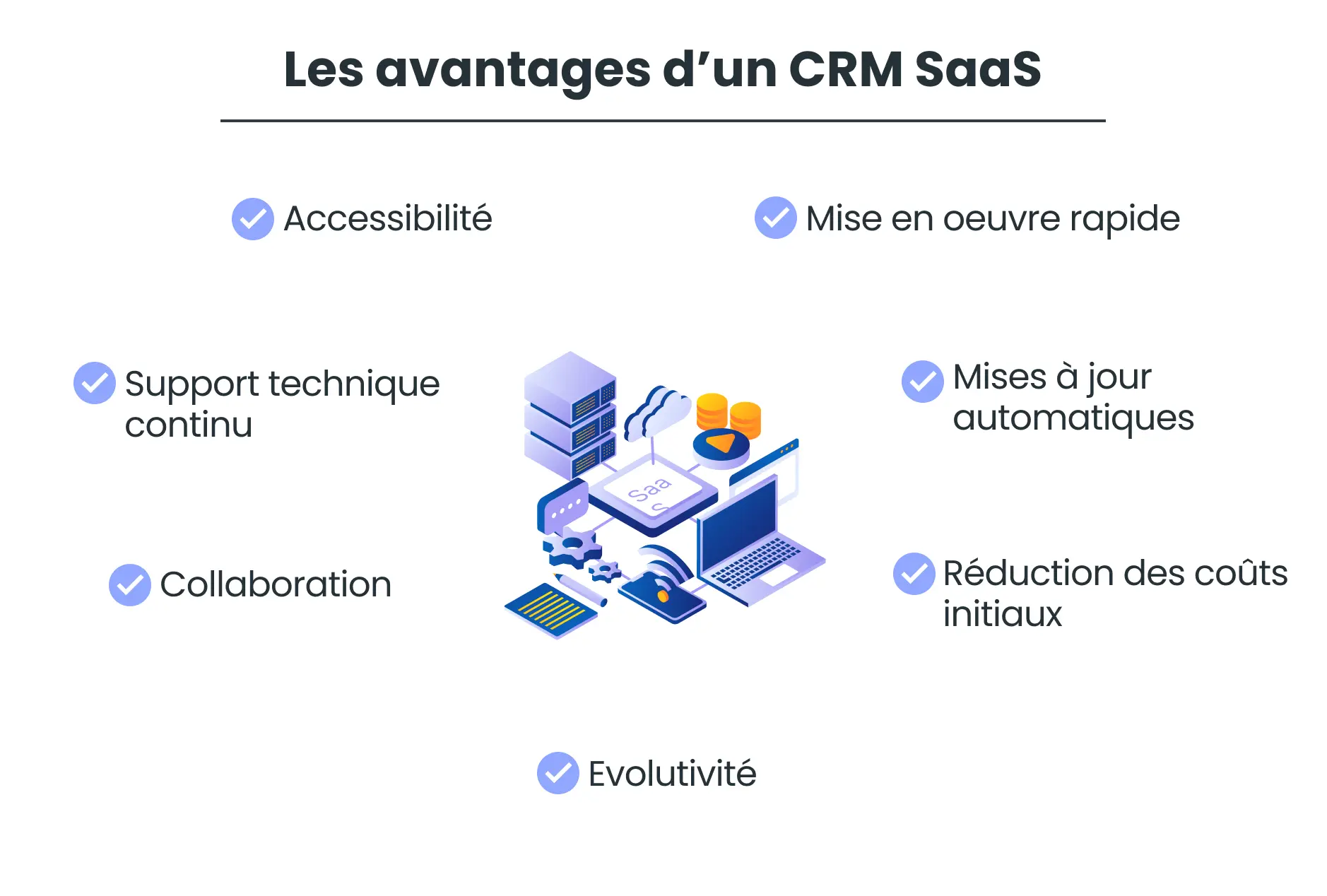
A SaaS CRM offers significant benefits:
Accessibility anywhere thanks to an Internet connection;
Rapid implementation without complex installation;
Automatic updates for a software that is always up to date;
Reduction of initial costs thanks to the subscription model;
Scalability to adjust resources according to needs;
Continuous technical support provided by the service provider;
Collaboration among teams with shared and real-time access to customer data.
SaaS CRM differs from licensed versions (on-premise), for which the client purchases the software, and open-source versions, which imply that an integrator implements a free program developed and maintained by the community.
CRM Cloud vs On-Premise
SaaS CRM is part of cloud services (see the box slightly below). It thus contrasts with on-premise CRM, a software solution installed and run locally on the servers or computers of the user company. Indeed, unlike solutions hosted in the cloud, on-premise CRM is managed, secured, and maintained by the company itself.
This approach allows complete control over data and systems, thereby offering increased flexibility for customization and integration with other internal systems. In the case of remote or multi-site use, synchronization operations can be programmed so that data is updated in a unified system.
When opting for a SaaS CRM, European companies are keen to choose a solution whose servers are located in the European Union rather than in the United States (for example), because the same laws do not apply!
Cloud CRM | On-Premise CRM | |
|---|---|---|
Accessibility | Accessible from anywhere with Internet | Accessible mainly from the internal network |
Initial Cost | Reduced, subscription-based payment model | High, investment in infrastructure and licenses |
Updates | Automatic, managed by the provider | Managed by the company, may require downtime |
Scalability | Easy to adapt according to growth | May require additional investments |
Maintenance | Reduced, managed by the provider | Company's responsibility, may require an IT team |
Security | Depends on the provider, privacy policy to be considered | Complete control, compliant with internal policies |
Long-term Cost | Can become high over time | Mainly initial, more limited recurring fees (resources, servers) |
🌐 The SaaS model does not exclude the possibility of accessing software services via an application installed on a device, such as a mobile app. SaaS has also accompanied the development of user interfaces and new uses, especially mobile ones, by allowing nomadic sales reps, for example, to record their entries or take orders directly from a mobile device or a tablet.
📚 What is the difference between SaaS and Cloud Computing?
Cloud computing is a model that enables ubiquitous and convenient on-demand access to shared computing resources (servers, storage, applications, etc.) via the Internet.
Cloud computing is divided into three main services:
IaaS (Infrastructure as a Service): provides virtualized computing infrastructure over the Internet. Example: Microsoft Azure.
PaaS (Platform as a Service): provides development platforms that allow developers to build and manage applications. Example: Heroku.
SaaS (Software as a Service): provides software and applications over the Internet. Example: Trello.
SaaS CRM: A strategic investment
SaaS platforms thus make it possible to combine CRM functions (centralization of data, sales tracking, e-mailing, sales pipeline, reporting, etc.) with the benefits of outsourcing, such as the elimination of purchasing and maintenance costs related to the software.
Usually for a very moderate entry price, SaaS platforms relieve organizations of many constraints related to infrastructure management, regulatory monitoring, internal security management, purchasing licenses and hardware, and even some indirect costs related to wear and tear, accidents, and unexpected service interruptions.
SaaS is therefore becoming, in the majority of cases, a strategic investment that optimizes both operating costs and human resources, while freeing teams from low value-added issues to focus on growing the business. SaaS has also largely contributed to the massive usage of CRMs, particularly among VSEs (Very Small Enterprises), which now constitute a full-fledged market segment, and for which publishers design financially accessible offerings sized for their use. However, SaaS has conquered businesses of all sizes and typologies, ranging from micro-businesses to the largest multinationals, including startups and SMEs.
To meet this growing demand for flexibility and mobility, all the big names in CRM now offer their solution in SaaS mode.
The Data Act: an impact on your SaaS CRM contract
Since September 12, 2025, the European Data Act has come into force to give data control back to those who generate it, notably businesses. It imposes new obligations on SaaS software publishers: customers can now terminate their contracts at any time, retrieve all of their data, and change providers without abusive fees or technical blockages.
Concretely, if you are looking to change your SaaS CRM or adopt one, the Data Act works in your favor. It marks the end of locked contracts and strengthens data portability. You no longer have to fear losing your data when changing providers.
This means you can test an online CRM, use it as long as it suits you, and leave it as soon as it no longer meets your needs, without being trapped.
Choosing your SaaS CRM
We will now review a number of criteria that will allow you to better define your project. Because, if you are definitively sure you want to go for a cloud-based web software, it's time to start working on your specifications!
Here are some questions to ask yourself:
What main objectives do you expect from your CRM?
Which type of CRM should you steer toward: marketing, sales, or support?
Do you operate in a specific industry (e.g., retail brand)?
Is it important for you to choose a French software?
Here are some of the best performing SaaS CRMs on the market, and a few criteria to guide your choice.
CRM Name | CRM Type | Target Industry | Main Strength | Country of Origin |
|---|---|---|---|---|
Sales | All sectors | Extensive customization and integrations | USA | |
Marketing | All sectors | Marketing automation | USA | |
Sales | BtoBtoC | CRM for all distribution networks | France | |
Sales | SMEs | Intuitive interface and pipeline management | USA | |
Sales | All sectors | Flexibility and customization | India | |
Sales | All sectors | Integration with Microsoft tools | USA | |
Sales | SMEs | All-in-one solution for SMEs | France | |
Sales | SMEs | Simplicity of use for SMEs | France | |
Sales | SMEs | Productivity and simplicity | France | |
Sales | All sectors | Advanced customization | USA | |
Marketing | B2B Marketing | Advanced tools for B2B marketing | USA | |
Marketing | SMEs | Marketing automation for SMEs | USA | |
Customer Service | All sectors | Omnichannel customer support | USA | |
Customer Service | SMEs | Customer support for SMEs | USA |
How much does a SaaS CRM cost?
SaaS CRMs start at around $30 per user per year. But depending on your needs and headcount, prices can quickly reach thousands or tens of thousands of dollars.
There is no free SaaS CRM, unless you opt for open-source. Be sure to take the time to study the cost of your CRM project.
Security of SaaS CRMs
In the vast majority of cases, the security of SaaS platforms is no longer in question. Indeed, major CRM players comply with GDPR regulations and make sure to constantly keep their equipment and software up to date. For customers, outsourcing the hosting of an application like CRM allows them to offload a large portion of security activities and costs, and does not prevent them in any way from accessing their data at any time.
What is the best CRM for a SaaS service?
It is possible that as an online services company, you offer software in SaaS mode yourself. You might then ask yourself if this could impact the requirements of your future CRM.
Generally, companies that offer software in SaaS mode market it online, directly from their site, and with an economic model based on a subscription system, to generate recurring revenue without relying on prospecting.
In this case, you will probably want to steer toward a “marketing” type CRM, which is better suited for intensive e-mailing activities and marketing automation. This way, your CRM manager can design the entire online commercial acquisition process from your new solution. Reflection should include optimizing the user experience, but also integrating analytics and tracking features for web users to continuously improve the performance of automated marketing.
Furthermore, your online sales model will lead you to connect your e-commerce platform to your tools (CRM, ERP, etc.). You will therefore want to pay special attention to the integrations provided by the publisher of your CRM, as well as the possibilities offered by the API key they have developed.
Finally, if your company is a startup, it's likely you are aiming for rapid growth, with HR development proportional to your commercial success or fundraising (we wish you that, in any case 🤞). It is therefore important to anticipate the evolution of your CRM in terms of the number of licenses and modules necessary for the future growth of your business. For example, if you are called upon to handle high volumes of customer service and steer toward a support-type CRM, you can evaluate the budget based on the number of desk users you will hire as you scale your team.
In the end, a company that develops services in SaaS mode should anticipate the following needs in its CRM project (and elaborate on them in the specifications):
Quality of integrations;
Adaptability to recurring revenue generation;
Power of marketing automation tools;
Scalability of the solution and adequate pricing;
Data security.
Margot has been working in Tech and SaaS for 8 years, with a multi-product experience that has given her a unique understanding of business challenges. On a daily basis, she analyzes, relentlessly tests, and relies on facts to shed light on market trends and help sales teams move forward.
See also

Artificial intelligence and field professions: what our 2026 studies reveal
Adoption, barriers, use cases: discover what our three studies reveal about the role of AI among sector managers, sales representatives, and foodservice sales reps.

CHR and RHF Sales Representatives: portrait of a relationship-driven profession in the era of data
Equipment, productivity, AI: discover the major trends for the HORECA and food service sales profession in 2026 through our field study.

Pharmaceutical Sales Representative in France: Portrait of a Field Job Under Pressure
Compensation, aspirations, AI usage: discover the major trends in the pharmaceutical sales representative profession in 2026 through our field study.

Area Sales Managers in France: who are they and how is the profession evolving in 2026?
Compensation, aspirations, AI usage: discover the major trends in the field sales representative profession in 2026 through our field study.
The area manager professions in 2026
Discover the trends, the challenges, and the key figures.