



Retail marketing: definition, trends, and best practices
Retail marketing encompasses all actions taken at the point of sale to boost sales. Definition, examples, and key techniques for brands in supermarkets.
In short
7 min read
Definition of retail marketing: all strategies to attract, convert, and retain customers in-store.
Importance of digitalization (web-to-store, omnichannel) to bridge the gap between physical and digital commerce.
Fundamentals structured around the 4Rs: Relationship, Retention, Reward, and Reductions.
Practical implementation through 10 best practices, including customer experience, merchandising, data, and training.
Steering business performance using key performance indicators (KPIs) such as sales revenue, conversion rate, and average basket.
Retail marketing refers to the strategies that enable chains, brands, and points of sale to attract customers to stores and encourage purchases. It is a discipline encompassing many techniques, and is subject to profound disruptions linked to the evolution of digital technology.
Sidely provides you with an overview of this concept in order to understand its challenges, trends, and above all, best practices.
We will start by navigating the definition and framework of retail marketing. To understand the impact of technologies in this field, we will look at an iconic case of digital transformation: that of the Carrefour group.
Finally, for brands that want to initiate a transformation or upgrade, we will offer a list of 10 best practices in retail marketing, as well as a series of key indicators to measure the resulting sales performance.
But before talking about marketing, let's start by reminding ourselves of what is meant by "retail".
What is retail?
Retail, or retail trade, refers to all activities related to selling products or services directly to final consumers, in small quantities, generally for personal or household use.
The term is used to refer to physical points of sale such as stores or supermarkets, but also online commerce or marketplaces. The retailer is therefore the final link in the distribution chain, and its customers are the final consumers.
The terms retail sales or retail distribution are also used. Based on selling in small quantities, retail is the opposite of trade, i.e. wholesale (BtoB or BtoB).
Now that the subject is defined, let's move on to retail marketing!
Retail marketing: the fundamentals
Retail marketing refers to all marketing strategies and techniques used by chains and points of sale to attract customers, maximize their purchases, and build loyalty.
This concept encompasses several aspects such as:
The in-store customer experience: creating an attractive and pleasant environment to encourage purchase;
Merchandising management: organizing products in the sales space to optimize their visibility and attractiveness;
Promotions and commercial offers: stimulating demand through discounts, bundled offers, or special events;
Digital marketing: integrating digital tools, such as mobile applications, email campaigns, or social media, to drive traffic in-store or online;
Customer loyalty: developing reward programs or personalized strategies to encourage customers to return.
💡Since the purpose of retail is to sell to consumers themselves, it is common to use the term shopper marketing to refer to marketing actions directed at them.
A diagrammatic way to represent these challenges is the use of the 4Rs of retail marketing:
Relationship between the brand and its customers;
Customer retention through merchandising, the customer journey, or sensory marketing;
Reward: loyalty cards, promo cards, and ambassador programs;
Price reductions: gifts, free services, payment facilities, etc.
🎯 The overall objective of retail marketing is to transform the buying experience into a pleasant and efficient moment, while increasing sales and consumer satisfaction.
Finally, the advent of the web and the smartphone have fostered the emergence of web to store, a set of techniques for bringing customers into physical points of sale thanks to digital marketing. Because now, digital technology has become indispensable in any retail marketing strategy, as we will see now.
Digitalization and retail marketing: the Carrefour case study
It would be naive to reduce retail to physical distribution. Indeed, e-commerce takes up a significant place in the lives of French people (around 10% of retail sales in 2024). Furthermore, store activity is largely correlated with the web marketing of chains and brands.
Thus, Carrefour displays its ambitions in terms of digital retail, and highlights its "data-centric" and "digital first" approach, i.e. the transformation of traditional distribution operations through digital technology. The tone is set.
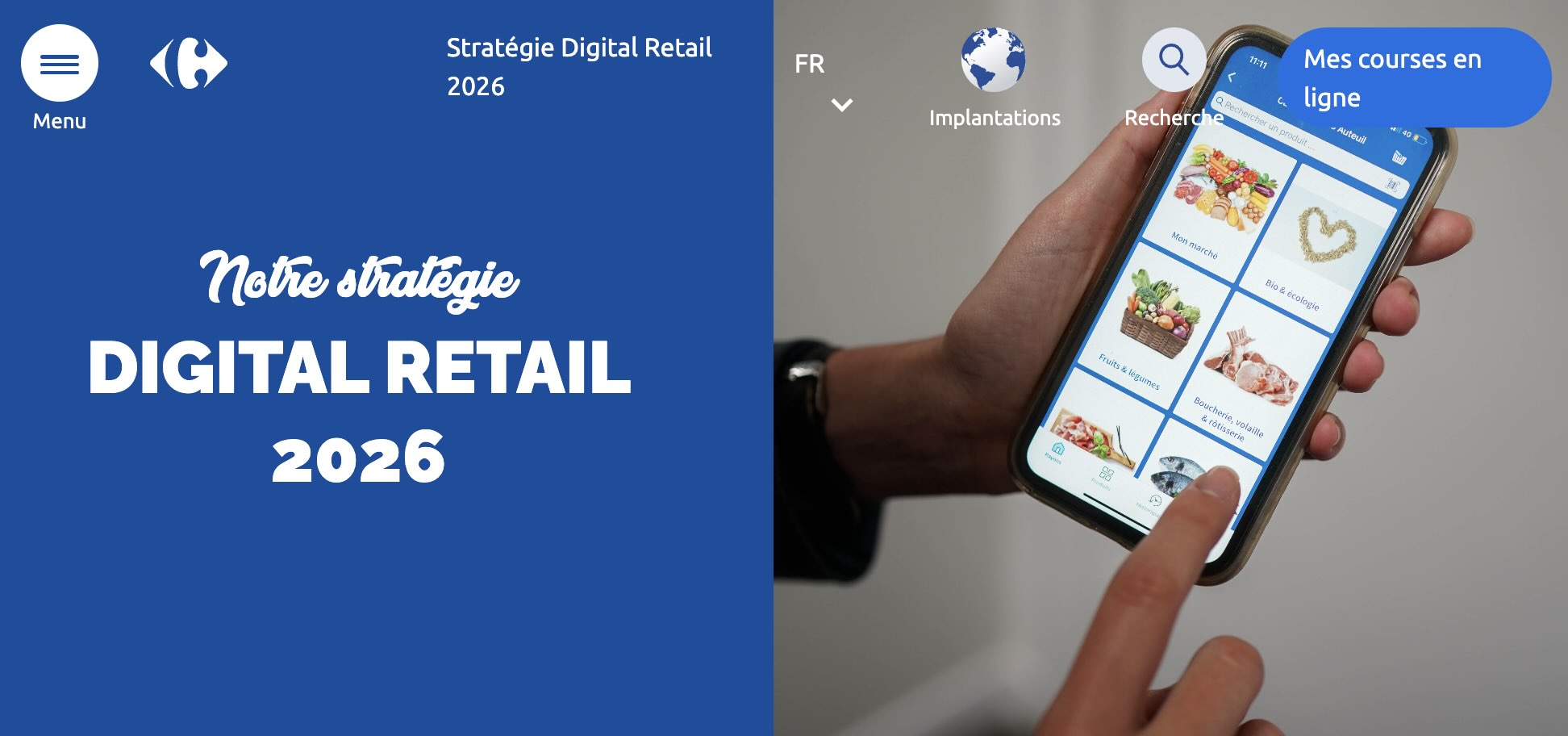
Like the French retail giant, many chains are developing omnichannel commerce, trying to make physical and digital commerce converge. Click and collect is a quite symbolic method of digitalization in the mass retail sector.
Customer knowledge is at the heart of these strategies, with the major challenge of capitalizing on the data stored by various web applications, PoS software in points of sale, or loyalty cards—an area in which Carrefour also has strong ambitions in 2025, with a new loyalty card operating across its entire network.
Carrefour thus presents itself as a pioneer in the digitalization of retail with two other notable achievements to its credit:
Carrefour Links: a data and retail media platform designed to enable the chain's brands and partners to use customer data effectively, to better target their advertising campaigns and optimize their performance in points of sale;
Digital transformation: moving the chain's internal tools to the cloud, allowing the group to manage its retail marketing more effectively: time-to-market, pricing, assortment construction, and activity forecasting.
But not everyone is Carrefour, and you might be looking for more classic techniques to set up—or consolidate—your retail marketing.
Sidely has therefore put together a list of best practices to boost the marketing of your points of sale!
10 best practices in retail marketing
Here are 10 best practices in retail marketing to maximize your performance in points of sale and build customer loyalty:
1. Offer a seamless, omnichannel customer experience
Ensure continuity between online and in-store experiences. Offer features like click-and-collect, mobile payment, or real-time inventory checking.
2. Leverage customer data
Analyze purchasing behavior to personalize your offers. Use a CRM to collect and segment data, which will allow for targeted and adapted promotions.
3. Optimize merchandising
Take care of the layout of the point of sale: group complementary products, use attractive colors and lighting, and highlight new products or promotions in strategic places. Optimizing the customer journey makes it possible to increase the average cart by encouraging impulse purchases. You must also build an assortment consistent with the point of sale's clientele and its catchment area.
💡Discover our thematic resources:
4. Offer relevant promotions and deals
Create promotional campaigns that meet the expectations of your target segments. For example, discounts on seasonal products or promotions linked to local events.
⚠️ However, avoid the trap of perpetual promotion, which harms brand image and seasonal peaks;
5. Encourage loyalty with adapted programs
Set up simple and engaging loyalty programs. Offer clear benefits, such as discounts or exclusive access for regular customers.
6. Train your store teams
Your employees are your best ambassadors. Invest in training to improve reception, product knowledge, and handling of objections. Support and sales techniques must be aligned with the chain's guidelines.
7. Focus on point-of-sale dramatization
Organize animations or demonstrations to capture customers' attention. This makes the buying experience more memorable and encourages interaction with your products. The window display deserves special attention and remains an irreplaceable tool for attracting customers.
8. Integrate digital in-store
Install interactive kiosks, QR codes, or digital screens to enrich the customer experience. These tools provide access to additional information or allow online ordering directly from the store.
9. Create a strong brand identity
Develop a recognizable and differentiating brand image. Highlight your values, whether eco-responsibility, innovation, or quality, to strengthen the emotional attachment of your customers.
10. Measure and analyze your results
Track key indicators like sales per sq. m, conversion rate, or average cart size. This data allows you to adjust your actions based on the results obtained.
💡 Measure your brand's performance in points of sale with the Sidely CRM.
Need a helping hand to be able to track your sales performance? That's great, we have also prepared a list of useful KPIs for you!
Performance indicators in distribution
Retail marketing performance indicators (KPIs) measure the effectiveness of actions and adjust strategies to achieve business goals.
Here are the main KPIs used in distribution:
Indicator | Description | Formula or Calculation Method | Analysis / Utility |
|---|---|---|---|
Sales revenue (turnover) | Total sales amount generated over a given period. | Total sales | Track revenue trends and identify global trends. |
Conversion rate | Ability to turn visitors into buyers. | (Number of purchases / Number of visitors) × 100 | Diagnose layout, pricing, or customer experience issues. |
Average cart | Average amount spent per transaction. | Sales revenue / Number of transactions | Evaluate cross-selling and up-selling strategies. |
Purchase frequency | Average number of purchases per customer over a given period. | Number of purchases per customer / Period | Identify regular customers and optimize loyalty building actions. |
Loyalty rate | Percentage of customers who have made multiple purchases. | (Number of loyal customers / Total number of customers) × 100 | Measure customer satisfaction and engagement. |
Out-of-stock rate | Percentage of products unavailable on shelves. | (Number of unavailable items / Total number of items) × 100 | Reduce sales losses and improve brand image. |
Gross margin rate | Profitability of sales. | [(Revenue - Cost of goods sold) / Revenue] × 100 | Verify that sold products generate sufficient margin. |
Customer satisfaction rate (NPS) | Probability that customers will recommend the point of sale. | Calculated from customer survey responses | Identify strengths and weaknesses of the customer experience. |
Numeric distribution | Proportion of points of sale where a product is listed. | (Number of stores with the product / Total number of stores) × 100 | Evaluate product coverage and adjust distribution strategy. |
Sell-out (checkout sales) | Actual sales of a product to consumers in store. | Volume or value of products purchased | Measure the effectiveness of promotions or product popularity. |
All that's left is to wish you good sales thanks to top-flight retail marketing!
Margot has been working in Tech and SaaS for 8 years, with a multi-product experience that has given her a unique understanding of business challenges. On a daily basis, she analyzes, relentlessly tests, and relies on facts to shed light on market trends and help sales teams move forward.
See also

Artificial intelligence and field professions: what our 2026 studies reveal
Adoption, barriers, use cases: discover what our three studies reveal about the role of AI among sector managers, sales representatives, and foodservice sales reps.

CHR and RHF Sales Representatives: portrait of a relationship-driven profession in the era of data
Equipment, productivity, AI: discover the major trends for the HORECA and food service sales profession in 2026 through our field study.

Pharmaceutical Sales Representative in France: Portrait of a Field Job Under Pressure
Compensation, aspirations, AI usage: discover the major trends in the pharmaceutical sales representative profession in 2026 through our field study.

Area Sales Managers in France: who are they and how is the profession evolving in 2026?
Compensation, aspirations, AI usage: discover the major trends in the field sales representative profession in 2026 through our field study.
The area manager professions in 2026
Discover the trends, the challenges, and the key figures.