
Sales Intelligence: Definition, Challenges, and Tools for Better Strategy Management
Knowing is good. Making the right decision at the right time is better. Discover how AI leverages field data to manage your business differently.

In short
8 min read
Sales intelligence transforms raw data (sales, market, field) into actionable insights to guide operational decision-making.
Unlike BI (a global vision of the company) or competitive intelligence (monitoring the external environment), sales intelligence focuses specifically on optimizing sales performance.
The field is a crucial source of data: sales representatives daily collect vital information on competition, product availability, and the effectiveness of in-store promotions.
Structuring collection through standardized forms is essential for transforming often scattered information into comparable and actionable data.
Sales intelligence makes it possible to prioritize sales actions where the impact is greatest, thus avoiding the waste of resources on low-potential points of sale.
It facilitates increased responsiveness to operational problems, such as stockouts, listing issues, or promotional failures.
Management becomes based on concrete facts rather than intuition, fostering better collective dynamics and informed strategic decision-making.
Today, companies have a significant amount of data at their disposal: sales, customers, markets, commercial visits... Yet, this information is often scattered and difficult to utilize.
This is precisely the role of commercial intelligence: transforming this data into useful information to guide commercial decisions.
For manufacturers and brands that rely on field sales teams, this challenge is even more crucial. Every day, sales representatives collect valuable information during their visits: product availability, competitor actions, distributor feedback, or promotion effectiveness.
In this article, we will look at what commercial intelligence is, why it is becoming essential for companies, and how to concretely exploit field data to better steer sales activity.
What is commercial intelligence?
Definition of commercial intelligence
Commercial intelligence refers to all the methods, tools, and data used by a company to better understand its market, customers, and sales performance in order to make more relevant sales decisions.
It relies on the collection, analysis, and utilization of commercial information from various sources: sales data, customer interactions, market data, competitor information, or feedback from field teams.
The goal of commercial intelligence is to transform this data into actionable insights, making it possible, for example, to:
better target high-potential prospects or points of sale,
identify commercial opportunities,
prioritize the actions of sales teams,
adapt the commercial strategy based on market developments.
In this context, commercial intelligence is not limited to data analysis. It primarily aims to connect information to action, helping companies steer their commercial activity more effectively and improve their sales performance.
In organizations with field sales teams, commercial intelligence also relies on exploiting data collected during commercial visits: in-store observations, competitor information, product availability, or customer feedback. Once structured and analyzed, this information allows for more precise commercial decision-making and tailored field actions.
What is the difference between commercial intelligence, business intelligence, and sales intelligence?
To fully understand the difference between commercial intelligence, business intelligence, and sales intelligence, it is necessary to define these three concepts. Although they are close and sometimes used interchangeably, they do not meet the exact same objectives within the company.
Commercial Intelligence
Commercial intelligence refers to the methods, data, and tools used to improve the performance of sales activities. It consists of collecting and analyzing information related to customers, prospects, commercial interactions, and sales performance to guide commercial decisions.
The goal of commercial intelligence is to help sales teams and managers answer operational questions such as:
which accounts or points of sale should be prioritized,
which opportunities present the highest potential,
which commercial actions generate the best results.
Commercial intelligence is therefore directly focused on improving commercial performance and operational decision-making. It helps to create a collective commercial and dynamic culture.
Business Intelligence
Business intelligence (BI) refers to the technologies and methods that allow for collecting, structuring, and analyzing a company's data to produce steering indicators.
BI typically relies on data analysis and visualization tools that allow for the creation of dashboards, reports, and performance indicators.
Unlike commercial intelligence, business intelligence is not limited to the sales department. It covers all company functions, for example:
finance,
marketing,
production,
logistics,
human resources.
BI thus makes it possible to steer the overall performance of the company based on consolidated data.
Sales Intelligence
Sales intelligence consists of monitoring and analyzing information related to a company's commercial environment in order to anticipate market developments and identify opportunities.
It relies mainly on the collection of external information, such as:
competitors' actions and strategies,
market trends,
regulatory developments,
innovations in an industry sector.
Sales intelligence thus helps the company to anticipate changes in its environment and adapt its commercial strategy.
The main differences between these three concepts
The main difference between these approaches lies in their scope and purpose.
Commercial intelligence is focused on sales optimization and decision support for sales teams. It primarily uses data related to customers, prospects, and sales activities.
Business intelligence has a broader scope. It allows for analyzing data from across the entire company to produce steering indicators and facilitate strategic decisions.
Sales intelligence, on the other hand, focuses on analyzing the external environment: market, competitors, and industry trends.
In other words:
sales intelligence observes the environment and market signals,
business intelligence analyzes the company's internal data,
commercial intelligence combines this information to guide concrete commercial actions.
These three approaches are complementary. Together, they enable companies to better understand their environment, exploit their data, and steer their commercial strategy more effectively.
Why commercial intelligence is becoming essential for companies
For manufacturers and brands with field sales teams, commercial intelligence has become essential for a simple reason: the market is complex, and commercial decisions can no longer rely solely on intuition.
Field teams visit dozens, sometimes hundreds, of points of sale. They negotiate with department managers, observe competition, monitor promotions, take orders, and report product information. Every visit generates useful data.
Without a structured approach to commercial intelligence, this information remains scattered and is rarely exploited to its full potential.
Understanding what is really happening in the field
For a brand that sells its products in major retail, food service (CHR), or other distribution networks, market reality plays out in the points of sale, which only field sales teams can observe.
Commercial intelligence allows for centralizing this information and obtaining a clear vision of what is actually happening in the field.
Better prioritizing commercial actions
Field teams cannot visit all points of sale with the same frequency. Brands must therefore make choices: which stores to visit first? Where to focus sales efforts? Which customers to develop as a priority?
By analyzing sales data (sales, potential, history of visits, promotional performance), commercial intelligence allows for prioritizing actions where the commercial impact is greatest.
This prevents, for example:
visiting low-potential points of sale too often
neglecting stores that could generate more sales
missing out on certain development opportunities
Quickly identifying commercial issues
In distribution networks, issues can arise quickly: an out-of-stock situation, a delisted product, a poorly implemented promotion, or more aggressive competition.
When field rep feedback is structured and analyzed, the company can detect these issues earlier and react faster, such as:
correcting a distribution issue
re-engaging a point of sale
adjusting a promotional strategy
supporting a product losing visibility
tracking and recovering lost revenue
Helping managers steer sales teams
For sales directors or regional managers, commercial intelligence also allows for better team steering. Thanks to data collected in the field, they can understand:
how sales representatives organize their visits
what actions are actually carried out in stores
what results are achieved
This allows for moving from management based on impressions to steering based on concrete data.
Transforming field observations into strategic decisions
Finally, commercial intelligence allows for transforming information collected during visits into useful decisions for the company.
Field data can, for example, reveal:
rapidly growing product categories
under-exploited geographic areas
more effective promotional formats
specific expectations of distributors
In other words, the information sent back by sales teams becomes a strategic source for guiding marketing, commercial, and sometimes even product decisions.
📌 A strategic resource that is often under-exploited
In many companies, sales representatives report back a huge amount of information, but it remains underutilized because it is not structured or analyzed.
Commercial intelligence is precisely what gives value to this information and transforms field observations into a real tool for steering commercial activity.
For brands and manufacturers that rely on field teams, it therefore becomes an essential lever for better understanding the market, organizing commercial actions, and improving sales performance.
What data feeds commercial intelligence?
Here is the main data that feeds commercial intelligence, particularly for manufacturers and brands with field sales teams.
Internal company data
Sales data
Sales data corresponds to all information related to completed transactions: volumes sold, revenue, sell-in, sell-out, number of orders, purchase frequency, sales trends over time...
This data helps to understand which products sell best, in which stores, and during which periods.
For manufacturers and brands, this data is essential for tracking commercial performance and guiding strategic decisions, such as reinforcing a product's presence in certain stores or adjusting a promotional policy.
Customer and point of sale data
Customer and store data groups information related to the accounts managed by the company: contact details, customer type, commercial potential, history of interactions, or segmentation.
In the case of a brand selling through a retail network, this data often concerns points of sale: retailers, store size, location, product categories sold, or estimated potential.
This information allows sales teams to better target their actions, adapt their sales pitch, and prioritize high-potential clients.
History of commercial interactions
The interaction history groups all information related to exchanges between the company and its clients: sales visits, calls, negotiations, sales proposals, or actions taken in-store.
This information helps to understand the context of the business relationship and avoid information loss between different points of contact.
It is particularly useful for tracking the progress of negotiations, preparing sales visits, and maintaining a consistent customer relationship over time.
Data collected by field forces
Commercial visit data
Visit data corresponds to information collected by sales reps during their store visits: point of sale qualification, product presence, shelf position, stock availability, promotional activities, feedback from store managers...
This data is particularly valuable because it provides a concrete view of the local situation in the field, which is often different from what sales figures show.
Merchandising and shelf presence data
This data concerns the visibility of products in points of sale: shelf share, shelf location, back-bar placement, menu placement, number of facings, presence of POS displays, theatricalization, or compliance with negotiated agreements.
It allows for an understanding of how products are actually presented to consumers and evaluates whether corporate commercial agreements are correctly applied in-store. This information is essential for brands present in retail, as visibility directly influences sales.
Promotional data
Promotional data groups information related to marketing operations implemented in points of sale: promotions, endcap displays, commercial activations, targeted happy hours...
It allows for measuring the effectiveness of promotional activities and understanding which operations genuinely generate additional sales.
This data helps sales and marketing teams to adjust their promotional strategies and duplicate the highest-performing actions.
Competitor information
Competitor data corresponds to information about competing products, their prices, their shelf presence, or their promotional actions. This information allows brands to understand how they position themselves against their competitors and adapt their commercial strategy.
Field teams often play a key role in raising this information, as they directly observe competitor actions in-store.
External company data
Data from retailer data sharing
Data sharing data corresponds to information that certain distributors share directly with their suppliers. This data generally comes from POS (point of sale) cash register systems or the distributor's internal tools.
This data gives brands a very precise view of the actual performance of their products at the retailer. They know exactly what was sold.
It is particularly useful for:
analyzing sales store by store
tracking promotion effectiveness
detecting out-of-stock situations
understanding product rotation
For field sales teams, this information also helps to prepare commercial visits with concrete data on store performance.
Data from retailer and consumer panels
Panel data is provided by specialized institutes that analyze sales and consumer behavior on a large scale. The most well-known players include NielsenIQ, Circana, and Kantar.
There are generally two types of panels: retailer panels and consumer panels.
Retailer panels measure sales made in the stores of a network or a group of distributors. They allow brands to compare their performance with that of the market and their competitors.
Consumer panels analyze purchase behaviors of households: who buys, how often, in which stores, and which products. For marketing and sales teams, this information helps guide development strategies and better target consumer segments.
📌 Why is this data important for commercial intelligence?
Commercial intelligence relies on combining several types of data:
- internal data, from CRM or sales
- external data, related to the market or competition
- field data, collected directly by sales teams
It is the combination of these different information sources that allows companies to better understand their commercial environment and make more relevant decisions.
How to transform field data into useful commercial decisions
The problem is rarely the amount of information in the CRM, but rather that this information is poorly structured, and therefore under-exploited.
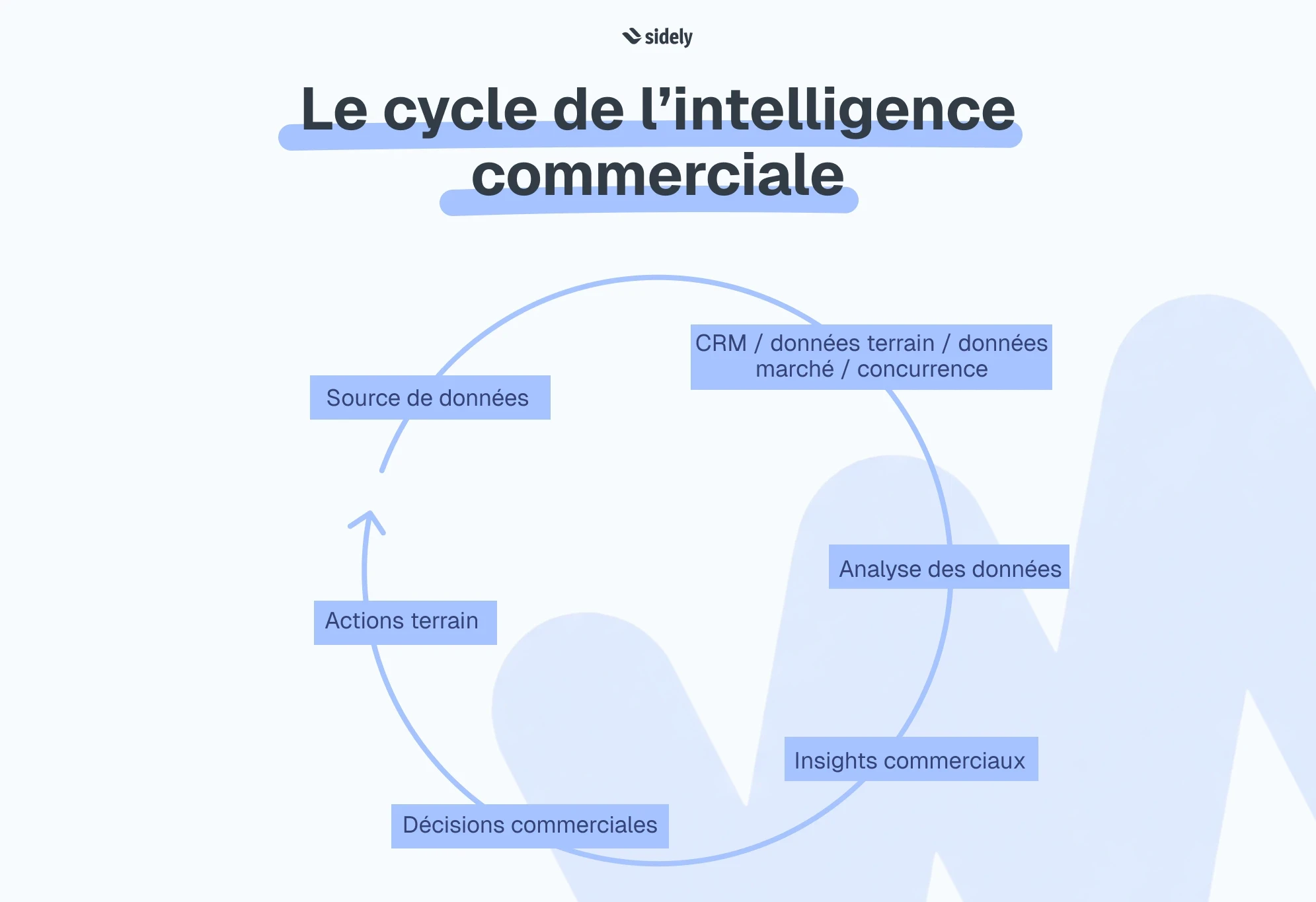
Transforming field data into commercial decisions therefore consists of following three simple steps: structuring the collection, analyzing the data, and using it to guide commercial actions.
Step 1: Structure data collection
Before analyzing field information, you must ensure that sales reps report comparable and usable data.
The goal is therefore to structure what is collected during visits.
Standardize the collected information
The first step is to define the key information that sales reps must record during their visits: what do you want to know? What is the essential information your sales force must report based on the set objectives?
This information must be the same for all sales reps to compare data across stores or geographic areas.
Use structured surveys
To facilitate information collection, it is preferable to use structured visit forms rather than free-text reports.
This makes it possible to report information quickly and, above all, to analyze it automatically afterward.
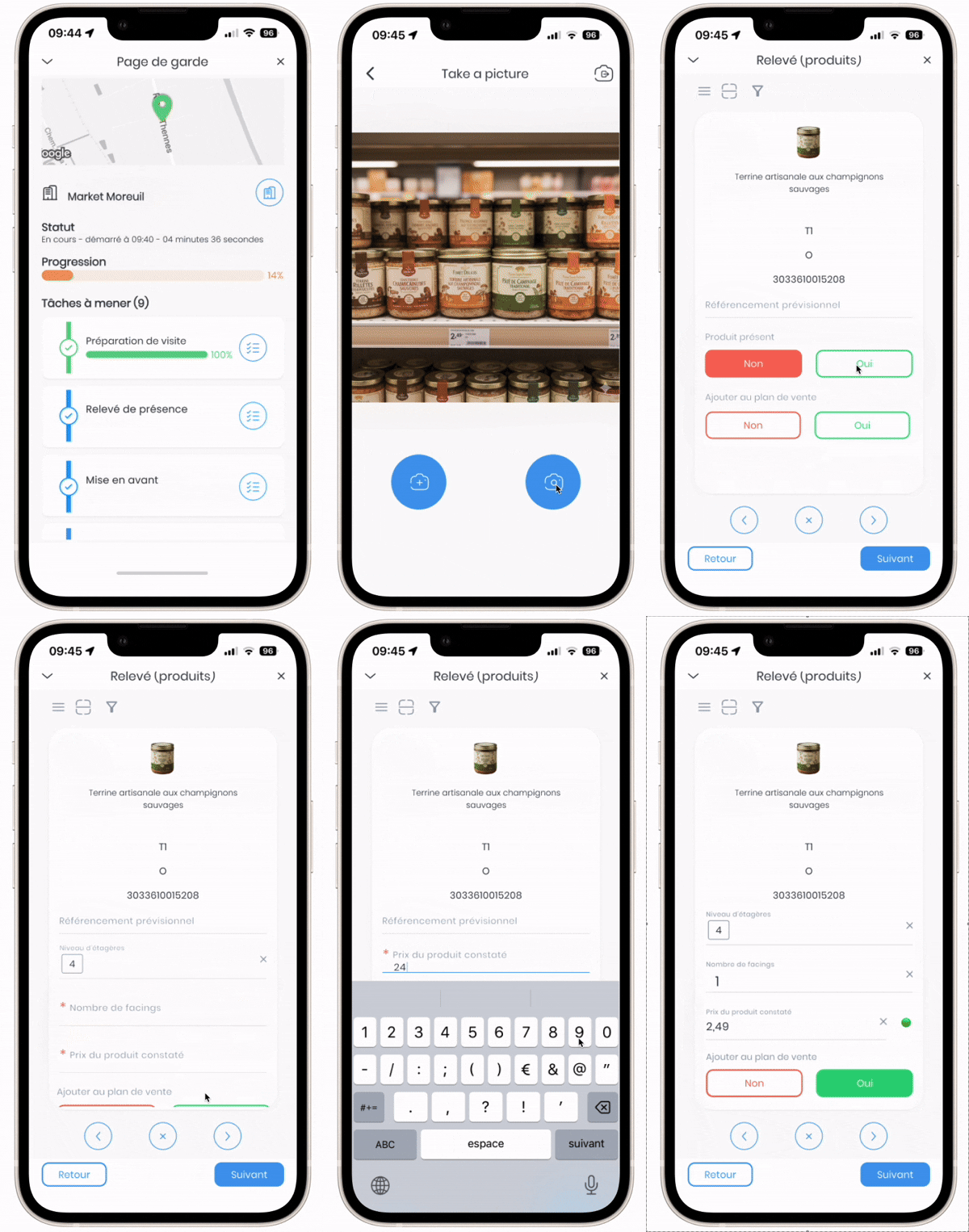
Example of a structured survey
Step 2: Analyze data to detect opportunities
Once field data is centralized, it can be used to identify situations requiring commercial action.
The goal is not to produce complex reports, but to spot useful signals to guide sales teams.
Identify high-potential stores
By cross-referencing visit data with sales or distribution data, it is possible to identify stores where the brand is under-exploited.
For example:
a store with high sales volume in the category but few products from the brand
a store rarely visited despite a high potential
a point of sale where products are poorly positioned
This information allows for directing sales representatives to points of sale where action can genuinely generate additional sales.
Spot stockouts or distribution issues
Field data also allows for quickly detecting issues that impact sales.
For example:
a product regularly missing from shelves
a non-compliant product listing
an un-implemented promotion
poor product visibility
By centralizing this information, the company can identify recurring issues and act quickly.
Measure the impact of commercial actions
Field data also allows for evaluating the effectiveness of actions carried out by sales teams.
For example:
stores where a display placement was obtained
points of sale where a promo was set up
stores where a new display layout was negotiated
By comparing these actions with sales, it becomes possible to understand which commercial actions actually generate results.
Step 3: Transform insights into commercial decisions
The final step is to use this information to concretely guide commercial actions.
Prioritize sales visits
Field data makes it possible to identify stores that require rapid intervention.
For example:
stores with out-of-stocks
points of sale with high untapped potential
stores where promotions are not implemented
This information can be used to adjust sales routes and focus visits where they will have the greatest impact.
Adjust the commercial strategy
The analysis of field data can also highlight useful trends for the commercial strategy.
For example:
certain categories perform better in certain areas
certain promotional formats are more effective
certain distributors poorly apply negotiated agreements
This information allows for adapting commercial negotiations or the development strategy.
Optimize marketing and promotional actions
Field data is also useful for improving marketing efforts.
In particular, it helps to understand:
if promotions are actually being set up
if products benefit from sufficient visibility
if marketing collateral is being used in-store
This information helps marketing teams design more effective campaigns that are better adapted to field reality.
Tools used to develop commercial intelligence
Tool Type | Role in Commercial Intelligence | What the tool realistically does |
|---|---|---|
CRM (Customer Relationship Management) | Centralize and structure commercial data | Store customer info, track business interactions, log field visits, keep history of sales actions, and offer a usable database to drive commercial activity. |
Data analysis & data visualization tools | Analyze sales performance and track key KPIs | Create commercial dashboards, monitor sales trends, analyze performance by area, product or client, identify trends, and quickly spot performance gaps. |
Sales intelligence tools | Enrich commercial data and detect opportunities | Merge external data with internal databases (decision-maker contacts, company insights, buying intent indicators) and target high-potential accounts or prospects. |
AI tools applied to sales (Artificial Intelligence) | Automate data analysis and deliver recommendations | Parse through massive data volumes, uncover growth opportunities, forecast sales, suggest commercial priorities, or recommend next actions for sales teams. |
It was by observing the still-fledgling digitalization of sales forces that Arthur envisioned Sidely. A graduate of EM Lyon and Le Wagon, he combines a rare commercial rigor with a true product culture. This dual expertise allows him to decipher the shifts in the profession and build a product that truly speaks to sales teams.
See also

Artificial intelligence and field professions: what our 2026 studies reveal
Adoption, barriers, use cases: discover what our three studies reveal about the role of AI among sector managers, sales representatives, and foodservice sales reps.

CHR and RHF Sales Representatives: portrait of a relationship-driven profession in the era of data
Equipment, productivity, AI: discover the major trends for the HORECA and food service sales profession in 2026 through our field study.

Pharmaceutical Sales Representative in France: Portrait of a Field Job Under Pressure
Compensation, aspirations, AI usage: discover the major trends in the pharmaceutical sales representative profession in 2026 through our field study.

Area Sales Managers in France: who are they and how is the profession evolving in 2026?
Compensation, aspirations, AI usage: discover the major trends in the field sales representative profession in 2026 through our field study.
The area manager professions in 2026
Discover the trends, the challenges, and the key figures.