

Parapharmacy: a sector between growth and transformation
An in-depth reading to understand all the challenges of the sector: key players, market and distribution organization, key figures, and trends.

In short
15 min read
The parapharmacy sector is experiencing strong growth, driven by the enthusiasm for well-being, natural products, and organic goods.
Unlike medicines, parapharmacy products are not reimbursable and are not subject to the pharmaceutical monopoly.
Distribution is extremely varied, including pharmacies, specialized parapharmacies, e-commerce, and supermarkets.
Physical pharmacies still dominate the market (80% of sales) thanks to the trust placed in pharmacists.
E-commerce is the most dynamic channel, encouraging the emergence of pure players and hybrid models such as "phygital".
Sociocultural developments, particularly the questioning of gender stereotypes, now influence brands' marketing strategies.
The parapharmacy sector is experiencing significant growth, but also profound transformations. Made up of a highly diversified fabric of players, it can be difficult to understand this very specific market.
In this article, Sidely offers you an overview of everything you need to know and understand to grasp the parapharmacy sector.
On the menu for this long format:
Definitions and products concerned;
Manufacturers and laboratories;
Distribution channel;
Categories of parapharmacies;
Key figures and trends;
E-Parapharmacy;
Socio-cultural changes.
Immediate boarding!
What is parapharmacy?
Born in the 1980s, parapharmacy encompasses care, beauty, and well-being products, which are not categorized as medicines.
Pharmacies can sell these products over-the-counter, in addition to the medicines that they alone have the right to distribute, under the pharmacy monopoly. To delve deeper into this subject, discover the main differences between pharmacy and parapharmacy.
Parapharmacies (retail stores) therefore do not have the right to sell medicines. They focus on the sale of products without therapeutic or medical properties, such as hygiene, beauty, and dietetic products, food supplements, veterinary products, or medical equipment such as blood pressure monitors or thermometers.
Driven by e-commerce and the absence of regulation regarding commercial locations, parapharmacy allows consumers to obtain beauty and care products without a medical prescription. On the other hand, reimbursement mechanisms are dedicated to medicines, and parapharmacy products are not reimbursable by health insurance.
A product is considered a medicine if it is intended to treat, prevent, or diagnose a specific disease or health disorder. Commercialization follows an evaluation and authorization process (MA), guaranteeing their safety, efficacy, and quality.
Parapharmacy products, intended solely for well-being, beauty, or personal care purposes without claiming to treat diseases, are not classified as medicines.
Products in the “parapharmacy” category
Parapharmacy covers many products, in fields as varied as cosmetics, hygiene, food supplements, dietetics, and childcare. There is something for all ages, from infants to seniors.
Here is a non-exhaustive list:
Cosmetics: moisturizing creams, anti-aging serums, perfumes, ointments, makeup;
Hygiene products: shower gels, toothbrushes, soaps, toothpastes, deodorants;
Food supplements: vitamins, minerals, probiotics;
Dietetic products: gluten-free foods, protein bars;
Health equipment: blood pressure monitors, thermometers, scales;
Childcare products: infant milk, diapers, baby care;
Veterinary products: pet food, pest control;
Natural health products: essential oils, herbal teas, plant extracts;
Accessories: gloves, sanitary masks;
Beauty accessories: makeup brushes, sponges, hairbrushes;
Devices and self-tests: glucometers, pregnancy self-tests, cholesterol tests.
Manufacturers and industrial players: varied profiles
The parapharmaceutical industry is largely driven by pharmaceutical laboratories, which also develop non-medicinal ranges, like French or international leaders such as Sanofi, Johnson & Johnson, or Pierre Fabre.
But the growing passion of French people for self-medication, products associated with well-being, beauty, or “natural” virtues has also given rise to a multitude of “small” brands, such as BabyBio, Les petits culottés, or Respire, as shown by online sales platforms dedicated to parapharmacy.
The lack of regulation regarding the term parapharmacy thus makes it easier to market products with more or less proven effects. However, it would be a mistake to imagine that these brands not affiliated with pharmaceutical laboratories remain confidential or local.
For example, La Rosée, born in 2015, is among the best-selling dermo-cosmetic brands in pharmacies, with a turnover exceeding 70 million euros. The Lyon-based brand owes its success to a substantial field commercial system and outstanding marketing efficiency on social networks.
Ultimately, the diversity of products that can join the large family of parapharmacy (and particularly in its organic and natural dimension) makes it complex to understand, and it is difficult to estimate the size of this market, whose distribution can extend to supermarkets!
Distribution channels in parapharmacy
Parapharmacy is a very unique market due to the number and variety of distribution channels that brands can use.
Let's take the example of skin care products (skincare). These can be purchased through the following channels:
Community pharmacies;
Physical parapharmacies;
Parapharmaceutical e-commerce (e.g. DocMorris, Easypara);
Supermarkets and hypermarkets (e.g. Carrefour, Leclerc);
Beauty and well-being boutiques (e.g. Parashop, Monoprix Beauté);
Perfumeries and cosmetic shops;
Online marketplaces (e.g. Amazon, Cdiscount);
Natural products stores etc.
Although brands and points of sale select products meeting a well-studied marketing positioning (ranges, price, image, etc.), some mainstream brands can offer their products through a very extensive network, allowing them to reach an extremely broad public, and sometimes target different population segments by playing on the specificities of each channel.
The diversity of distribution channels, and the advantages and disadvantages associated with each, lead pharmaceutical laboratories to choose a specific distribution method, in order to address their market under optimal conditions, both in terms of targeting, image, and logistics.
Ultimately, many players can position themselves between the manufacturer and the consumer. We can talk about:
Direct channel: the manufacturer sells directly to consumers via an online sales site.
Short indirect channel: the manufacturer distributes via pharmacies and parapharmacies;
Long indirect channel: the manufacturer sells its products to a wholesaler, who supplies pharmacies, parapharmacies, or even specialized online platforms.
The short channel is preferred for its ability to protect the manufacturer's profit margins.
The long channel is more compatible with achieving large volumes, favored by wholesalers. Appealing to intermediaries thus allows large quantities of products to be sold (sell-in) and often to deploy across the national territory more rapidly.
But then it becomes much more complicated to control one's image in the points of sale, to obtain cash register exit data (sell-out), and to control the listing and visibility of products. This is why laboratories have no choice but to send pharmaceutical sales representatives to each point of sale to monitor merchandising.
Using a pharmaceutical merchandising audit application then proves crucial to maximize the ROI of field visits.
Categories and economic models of parapharmacies
There are approximately 3,600 parapharmacies (points of sale) nationwide. These are divided into different categories: integrated, independent, and franchised, to which we can add the category of e-parapharmacies.
Model | Examples | Description |
|---|---|---|
Integrated parapharmacies | Leclerc, Carrefour, Monoprix | Parapharmacies attached to large supermarkets or pharmacy groups, benefiting from strong visibility and high foot traffic. |
Independent parapharmacies | Pharmacie Lafayette, Parapharma+ | Autonomous, smaller-sized points of sale, offering more selective products and flexible relationships with brands. |
Franchised parapharmacies | Parashop, Univers Pharmacie | Franchised points of sale allowing entrepreneurs to benefit from a recognized brand and marketing and logistical support. |
Online parapharmacies | Doctipharma, Easyparapharmacie | Online sale of parapharmaceutical products, offering competitive prices and a wide choice accessible to a national or international audience. |
This division is, however, quite simplistic, particularly because physical players can also develop their online sales platforms, notably major brands via drive-through services.
Furthermore, brands and laboratories also use major online sales sites to offer their products to benefit from optimal visibility, without having to manage it all themselves.
Just like pharmacies, parapharmacies can try to increase their margins by lowering their purchasing costs through the establishment of dedicated purchasing structures. These can be purchasing groups, central buying offices, professional associations or cooperatives, shared labels or private labels, and of course integrated networks (excluding franchises), in which case they are literally subsidiary companies.
It is therefore a multifaceted market with players of very diverse sizes - but also natures.
Creators must choose from these three models, and the decision has a significant impact on the management of their capital, their freedom of governance, or their choice of suppliers. The table below summarizes the most important aspects to consider when deciding to become independent, franchised, or integrated.
Criteria | Independent | Franchised | Integrated |
|---|---|---|---|
Ownership | Individual owner | Franchisor with franchisees (independent managers) | Group, brand, chain |
Know-how | Autonomy in acquiring skills | Transfer of know-how from franchisor to franchisee | Standardized, with internal training |
Assortment decision | Total autonomy | Often a standardized range or franchisor recommendations, centralized promotions. | Centralized at the group level |
Pricing | Total freedom | Partially or totally regulated by the franchisor | Defined by management |
Marketing | Independence, total responsibility | Benefits from network marketing campaigns | Centralized and consistent marketing management |
Inventory management | Autonomous, negotiates directly with suppliers | Semi-centralized with franchisor recommendations | Centralized and optimized on a large scale |
Royalties | None, profits fully retained | Royalties to be paid to the franchisor (fixed amount or percentage of turnover) | No royalty (internal cost) |
Flexibility | Very flexible | According to the clauses of the franchise agreement and the franchisor's standards | Very limited (following group guidelines) |
Key figures and trends in the sector
Each French person spends an average of more than 210 euros per year on parapharmacy products. Born in the 1980s, this rapidly growing market is whetting the appetite of both manufacturers and distributors.
General growth of the sector
The turnover of parapharmacy in France is difficult to assess, and varies according to sources between 4 and 6 billion euros in 2023 (according to Xerfi). The market is growing much faster than that of medicines, with a growth of 5% compared to the previous year.
Parapharmacy is benefiting from a growing demand for health and beauty products, especially natural and organic ones. The market is notably driven by the essential segment of skincare: the sale of cosmetic products in pharmacies and parapharmacies actually grew by 14% to reach 2.1 billion euros, according to the GERS 2023 study – sell-out data.
Food supplements also show rising figures, in the range of 9% in pharmacies and 4% in parapharmacies, according to Smart RX. Nuxe, La Roche Posay, or even Bioderma, are among the big winners of this growth in self-medication and well-being!
E-commerce was boosted by the Covid effect, contributing to this strong performance of the sector.
Cocorico
France is world-famous for its quality skincare products. One only has to count the number of recognized French players, such as Avène, Pierre Fabre, Bioderma, or La Roche-Posay, to be convinced. And, while their consumption is relatively commonplace in France, they are sometimes snapped up at high prices abroad. Witness the rush on parapharmacies during the 2024 Olympic Games!
The weight of traditional pharmacies
However, physical pharmacies still dominate the market with nearly 80% of sales. A market share that contrasts with the stagnation of their overall activity. The number of community pharmacies has actually dropped from 24,000 to 22,000 in five years, and the sector is facing serious difficulties in recruitment.
But this does not prevent pharmacists from capturing the largest part of the parapharmacy turnover, for two main reasons: French people trust their pharmacist for health advice, and the pharmacy remains an obligatory stop to obtain prescription medicines.
This is why pharmaceutical merchandising remains a major concern for laboratories, always seeking commercial performance in these highly strategic points of sale.
Parapharmacies face multifaceted competition
Faced with pharmacies, there are no more than 3,600 physical parapharmacies in France. But, despite their small number, they nevertheless manage to capture 18% of the market, a very clear progression, since this market share was around 5% in 2021. Note that large retailers such as Carrefour and Leclerc account for 10% of total turnover, thanks to their various corners and shop-in-shops.
Finally, the leadership of pharmacies and competition from pure players like Amazon and online sales platforms make small parapharmacies the most vulnerable players during periods of market tightening.
This is why starting a parapharmacy is not always... a walk in the park. Therefore, many entrepreneurs opt for the franchise formula. For an investment and generally an entry fee (the total usually represents between 100,000 and 150,000 euros), this affiliation allows them to benefit from the marketing resources and support of recognized and prosperous operators.
E-parapharmacy: a rapidly changing market
Online sales: the new El Dorado for parapharmacy brands?
Although it still remains a minority in the sector's overall turnover, e-parapharmacy is the channel experiencing the strongest growth rate, and some of its players are becoming e-commerce giants. For example, Atida - better known under the name SantéDiscount - achieved a turnover of 67 million euros in 2023.
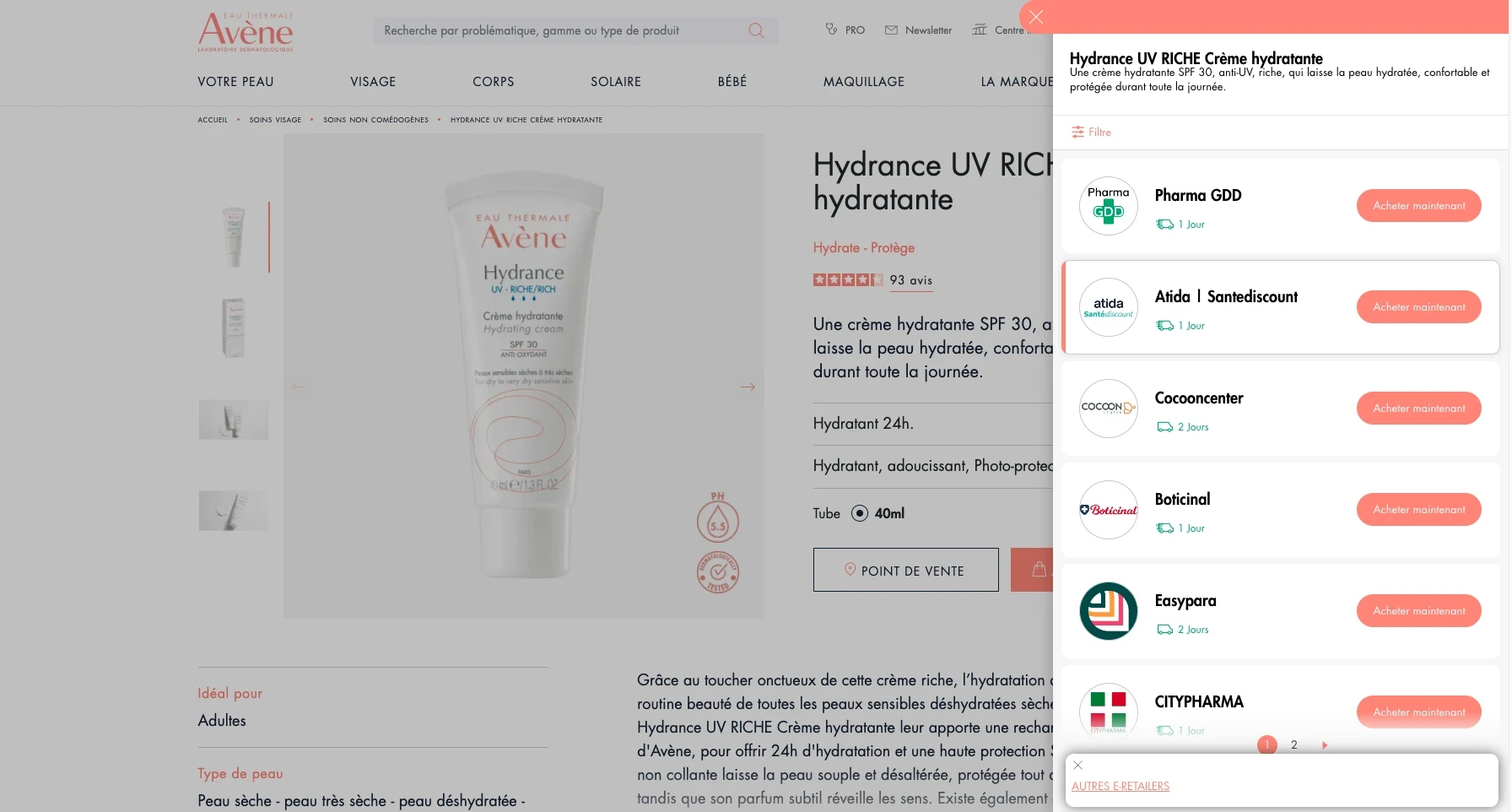
Let's also mention Doctipharma, Cocooncenter, Parashop.fr, or Easyparapharmacie and its explosive growth (a turnover that went from €17M in 2016 to €46M in 2021!). So many platforms that whet the appetite of brands, for various reasons, such as access to a wide audience, or compensating for low margins (related to competitive pressure) with larger sales volumes.
Furthermore, by distributing their products through all types of channels (supermarkets, specialized stores, e-commerce sites), laboratories manage to reach all categories of customers, so that every French person can find parapharmacy products in the physical or virtual shops that suit them. A winning flexibility!
Benefits for the consumer
Online sales offer real advantages compared to physical sales, particularly the ability to offer lower prices. Buying from home allows consumers to benefit from advantageous rates, but also to have time to compare prices.
Another notable advantage: unlike the assortment of a physical point of sale limited by its storage capacity and its preferred business partners, e-parapharmacy websites build almost unlimited assortments. For the consumer, it is the guarantee of being able to choose from tens of thousands of references, without brand or range restrictions.
Competition and sector transformation
But online parapharmacy sales are highly contested: the market is shared among several types of operators, including physical pharmacies, parapharmacies, supermarkets, as well as e-commerce pure players.
Furthermore, hybrid models are emerging, and could shape the future of this industry. Like Pharmazon, initially a supplier and central buying office for pharmacists, which now allows individuals to order online, and choose which pharmacist the money will be paid to. This model, which mixes online sales and physical distribution, signals a possible boom in "phygital" in the field of parapharmacy.
The development of click & collect and rapid delivery reinforce this trend toward the dematerialization of parapharmacy sales. Finally, regulatory flexibility makes sales possible on marketplaces such as Amazon or Cdiscount. We are far from being accompanied by a health professional!
A limited potential?
However, e-commerce is far from convincing everyone; 2 out of 3 French people have never used it for parapharmacy, and - above all - have no intention of changing their minds! Community pharmacies therefore still have a bright future ahead of them, and, as in many industries, online sales and physical points of sale can perfectly coexist in the long term.
It remains to be seen whether new generations will still be tempted to ask pharmacists for advice!
Reasons for this sustained growth
Many factors have allowed parapharmacy to experience such a marked success:
Enthusiastic support for well-being: well-being and beauty are becoming major issues for French people, particularly among the wealthy classes. Furthermore, gender barriers are fading and men are spending more and more on care and beauty products;
Profitability of pharmacies: parapharmacy allows pharmacists to increase their profitability, in comparison with medicines whose prices are set by the state;
Lenient legislation: unlike medicines, which are subject to very strict health and scientific checks, parapharmacy products find their way onto the market fairly easily, and no proof of tangible results is required;
Mass distribution: from specialized shops to supermarkets, including pharmacies and e-commerce, parapharmacy benefits from a globalized distribution network;
Easy advertising: industrial players face no barriers in advertising their products across all media and channels, (provided, of course, they do not violate ethical rules, such as the ban on misleading advertising).
h2 id="179">A market driven by socio-cultural changes
When natural rhymes with profits
Consumers are increasingly concerned about their health and appearance. The rise of "preventive health" thus encourages the purchase of care, beauty, and well-being products, such as food supplements, dermatological products, and cosmetics.
It is difficult to say whether laboratories are accompanying this change or creating it through the intensity of their marketing campaigns. But a growing number of French people have a positive view of alternative medicine and self-medication, particularly regarding natural and organic products.
And brands know how to market and monetize these natural benefits! Products conveying a premium image are increasingly favored by consumers anxious to take the greatest care of their body. And increased competition is pushing historical players to strengthen innovation in this direction.
Monoprix Beauté's strategy is an example of this, with an assortment that mixes major brands, niche products, and responsible or organic beauty products. The brand also highlights exclusive brands or those hard to find elsewhere, notably through limited editions or special partnerships.
A very feminine market... or not
Historically, women have constituted the majority share of the target for the parapharmaceutical industry, which was first built on the sale of cosmetic products (creams, makeup, skincare) and personal hygiene products. Women are also targeted as mothers, and childcare is a highly profitable segment.
But times are changing, and more and more men are consuming parapharmacy products, particularly in the areas of skincare, hair products, and food supplements. Schoolab informs us that the men's cosmetics market was growing 1.5 times faster in 2022 than the women's, representing 10.4% of the total market in France, with a turnover of 680 million euros.
Men are more open about using specific cosmetic products, and are notably increasingly buying them themselves. Hygiene and self-care are now perceived as elements of well-being, and "feminizing" clichés are hard to break, particularly in large cities, where trends move faster. Many brands have seen an opportunity in this, like Horace, which focuses on men aged 25 to 49, using campaigns that feature uninhibited male consumers.
However, it is risky to claim that the male market will catch up with the female market, because socio-cultural barriers do not disappear overnight. Currently, less than half of men use appropriate cosmetic care...
Pharmaceutical marketing thus finds itself facing barriers that it largely helped to build, as genders allowed the deployment of intense advertising campaigns based on male-female differences.
Identification, fluidity, beauty standards... marketing doesn't miss a beat
Some brands are nevertheless tackling the thorny questions of representation and inclusivity by challenging traditional gender stereotypes in their advertising campaigns. Highlighting the diversity of representations allows them to create a sense of belonging and inclusion for all consumers, regardless of their gender.
The same goes for beauty standards, regularly challenged by the most daring brands. We particularly think of the "Dove Real Beauty" campaign and its ambition to question our definition of beauty.
We also observe a growing trend toward non-gendered or unisex products. Younger generations are looking for products that are not limited to strict gender categories. Moreover, even for brands that prefer not to rush into these new strategies, advertising language tends to smooth out in favor of a more inclusive discourse.
Ultimately, the entire positioning strategy of brands is at stake. Some choose to target a specific gender with tailored products, while others opt for a more neutral approach, aiming to attract a wider audience without distinction of gender.
One thing is certain, representations have always been at the center of communication, and our era is marked by profound upheavals, whose trends brands must - at the very least - try to decipher.
To conclude
Driven by a massive French enthusiasm for beauty, naturalness, and organic products, the parapharmacy sector is experiencing significant growth. Manufacturers, startups as well as laboratories, have at their disposal a distribution network as vast as it is diversified.
The sector is also undergoing profound change, particularly under the effect of e-commerce and competition from players as varied as supermarkets and traditional pharmacies.
Finally, we have seen that socio-cultural changes have a considerable impact on the communication strategy and positioning of brands, particularly on issues of gender and beauty standards.
The parapharmacy sector, so difficult to understand due to the variety of players that compose it, is a fascinating world guided by competition and the race for profits. But these players can also collaborate intelligently to grow together: to find out how, read our article dedicated to pharmaceutical trade marketing.
Alexis co-founded Sidely after several years of service as a sales director. To understand what builds, or breaks, a salesperson's performance, he conducted more than 100 telephone interviews with field sales representatives. At Sidely, he transforms this raw knowledge into concrete support, based on facts rather than assumptions.
See also

Artificial intelligence and field professions: what our 2026 studies reveal
Adoption, barriers, use cases: discover what our three studies reveal about the role of AI among sector managers, sales representatives, and foodservice sales reps.

CHR and RHF Sales Representatives: portrait of a relationship-driven profession in the era of data
Equipment, productivity, AI: discover the major trends for the HORECA and food service sales profession in 2026 through our field study.

Pharmaceutical Sales Representative in France: Portrait of a Field Job Under Pressure
Compensation, aspirations, AI usage: discover the major trends in the pharmaceutical sales representative profession in 2026 through our field study.

Area Sales Managers in France: who are they and how is the profession evolving in 2026?
Compensation, aspirations, AI usage: discover the major trends in the field sales representative profession in 2026 through our field study.
The area manager professions in 2026
Discover the trends, the challenges, and the key figures.