

Omnichannel: marketing and retail strategies in the digital age
What is an omnichannel strategy? Definition, difference with multichannel, brand examples, and steps to set up a unified customer experience.

In short
7 min read
Definition: An omnichannel strategy connects all touchpoints (physical and digital) to provide the customer with a seamless and unified experience.
Differentiation: Unlike multichannel or cross-channel, omnichannel relies on total integration and the elimination of friction points in the purchasing journey.
Data and CRM: The centralization of customer data is the central pillar, using tools like CRM or CDP to obtain a 360-degree view of the consumer.
Organization: Success requires breaking down internal silos and aligning teams (marketing, IT, logistics) around cross-functional goals and KPIs.
Innovation: Omnichannel now extends to generative AI and conversational commerce, allowing direct interaction with customers within assistants like ChatGPT.
Performance Measurement: Success is managed through cross-functional indicators such as omnichannel CLV, cross-channel repurchase rate, and synchronized inventory accuracy.
This past decade has seen numerous changes in retail. One of the most striking is undoubtedly the emergence of the omnichannel strategy, which has become one of the most structuring levers in retail. It aims to offer a consistent and seamless customer experience across all channels, both physical and digital, by connecting them to each other rather than juxtaposing them.
This article offers a complete view of omnichannel retail: precise definition, differences with multichannel and cross-channel, implementation steps, tools, concrete examples, and challenges specific to retail and mass distribution.
Table of Contents
Definition and general context
Omnichannel, multichannel, cross-channel: what are the differences?
A brief history of omnichannel retail
Advantages and benefits for businesses
Omnichannel distribution and mass distribution
How to set up an omnichannel strategy?
Tools and technologies for an omnichannel strategy
KPIs and measuring omnichannel performance
Data-driven marketing: the disruption of retail
Examples of successful omnichannel transformations
The big omnichannel failures
The challenges to overcome for a successful omnichannel transition
New trends: augmented omnichannel
Definition and general context
The term omnichannel refers to a strategy that aims to offer a seamless and integrated experience across all of a company's sales and communication channels. For example, adding an item to an e-commerce cart and being able to view the physical points of sale that have it in stock.
This involves a connection between the different touchpoints (physical stores, website, mobile application, social networks, customer service, etc.) so that the customer can navigate from one channel to another without disruption.
The key word is therefore customer experience: omnichannel retailing must maximize sales by minimizing the friction points associated with changing platforms that occur during the buying journey.
Halfway between marketing and distribution, omnichannel is designed to constantly evolve to adapt to the new behaviors of target consumers. We even speak of omnichannel shopping, or the omni-consumer!
Implementing omnichannel marketing requires a very detailed understanding of the different audiences targeted by the brand (the famous buyer personas), and an excellent analysis of their buying journeys. Its impact on all parameters of the marketing mix makes it an essential component of the distribution strategy.
The omnichannel approach is already widely adopted by brands and retailers: the popularity of web-to-store or in-store pickup are undeniable proof of this. And if you have never heard the expression brick and mortar (i.e., physical commerce), it is because distribution relying exclusively on traditional stores has become the exception that proves the rule!
Omnichannel, multichannel, cross-channel: what are the differences?
These three terms are often confused. Here is a clear distinction:
Approach | Description | Channel Coordination | Concrete Example |
|---|---|---|---|
Single-channel | A single point of contact with the customer. | None | Physical store only |
Multichannel | Several channels coexist (website, store, catalog...) but operate in silos. | Low / none | The online price is different from the in-store price |
Cross-channel | Channels are interconnected and can complement each other within the same customer journey. | Partial | Online order, in-store pickup (click & collect) |
Omnichannel | Total integration: the customer experiences a unified journey regardless of the channel used. | Complete and in real time | Cart started on mobile, finalized in store with the same promotions |
Key point: the fundamental difference between omnichannel and multichannel is not the number of channels used, but the degree of their integration. An omnichannel brand shares its data (inventory, customer history, promotions) in real time across all its channels.
A brief history of omnichannel retail
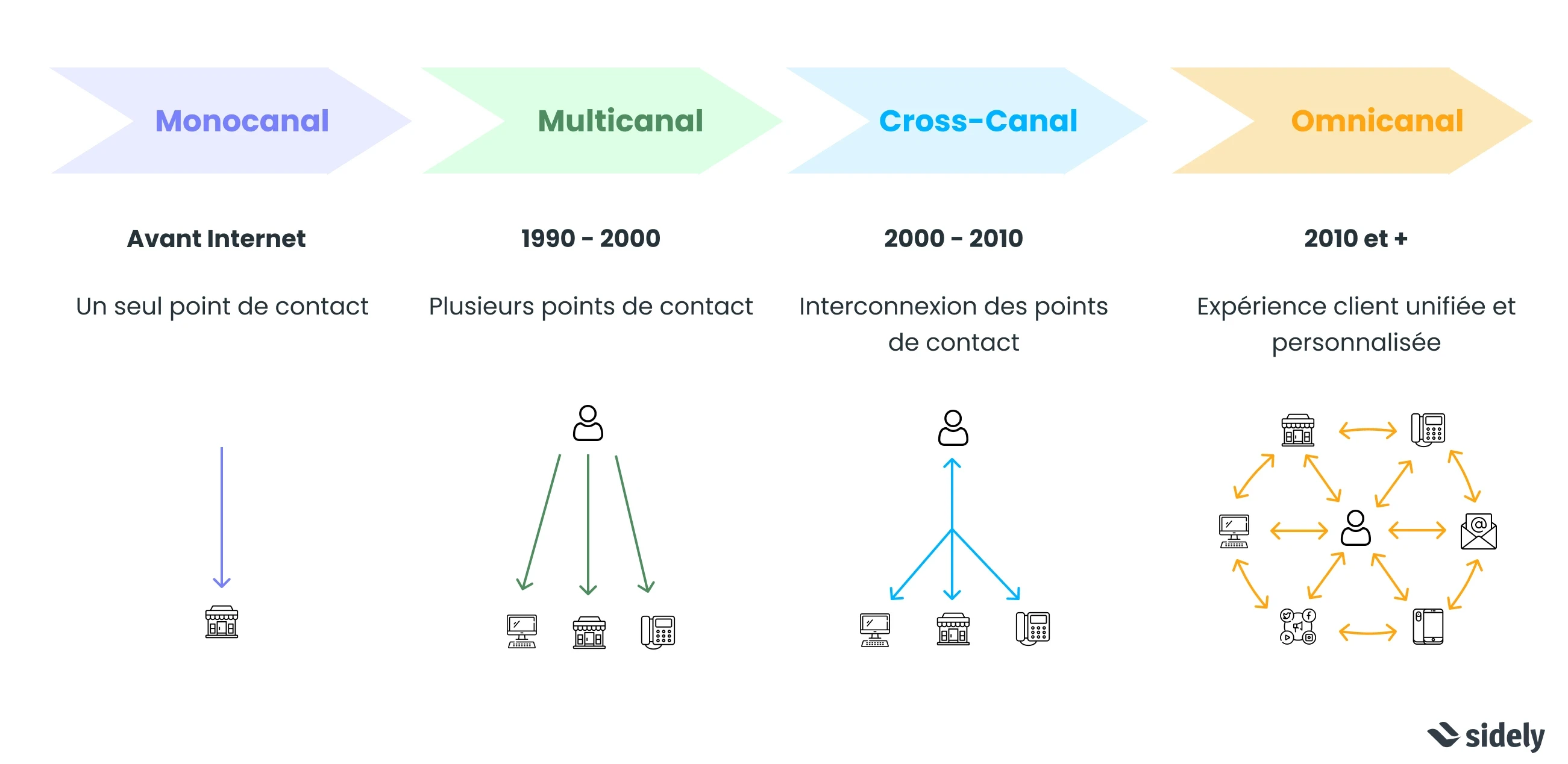
Omnichannel is the most recent stage in a progressive evolution of commercial strategies in response to new consumer expectations. It can be represented in the form of a timeline that shows how companies transitioned from a siloed approach to a seamless and integrated customer experience:
Single-channel (before the Internet): a single point of contact for the customer (store, phone, or catalog), limiting interactions and purchasing opportunities;
Multichannel (1990s-2000s): multiplication of sales channels (stores, e-commerce sites, call centers), but without real coordination between them;
Cross-channel (2000s-2010s): appearance of interconnections between channels, allowing for smoother customer journeys (click-and-collect, showrooming);
Omnichannel (2010s and beyond): total integration of touchpoints for a unified and personalized customer experience, regardless of the channel used (store, web, mobile, social networks, conversational commerce).
Related resource: Multichannel and mass distribution
And of course, omnichannel retail does not mark the end of history! At the end of the article, we will look at the new trends that are disrupting retail.
Advantages and benefits for businesses
Omnichannel offers many benefits to organizations that implement it effectively:
Brand image: consistency across channels: web, stores, mobile, etc.;
Increased accessibility: elimination of "barriers to usage";
Increased sales: maximization of sales opportunities and average basket value;
Customer loyalty: a personalized and facilitating experience that fosters habit and attachment;
Data utilization: personalization of offers thanks to multichannel data collection;
Cost optimization: optimized management of inventory and resources;
Offline-online flexibility: the customer finalizes purchases as they wish;
Simplified returns management: flexibility in product return processes;
Visibility and awareness: extension of the relationship between the brand and the customer;
Competitiveness: differentiation from competitors;
Adaptation and resilience: responsiveness to technological changes.
🏆 The great strength of omnichannel is to propose solutions to all marketing challenges: engagement, retention, loyalty, branding, and awareness. Let's add that this modern customer journey strengthens the "tech" perception that customers have of a brand, reinforcing the company's storytelling!
The limits and drawbacks of the omnichannel strategy
Omnichannel retail is not without constraints. Here are the main limits to anticipate:
High implementation cost: technological integration, redesign of information systems, team training.
Organizational complexity: requires breaking down internal silos between marketing, IT, logistics, and sales teams.
Sensitive data management: cross-collection on many channels → reinforced GDPR obligations.
Difficult marketing attribution: it is complex to identify which channel triggered the final sale (see Challenges section).
Risk of inconsistency: imperfect synchronization between channels generates frustration (different prices, outdated inventory).
Not suitable for all models: niche or luxury brands (Hermès, Chanel, Louis Vuitton) may voluntarily choose to limit their multichannel presence to preserve their exclusivity.
Omnichannel distribution and mass distribution
The omnichannel strategy does not just unify physical and digital commerce. For a brand that has chosen an intensive distribution strategy, the experience must also be the same across all channels of the same distribution network.
Typical example: loyalty programs in mass distribution work across different store formats (hyper, super, convenience) as well as on e-commerce sites.
For grocery and retail chains, omnichannel increases the importance of category management, which must ensure the harmonization of availability, prices, or promotions across the entire network.
Specific challenges of omnichannel in grocery retail
For chains and brands present in mass distribution, the omnichannel strategy raises challenges specific to the sector:
Grocery Retail Challenge | Omnichannel Problematic | Best Practice |
|---|---|---|
Price consistency | A promotional price displayed on the e-commerce site must be identical on the shelf at the time of the operation. | Synchronize pricing systems between e-commerce and in-store terminals/electronic shelf labels. |
Product availability (Numeric Distribution) | The consumer expects to find in store what they see on the retailer's website. | Display real-time availability by point of sale (as Decathlon does). |
Loyalty programs | The customer must be able to use points and benefits interchangeably in store or online. | Integrate loyalty programs into a single omnichannel CRM (e.g., Carrefour, E.Leclerc cards). |
Click & collect | In-store pickup generates physical traffic but requires synchronized logistics. | Reserve dedicated areas and train staff on online order fulfillment. |
Category management | Harmonization of assortments must take into account both digital and physical channels. | Category management must ensure the consistency of availability, prices, and promotions across the entire network. |
The role of field data collection in mass market omnichannel
In the context of mass distribution, the omnichannel strategy also relies on the quality of the data gathered from the field. Sales teams (district managers) play a key role: price audits, checking product availability, reporting out-of-stocks...
This field data, consolidated in a CRM adapted to retail, allows brands to detect discrepancies between the digital offer and store reality and to act quickly to correct gaps before they degrade the omnichannel customer experience.
How to set up an omnichannel strategy?
Implementing an omnichannel strategy is a structuring project that involves the entire organization. Here are the 7 key steps to successfully complete this transformation:
Step 1 - Audit existing channels
Start by mapping all your current touchpoints: e-commerce site, mobile application, physical points of sale, social networks, customer service, newsletter, etc. Identify information silos and gaps in the customer journey. Ask yourself: at what point does my customer lose the thread of their experience?
Step 2 - Define your omnichannel personas
Each customer segment has its own habits of navigating between channels. Define omnichannel buyer personas that describe not only who your customer is, but also how they move from one channel to another in their purchasing journey.
Step 3 - Unify customer data
Omnichannel retail relies on a 360-degree view of the customer. This requires centralizing data from all your channels in a dedicated tool: omnichannel CRM or CDP (Customer Data Platform). Every customer interaction, regardless of the channel, must enrich this single profile.
Step 4 - Align internal organization
Omnichannel transformation often fails for organizational rather than technological reasons. Silos between e-commerce, marketing, IT, logistics, and physical retail teams must be broken down. Common governance and shared objectives (cross-functional KPIs) are essential.
Step 5 - Choose and integrate the right tools
An adapted technological ecosystem is the foundation of omnichannel retail. Solutions to evaluate include: omnichannel CRM, unified e-commerce platform, marketing automation tools, real-time inventory management solution, cross-channel analytics platform.
Step 6 - Deploy progressively
It is rare (and risky) to deploy everything at once. Choose an iterative approach: start with the most strategic channels for your business, measure the results, then gradually extend integration.
Step 7 - Measure and iterate
Define your omnichannel KPIs from the start and set up a tracking dashboard. Omnichannel retail is a continuous process, not a project with an end date: consumer behaviors change, your tools and your practices must evolve with them.
Tools and technologies for an omnichannel strategy
Implementing an omnichannel strategy relies on an integrated technological ecosystem. Here are the main categories of tools and their role:
Tool Category | Role in Omnichannel Retail | Examples |
|---|---|---|
Omnichannel CRM | Centralizes customer history across all channels. Allows a 360° view and triggers personalized actions. | Salesforce, HubSpot, Sidely |
CDP - Customer Data Platform | Unifies customer data from disparate sources (web, mobile, store, CRM, ERP). | Segment, Tealium, Adobe Real-Time CDP |
E-commerce platform | Manages the online store with real-time inventory and promotion synchronization. | Shopify, Magento, Salesforce Commerce Cloud |
Marketing automation | Orchestrates cross-channel communications (email, SMS, push notifications, social networks) based on customer behavior. | Brevo, Klaviyo, Adobe Campaign, HubSpot |
Omnichannel payment solution | Enables payment collection and return management across all channels with a unified history. | PayPlug, Adyen, Stripe |
Cross-channel BI / analytics tool | Measures performance by channel and enables sales attribution. | Google Analytics 4, Tableau, Power BI |
Connected ERP | Synchronizes inventory, orders, and returns between physical and digital channels in real time. | SAP, Oracle NetSuite, Cegid |
Content Management Platform (CMS) | Distributes consistent content across all digital channels. | Contentful, Strapi, headless WordPress |
Good to know: CDP vs CRM
The CRM manages the commercial relationship with the customer (contacts, opportunities, purchase history). The CDP aggregates behavioral and anonymous data from all touchpoints to build a unified profile. The two are complementary in an omnichannel architecture.
KPIs and measuring omnichannel performance
Measuring the performance of an omnichannel strategy means looking beyond single-channel indicators to adopt a cross-functional view. Here are the key KPIs to track:
KPI | Definition | Why it matters |
|---|---|---|
Cross-channel repurchase rate | Share of customers who make their second purchase on a different channel from the first. | Measures the effectiveness of channel integration and omnichannel retention. |
Omnichannel Customer Lifetime Value (CLV) | Total value generated by a customer across all their purchasing channels. | Omnichannel customers generally have a CLV 30% to 50% higher than single-channel customers. |
Web-to-store conversion rate | Share of online visits that generate an in-store visit or purchase. | Key indicator of click & collect and drive-to-store strategies. |
Cross-channel loyalty program usage rate | Share of loyalty program members who use it on at least two channels. | Reflects the omnichannel maturity of the program and customer engagement. |
Omnichannel NPS | Customer recommendation score measured independently of the interaction channel. | Helps detect channels that degrade the overall experience. |
Synchronized out-of-stock rate | Consistency between inventory displayed online and store reality. | A high rate of inventory discrepancy destroys customer trust online. |
Cross-channel return rate | Share of returns made on a different channel from that of the purchase. | Measures the smoothness of the post-purchase journey and associated logistics costs. |
Data driven marketing: the disruption of retail
With the rise of omnichannel, sales now rely on data collection and analysis to personalize the customer experience.
The hyper-growth of the web has given rise to countless ways to research and buy. This ocean of new possibilities has in turn led to the emergence of global marketing platforms and tracking tools capable of memorizing buying behavior and adapting marketing campaigns in real time. AI then makes it possible to formulate purchase predictions and automate actions that convert, maximizing the impact of promotions and commercial offers.
Ultimately, the more companies centralize and exploit data, the more they optimize their sales. For example, analyzing the online journey – navigation, additions to the cart – can guide the organization of in-store merchandising. Thus, far from being a simple technology gadget, omnichannel redefines value creation by synchronizing all touchpoints.
However, while omnichannel is a real opportunity for companies that dare to invest in technology, the transformation it entails involves its share of challenges. For example, managing multiple channels requires rigorous coordination, particularly in terms of logistics and inventory. To succeed in their omnichannel transition, many companies are abandoning their siloed organization in favor of a 360-degree vision that prioritizes integration and fluidity.
💡The exception that proves the rule
Some niche or luxury brands, such as Hermès, Chanel, or Louis Vuitton, choose to limit their online presence to preserve their exclusivity and control their image. Rather than adapting to consumers' new buying behaviors, they impose their own codes, thereby reinforcing the desirability of their products.
This approach shows that omnichannel availability is not an absolute necessity: a brand can favor a more selective model while guaranteeing a consistent and controlled customer experience on the channels it chooses to activate.
Examples of omnichannel transformations
Need inspiration or practical cases to absorb all these concepts?
Let's start with 3 brands regularly cited for the success of their omnichannel strategies.
👟Nike
Nike's omnichannel approach relies in particular on the launch of an application that allows customers to reserve items online and pick them up in store. The app also offers exclusive discounts via the Nike Members Rewards loyalty program and provides detailed information by scanning products in store.
💄Sephora
Sephora focuses on omnichannel by integrating its loyalty program and services online and in-store. Customers can reserve products online, take advantage of virtual beauty consultations, and use interactive screens in-store to get personalized recommendations, thereby improving their shopping experience.
🎾Decathlon
Decathlon has integrated its online and physical sales channels to streamline the buying experience. Its application and website allow users to check product availability, order online, and choose between delivery and in-store pickup. The retailer also uses local inventory ads to inform customers in real time, optimizing the buying experience and sales.
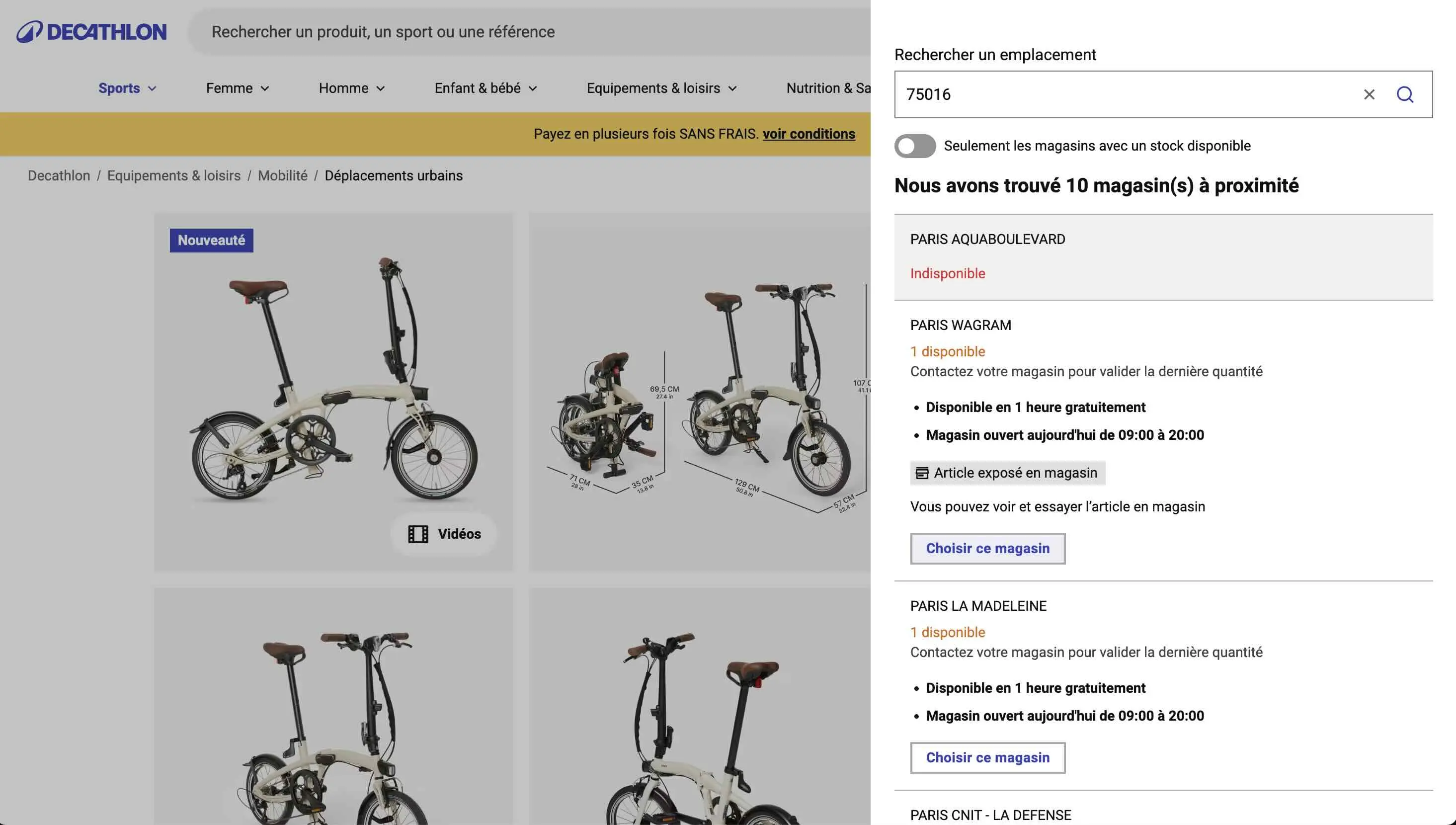
Decathlon's e-commerce site also allows visualization of physical store inventory
Carrefour 🛒
Carrefour is a prime illustration of the omnichannel strategy in French mass distribution, and the retailer continues to push the limits of the concept. The Carrefour+ loyalty program works seamlessly in hypermarkets, convenience supermarkets, and on the e-commerce site, with personalized promotions synchronized across all channels. The Carrefour Drive service allows placing orders online for drive-through pickup, and the app allows scanning products in-store to access reviews, compare prices, and check availability in other points of sale.
But it was in March 2026 that Carrefour took an unprecedented step: the retailer became the first European food distributor to integrate into ChatGPT. Since March 26, 2026, users can connect their Carrefour account directly to the OpenAI chatbot interface, and do their shopping in natural language, without leaving ChatGPT. Concretely, they just need to activate the Carrefour application in the dedicated section of ChatGPT, and then dialogue with the assistant: ask for recipe ideas for a given number of guests, check the availability of a product in drive, or compose a basket based on a budget or diet. The AI automatically generates an adapted shopping list, taking into account available products in real-time and current promotions — before the order is finalized and paid for on Carrefour.fr. Carrefour thus targets the 26 million ChatGPT users registered in France, setting up shop where the buying decision now begins to form.
This initiative perfectly illustrates the shift toward augmented omnichannel: the entry channel is no longer the retailer's site or application, but a third-party AI interface where the consumer already formulates their needs. It is a new definition of omnichannel commerce: being present not only on all physical and digital channels, but also at the heart of the AI assistants that consumers consult before buying. According to CEO Alexandre Bompard, 60% of consumers already state they use AI in their shopping journey, a trend that is expected to continue to accelerate.
Now let's see how omnichannel can be activated sporadically to improve the performance of a temporary event.
To do this, we will take the example of a retailer wishing to launch an operation for Black Friday, and ask ourselves what are the good and bad practices in this context.
Black Friday Example
Category | Best Practices | Bad Practices |
|---|---|---|
Channel integration | Offer Click & Collect with synchronized inventory between site and stores. | Have different promotions between online and in-store commerce. |
Inventory management | Display real-time product availability across all channels. | Fail to update inventory online or in-store, creating unexpected out-of-stock situations. |
Consistent communication | Send uniform messages across all channels (email, social networks, website). | Neglect training store staff on online offers, generating inconsistencies in information. |
The big omnichannel failures
Yes indeed! There are not only successes in this domain. And while the failures of French companies rarely make much noise, the American market is much more transparent in this regard.
Mass distribution notably offers two textbook cases of a problematic omnichannel strategy:
Target: Target's Cartwheel application aimed to integrate coupons and promotions between online and in-store purchases. However, the integration between the app, the site, and in-store systems was inconsistent, preventing customers from using their discounts and loyalty points correctly. This failure resulted in significant frustration.
Walmart: the US giant launched a mobile app to support its omnichannel strategy, but it had bugs and offered a poor user experience, as well as synchronization problems between online orders and in-store inventory. Result: many customers lost trust and turned away from the systems offered by the world's number 1 in retail.
The challenges to overcome for a successful omnichannel transition
With the rise of digital and cross-channel, new constraints have emerged.
The most recurring is marketing attribution, which consists of knowing which channel is at the source of the sale. The multiplicity of touchpoints can complicate the interpretation of the buying psychology. And within companies, debates rage between department heads, each believing that their channels are the ones contributing most actively to revenue!
Furthermore, omnichannel has fostered the emergence of new technological challenges, and companies must constantly modernize their functional approach to benefit from the expected synergies.
Summary of the most typical cases:
Issues | Solutions |
|---|---|
Sales attribution and customer journey tracking: fragmented customer journey → difficulty identifying which channel (most) influenced the purchase. | Implement a multi-touch attribution model and use omnichannel tracking tools. |
Data unification and reliability: disparity of sources (CRM, ERP, e-commerce, stores), risk of inconsistencies. | Centralize data in a CDP (Customer Data Platform) or an omnichannel CRM and use ETL tools to harmonize flows. |
Definition and tracking of relevant KPIs: need for indicators adapted to each channel while maintaining a global view. | Define cross-functional KPIs (e.g., cross-channel repurchase rate, Customer Lifetime Value) and use dynamic dashboards. |
Real-time and responsiveness: delays in data collection and analysis, limiting rapid decision-making. | Use real-time BI tools and predictive AI solutions to anticipate trends. |
Regulatory compliance and data protection: GDPR constraints and customer consent management. | Implement consent management tools and adopt a privacy-by-design approach to secure data. |
New trends: is omnichannel soon to be outdated?
While no new term has yet emerged to describe the evolution of commerce, we see many practices emerging that impact retail:
Phygital and immersive experiences: connected terminals, augmented reality, and virtual try-ons contribute to making points of sale experiential locations, reinforcing customer engagement;
Hyper-personalization: linking customer data with artificial intelligence allows brands to offer ultra-targeted recommendations and anticipate consumer needs;
Predictive and automated commerce: purchases become autonomous thanks to connected objects and voice assistants (automatic replenishment, dynamic subscriptions based on actual consumption);
Web3 and decentralized commerce: with blockchain, brands are exploring new loyalty models (NFTs, tokenized reward programs);
Real-time commerce & instantaneity: live shopping, instant messaging, and conversational commerce via AI allow instant interaction with brands, accelerating decision-making and purchasing.
These developments reinforce the logic of augmented omnichannel, where the customer experience becomes ultra-connected, fluid, and predictive, adapting to consumption habits in real time.
While some experiences turn sour, like the Odyssey NFTs launched by Starbucks to strengthen its loyalty program, other trends are gaining momentum, such as cashierless stores.
Starbucks NFTs: a project abandoned after two years
Alexis co-founded Sidely after several years of service as a sales director. To understand what builds, or breaks, a salesperson's performance, he conducted more than 100 telephone interviews with field sales representatives. At Sidely, he transforms this raw knowledge into concrete support, based on facts rather than assumptions.
See also

Artificial intelligence and field professions: what our 2026 studies reveal
Adoption, barriers, use cases: discover what our three studies reveal about the role of AI among sector managers, sales representatives, and foodservice sales reps.

CHR and RHF Sales Representatives: portrait of a relationship-driven profession in the era of data
Equipment, productivity, AI: discover the major trends for the HORECA and food service sales profession in 2026 through our field study.

Pharmaceutical Sales Representative in France: Portrait of a Field Job Under Pressure
Compensation, aspirations, AI usage: discover the major trends in the pharmaceutical sales representative profession in 2026 through our field study.

Area Sales Managers in France: who are they and how is the profession evolving in 2026?
Compensation, aspirations, AI usage: discover the major trends in the field sales representative profession in 2026 through our field study.
The area manager professions in 2026
Discover the trends, the challenges, and the key figures.