

CRM data analysis to make decisions, not just measure
CRM data analysis: how to choose the right metrics to drive sales activity and make concrete decisions.

In short
5 min read
CRM data analysis must become an operational management tool rather than a passive measurement exercise.
The value of CRM data lies in its ability to trigger rapid and relevant decisions, not in its exhaustiveness.
To manage effectively, it is imperative to limit the number of monitored indicators to a maximum of two or four in order to remain focused on the essentials.
Analysis must imperatively start from the concrete decisions to be made on the ground rather than from the data available in the tool.
CRM becomes a performance driver when it allows the interpretation of indicators to be adapted according to each individual's level of responsibility.
Today, 91% of companies with more than 11 employees use a CRM, according to Salesforce. Proof that these systems have become essential for structuring customer relationships and tracking sales performance.
Despite this massive adoption, most CRM analyses do not lead to concrete decisions on a daily basis. Too many indicators dilute attention, and few of them are directly linked to the operational decisions of sales and management teams.
The paradox is clear. The more data companies collect, the harder it becomes to make decisions at the right time. CRM data analysis should not be a measurement exercise for the sake of measuring, but a steering tool that enlightens concrete operational decisions (reallocating efforts, adjusting goals, detecting drop-off risks).
In this article, we show how to use CRM data analysis to decide, and not just measure, by linking it directly to sales management challenges.
Analyzing CRM data: what are we really talking about?
Analyzing CRM data is not about producing charts of numbers or multiplying indicators. It is a process of transforming raw data into operational decisions.
Concretely, CRM data is an objective fact resulting from commercial activity: a visit made, a call placed, an opportunity created, an action plan completed. As long as it is isolated, this data has no decision-making value.
A CRM indicator is a contextualization of this data, for example, a coverage rate, a contact frequency, or the progress level of actions.
Finally, CRM data analysis consists of using a limited number of indicators to reduce uncertainty before making a decision: prioritizing a portfolio, adjusting a goal, triggering managerial coaching.
In other words, analyzing CRM data comes down to answering a simple question: what should we do now?
CRM data analysis: investment or cost?
This is where the main confusion lies. A CRM analysis can be either an investment or a cost, depending on how it is used.
It becomes a cost when it is limited to:
producing descriptive reports,
explaining results after the fact,
populating dashboards with no explicit link to a decision.
In this case, time is spent collecting, consolidating, and commenting on numbers, without any direct impact on sales action. The analysis consumes resources but does not change priorities, behaviors, or results.
Conversely, CRM data analysis becomes an investment when it:
enlightens concrete trade-offs,
allows for anticipation rather than observation,
directly influences field and managerial decisions.
An analysis that highlights a drop in field coverage, before it translates into a drop in revenue, creates value. It allows for earlier action, with an adjustment cost much lower than that of a late recovery.
The difference is therefore less technological than managerial. CRM data analysis only has value if it is thought of as a steering lever and not as a measurement exercise.
Why most CRM analyses do not lead to decisions
Several obstacles explain why analyzing CRM databases remains, in many organizations, a measurement exercise rather than an action lever.
The first obstacle is the multiplication of indicators without a clear hierarchy. Many dashboards gather dozens of KPIs without any explicit link to a specific decision. In reality, national sales directors often inherit an existing database when they take office. They adjust it, add indicators they deem relevant, but rarely by starting over with a global reflection.
Gradually, dashboards accumulate, versions multiply, and it becomes difficult to know where to look to make a decision. We know what we are measuring, but not always why. Or we identify a signal, without knowing what analysis or action follows. Managers measure a lot, but make few decisions.
The second obstacle concerns data quality and consistency. Despite a very high CRM adoption rate, with 91% of organizations equipped, effective use remains uneven. Incomplete entry, different definitions among teams, unshared rules—these gaps weaken trust in the numbers and slow down decision-making.
Before even trying to enrich the analysis, it is therefore essential to secure data quality, even if it means conducting a CRM completeness audit. The quality of the analysis directly depends on the quality of the data feeding the CRM. This is an absolute priority.
Finally, many analyses are produced too late or at the wrong level. A frozen monthly report helps explain past results, but is of little use for managing daily sales activity. When information arrives after the fact, the decision no longer has an impact. In this case, it is not just the analysis that needs to be questioned, but the tool itself: why is the data not available in real time, when action can still make an impact?
Using CRM data to decide, not just to measure
Measuring sales activity consists of describing what happened. Deciding consists of acting on what is going to happen. CRM data analysis becomes truly useful when it enables this shift.
In many organizations, CRM data is correctly collected but poorly utilized. It is used to generate numbers, rarely to guide concrete choices. The issue is not the lack of data, but the lack of decision-making logic in its use.
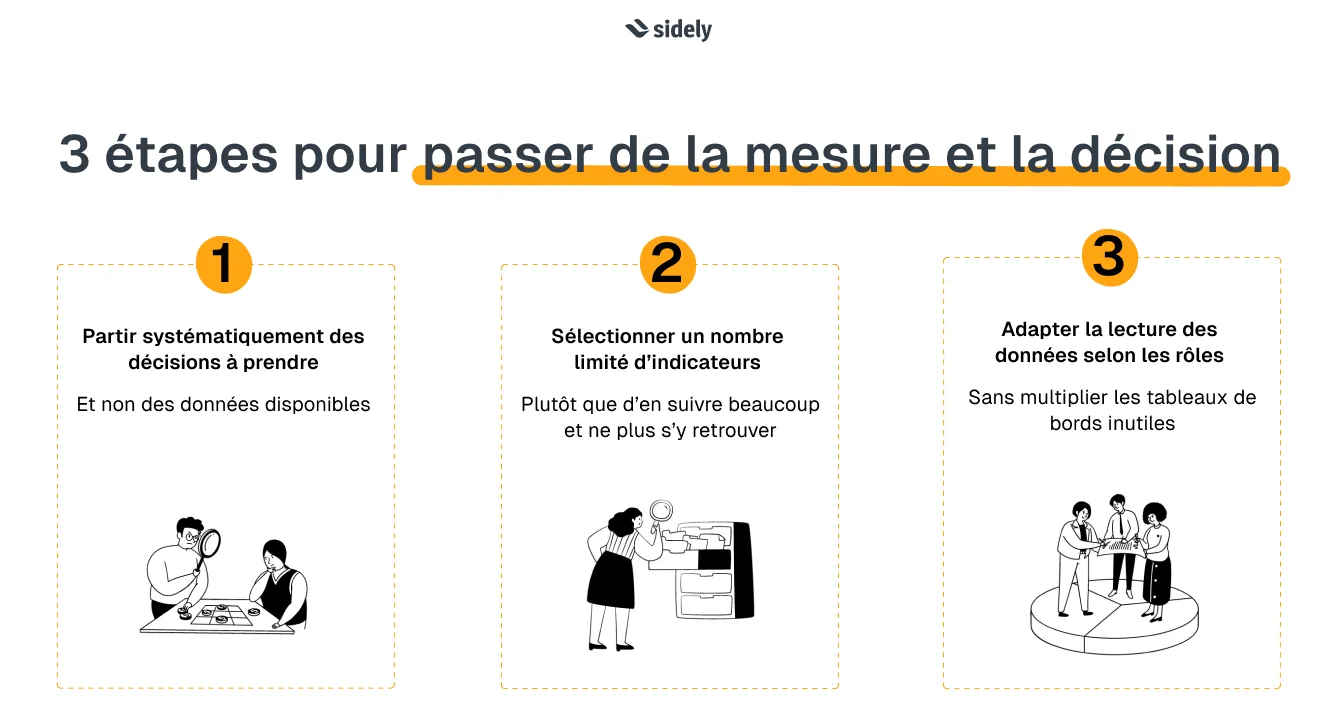
Our three-step advice:
Systematically start with the decisions to be made, and not the available data;
Select a limited number of indicators directly linked to those decisions;
Adapt the reading of data according to roles, without multiplying useless dashboards.
Start with the decisions to be made, not the available indicators
A decision-oriented CRM analysis always starts with the decisions to be made, and not with the data available in the tool.
To know what to analyze, it is essential to start with the concrete. The goal is not to explore all the data, but to orient the analysis towards specific operational choices. To do this, first ask yourself simple questions directly linked to action:
Where to focus sales effort this week? Analyze two to three priority indicators, for example the activity level, key account coverage, or the progress of action plans.
Which clients are at risk of dropping off? Observe variations in numeric distribution or sell-in, the date of the last order, or a drop in contact frequency compared to the usual pace.
Which zones or portfolios require rebalancing? Analyze your territory assignment, for example using a map, to identify overlapping areas or workload imbalances. A drop in performance by a sales rep should lead to targeted analysis.
The goal of these questions is to structure the choice of indicators. Every selected KPI serves to make decisions.
Transform data into actionable signals
Using CRM data to decide means transforming volumes of information into simple, readable, and immediately interpretable signals.
A drop in sell-out, a decrease in the number of store audits carried out, or an unresolved out-of-stock situation are all weak signals that reflect an underlying problem. Everything is potentially revealing, provided you know what you are trying to detect. The value of the analysis lies not in the exhaustiveness of the data, but in its ability to trigger a quick and relevant decision.
A useful indicator is therefore an indicator that is:
understandable without complex interpretation,
capable of highlighting a significant gap or evolution,
directly linked to an identifiable action.
The goal is to have actionable data at each stage of the sales cycle, and not just at the end of the journey.
Targeting: prioritize visits based on out-of-stocks, missing items, or the associated loss of earnings.
Planning and preparation: tailor your actions by point of sale to maximize the impact of innovations and strategic products.
Visit and field execution: analyze product mix, loyalty, or cannibalization phenomena to demonstrate the incremental value of your references.
Follow-up and resale: rely on concrete and measurable data to facilitate the resale of promotions and strengthen commitment at the point of sale.
Voluntarily limit the number of indicators
Multiplying indicators complicates reading and slows down decision-making. A simple rule is to limit each decision to two to four indicators maximum. This framework imposes a strict prioritization of information and promotes faster analyses, better integrated into the daily routine of sales and management teams. It forces focus on the essentials.
At Sidely, this approach is a structuring principle: it is better to track a limited number of indicators, but fully exploit them with clear and concrete corrective actions, rather than multiplying KPIs without ever transforming them into operational decisions.
Adapt CRM analysis to the decision-making level
An effective CRM analysis requires adapting the reading of data according to roles. The same data can serve very different decisions depending on the level of responsibility. CRM analysis becomes relevant when it is aligned with the decision level of each user:
The sales rep uses it to prioritize actions and prepare visits.
The manager uses it to support, decide, and guide execution.
The sales director uses it to adjust resources and anticipate risks.
It is therefore not the data that changes, but the interpretation made of it. Concretely, this allows the manager to adopt a coaching posture, by giving precise directions: focus effort on a specific client, strengthen presence in a specific territory, correct an identified execution deviation. At the same time, the CRM must allow sales representatives to draw conclusions from their data themselves, and say to themselves: given the situation, I need to adjust this action.
It is in this spirit that integrating an analytical assistant, for example based on artificial intelligence, makes perfect sense. By drawing on CRM data, it can guide sales reps in reading indicators, suggest priorities, and facilitate more autonomous decision-making, without substituting for the managerial role.
Analyze less, decide better
CRM data analysis is not an isolated statistical exercise. Its value is measured by the quality of the decisions it helps make. While CRMs are now adopted by almost all structured companies, the difference in performance lies in the ability to transform data into operational choices.
Margot has been working in Tech and SaaS for 8 years, with a multi-product experience that has given her a unique understanding of business challenges. On a daily basis, she analyzes, relentlessly tests, and relies on facts to shed light on market trends and help sales teams move forward.
See also

Artificial intelligence and field professions: what our 2026 studies reveal
Adoption, barriers, use cases: discover what our three studies reveal about the role of AI among sector managers, sales representatives, and foodservice sales reps.

CHR and RHF Sales Representatives: portrait of a relationship-driven profession in the era of data
Equipment, productivity, AI: discover the major trends for the HORECA and food service sales profession in 2026 through our field study.

Pharmaceutical Sales Representative in France: Portrait of a Field Job Under Pressure
Compensation, aspirations, AI usage: discover the major trends in the pharmaceutical sales representative profession in 2026 through our field study.

Area Sales Managers in France: who are they and how is the profession evolving in 2026?
Compensation, aspirations, AI usage: discover the major trends in the field sales representative profession in 2026 through our field study.
The area manager professions in 2026
Discover the trends, the challenges, and the key figures.