

AI and data analysis: the challenge of data quality
Discover why data reliability is essential for leveraging artificial intelligence in supermarkets, the hospitality sector, foodservice, or specialized retail. Strategy, mistakes to avoid, and best practices on the ground.

In short
6 min read
The effectiveness of artificial intelligence directly depends on the quality of the input data (GIGO principle: Garbage In, Garbage Out).
Field data collection often suffers from human errors: incomplete entries, duplicates, delayed entries, or a lack of standardization.
Data reliability is a strategic, operational, and economic imperative essential for sustainable commercial performance.
It is imperative to structure and standardize data before any deployment of AI tools to guarantee consistent analyses.
Humans remain indispensable for interpreting AI recommendations and adjusting them based on field reality.
Quality improvement relies on team awareness, automation of data entry, and clear process governance.
In a constantly evolving business environment, artificial intelligence (AI) has become a strategic lever to optimize sales management and refine decision-making. Companies operating in sectors such as mass retail (GMS), hotels, restaurants & cafes (CHR), out-of-home dining (RHF), and large specialized stores (GSS) are particularly affected. However, the effectiveness of AI intrinsically depends on the quality of the data it leverages. Inaccurate or incomplete information can distort analyses and lead to erroneous strategic decisions.
For sales managers overseeing field teams and geographical business development, the challenge is twofold:
Ensure the reliability of data entered by mobile sales representatives.
Develop a robust data strategy before deploying AI tools.
Without active involvement to structure, validate, and interpret data, AI cannot reveal its full potential.
The Challenge of Data Quality
Without clean data, there is no effective AI.
The challenge of data quality for a sales team is simultaneously strategic, operational, and economic. Reliable data is not a simple asset; it is the absolute prerequisite for sustainable sales performance, especially in a context of geographical expansion.
The "Garbage In, Garbage Out" Principle
The principle of "Garbage In, Garbage Out" (often abbreviated as GIGO) is a fundamental concept in computer science and artificial intelligence. This principle means that the quality of the results produced by a system directly depends on the quality of the input data. In other words: if you provide incorrect, incomplete, or biased data to an AI, it will produce incorrect analyses, predictions, or recommendations.
Even the most high-performing algorithms cannot compensate for poor quality data.
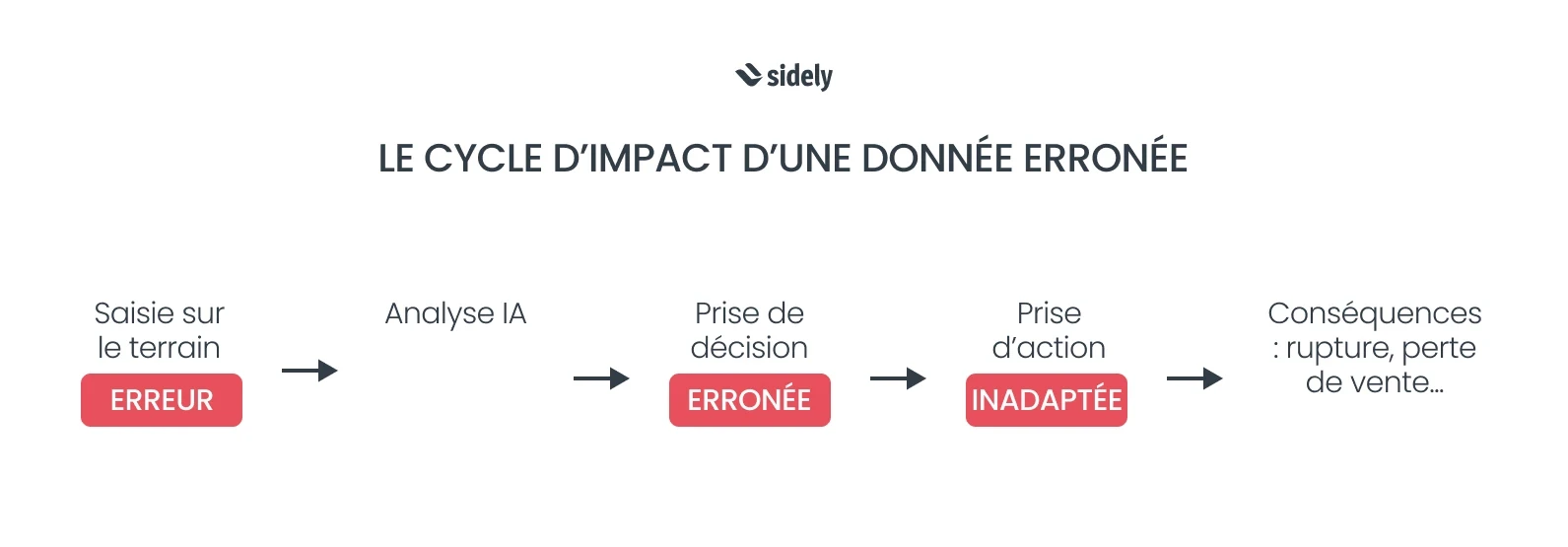
Let's imagine a field sales representative who, during an in-store shelf audit, mistakenly enters that all products are well stocked, even though several items are missing from the shelves.
The CRM transmits this information to the AI.
The AI considers that the situation is optimal.
It does not trigger an alert for out-of-stocks.
Result: no corrective action is proposed, while the point of sale loses sales.
In this case, the human entry error distorts the automatic analysis, which can impact sales performance. A simple input error is enough to disrupt the entire supply chain.
Common Errors in Field Data Collection
In distribution networks, sales representatives are responsible for reporting key information: shelves, stocks, orders, returns, promotions. Yet, this collection is not always reliable. You know this better than anyone.
Here are the main errors frequently observed in mobile sales teams, which can impact your data analysis:
Incomplete or Approximate Manual Entry
Omission of mandatory fields: products not filled in, quantities forgotten, comments left blank.
Incorrectly filled fields: number errors, ambiguous abbreviations, inconsistent spelling.
Incomplete reports: omitting certain items on shelves, or lacking a photo of the shelf display.
Copy-and-Pasting or Duplicating Reports
To save time, some sales reps duplicate reports from one visit to another without updating the information. Others copy and paste generic comments into customer profiles.
Delayed or Forgotten Entry
The data is recorded several hours or days after the visit, which increases the risk of memory errors.
Sometimes, entry is simply forgotten, particularly at the end of the day or during high-activity periods.
Lack of Standardization
Every sales rep has their own way of describing a situation or coding information.
Lack of dropdown menus, formatting rules, or automatic checks.
Poor Understanding of Data Importance
Some sales reps view data entry as an administrative task unrelated to their performance.
They do not see how poor data can impact head office decisions, logistics, or sales forecasts.
This lack of precision prevents AI from producing coherent analyses.
Humans at the Core of AI-Assisted Data Analysis
AI has the ability to identify correlations and patterns in data. But it does not possess the intuition or field knowledge that characterizes your teams. Human intervention remains crucial.
The proper use of AI therefore relies on the teams' ability to interpret suggestions and adjust them based on the actual context.
👉 In fact, we have dedicated an entire article to this subject if you wish to explore further.
Data Strategy and AI: Structuring Data Before Exploiting Artificial Intelligence
Why Structure Data Before Deploying AI?
AI does not work in a vacuum. It can only generate value if the data it processes is well-structured and contextualized. If input data is unreliable, AI will not be able to properly assist your teams.
Let's take a case in specialized retail (GSS): if data related to sales, product returns, and promotional campaigns are split between an ERP, several Excel files, and a merchandising tool, AI will not be able to cross-reference the information effectively.
Result: incomplete analyses, and therefore of little use.
Building an Effective Data Strategy
Setting up an effective data strategy is a prerequisite for adopting artificial intelligence in any sales organization. Without reliable, consistent, and well-organized data, even the best AI tools cannot produce relevant analyses or guide informed decisions. This strategy rests on three fundamental pillars:
Relevance: define data that has real value for your sales decisions.
Standardization: establish clear formats and data entry methods shared by everyone.
Centralization: gather data in a single space, accessible to both headquarters and field roles.
This often requires an overhaul of existing tools, or at the very least a review of current processes.
Before talking about artificial intelligence, we must talk about data quality. An AI will never replace missing or poorly structured data. It can interpret it, model it, highlight it—but only if it rests on a reliable foundation. Building an effective data strategy is therefore, first and foremost, about creating the necessary conditions for a high-performing, useful, and relevant AI serving your business challenges.
How to Guarantee Reliable Data?
Ensuring the reliability of field data is based on a balanced combination of technology and human support. To achieve this, several levers can be activated. Guiding data entry within the CRM is an essential first step: this involves using predefined fields, dropdown lists, or validation rules to prevent errors or omissions. In parallel, certain data capture tasks can be automated using technologies such as image recognition, scanning, or OCR-assisted entry. Finally, nothing replaces a well-trained team: raising field teams' awareness about the importance of their daily inputs is indispensable. A well-trained sales rep then becomes an essential link in the data quality chain.
To take full advantage of artificial intelligence in a sales context, data reliability is a non-negotiable condition. As a sales director, you have five concrete levers to structure, secure, and leverage data collected in the field.
Raise Teams' Awareness of Data Impact
Your sales reps are the primary producers of field data: shelf audits, visit reports, order information... Yet, they are not always aware of the strategic reach of their inputs. It is therefore essential to explain to them how their actions have a direct impact on the analyses, forecasts, and decisions made at the regional or national level. Illustrating this with concrete cases of errors or distorted decisions due to incorrect information can strengthen awareness. Even better, show them that quality data also benefits their own performance, whether through more relevant recommendations, automated reporting, or more efficient route planning.
Structure Entry Fields to Avoid Errors
Standardizing data entry is a key challenge to avoid inconsistencies and duplicates. Poorly entered data, a different name for a point of sale, or a field left empty can harm all of your analyses. This is why it is preferable to enforce standardized formats in the CRM for all critical fields: visit type, outlet status, out-of-stock level, among others. The user experience must also promote reliability: dropdown lists, checkboxes, or mandatory fields guide sales reps in the right direction. To complete the system, certain validation rules can be automated: for example, a presence report cannot be saved without a GPS check-in.
Automate Wherever Possible to Secure Data
The more tasks are manual, the more the risk of error increases. Conversely, AI technologies now allow for the automation of part of the data collection process, improving both speed and reliability. A concrete example: a shelf audit can be done from a simple photo analyzed automatically. It is also possible to use a voice assistant to dictate a visit report, which will be transcribed and integrated directly into the CRM. Finally, specific data points like stock shortages or thresholds can be monitored automatically using sensors or smart alerts.
Establish Clear Data Governance
Data quality depends as much on tools as it does on the rules governing their use. It is essential to clearly define who is responsible for data entry, when, and with which tools. Setting up a data quality representative in each region or hub helps keep an eye on the entire process. This role can be supplemented by regular audits that identify friction points, poorly filled fields, duplicates, or inconsistencies across teams. This framework reassures, creates accountability, and guarantees better consistency in data exploitation.
Train and Equip Teams Regularly
Finally, a well-designed tool does not replace well-conducted training. A poorly trained or unsupported sales rep risk bypassing the tool or using it incorrectly. That is why it is essential to plan regular training sessions along with simple, accessible educational updates (tutorials, videos, quick guides). Special attention must also be paid to interface ergonomics: data entry must be intuitive, fast, and adapted for mobile use. Well-understood and well-used tools are the key to reliable data, and thus, to relevant exploitation by artificial intelligence.
Data Maturity: A Prerequisite Before Integrating AI
Diagnosing the Company's Data Maturity
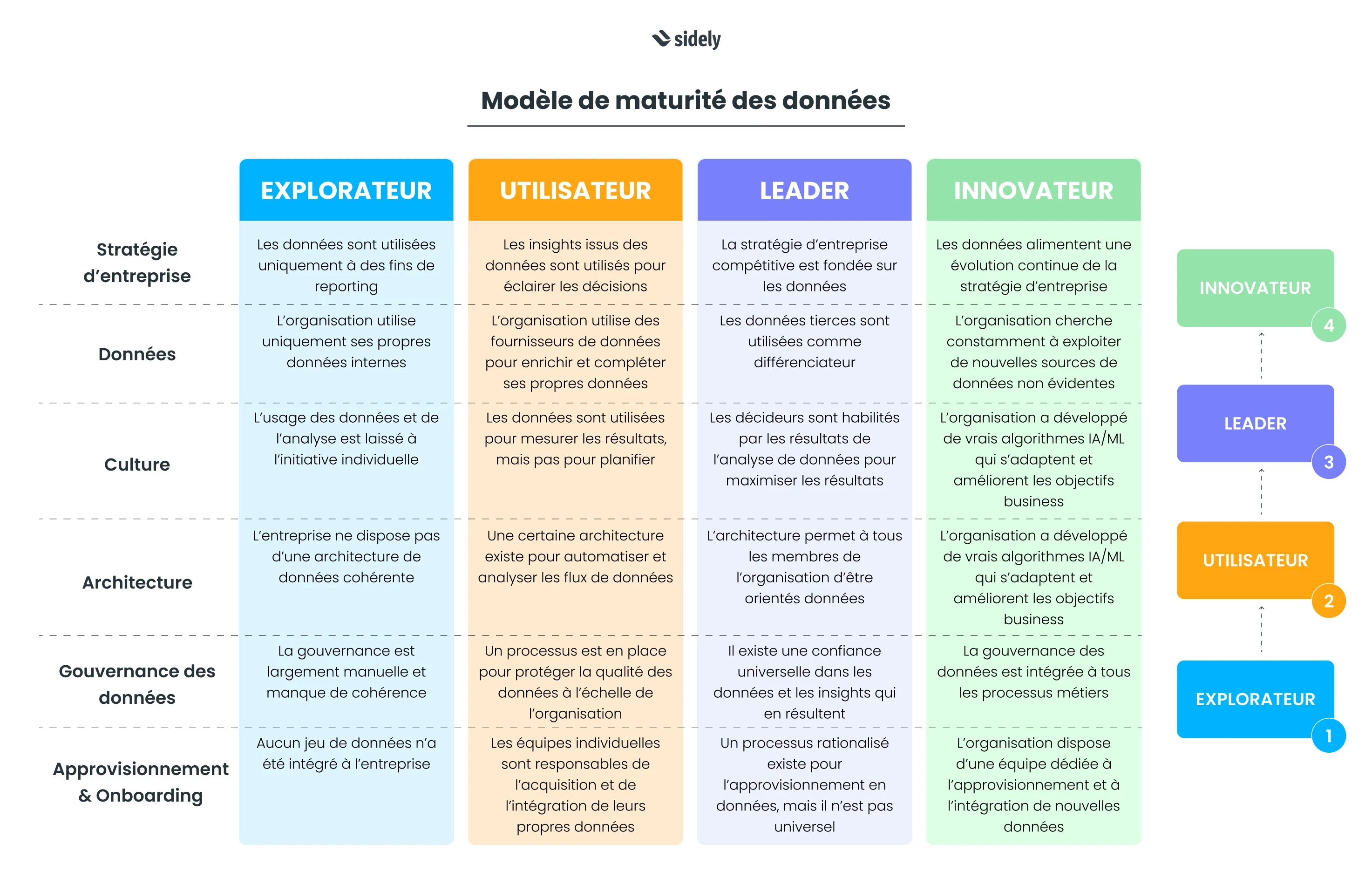
Before integrating AI into your sales processes, it is essential to assess the maturity of your data assets.
Here are some key criteria:
Is the data uniform?
Is it free of duplicates and errors?
Is it centralized and accessible to all stakeholders?
Is it concretely utilized by your teams?
An accurate mapping of your current situation will allow you to prioritize the projects to be carried out before moving forward.
Improving Data Maturity
To strengthen the quality of your information system:
Establish clear governance: who is responsible for data quality and integrity?
Invest in reliability tools: connected CRM, anomaly detection systems, automatic field validation.
Foster a "data" culture: involve your teams, make them aware of the impact of their inputs, share concrete feedback.
This is a gradual transformation, but essential for AI to become a true decision support tool.
Artificial intelligence can transform the way you manage your teams, prioritize your visits, optimize your assortments, and structure your sales strategies. But it can do nothing without reliable, organized, and interpretable data.
That is why:
You must first ensure that your data is reliable, uniform, and centralized.
You must train your teams to collect, enter, and utilize data with rigor.
You must support the introduction of AI with a clear structuring of your tools and processes.
And above all, you must value the role of humans, who remain the final interpreters of any algorithmic recommendation.
The future of business development in GMS, CHR, RHF, and GSS relies on smart collaboration between AI and the men and women in the field. It is by bringing these two forms of knowledge—analytical and empirical—together that you will truly be able to boost your performance.
Margot has been working in Tech and SaaS for 8 years, with a multi-product experience that has given her a unique understanding of business challenges. On a daily basis, she analyzes, relentlessly tests, and relies on facts to shed light on market trends and help sales teams move forward.
See also

Artificial intelligence and field professions: what our 2026 studies reveal
Adoption, barriers, use cases: discover what our three studies reveal about the role of AI among sector managers, sales representatives, and foodservice sales reps.

CHR and RHF Sales Representatives: portrait of a relationship-driven profession in the era of data
Equipment, productivity, AI: discover the major trends for the HORECA and food service sales profession in 2026 through our field study.

Pharmaceutical Sales Representative in France: Portrait of a Field Job Under Pressure
Compensation, aspirations, AI usage: discover the major trends in the pharmaceutical sales representative profession in 2026 through our field study.

Area Sales Managers in France: who are they and how is the profession evolving in 2026?
Compensation, aspirations, AI usage: discover the major trends in the field sales representative profession in 2026 through our field study.
The area manager professions in 2026
Discover the trends, the challenges, and the key figures.