

Why invest in a CRM in 2026
Saving time, better field visibility, simplified management: why invest in a sales CRM? The concrete benefits and ROI for sales forces.

In short
6 min read
CRM has become an indispensable tool for French SMEs, adopted by more than 90% of companies with more than 10 employees.
It centralizes and automates commercial interactions, freeing sales forces from time-consuming administrative tasks (about 30% of working time).
It constitutes a major lever of profitability by promoting acquisition, customer retention — 5 times less expensive — and sales growth.
The integration of a modern CRM allows for connecting marketing, ERP, and communication tools to create seamless omnichannel customer journeys.
Measuring ROI, through KPIs like conversion rate and LTV, often demonstrates a fast return on investment for businesses.
Choosing a solution tailored to business needs and the mobility of field teams is a key success factor in avoiding internal resistance.
In 2025, two out of three French SMEs are equipped with customer relationship management software, making it the third most used type of software by these businesses. This adoption rate reaches over 90% for companies with more than 10 employees.
Yet, the question of investing in a CRM has never been so strategic. In a context of unchecked technological innovation, even companies that are already equipped are questioning the evolution of their current tools.
This article explores the crucial challenges of CRM investment through six key areas:
The fundamentals;
The business benefits;
The impact of technological innovation;
Evaluating return on investment;
Choosing the right solution;
A forward-looking vision.
1) CRM: The Fundamentals
The term CRM (Customer Relationship Management) refers both to the customer relationship management strategy and the technological tools that support it. These solutions centralize and automate all sales and marketing interactions.
Core Features
CRM software generally includes the following features:
Centralization of customer data (contact details, history, preferences);
Interaction tracking (calls, emails, meetings);
Sales process automation;
Sales opportunity management;
Reporting and performance analysis.
Most modern CRMs are offered in SaaS (cloud) mode and include mobile applications optimized for field teams, a crucial aspect in sectors like retail distribution, where sales representatives conduct in-store audits.
These solutions are sometimes specialized (email marketing, teleprospecting) or verticalized (large-scale retail, very small businesses, etc.). They generally integrate various modules addressing all or part of the functions related to commercial relationships (prospecting, billing, reporting, etc.).
A Fundamental Profitability Driver
As a result of optimal management of the commercial relationship, prospects and customers benefit from responses aligned with their expectations. This satisfaction drives revenue growth; an effective CRM solution thus allows companies to increase results in acquisition, upselling, and retention alike. An integrated CRM has become a true pillar of corporate profitability.
To understand the importance of optimized sales processes, let's just remember that:
Acquisition costs 5 times more than retention;
Sales reps spend an average of 30% of their time on administrative tasks.
2) The Business Benefits of CRM
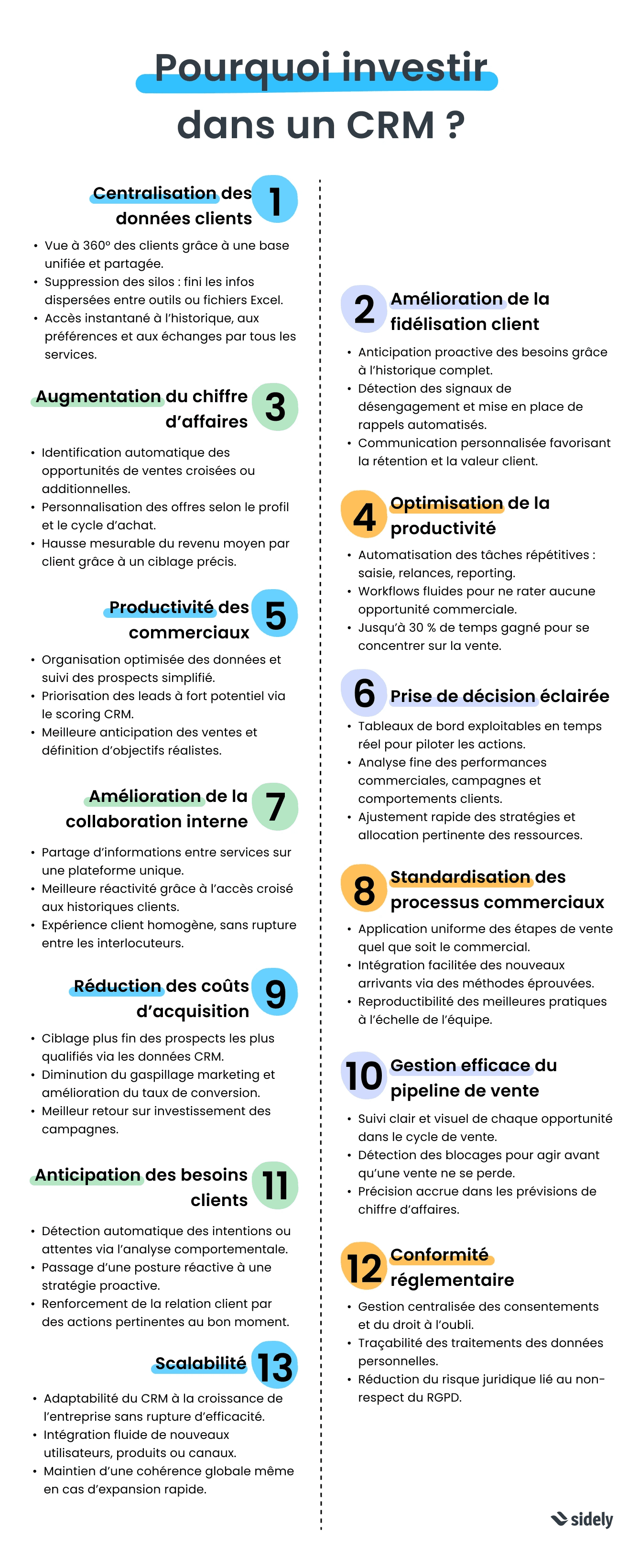
A well-implemented CRM solution generates value at different levels. For each pain point, the business finds an associated actionable benefit.
Table of Benefits by Pain Point
Issue | CRM Benefit | Application Example |
|---|---|---|
Silos between departments | Centralization and sharing of information | Single, reliable, and up-to-date database, 360° view of customer relationships, coordination between departments |
Low conversion rate | Sales efficiency | Sales funnel modeling, customizable pipelines, structured sales follow-up |
Ineffective marketing | Targeted marketing | Advanced segmentation, targeted and personalized campaigns, tracking, performance measurement |
High churn rate | Improved retention | Personalized follow-up, targeted email campaigns, customer scoring, proactive actions, alerts on weak signals |
Stagnating revenue | Revenue growth | Detection of cross-sell and upsell opportunities |
Time wasted on administration | Productivity gains | Automation of workflows, reminders, and repetitive tasks, pre-built email sequences |
Intuitive decisions | Data-driven steering | Dashboards, sales KPIs, conversion analysis, transforming raw data into operational insights |
Disparate sales methods | Standardization of sales processes | Structured pipelines, uniform and reproducible sales methods: unified sales scripts and sequences, template emails |
High marketing costs | Reduction of acquisition costs | Automatic lead qualification, fine segmentation, A/B testing |
Lack of pipeline visibility | Effective sales cycle management | Kanban view, tracking of conversion stages, customer follow-up alerts |
Lack of anticipation | Proactive detection of needs | History analysis, escalation of weak signals |
Regulatory non-compliance | GDPR compliance | Structured personal data management: recorded consents, opt-in/out management, communication traceability |
💡The CRM evolves with the business. It adapts to new needs, integrates other tools, and supports the expansion of markets or teams. Through its flexibility and impact on overall performance, it constitutes the structural lever for sustainable growth.
3) Technological Evolution: New Challenges, New Opportunities
Since their first appearance, CRMs have continually evolved. But our current era marks a significant turning point.
From Reporting to Smart Assistance
Historically, the CRM was born from the need to centralize and report sales information. Over time, automation (particularly via SFA software) has allowed organizations to boost their efficiency. In 2025, artificial intelligence is transforming these tools into true operational assistants that:
Help with decision-making through predictive analysis;
Optimize the planning of sales reps' routes;
Automatically prepare client visits;
Qualify and nurture marketing leads;
Generate alerts on client risks.
Chatbots, AI agents, and other virtual assistants are becoming mainstream, allowing sales reps to focus on selling and negotiating. The scale of these changes is leading companies to question the functioning of their current customer management tools: having already invested in a CRM does not guarantee being ready for the revolution that has begun!
Impact on the Digital Ecosystem
The central role of CRM requires it to evolve with its ecosystem: it must integrate into a constantly changing technological environment to become the central hub that connects:
Marketing tools (email marketing, social networks);
Management systems (ERP, invoicing);
Communication platforms;
This interconnection makes it possible to create consistent omnichannel customer journeys, meeting today's expectations for personalization and fluidity. In the big data era, only a modern, powerful CRM can aggregate and compile the multiple data points that feed the relationship between a brand and its customers.
This technological acceleration should guide companies to direct their searches towards vendors with expertise in their industry and a strong culture of innovation, such as scale-ups already validated by the market. This is the case with Sidely CRM, the French leader in retail distribution CRMs.
4) Measuring the Return on Investment of CRM
A CRM represents a sustainable strategic investment. Unlike a one-off purchase, its deployment is part of a fundamental transformation of sales processes, and the many benefits listed above result in measurable outcomes.
Benchmark KPIs
To evaluate the impact of a CRM, several indicators can be monitored. A reliable analysis will need to compare metrics before and after the deployment of the new commercial software.
Type of Indicator | Key Performance Indicators (KPIs) |
|---|---|
Sales | Conversion rate by pipeline stage |
Sales cycle length | |
Number of meetings conducted per sales rep | |
Overall revenue | |
Customers | Net Promoter Score (NPS) |
Customer retention rate | |
Lifetime Value (LTV) | |
Customer Acquisition Cost (CAC) | |
Operational | Time spent on administrative tasks |
Lead response time | |
Tool adoption rate by teams |
* This list is not exhaustive, but contains some essential indicators.
Calculating ROI
The formula for calculating CRM ROI is:
ROI = (Generated Gains - CRM Costs) / CRM Costs × 100%
According to Nucleus Research, companies get back an average of $8.71 for every dollar invested in a CRM. With modern SaaS solutions, the monthly cost per user becomes very low, allowing for a fast ROI.
5) Choosing the Right Solution
Once the decision to invest has been made, you need to choose from a diverse offer of CRM software. Here are a few strategic areas to explore internally.
Essential Selection Criteria
Type of Criterion | CRM Selection Criteria |
|---|---|
Business needs | Alignment with your specific sales processes |
Capacity for customization and scalability | |
Management of sector-specific characteristics | |
User experience | Intuitive interface to foster adoption |
Mobile accessibility for field teams | |
Quality training and support | |
Technical integration | Compatibility with existing systems (ERP, email) |
Open APIs for future developments | |
Advanced reporting capabilities | |
Economic aspects | Pricing transparency |
No hidden costs | |
Scalable pricing model |
To read more on this topic:
Key Success Factors
A successful CRM implementation rests on several pillars:
Management involvement: project sponsorship at the highest level;
End-user participation: co-construction with field teams;
Adapted training: a structured onboarding program;
Phased deployment: a step-by-step approach to reduce resistance;
Continuous measurement: tracking KPIs and making regular adjustments.
Sidely: CRM for Retail Brands
Does your business sell its products through a distribution network? Sidely is made for you!
Whether you deal with supermarkets, hotels and restaurants, specialized retail, catering services, or even drugstores, Sidely CRM is designed to make life easier for your mobile sales forces and sales management teams:
Databases of points of sale;
Smart planning for sales reps' routes;
Field data collection with forms specific to your industry;
Management of trade and promotional operations;
Steering and reporting designed for distribution activity.
Sidely is a Sales Force Automation (SFA) CRM available in web, mobile, and tablet versions, which stands out for its simplicity of use and administration, and its adaptability to field demands.
Ready to see how a commercial CRM can revolutionize your business?
→ Try Sidely for free for 15 days or request a demo to discover its potential!
6) Steering Towards 2030: A Transformation Already Underway
In this context, companies that choose not to adopt a CRM, or opt for in-house development, expose themselves to several risks. They could see their competitors gain significant advantages in business management:
Speed in positioning themselves on business opportunities;
Better alignment with prospect expectations;
Better organization and speed of their sales forces in the field;
Greater number of customer visits conducted thanks to recovered time;
Anticipation of customer needs before they are expressed;
Capacity to deliver tailored customer experiences;
Stronger defensive capability over their client portfolio;
Automatic adjustment of strategies in response to market changes.
Gaps in profitability could also widen as a consequence of the various points listed.
Especially since by 2030, several trends will become the norm; AI is expected to facilitate the hyper-personalization of interactions and the automatic generation of sales and marketing content, and predictive and prescriptive analytics could become standard, which only a dedicated tool can handle.
With people becoming accustomed to highly powerful, customer-centric digital services, only companies equipped with a modern CRM will be able to meet the new expectations of their target contacts.
🇫🇷 Finally, questions of digital sovereignty will continue to grow in importance, and more and more French companies will choose a French CRM that offers locally developed solutions, hosts their data in the EU, and provides support in French.
Alexis co-founded Sidely after several years of service as a sales director. To understand what builds, or breaks, a salesperson's performance, he conducted more than 100 telephone interviews with field sales representatives. At Sidely, he transforms this raw knowledge into concrete support, based on facts rather than assumptions.
See also

Artificial intelligence and field professions: what our 2026 studies reveal
Adoption, barriers, use cases: discover what our three studies reveal about the role of AI among sector managers, sales representatives, and foodservice sales reps.

CHR and RHF Sales Representatives: portrait of a relationship-driven profession in the era of data
Equipment, productivity, AI: discover the major trends for the HORECA and food service sales profession in 2026 through our field study.

Pharmaceutical Sales Representative in France: Portrait of a Field Job Under Pressure
Compensation, aspirations, AI usage: discover the major trends in the pharmaceutical sales representative profession in 2026 through our field study.

Area Sales Managers in France: who are they and how is the profession evolving in 2026?
Compensation, aspirations, AI usage: discover the major trends in the field sales representative profession in 2026 through our field study.
The area manager professions in 2026
Discover the trends, the challenges, and the key figures.