
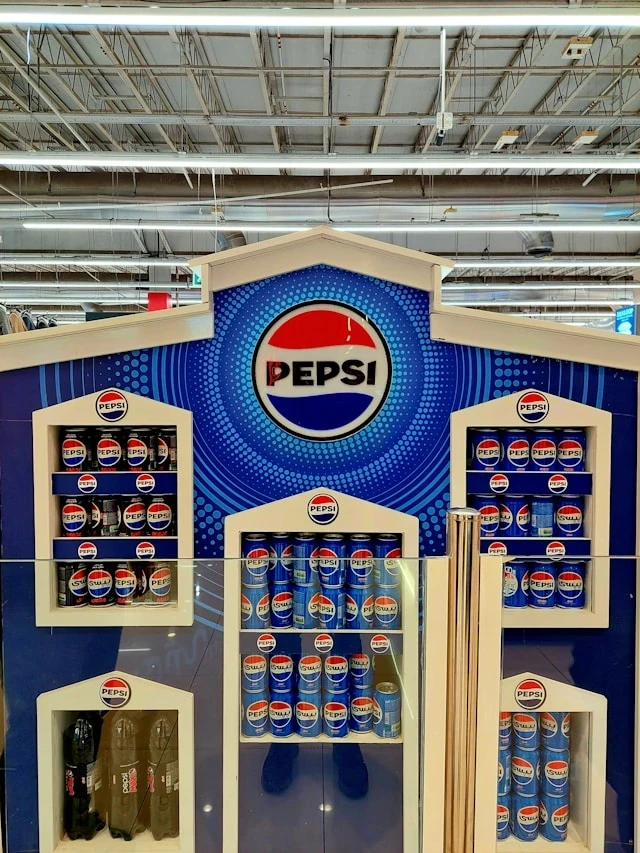
Shop-in-shop: best practices for your brand
Discover the benefits and best practices of a successful shop-in-shop strategy in retail. Our tips for your brand | Sidely

In short
4 min read
The shop-in-shop (or brand corner) creates a dedicated space for a brand within a department store to strengthen its visual identity and boost its sales.
This strategy allows brands to expand their audience by leveraging the existing foot traffic of a large retailer, while limiting the investment costs associated with opening their own retail outlets.
The setup facilitates control over product presentation and offers flexibility for temporary campaigns (launches, promotions) or long-term strategic partnerships.
The management of the shop-in-shop varies based on the level of delegation, ranging from the retailer-managed model to full concession (high brand autonomy).
Success relies on the strategic choice of the host store, an optimized physical location, rigorous inventory management, and accurate performance tracking via key performance indicators (KPIs) and field visits.
When we talk about the shop-in-shop concept, the examples that come to mind are often department stores, such as Galeries Lafayette or Fnac and Darty, which thus benefit from belonging to the same group. However, this rapidly growing trend is quickly spreading across the retail sector.
If your brand is looking to develop its market share or marketing strategy, you may be wondering about the ins and outs of the shop-in-shop concept applied to the physical and commercial environment of large-scale retail. If so, you are in the right place: this article explores the definition of shop-in-shop, its benefits for brands, the different ways it can be managed, and finally the key steps to implementing it successfully.
What is a shop-in-shop?
A shop-in-shop — or brand corner — refers to a space specially dedicated to a brand within a host store, in order to design a mini point of sale in its image. It thus allows for the customization of a specific area that reflects the brand's visual identity, and in which its products or services are sold.
The shop-in-shop offers the opportunity to set up temporary boutiques to highlight specific events, such as promotions, product launches, or seasonal rotations. In other cases, its installation is permanent and reflects the implementation of a long-term strategic partnership between two actors who are often financially independent of each other.
What are the benefits of a shop-in-shop for a brand?
By opting for a shop-in-shop, brands can extend their reach to a wider audience by leveraging the benefits of a major store. For example, Easy Cash, the leading buy-and-sell second-hand network, already collaborating with Cora, announced its partnership with Auchan in 2022 to grow further by expanding its network of business partners for this type of strategic operation.
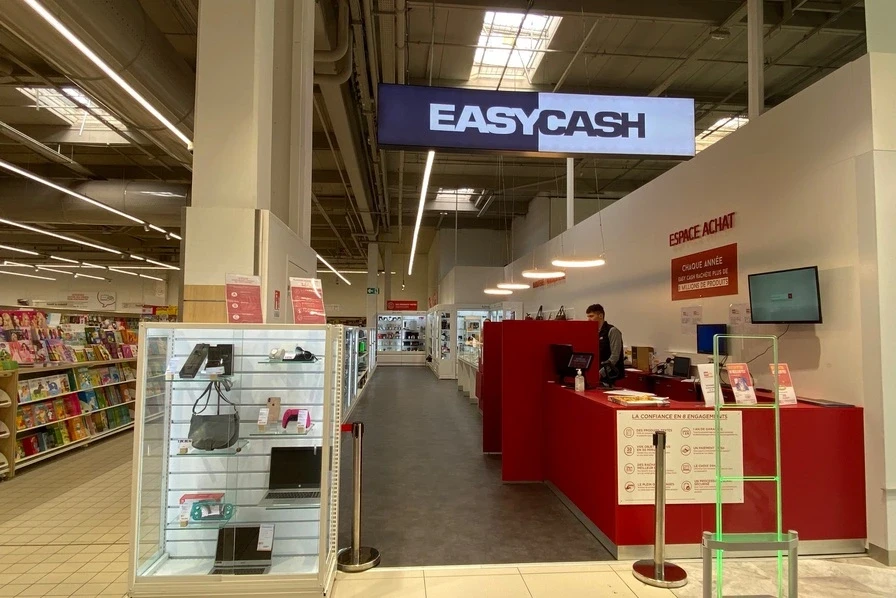
Credit: LSA Conso
Darty has also installed permanent shop-in-shops in certain Carrefour stores. This practice allows the retail giant to arm itself against competition from e-commerce, as well as department stores.
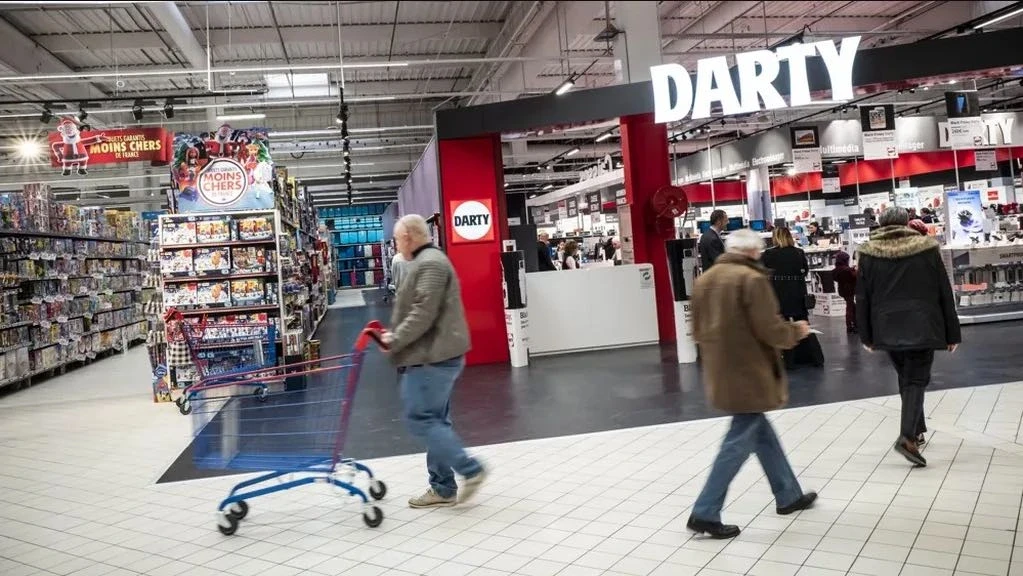
Credit: Les Echos
For its part, Haribo showcases its promotions through a similar setup within Leclerc stores.
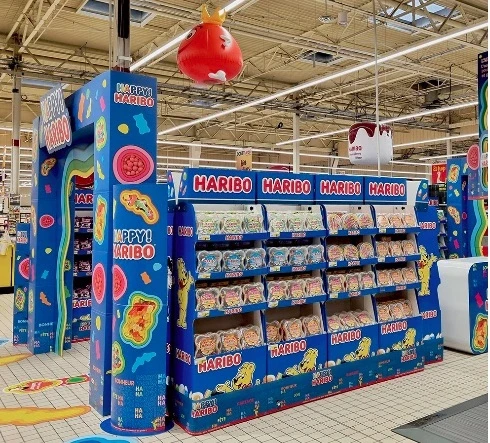
Credit: Strada Marketing
The shop-in-shop concept thus offers brands the opportunity to leverage the visibility of the store in which it is installed.
This is how Sushishop rolled out in most Leclerc hypermarkets.
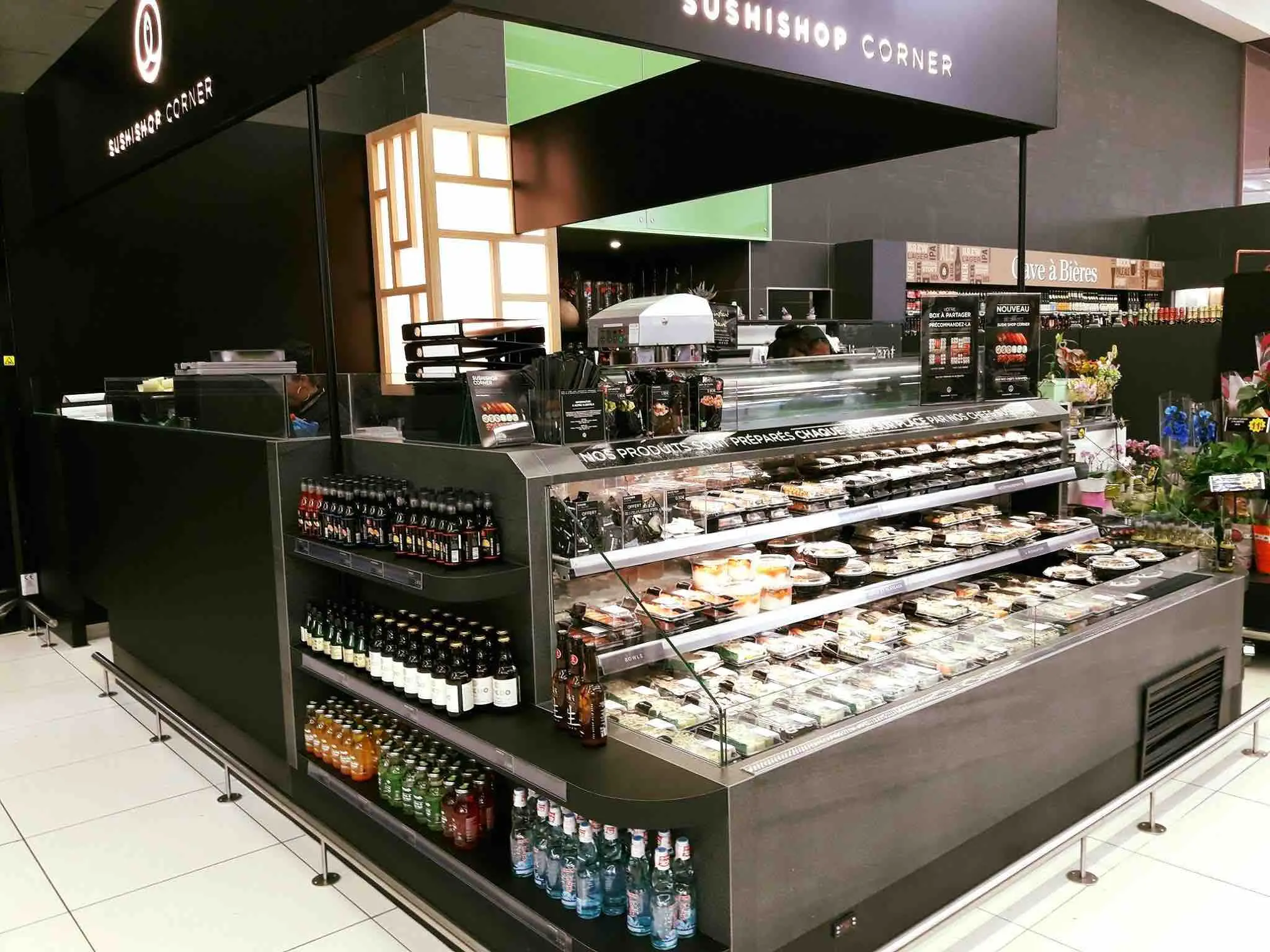
Credit: E.Leclerc Saint Pierre du Mont
Furthermore, this approach offers the possibility of testing new geographical areas or new markets, while limiting the investments that would be required to open dedicated points of sale.
Additionally, the shop-in-shop gives the brand better control over how its products are presented, as seen in the example of La Laitière in Carrefour hypermarkets.
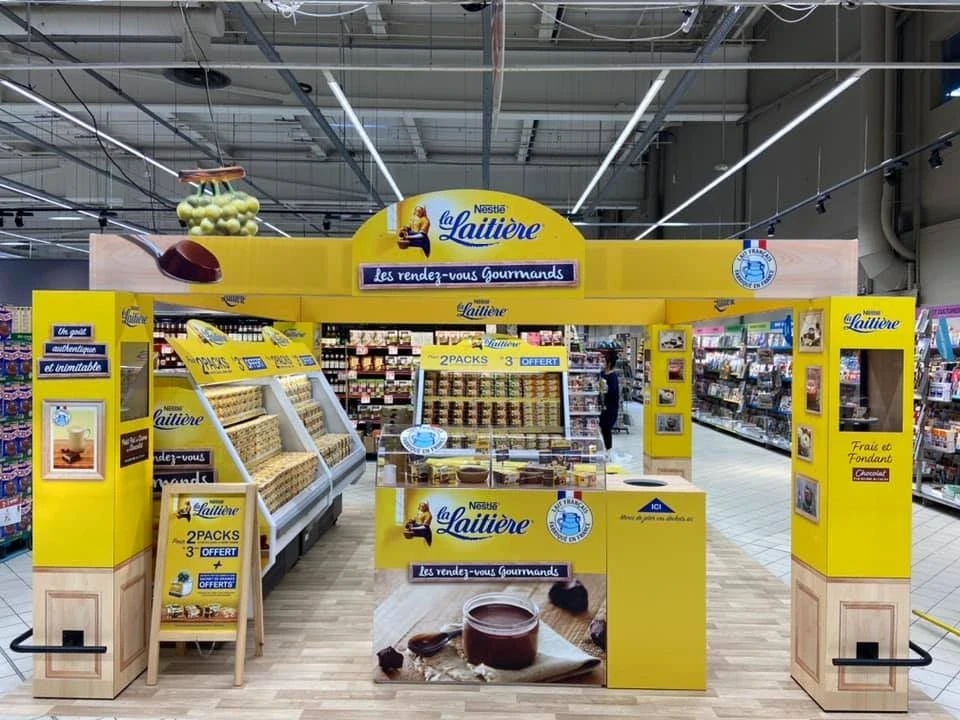
Credit: Carrefour Ormesson
Finally, shop-in-shops allow for strategic partnerships between strong brands. The opening of Lego France's first permanent corner shop in a FNAC store in December 2023 is a prime example.
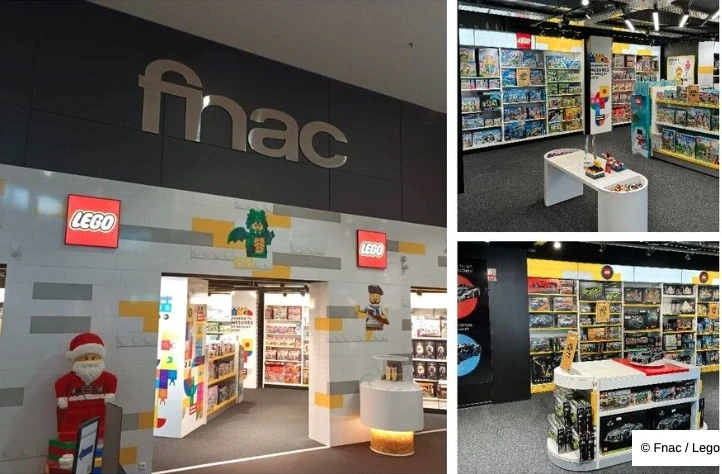
Credits FNAC / Lego
How are shop-in-shops managed?
These mini points of sale can be launched under different forms of partnership. This table helps to understand the various aspects of the collaboration.
Shop-in-shop managed by the Store | Dedicated shop-in-shop | Concession shop-in-shop | |
|---|---|---|---|
Definition | Boutique in which everything is managed by the host store | Boutique where agreements between the brand and the host store split the powers and commitments of both parties | Tenant boutique inside a department store. E.g., Lacoste at Galeries Lafayette |
Brand autonomy | None | Low or medium | High |
Offering | Managed by the retailer | Agreement between brand and retailer, or managed by the brand | Managed by the brand |
Merchandising | Managed by the retailer | Agreement between brand and retailer, or managed by the brand | Managed by the brand |
Brand image | Managed by the retailer | Agreement between brand and retailer, or managed by the brand | Managed by the brand |
Stock | Managed by the retailer | Purchased by the retailer or managed by the brand | Managed by the brand |
Staff | Retailer's staff | Agreement between brand and retailer | Brand's staff |
Checkout | Managed by the retailer | Managed by the retailer | Managed by the brand |
How to set up a shop-in-shop in supermarkets/hypermarkets?
If you plan to roll out this type of strategy, you will need to go through several essential steps.
Here are some key points of reflection to integrate into your strategy.
Choice of retailer / host store
To successfully integrate a shop-in-shop, the choice of host store is of crucial importance. It is imperative to select an establishment whose customer base matches the audience you are targeting. Another possible approach: if you are launching a product in a new customer segment, you can accelerate its promotion by placing it in a strategic point of sale that already attracts that clientele.
Another sensitive point: it is essential to look into the reputation of the point of sale. Social media and Google reviews, for example, can be valuable tools in this process. And for good reason, the reputation of the host brand can have positive or negative repercussions on the perception of your own brand.
Finally, you must assess how open the host store's management is to collaboration, as this will help facilitate the implementation of the shop-in-shop and, above all, its improvement, which necessarily involves regular monitoring and feedback.
Location selection
Contractual negotiations will have a significant impact on the results of the operation: this goes beyond agreeing on the design of the shop-in-shop, POS displays, or communication materials. Indeed, discussions with the retailer are important in determining the most strategic area to select.
As a general rule, the entrance of the store is the space used. This is where hypermarkets position strategic, often highly theatrical promotions. Therefore, every effort must be made to secure this strategic space. And if that is not possible, it will be essential to carefully study customer flow within the point of sale to ensure maximum visibility for your products or services. Understanding the customer journey in the store concerned is a key element to consider.
Inventory management
To maximize the effectiveness of the shop-in-shop, close collaboration with your retailer is essential. Together, you will define procedures to monitor inventory levels, thereby minimizing the risks of out-of-stock situations or overstocking.
At the same time, you will develop a supply schedule based on sales forecasts. For this, take into account planned promotional actions, but also historical sales data observed in your other shop-in-shops during similar periods.
Setting objectives
In most cases, the shop-in-shop aims to allow you to drastically increase your market share in a store: by benefiting from a dedicated point of sale instead of your usual shelf share, your objective is to cannibalize revenue on a product or on your entire product range.
If you think in terms of results rather than market share, make sure that the additional margin generated by your sales corner covers—and then makes profitable—the cost of its deployment. However, an exception could exist: if your brand is new to the market, a marketing campaign that does not show a profit margin can still be justified by a significant gain in brand awareness. Indeed, brand visibility is often a prerequisite for its commercial success.
Performance monitoring of the shop-in-shop in supermarkets/hypermarkets
Maintaining the performance of your sales corner in supermarkets/hypermarkets requires close collaboration with the host chain or point of sale. Nevertheless, for performance monitoring, it is often the brand that has to manage on its own by gathering internal information and conducting in-store checks. Furthermore, these reports must often be consolidated by cross-referencing Sell-in and sell-out data.
Indeed, the financial impact of the shop-in-shop must be evaluated through sales analysis. It will therefore be necessary to calculate its return on investment (ROI).
In addition, your area managers will need to make regular visits to the relevant points of sale to ensure compliance with contractual agreements, especially regarding the layout of communication elements. This guarantees the maintenance of an optimal quality level of the commercial offer, thereby contributing to consistent customer satisfaction.
If the shop-in-shop is deployed in a point of sale where your products were already distributed, a before/after comparison of sales levels can already be a good performance indicator. As always, checkout data is essential for analyzing sales at a store level.
If, on the contrary, it is a new creation—meaning you have no history with the store in question—take the time to define the right objectives, and specify the means to verify results in the partnership contract.
Finally, note that the KPIs required for performance analysis vary according to the collaborative model (see table above). The case of concessions is relatively simple: your own checkout records allow you to obtain the desired level of analysis in the reporting.
On the other hand, as soon as the checkout is managed by the retailer, you will need to study the usual indicators for brands in supermarkets, such as the evolution of numeric distribution (relating to the assortment present in the shop-in-shop). For this, equip yourself with a mobile application featuring shelf scanning.
The shop-in-shop therefore constitutes a collaboration in which both the brand and its retailer win. The manufacturer benefits from the traffic of an existing point of sale and runs its strategy at a lower cost, and the retailer deploys new sales strategies that allow it to better resist the rise of online shopping or department stores.
Knowing these strategic advantages and the interest your retailers will have in supporting you in this endeavor allows you to boost your field marketing, and ultimately, to develop your sales revenue in supermarkets/hypermarkets. To achieve this, it will be essential to prepare the partnership, carefully define the collaboration with the point of sale, and ensure you can analyze the results with precision!
It was by observing the still-fledgling digitalization of sales forces that Arthur envisioned Sidely. A graduate of EM Lyon and Le Wagon, he combines a rare commercial rigor with a true product culture. This dual expertise allows him to decipher the shifts in the profession and build a product that truly speaks to sales teams.
See also

Artificial intelligence and field professions: what our 2026 studies reveal
Adoption, barriers, use cases: discover what our three studies reveal about the role of AI among sector managers, sales representatives, and foodservice sales reps.

CHR and RHF Sales Representatives: portrait of a relationship-driven profession in the era of data
Equipment, productivity, AI: discover the major trends for the HORECA and food service sales profession in 2026 through our field study.

Pharmaceutical Sales Representative in France: Portrait of a Field Job Under Pressure
Compensation, aspirations, AI usage: discover the major trends in the pharmaceutical sales representative profession in 2026 through our field study.

Area Sales Managers in France: who are they and how is the profession evolving in 2026?
Compensation, aspirations, AI usage: discover the major trends in the field sales representative profession in 2026 through our field study.
The area manager professions in 2026
Discover the trends, the challenges, and the key figures.