

Time Management: How to Improve Sales Force Performance
Your sales reps only spend 1/3 of their time in meetings: help them optimize their time to sell more!

In short
5 min read
Sales representatives spend about 2/3 of their time on tasks not directly related to selling.
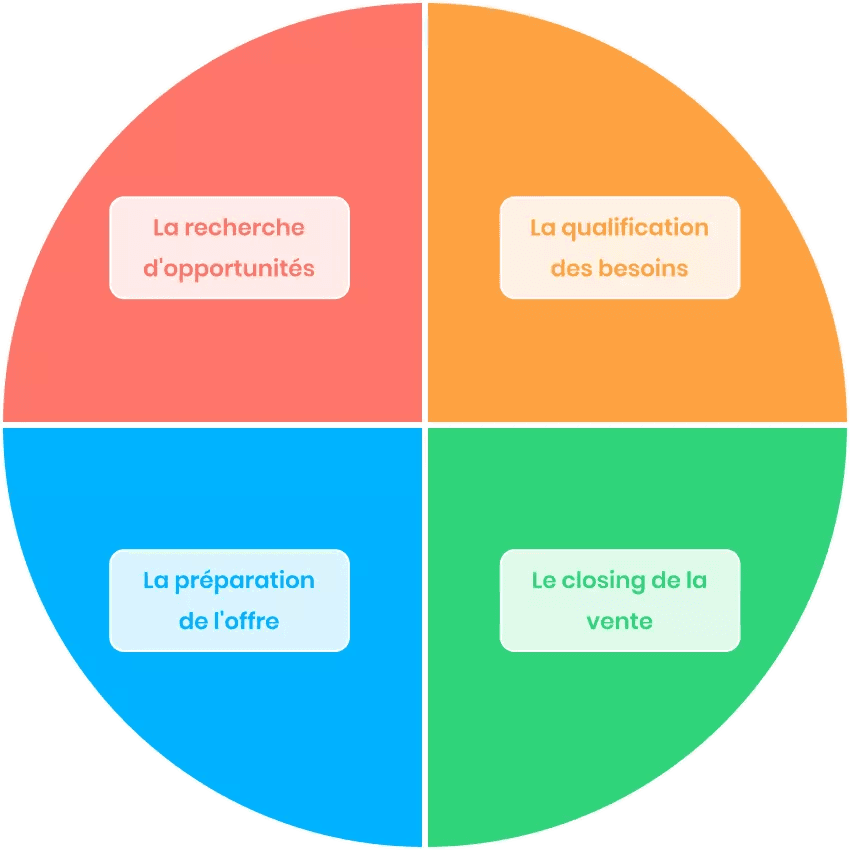
Sales activity is structured into four phases: finding opportunities, qualification, proposal preparation, and closing.
Productivity is hindered by time-consuming administrative tasks and difficult access to customer information.
An unsuited CRM, perceived as a constraint or a monitoring tool, is often abandoned by teams.
Mobility requires 'mobile-first' tools that allow data access, even offline, to optimize time in the field.
Six key levers to improve performance: auditing tasks, optimizing processes, adopting suitable tools, automation, training, and empowering employees.
Why do your sales reps spend only a third of their time selling? This question might seem like bait for your readers, but it actually represents a reality that is not always pleasant. And with good reason: the allocation of sales reps' working time is a point of tension in many companies.
That your sales reps do not spend 100% of their time selling will obviously come as no surprise to you. However, chances are that the actual time your sales forces devote to business development is well below what you imagine.
So, what would your reaction be if I told you that your sales reps actually spent nearly 2/3 of their days on activities unrelated to selling and, consequently, generating no revenue?
How is a sales rep's activity divided?
In theory, a sales rep's activity is divided into four key stages:
Searching for opportunities, meaning identifying business opportunities through prospecting (finding new potential clients) or by detecting needs among existing clients (upsell/cross-sell);
Qualifying needs, meaning understanding what the client is looking for, what their expectations, problems, and goals are. The purpose is to ensure that your offer or products will suit the client's needs;
Preparing the offer, meaning creating a commercial proposal, determining prices, terms, and delivery times;
Closing the sale. This is the moment when your client will make their purchasing decision.
The challenges of optimizing sales performance
Days cluttered with low-value-added tasks
Whether it's looking up information, scheduling appointments, or performing administrative tasks (meeting reports, expense reports, updating information systems...), a sales rep's day is cluttered with a multitude of tasks impacting their productivity, and over the long term, their motivation.
In the majority of companies, sales reps do not have access to tools that allow them to better organize their day and maximize their selling time in the field. This premise is worrying, since proper time management is the hallmark of a good sales rep. It is therefore crucial for the company to help the sales rep reduce the tasks that hinder their productivity.
Access to information: the core of the problem?
The control and distribution of information are major issues for companies. The lack of visibility regarding a prospect or a client (interaction history, past contracts, order history...) gives the sales rep an additional workload that takes them away from selling. The sales rep must be able to easily access all the information that will allow them to prioritize their sales activities and maximize their sales potential.
Consistency in information must also be a priority, given that the success of many opportunities depends on proper command of company data. It is inconceivable that you or your employees should miss a deal because an employee is sick, or another has left the company without sharing their interaction history with a client/prospect.
CRM, a catalyst for tension
An tool that very often crystallizes the majority of tensions between sales reps and management, CRM is frequently singled out by sales reps as one of the main causes of their loss of productivity.
Never up-to-date, too time-consuming to fill out, too complex to use... The reasons why a CRM is neglected by sales forces are numerous.
Originally intended as a productivity tool (see Why invest in a CRM), a poorly used CRM can even become counter-productive. The frustration resulting from using an unadapted solution means that CRM is most often perceived by sales reps as a punishment and a means of 'tracking' their activity, rather than an everyday ally.
Not all systems experience this same resentment from sales reps—those that allow clear tracking of their sales cycles, current opportunities, and the ability to link documents are the most popular tools.
Mobility: the daily life of your sales force
As we saw above, the 'simple' implementation of a CRM (an understatement, as implementing many systems can prove painful) is not a systematic solution to your problems.
Since most systems have been thought out and designed for desk-bound use, your mobile users will not be able to benefit from these tools, which will then be perceived as a punishment. How many times have your sales reps found themselves before a meeting, in their car in the parking lot, laptop on their lap, tethered to their phone, desperately searching for signal to access the company's database? How much time have they spent re-entering their meeting reports into your information systems in the evening at home or at the hotel? What about days wasted looking for lost receipts and processing expense reports?
Considering the investment and time that setting up a CRM will certainly represent, you cannot afford for the deployed solution to be neglected by your sales reps. An assessment and a good understanding of your needs will therefore be essential.
6 concrete actions to put in place to improve sales performance
1. Conduct an assessment
First and foremost, it is essential for you to conduct an audit to understand exactly which tasks are taking your sales reps away from selling. To perform this diagnosis, collaborate with your teams: collect and list their feedback, ranking them from most to least frequent.
2. Rethink your processes
Processes for handling administrative tasks rarely keep pace with a company's growth, and some of them can represent a bottleneck to your growth. Do your sales reps spend half a day a week processing their expense reports? It might be time to rethink how they are handled!
3. Adopt the right tools
Technology and digital solutions are your best allies. Despite digitization in the professional world, the field sales profession remains very artisanal. Are you sure you are setting your teams up for success by giving them access to tools to help them increase their daily productivity?
To help you determine which CRM tool best fits your sales organization, it is important to ask yourself several key questions.
4. “Less is better”
Eliminate or automate redundant and time-consuming tasks with low added value. Chances are that a good many of these can be automated, if not eliminated, to free up valuable time for your employees.
5. Train your sales reps
Training your employees is also crucial to get the best out of your sales reps. Whether it’s time management or using company tools, your employees need to know company resources inside out, otherwise their engagement may falter.
6. Trust your employees
Management interference and 'micro-management' can have harmful consequences not only on your employees' productivity, but can more broadly contribute to a loss of trust and demotivation that will heavily impact their performance.
Business solutions, the key to your teams' productivity
To optimize your company's sales organization and allow your sales reps to maximize selling time, there are solutions adapted to their daily routines and the realities of their job.
On the move, your teams do not have time to enter superfluous information, and are looking above all for a simple and effective assistant that allows them to effortlessly track their sales pipeline. They need a mobile-friendly CRM.
Collaboration is also a key success factor for your sales reps: chat, collaborative database, news sharing, document management—your sales reps' solution must allow them to access information anywhere, anytime, with or without network coverage.
While software publishers have ignored the field for far too long, solutions for mobile sales reps are gradually appearing with the ambition of helping sales reps find pleasure and value in using the CRM.
Sidely is a 'mobile-first' sales force software (thought out and designed for the mobile user) that accompanies the field sales rep daily, whether they are prospecting, on customer routes, or at trade shows, allowing them to finally regain control of their daily routine.
Angela heads up Customer Success at Sidely. She leads her team with an approach that is both highly human-centric and deeply product-oriented. This dual perspective—understanding customer needs while mastering how technology solves them—allows her to see what others miss. She supports sales teams by experiencing their daily challenges alongside them.
See also

Artificial intelligence and field professions: what our 2026 studies reveal
Adoption, barriers, use cases: discover what our three studies reveal about the role of AI among sector managers, sales representatives, and foodservice sales reps.

CHR and RHF Sales Representatives: portrait of a relationship-driven profession in the era of data
Equipment, productivity, AI: discover the major trends for the HORECA and food service sales profession in 2026 through our field study.

Pharmaceutical Sales Representative in France: Portrait of a Field Job Under Pressure
Compensation, aspirations, AI usage: discover the major trends in the pharmaceutical sales representative profession in 2026 through our field study.

Area Sales Managers in France: who are they and how is the profession evolving in 2026?
Compensation, aspirations, AI usage: discover the major trends in the field sales representative profession in 2026 through our field study.
The area manager professions in 2026
Discover the trends, the challenges, and the key figures.