

The role of the sales promoter
Discover the role of the sales promoter, their missions, and the tools they use to improve in-store performance.

In short
6 min read
The sales promoter guarantees operational execution at the point of sale, converting commercial agreements into actual product visibility and availability.
They play a strategic role in limiting revenue losses related to out-of-stock situations, which push 70% of consumers to switch brands.
Their main missions include compliance with planograms, stock replenishment management, sales promotions, and conducting competitive intelligence on the ground.
They provide an essential interface between the strategy defined at headquarters and the reality on the ground, by coordinating their actions with area managers and store teams.
The profession is becoming highly digitalized through mobile CRMs, allowing for better route planning and real-time information feedback for agile decision-making.
In a retail outlet, a product's performance is not determined solely during negotiation. It is played out above all in its execution on the shelf. Between a signed agreement and a product that is actually visible, available, and well-positioned, the gap can be significant.
According to industry studies, between 7% and 10% of turnover is lost each year due to out-of-stock situations, with peaks reaching up to 7.4% in consumer goods (NielsenIQ). On the consumer side, the impact is immediate: 70% switch brands and 30% switch stores when a product is unavailable (NielsenIQ).
In other words, performance is not only about the offer… but about its actual presence on the shelf. This is precisely where the sales merchandiser comes in.
The sales merchandiser is responsible for developing sales of a product or a range. They act directly in-store to ensure its visibility, availability, and promotion. Beyond their operational missions, the sales merchandiser plays a key role in the distribution chain. They form the link between the strategy defined beforehand and its concrete implementation in-store. While decisions are made at headquarters, they are the ones who make them visible, tangible, and effective on the ground.
In a context of increased competition at the point of sale, where every SKU fights for consumer attention and where product availability becomes decisive, this role takes on an even more strategic dimension.
This article attempts to answer the following question: What are the key missions of a sales merchandiser today?
To do this, we propose to concretely decipher their role: their missions in-store, their place in the commercial ecosystem, their interactions with field teams and partners, the tools they use on a daily basis, as well as the flow of a typical day.
Role and missions of the sales merchandiser
The role of the sales merchandiser is fully integrated into execution at the point of sale. Their goal is simple: to transform a brand's presence into real performance, by acting directly on the visibility, availability, and attractiveness of products.
Shelf placement and merchandising
The merchandiser ensures compliance with planograms and the proper placement of products. They optimize their positioning, adjust facings, and set up POS materials to maximize their visibility.
Inventory management and restocking
In-store, a stockout means a lost sale. The merchandiser ensures that products are readily available, identifies gaps on the shelves, checks inventory in the back room, and puts the necessary SKUs back in place. This vigilance helps limit turnover losses related to product unavailability.
Commercial activation
Depending on the operations, they may set up tastings, demonstrations, or promotional setups. These actions make it possible to create engagement in-store, highlight products, and accelerate their rotation.
Monitoring execution of commercial agreements
They verify that the conditions negotiated beforehand (pricing, promotions, location) are indeed respected in-store. In the event of a discrepancy, they report the information to quickly correct the situation.
Relationship with store teams and consumers
In direct contact with the retail outlet, they advise, answer questions, and train teams on product characteristics. This proximity strengthens both commercial efficiency and brand image.
Competitive intelligence
They observe the practices of competing brands on shelves: positioning, pricing, POS, current promotions. This information is passed back to sales teams to adjust strategy if necessary.
The sales merchandiser compared to other field jobs
Before going into the details of the missions, it is useful to clear up a common ambiguity. The sales merchandiser is often confused with other field profiles. Yet, each intervenes at a specific point in the distribution chain, with different but complementary responsibilities.
Sales merchandiser vs. sales representative
The sales representative acts upstream, by developing the client portfolio and negotiating agreements with retailers. The merchandiser then steps in to apply these agreements on the ground. In other words, the sales representative builds the conditions for sale while the merchandiser guarantees their execution in-store.
Sales merchandiser vs. area manager
The area manager drives the commercial strategy over their territory, negotiates with retail outlets, and defines action priorities. The sales merchandiser, for their part, steps in to deploy these decisions in-store and adjust their implementation based on field reality. Unlike the area manager, they do not have a negotiation role: they apply the agreements already established. The two roles function complementarily: one sets the course, the other ensures it is actually followed.
Sales merchandiser vs. pure merchandiser
The pure merchandiser focuses mainly on product setup, often on an occasional basis, during planogram changes or shelf reorganizations. The sales merchandiser, on the other hand, operates within a continuous follow-up logic. They do not just set up: they return, observe, adjust, and continuously optimize product performance in-store.
The sales merchandiser is thus positioned between commercial strategy and store implementation. Their role consists of transforming agreements into concrete results, by ensuring the visibility, availability, and performance of products in the field.
How to become a sales merchandiser?
The sales merchandiser profession remains accessible through various pathways. A vocational high school diploma in commerce, a 2-year technical degree in sales, or a bachelor's degree in business or marketing provides a solid foundation. Initial experience in sales or large retail is generally an asset, as it helps better understand point-of-sale challenges.
But beyond diplomas, it is above all field skills that make the difference.
Technical skills
Mastery of merchandising techniques and product knowledge
Use of tracking and reporting tools (CRM, Excel, PowerPoint)
Ability to organize promotional activities and events in the field
Personal skills
Excellent interpersonal and communication skills
Autonomy, organizational skills, and dynamism
Persuasiveness, adaptability, and negotiation skills
Compensation and working environment
Compensation is generally between €25,000 and €35,000 gross annual, to which bonuses linked to objectives can be added. The job involves mostly field-based work, with regular travel and a fast-paced environment geared towards performance.
Career progression prospects
With experience, there are many opportunities: area manager, merchandising manager, trade marketing manager, or even head office positions in marketing or key account management (Regional Sales Manager, Merchandising Manager, Trade Marketing Manager, etc.).
Relationships with teams and partners
The sales merchandiser is not an isolated execution agent. They operate at the heart of an ecosystem where they connect the brand, the sales teams, and the retail outlet.
In the field, they work in constant interaction with store teams. They exchange ideas with department managers, advise on product displays, explain ongoing operations, and facilitate their setup. A well-placed product relies as much on negotiated agreements as on the ability to collaborate effectively with field teams.
They also play a supporting role: by presenting products, sharing sales arguments, or explaining promotional schemes, they help store teams feel more comfortable selling.
But it is especially in their relationship with the area manager that the merchandiser's role takes on its full dimension. As mentioned earlier, both function in complementarity and continuous coordination. The area manager defines priorities, negotiates agreements, and drives performance, while the merchandiser intervenes in-store to execute, adjust, and enforce these decisions.
Concretely, they share information, align priorities, and track results together. The merchandiser reports shelf setup discrepancies, signals stockouts, shares field feedback, and warns in case of non-compliance with agreements. These exchanges allow the area manager to adjust their strategy and prioritize actions to be taken.
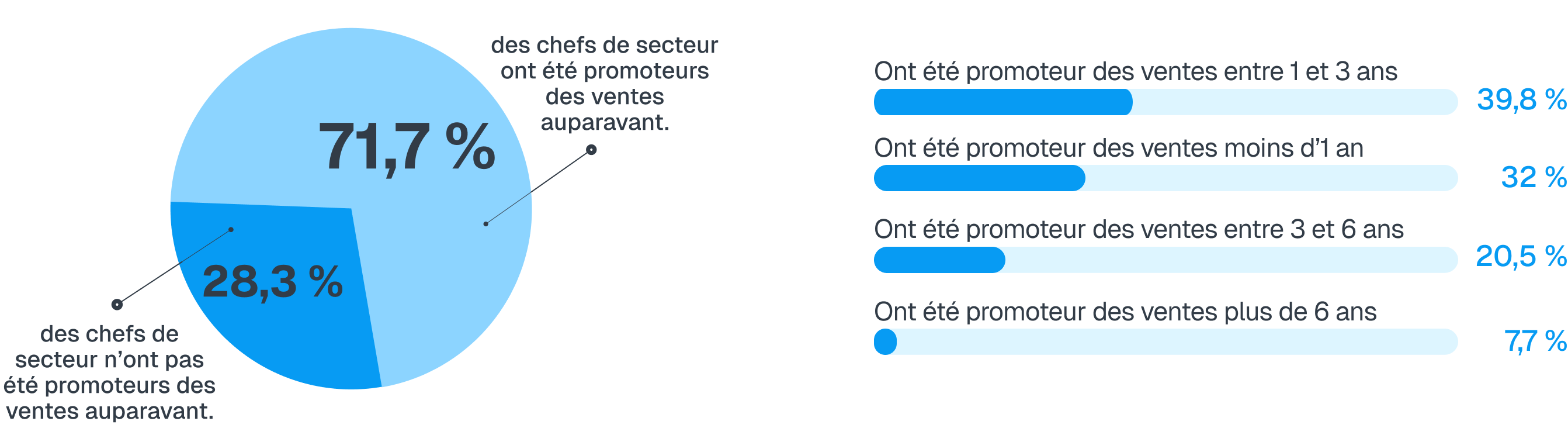
This complementarity is often part of a career progression path. According to the Sidely study on the area manager profession, 28.3% of area managers held a sales merchandiser position before moving up. 39.8% of them performed this role for 1 to 3 years, while 32% stayed in it for less than a year. Experience, even brief, in the field is often sufficient to advance to higher-responsibility positions.
Source: Sidely area manager study
Beyond these reports, the merchandiser intervenes directly to optimize performance: they observe the competition, analyze shelf practices, adjust facings, and carry out the necessary replenishments. They thus stand out as an essential link between the field and the commercial teams.
The tools of the sales merchandiser
The profession has progressively gone digital. Where it once relied mainly on observation and manual tracking, the sales merchandiser today relies on tools that make it possible to better manage activity and act more effectively in-store.
Mobile applications and field CRM
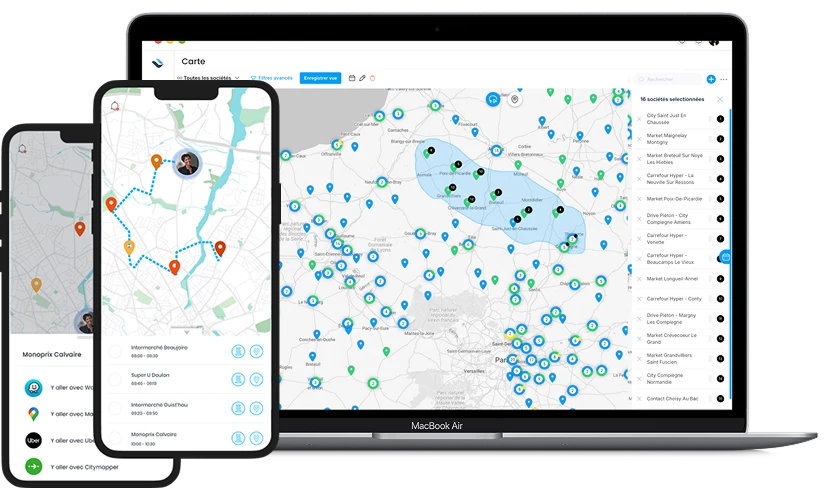
On a daily basis, they use mobile applications to organize their routes, prioritize visits, and track their actions. These tools centralize key information: objectives, visit history, performance by retail outlet, or alerts on stockouts.
These tools primarily help structure visits and better target priorities. Mobile CRM applications for field sales reps therefore facilitate the tracking of actions and avoid wasting time on low-value tasks.
Route planning and optimization
One of the major challenges of the job remains time management. Not all retail outlets are equal, and not all visits have the same impact.
Today's tools allow for optimizing and planning commercial routes by prioritizing stores based on their potential, observed discrepancies, or actions to be carried out. This approach avoids unnecessary travel and concentrates efforts where they are truly needed.
It is a key lever for limiting unproductive visits and maximizing time spent on high-impact actions.
Source: Sidely CRM
Real-time reporting tools
They rely on reporting tools that allow them to instantly report field information: photos of shelves, price audits, display tracking, or signaling of stockouts. This ability to quickly report information allows actions to be adjusted without waiting, and even without an internet connection, data can be entered and then synchronized automatically, ensuring continuity in field tracking.
We no longer observe after the fact: we correct directly in-store.
POS and physical displays
Alongside digital tools, physical materials remain essential. POS (point-of-sale advertising) displays play an important role in the purchasing decision.
When well used, they can generate a 20% to 25% increase in sales according to InGoods, by improving visibility and triggering impulse purchases. The merchandiser's role therefore consists of setting them up, but above all ensuring they are well-positioned and truly visible.
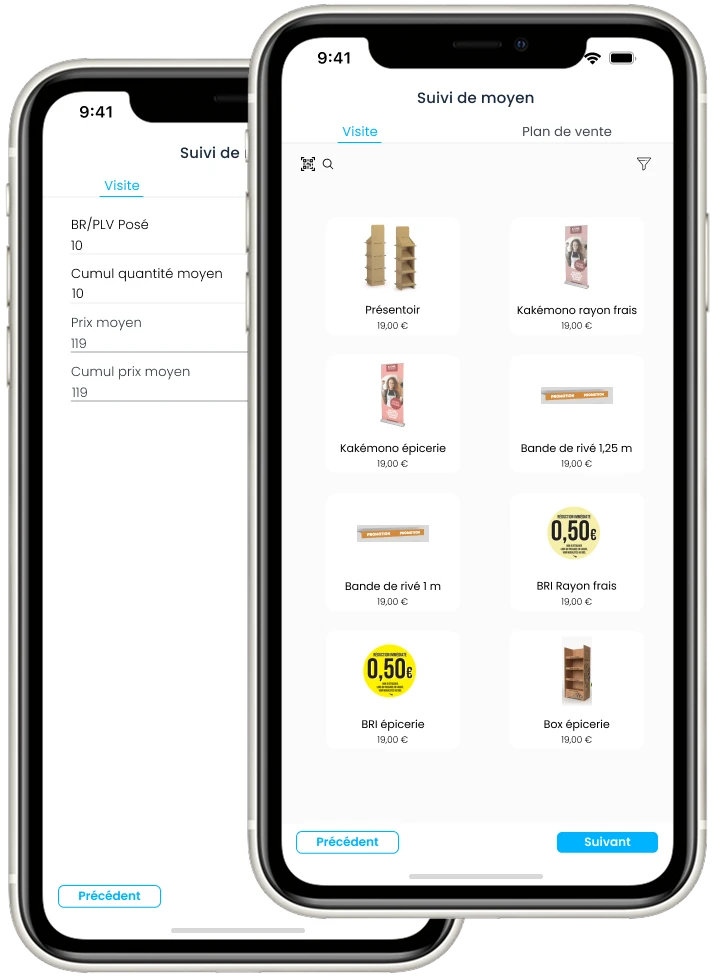
In this context, tools like a field CRM allow for better tracking and management of these displays: verifying their presence in-store, ensuring compliance, tracking setup dates, or sending back their status via field photos. This prevents discrepancies between what is planned and what is actually installed.
These actions are part of a broader logic of in-store marketing, where visibility, location, and execution play a direct role in commercial performance.
Source: Sidely CRM
The digitalization of the profession
This development is all the more important as field execution has a direct impact on sales. According to several studies on in-store purchasing behavior, nearly 60% of purchase decisions are influenced by merchandising and product displays (In-Goods, 2023). These elements show that in-store execution is not a simple operational issue, but a direct lever for commercial performance. To optimize commercial routes and maximize time spent in-store, tools primarily allow for targeting retail outlets with the highest potential, based on observed discrepancies or identified opportunities. The goal is clear: concentrate efforts where they will have the most impact.
These tools also make it possible to track key indicators such as numeric distribution, stockout rates, or display compliance, in order to concretely measure the performance of the actions taken.
What does a typical day for a sales merchandiser look like?
8:00 AM. The day begins even before arriving at the store. On my CRM, I check my priorities: a retail outlet with reported stockouts, another where a promotional setup needs to be put in place, and a third with high potential to be reworked. The route is planned, but as is often the case, it may change.
9:00 AM. First store. I take a quick look at the shelf and that's enough to understand. Some products are well in place, others have disappeared. A planned promotion is not visible. I analyze, then head to the stockroom, find the missing products, replenish the shelf, adjust the facings, and install the promotional materials. In a few minutes, the shelf looks completely different. Before leaving, I talk with the department manager. I remind them of the ongoing operation, explain the goals, and make sure everything is clear.
10:30 AM. Second retail outlet. Here, everything is in place… but the competition is particularly visible. I spot the gaps, observe the other brands, adjust the shelf layout, and try to bring visibility back to my products. Every detail counts. Between two visits, I take a few minutes to report the information to headquarters: photos, observed discrepancies, actions taken.
12:00 PM. Third store. An in-store activation is planned. I set up the display, attract customers, present products, and answer questions. The goal is no longer just to be visible, but to trigger the purchase.
4:00 PM. Final adjustments. A store not originally planned on my route requires a quick visit. A stockout is reported, I need to intervene.
5:30 PM. Heading back. I take stock of my day: what was corrected, what still needs to be followed, and the information to be transmitted to improve my performance in each store in the coming days.
A sales merchandiser's day is, above all, a succession of quick adjustments and decisions, with a clear goal: maximize the impact of every store visit.
The sales merchandiser is much more than a simple execution agent. They are the guarantor of performance at the point of sale, the person who transforms commercial agreements into concrete and visible results on shelves.
Throughout this article, we have seen that their missions cover a broad spectrum: from shelf placement to checking commercial agreements, including commercial activation, relationships with teams, and competitive intelligence. All of these actions, put together, have a direct impact on sales and brand image.
But the profession is evolving. The digitalization of field tools, the rise of data, and the growth of artificial intelligence are progressively transforming the way we work. The merchandiser no longer just observes and acts: they manage, measure, and anticipate. Field CRMs, real-time reporting tools, and mobile applications now allow them to prioritize their actions, adjust their decisions, and maximize the impact of every visit.
In this context, brands that invest in their field teams and in the right tools gain a competitive edge. Because in an environment where 70% of consumers switch brands when faced with a stockout, every single store visit counts.
Taina left her position as Area Manager at AB InBev for marketing and communications, a true career choice. Having experienced the reality of the sales force from the inside, she writes about the profession without ever distorting it. She doesn't just talk about the field; she comes from it. Outside the office, she tracks down the best tables in town: finding the right spot is a serious business.
See also

Artificial intelligence and field professions: what our 2026 studies reveal
Adoption, barriers, use cases: discover what our three studies reveal about the role of AI among sector managers, sales representatives, and foodservice sales reps.

CHR and RHF Sales Representatives: portrait of a relationship-driven profession in the era of data
Equipment, productivity, AI: discover the major trends for the HORECA and food service sales profession in 2026 through our field study.

Pharmaceutical Sales Representative in France: Portrait of a Field Job Under Pressure
Compensation, aspirations, AI usage: discover the major trends in the pharmaceutical sales representative profession in 2026 through our field study.

Area Sales Managers in France: who are they and how is the profession evolving in 2026?
Compensation, aspirations, AI usage: discover the major trends in the field sales representative profession in 2026 through our field study.
The area manager professions in 2026
Discover the trends, the challenges, and the key figures.