

Equalization and margin pools: the financial strategies of mass retailing
Do your distributors' pricing policies seem incomprehensible to you? You might be missing a few technical concepts. We'll explain everything!

In short
6 min read
Margin volume represents the total profit generated by a product or department, calculated based on sales volume and not just as a percentage of the margin rate.
Margin equalization is a financial balancing technique that consists of modulating margins across different products to optimize the overall profitability of a banner.
Pricing strategies (competitive, dynamic, psychological) are dictated by a triple pressure exerted by customers, competitors, and suppliers.
Retailers may intentionally reduce the unit margin on certain loss leaders to increase volumes and thereby increase the overall margin volume.
Product innovation allows retailers to partially escape market pressures, due to the lack of an established psychological price and direct competition during the launch.
For brands in supermarkets (GMS), mastering these concepts is crucial to anticipate retailer strategies during annual negotiations and protect their own profitability.
Margin equalization... Margin mass... As a brand selling through mass retail, understanding what lies behind these words could very well help you in annual negotiations.
Today, Sidely popularizes two financial strategy techniques used by retailers to increase their profits!
Margin mass: definition and calculation
Margin mass is nothing other than the total margin achieved on a product reference, a department, or even a supermarket. It can be calculated by summing the profits resulting from all sales of the concerned product, department, or point of sale over a given period.
But then, what is the interest?
This result is of particular interest to mass retail players, who know that the margin rate in itself is an insufficient indicator to evaluate the profits generated on a product. Indeed, the margin rate evaluates the potential profitability of an item, but not the profits that the retailer will realize on its sales, which also depend on sales volume.
This is why retailers and stores are sometimes willing to reduce their unit margin, if it can allow them to sell more products and thus increase their margin mass, meaning their total profit.
For example, suppose a product has a unit margin of $10 and sells at 1,000 units per month, thereby generating a margin mass of $10,000 ($10 unit margin x 1,000 units). If the distributor decides to lower the retail price of this product, which reduces the unit margin to $8, but increases sales to 1,500 units per month, the total margin mass will then be $12,000 ($8 unit margin x 1,500 units).
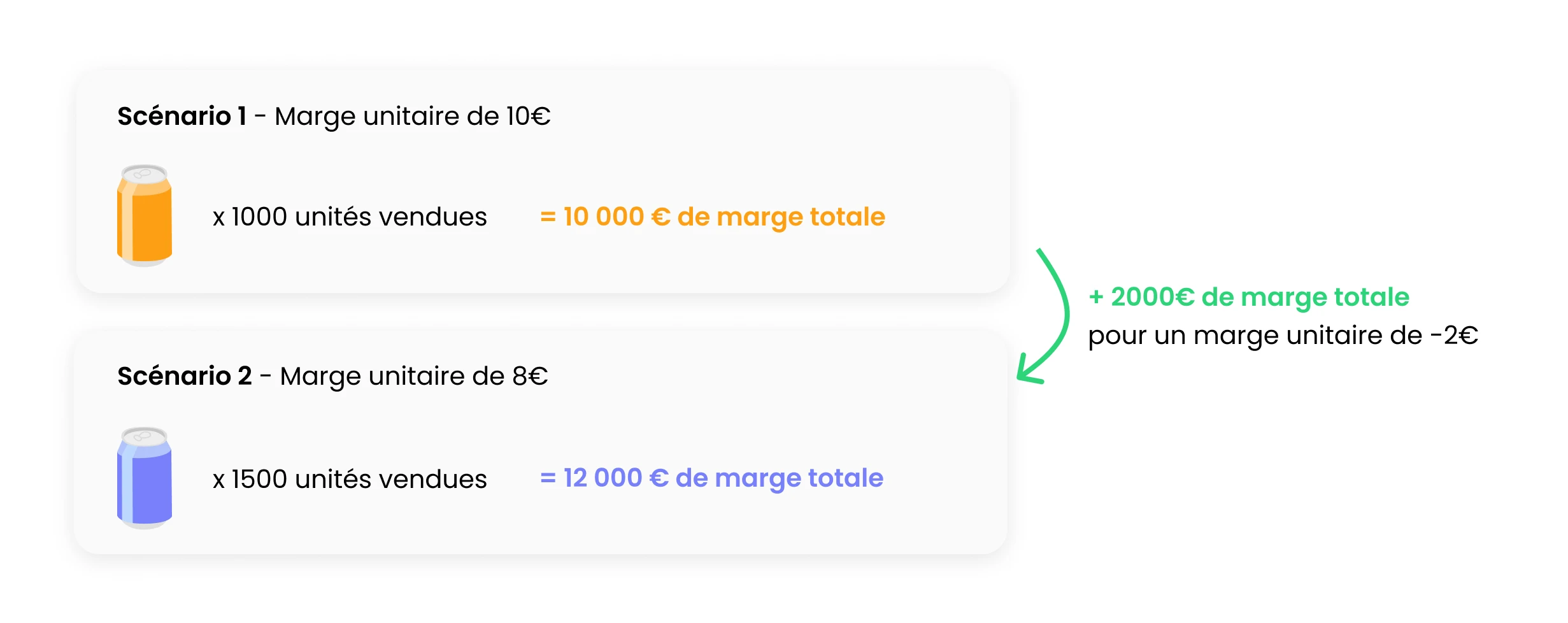
The unit margin went down, but the total margin, or margin mass, went up.
Before understanding how retailers determine margin rates, let's start by understanding what factors trigger this pressure on prices.
Factors that impact prices
If distributors adjust their margins to increase sales volumes, it is because they are under pressure from three types of actors: customers, competitors, and suppliers.
Let's take an example. If we consider that the residents of a region have a psychological price in mind for a one-liter bottle of Coca-Cola, it is unlikely they would accept without flinching a 20% variation from one point of sale to another. This phenomenon exerts a double pressure: that of the psychological price, and that of the prices practiced by the competition. Note that Coca-Cola is one of those major brands that are powerful enough to push their distributors to drastically limit their margin rate. Hence, new pressure from suppliers (this is especially the case in intensive distribution).
Distributors derive three pricing techniques from this:
Competitive: based on the prices practiced by competing points of sale;
Dynamic: by adjusting prices in real-time according to demand and market conditions;
Psychological: by not exceeding the price that shoppers instinctively associate with an item.
But these different techniques do not always allow them to escape market constraints. In some cases - albeit rare - distributors even find themselves experiencing "suffered" prices, due to these games of cross-pressures.
Except that retail giants have more than one trick up their sleeve, and to make sense of it, they use a proven financial management technique: margin equalization!
Margin equalization and overall profitability
As a general rule, when a distributor lowers their margin rate on a product or department, they try to recover the shortfall (in terms of margin rate, therefore) on other items. Thus, the margin rate varies from one product to another, with the distributor seeking the general balance that maximizes the overall margin mass.
This is margin equalization: a technique that consists of distributing the margin in a differentiated manner among products, to obtain the configuration that optimizes overall profit.
Historically, entry-level prices and private labels allowed retailers to increase their average margin rate. Now, new trends and innovation can also be used to achieve much stronger ratios, as Olivier Dauvers explains with the example of plant-based matchsticks.
Let's now see how an innovative product allows the distributor to bypass our three pressure factors (customers, competitors, suppliers):
On a new product, the psychological price does not yet exist;
Furthermore, exclusive distribution of a launching brand can eliminate competitive pressure;
Finally, in this configuration, the supplier is rarely in a position of strength that would allow them to pressure the distributor to lower their margin.
Here is how margin equalization helps optimize margin mass: a distributor can lower their profitability rate on a consumer product and compensate with a very high margin rate on a niche or future product (or a private label).
What about the brands?
Any brand selling its products in mass retail has an interest in understanding these financial mechanics, as they have a huge impact on profitability, assortment, competitiveness, and even merchandising.
Furthermore, when a lower customer price must be offered, it is common for the distributor to try to save their margin by asking the supplier to lower theirs.
Finally, analyzing these pricing strategies can allow brands to decipher the positioning of distributors during annual negotiations (which, otherwise, can sometimes seem quite irrational!).
Manufacturers can thus sharpen their negotiation techniques. For example, the compensation included in the back-margin can be conditioned on sales volume, with the application of tiers. In other words, the supplier can agree to a modulation of their compensation based on the sales volumes achieved during the past period.
The distribution contract must then describe these terms precisely. Brands, however, should be wary of these mechanics, first because they are making a financial bet on the future (what about financial capacity at N+1?), and second because a drop in selling price can impact the image of certain brands.
Note that some brands are no strangers to the practice of margin equalization, an exercise that falls fully within marketing strategy. Thus, it is entirely possible to lower one's margin rate on a loss leader product used to gain awareness or trial for the brand, and to inflate it on a complementary product in order to maximize the final margin mass.
Pretty clever!
Alexis co-founded Sidely after several years of service as a sales director. To understand what builds, or breaks, a salesperson's performance, he conducted more than 100 telephone interviews with field sales representatives. At Sidely, he transforms this raw knowledge into concrete support, based on facts rather than assumptions.
See also

Artificial intelligence and field professions: what our 2026 studies reveal
Adoption, barriers, use cases: discover what our three studies reveal about the role of AI among sector managers, sales representatives, and foodservice sales reps.

CHR and RHF Sales Representatives: portrait of a relationship-driven profession in the era of data
Equipment, productivity, AI: discover the major trends for the HORECA and food service sales profession in 2026 through our field study.

Pharmaceutical Sales Representative in France: Portrait of a Field Job Under Pressure
Compensation, aspirations, AI usage: discover the major trends in the pharmaceutical sales representative profession in 2026 through our field study.

Area Sales Managers in France: who are they and how is the profession evolving in 2026?
Compensation, aspirations, AI usage: discover the major trends in the field sales representative profession in 2026 through our field study.
The area manager professions in 2026
Discover the trends, the challenges, and the key figures.