

5W1H Method: Improve Your Business and Marketing Processes
Who, What, Where, When, How, How much, Why: complete definition of the QQOQCCP (5Ws and 2Hs) method with a concrete example and applications in sales and marketing.

In short
7 min read
The 5Ws and 2Hs method (Who, What, Where, When, Why, How, How much) is a seven-step structured analysis tool for problem-solving.
Its main objective is to systematically collect information to establish an accurate diagnosis and facilitate decision-making.
Applied to the large retail sector (supermarkets and hypermarkets), this method helps to structure annual negotiations with central purchasing organizations.
It also allows for refining marketing customer segments and adapting packaging according to the target audience.
The framework facilitates the standardization of discussions with store managers and department managers.
The approach makes it possible to develop a commercial and marketing strategy based on more solid and rational foundations.
The use of this tool helps identify key parameters influencing a business situation in order to implement effective corrective measures.
Selling ever more: this is the obsession of sales and marketing directors! At the heart of this ambition, there is the human element. Because increasing revenue necessarily involves improving sales processes, and therefore the salespeople.
Today, Sidely explores a tool as simple as it is effective to boost your performance: the QQOQCCP method (the French equivalent of the 5W2H method). Its objective: to facilitate the diagnosis of a given situation in order to implement solutions or corrective actions, all with logic and method.
We might as well tell you right now, sales performance is in the spotlight in this article. 😎
Once we have defined the method and explored its use in sales and marketing, we will see how to leverage it to gain market share in supermarkets (GMS).
Let's go!
QQOQCCP: presentation of the method
What is the QQOQCCP method?
The QQOQCCP method is an analytical tool that structures the examination of a situation around 7 simple questions: What, Who, Where, When, How, How much, Why?
By answering these 7 questions, you get a clear and complete view of a situation, allowing you to better diagnose it and decide what to do. It is also called the QQOQCP method (without the second C) when the "How much" dimension is not relevant.
The main objective of this approach is to collect essential information systematically in order to gain a deep understanding of a situation or problem. This then makes it possible to draw up a clear and comprehensive overview, thereby facilitating decision-making and the implementation of corrective actions.
The QQOQCCP structure thus provides you with a clear and global understanding of a situation by identifying the parameters in which it occurs, in a rational and organized manner, as shown in the table below.
Letter | Question | Description |
|---|---|---|
Q | Quoi (What) | Objective, problem, process to improve. |
Q | Qui (Who) | Stakeholders, actors involved, impacted parties. |
O | Où (Where) | Location or context in which the situation occurs. |
Q | Quand (When) | Time, frequency, duration of the situation. |
C | Comment (How) | Observable effect, mechanism that triggers the situation. |
C | Combien (How much) | Quantification, cost, key figures. |
P | Pourquoi (Why) | Origin and causes of the situation. |
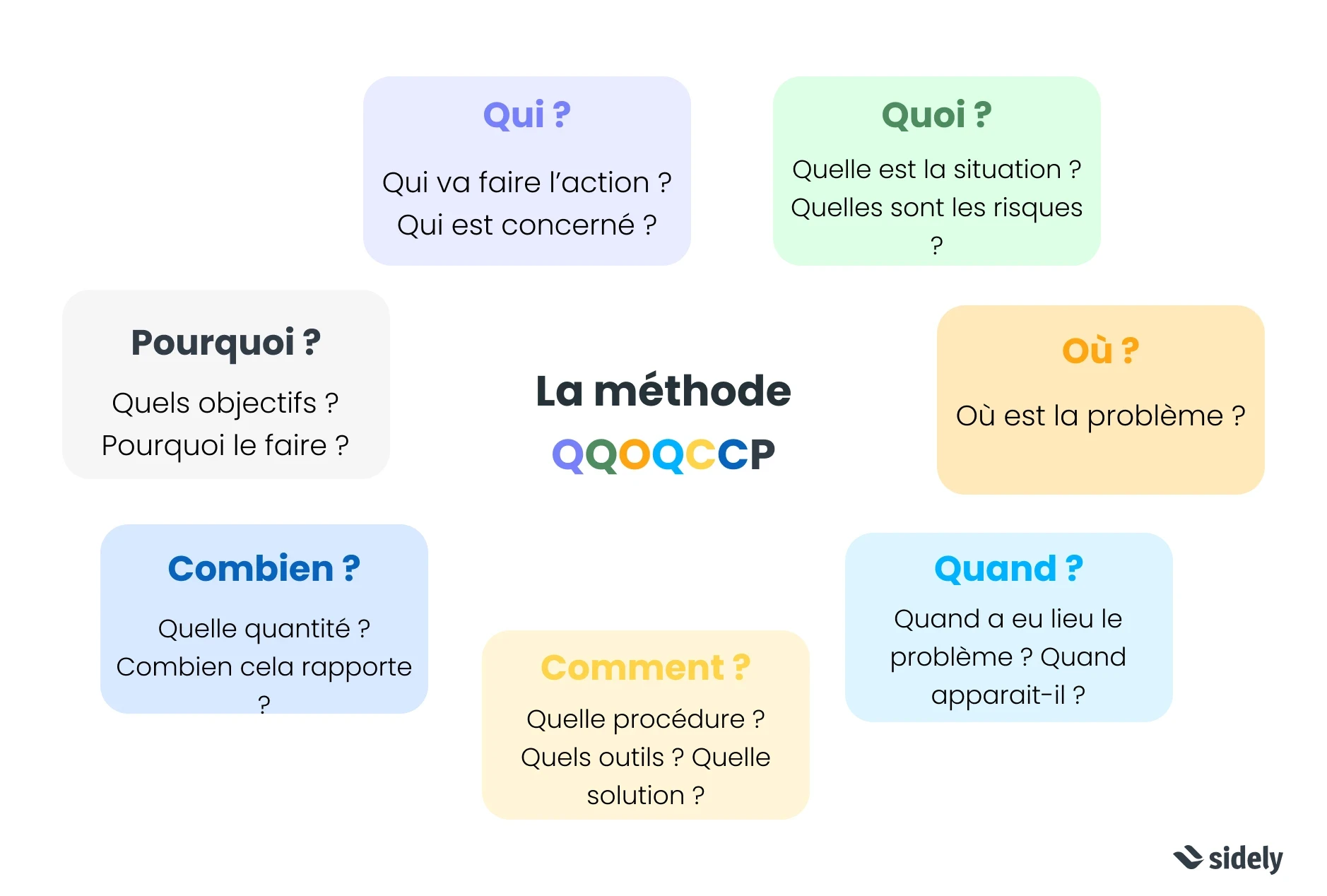
The answers gained through the QQOQCCP questioning form an analysis that allows for the deployment of a tailored action plan. Simple, versatile, systematic, and comprehensive, this method is therefore a powerful tool for problem-solving and analysis in almost any professional environment: project management, market analysis, quality control, or even HR conflict resolution, etc.
💡 In some situations, it is not possible to quantify the subject of the process. In those cases, the "C" for "How much" (Combien) is removed, and the QQOQCCP method becomes QQOQCP.
📚 Origins and evolution
The QQOQCCP method has its origins in the questioning used by the Roman rhetorician Marcus Fabius Quintilianus in the 1st century AD. Quintilian used this approach to analyze situations in a comprehensive and structured way, asking broad questions to understand the various aspects of a problem.
Since Roman antiquity, this questioning framework, termed "quintilian", has transcended ages and continued to serve in countless contexts, including those we have covered in this article.
🇺🇸 English speakers use the acronym 5W: What, Why, Who, When, Where. It is easier to remember, but it must be supplemented with two H's (how and how many) to achieve full equivalence!
The QQOQCCP method in practice
How to apply the QQOQCCP method in 5 steps
Define the problem (the What). Formulate the situation to be analyzed in one clear sentence. This is the starting point: all questioning flows from it.
Go through the 7 questions in order, without skipping any. For each, note down everything you know, and especially what you do not know yet.
Collect factual answers. Rely on concrete data, not assumptions. An empty box = information to go look for.
Identify the causes (the Why). This is the key step: the "Why" transforms a simple overview into a real understanding of the problem.
Build your action plan. The answers obtained give you the concrete levers on which to act. You move from diagnosis to decision.
💡 Tip: always keep the "Why" for last. The first six questions describe the situation, while the last one reveals its cause.
Concrete example: applying QQOQCCP to a recurring delivery delay
Let’s take a common situation: a company notices repeated delivery delays. Here is how QQOQCCP helps frame the problem:
Question | Application to the problem |
|---|---|
What? | Customer deliveries are recurringly arriving late. |
Who? | The logistics department, the carrier, the affected customers. |
Where? | Mainly on deliveries to rural areas and long-distance routes. |
When? | Especially at the end of the month, during peak order periods. |
How? | Orders are prepared late and leave after the carrier's cutoff time. |
How much? | 18% of deliveries affected, which is ~40 packages per week. |
Why? | Understaffing in order preparation during peak periods, which is never anticipated. |
In just a few minutes, the problem goes from "we deliver poorly" to a precise diagnosis: temporary understaffing in preparation, concentrated on end-of-month peaks. The solution becomes obvious: reinforce the team during these periods. This is the entire strength of this method, as it transforms a vague feeling into a measurable and actionable problem.
QQOQCP or QQOQCCP: what is the difference?
Both refer to the same method. The only difference: QQOQCP (with only one C) removes the "How much?" question. It is used when the situation does not lend itself to quantification, such as a relational conflict, an organizational matter, or a qualitative issue.
Concretely:
QQOQCCP = What, Who, Where, When, How, How much, Why → for measurable situations (logistics, production, performance).
QQOQCP = What, Who, Where, When, How, Why → for qualitative situations, without a numerical dimension.
In both cases, the logic remains identical: systematic questioning to understand a situation before acting.
QQOQCCP applied to sales performance
The QQOQCCP method is essential in the sales and marketing sectors, especially in B2B. It is the perfect framework for improving your communication strategies and marketing campaigns, or even boosting your product marketing, since the QQOQCCP method allows you to define buyer personas with specific profiles and needs!
But as you know, at Sidely, what we are passionate about is sales performance. So that is the angle we are going to develop throughout this article.
→ Because the QQOQCCP method should be used without moderation during the entire sales cycle: by asking structured questions, you will be able to clarify the challenges and direct actions toward suitable solutions.
Concrete example: a food-service (on-premise) salesperson facing a product that is not moving
A common situation in the food-service industry: a product listed on an establishment's menu is not selling as expected, and the manager is beginning to doubt its value. Here is how QQOQCCP allows you to frame the problem before the next visit:
Question | Application to the problem |
|---|---|
What? | A product listed on the menu generates very few sales. |
Who? | The manager, the waitstaff, the bartender, the sales rep. |
Where? | At a specific establishment, while the product sells well elsewhere in the sector. |
When? | Since listing, with no spikes even during high-traffic periods. |
How? | The product is in stock but poorly visible, and the waitstaff does not actively suggest it. |
How much? | A few units sold per month, far below the potential of an establishment of this size. |
Why? | No display at the bar, no talking points shared with the team: the product is on the menu but nobody pushes it. |
In a few minutes, the sales rep moves from a discouraging observation ("it doesn't work here") to a clear diagnosis: this is not a product problem, but a visibility and waitstaff ownership problem. They arrive for the visit with a concrete solution (training staff, repositioning the product at the bar, offering promotional display materials) rather than risking delisting.
The benefits for sales activities
In the context of sales prospecting, QQOQCCP can help to:
Evaluate sales potential;
Facilitate lead scoring;
Analyze market needs and reorganize your conversion funnels;
Refine your discovery plans and sales pitches;
Compare salesperson performance based on standardized practices.
We could have gone on listing these for a long time as the method has so many impacts on sales performance. We will now explore the main ones.
Discovery, the cornerstone of sales
The QQOQCCP method allows salespeople to master the prospect needs discovery phase.
Indeed, although the flow of sales meetings varies depending on the industry and target, most companies use the following framework:
Preparation: gather information about the prospect to personalize the approach;
Introduction: build rapport for the conversation;
Discovery: understand the client's true needs and challenges;
Presentation: explain how the product/service can meet these expectations;
Demonstration: allow the prospect to concretely visualize using the product;
Negotiation: address financial and contractual aspects and handle objections;
Closing: clarify next steps to secure the customer's commitment.
This outline clearly shows the crucial importance of the discovery phase, which allows you to launch the sales sequence equipped with information that is as essential as it is decisive.
The QQOQCCP method, through its rigorous nature (some would say academic!), has the advantage of validating the sales fundamentals. The most rigid among you will choose to apply it to the letter and in the order indicated by the acronym. Others will prefer to proceed more naturally in the interview while validating the elements before moving to the demonstration phase.
In any case, using this technique will allow your contact to clarify the answers they give you, and you can then leverage them in your sales pitch.
💡 You can therefore completely combine the QQOQCCP method with the funnel technique, in order to transition from discovery to sale.
⚠️ Be careful to maintain the right rhythm if you use it in telesales or telephone appointment setting: always avoid the "interrogation" effect.
Open-ended questions
Another major benefit of the QQOQCCP method: it has the virtue of "forcing" salespeople to formulate open-ended questions, which prove crucial for identifying prospect pain points.
Example:
You visit two car dealerships to buy a new car.
Here are the first questions asked by the advisors who welcome you:
Dealership A: do you prefer red or blue? (closed question);
Dealership B: what type of vehicle are you looking for? (open question).
Discovery starts off poorly in the first case. The second salesperson, however, prompts you to project yourself into using the vehicle and articulate your need.
Elementary? Not so much: most sales directors who shadow their reps in the field discover that these fundamentals are not mastered, and this does not only apply to juniors…
And because bad habits tend to return quickly, it can be useful to use a proven tool to structure your discovery: the QQOQCCP method! 😉
Sales and negotiation
Next comes the sales phase, and – often – negotiation. Thanks to the QQOQCCP method, you have factual information that arms you to handle objections effectively. Indeed, you just need to build your argument by using the points your prospect provided you, which will define your commercial proposal.
And yes, once the pain point appears during discovery, following up with open questions focused solely on the main challenge is usually enough to close the sale. The right method therefore consists in bringing the prospect's problem to light, and rolling out the questions that logically arise to resolve it. Sometimes, the prospect is not even aware of it themselves, and asking them questions will help them realize it and formulate it.
You will no longer make the mistake of deploying your entire sales pitch, which is tedious for the prospect, especially when they have clearly expressed their problem and are simply waiting for an appropriate response.
The QQOQCP method therefore allows you to filter your arguments. It makes the conversation more natural and allows you to support your contact in solving a problem.
The payoff: an increase in your close rate and revenue, whether your reps are inside or outside sales. It is therefore the performance of the sales department – and thus the company – that is at stake.
Examples of QQOQCCP for a brand in supermarkets (GMS)
Does your brand sell its products in large retail chains?
-> This might be the opportunity to consolidate your sales and marketing processes!
With the QQOQCCP method, you will equip yourself with a thinking framework that will help improve your methodologies in many areas:
Prepare your annual negotiation meetings with buying groups;
Refine your customer segments in marketing;
Review your product packaging according to the target audience;
Structure discussions with store managers and department heads, etc.
It is the perfect framework for developing a sales or marketing approach built on solid foundations.
Here are some examples of key questions to guide your thinking in different retail contexts.
Questions | Buying Group / Retail Banner | Corporate/Integrated Store | Independent Store | Shopper (End Customer) |
|---|---|---|---|---|
Who | Who is the decision-maker for purchasing this product? | Who is the decision-maker for purchasing this product? | Who is responsible for purchasing decisions in your store? | Who influences your purchase choices (friends, family, etc.)? |
What | What is the retail banner's strategy? | What is the banner's strategy? | What is your point of sale's strategy? | What need are you trying to satisfy with this product? |
Where | Which store tiers and points of sale are affected? | What is your trade area? | What is your trade area? | Where do you usually buy this type of product? |
When | Date and duration of the listing | Date and duration of the listing | Date and duration of the listing | How often do you buy this product? |
How | How do you plan to promote this product to customers? | How do you plan to promote this product to customers? | How do you plan to promote this product to customers? | What is your preferred channel for information on new items and promotions (social media, TV, paper circulars, etc.)? |
How Much | What purchase volume are you committing to? | What purchase volume are you committing to? | What purchase volume are you committing to? | How much are you willing to spend on this product? |
Why | Why limit the mandatory assortment? | Why limit the mandatory assortment? | Why limit the mandatory assortment? | Why choose this product over another (quality, price, brand). |
Do you want to improve your sales performance in retail chains?
-> Discover the leading CRM in food-retail (GMS)!
Margot has been working in Tech and SaaS for 8 years, with a multi-product experience that has given her a unique understanding of business challenges. On a daily basis, she analyzes, relentlessly tests, and relies on facts to shed light on market trends and help sales teams move forward.
See also

Artificial intelligence and field professions: what our 2026 studies reveal
Adoption, barriers, use cases: discover what our three studies reveal about the role of AI among sector managers, sales representatives, and foodservice sales reps.

CHR and RHF Sales Representatives: portrait of a relationship-driven profession in the era of data
Equipment, productivity, AI: discover the major trends for the HORECA and food service sales profession in 2026 through our field study.

Pharmaceutical Sales Representative in France: Portrait of a Field Job Under Pressure
Compensation, aspirations, AI usage: discover the major trends in the pharmaceutical sales representative profession in 2026 through our field study.

Area Sales Managers in France: who are they and how is the profession evolving in 2026?
Compensation, aspirations, AI usage: discover the major trends in the field sales representative profession in 2026 through our field study.
The area manager professions in 2026
Discover the trends, the challenges, and the key figures.