

B2B Cold Calling: 20 Techniques to Outperform Your Goals
Preparation, pitch, follow-up… 20 proven techniques to improve the effectiveness of your B2B calls.

In short
10 min read
Rigorously measure your key performance indicators (number of calls, contact rate, conversion, and signing) to identify your levers for improvement.
Rely on concrete data rather than intuitions or superstitions to validate your prospecting techniques and eliminate what does not work.
Adopt a consulting attitude: the true objective is to be sincerely interested in the prospect's challenges through active listening rather than solely focusing on making a pitch.
Focus on transparency and integrity to embody trust, even if that means being honest about the limits of your offer.
Know how to identify and master the "breaking points" of the meeting by showing boldness to score a decisive point.
Experiment with anti-selling (non-selling) to step away from the traditional posture of the pushy salesperson and establish a more authentic and balanced relationship.
Cultivate an exemplary intensity and determination that prove to the prospect your future commitment and your ability to go above and beyond for their satisfaction.
60% of B2B sales representatives report that their main difficulty is booking appointments!
And with good reason: cold calling is as difficult as it is time-consuming, and it requires both a great deal of skill and emotional management.
Yet, the reward is well worth the effort. Outbound calling remains an effective and proactive way to grow your revenue, and for sales reps who perform well on the phone, it is the ultimate guarantee to increase business volume!
So, are we rolling up our sleeves?
💡 This article was born from a simple observation: in my opinion, most telemarketing blogs miss the point. The hardest part of cold calling has nothing to do with technique, but rather relies on managing emotions.
That is why, after reviewing the classics of phoning (preparation, call flow, reporting, etc.), we are going to dive into the core of the matter with the psychology you need to develop and how to define your sales positioning in teleprospecting.
I have integrated many anecdotes into my advice, so you can better grasp them and, above all, understand that everything is based on my hands-on field experience.
→ The plan:
With that said, let's tackle the basics of phone performance.
Organizing Performance in Cold Calling
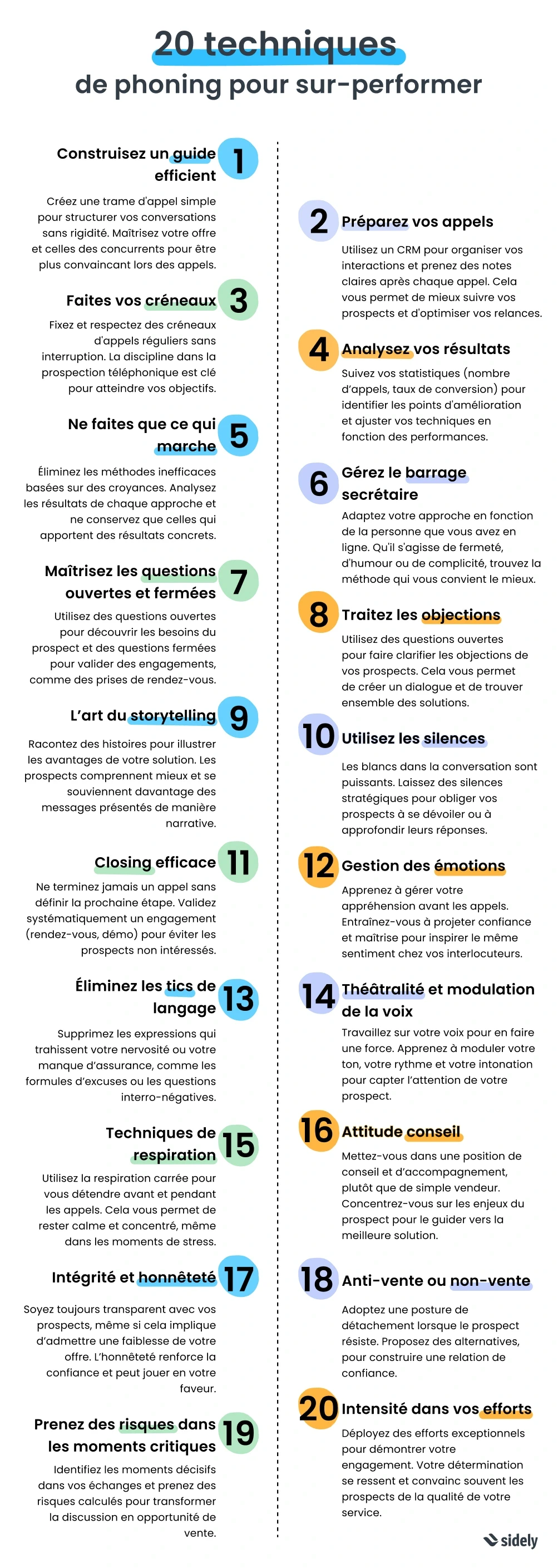
1. Create an Efficient Guide
In theory, this is usually the manager's job. In call centers, they make full scripts to have an answer for everything. But in B2B, this is generally unsuitable. In fact, you don't necessarily need a complete phone call script.
Most of the time in B2B, a simple call outline is enough (for example, the CROC method), as long as you have found a super effective and memorable introduction, and you have the right methodologies to handle objections quickly and effectively.
To start, you need to perfectly master your offer, and as much as possible, those of your competitors. In my opinion, the ideal is to work in team workshops to compare techniques and share secret weapons.
An effective and mastered guide allows you to approach sales calls with confidence. That doesn't mean you have it in front of your eyes during the phone call. On the contrary, if you have internalized the key points, speaking naturally will increase the impact of your message.
2. Prepare Your Calls
Nowadays, all sales outreach teams use sales CRMs to schedule calls, track interactions with prospects, write call notes, etc. One thing sales reps are too rarely taught to do is note-taking. Being able to recap the key points of a conversation in a clear and concise way saves time on the next call.
This is the best way to feel ready to make a call without thinking about it for an hour.
After 20 minutes on the line, you sometimes find it hard to type your summaries. Learn to organize your notes with keywords and, why not, colors. You need to capture the essentials with conciseness.
3. Schedule Your Time Slots
This is undoubtedly the most important recipe in cold calling. Setting and sticking to your call slots maximizes efficiency and productivity. Put your smartphones on silent and make yourself unavailable to others for the entire duration of the slot.
→ Nothing should disturb you.
If you set a goal of 30 calls in the slot, make them, with no conditions or exceptions. It’s workout 🥊
In my experience, there is no standard slot; everyone must find the duration and methods that generate the most performance. The only rule is discipline. If you want to achieve your sales goals, start by doing your call slots. Otherwise, don't cry about it! 😵
4. Analyze Your Results
Basic: a sales rep tracks their stats. You probably have the ability to analyze your statistics automatically based on the call results you qualify in your CRM or the company's phoning solution. If you don't have any of that = then paper/pencil. You must measure:
The number of calls;
The rate of meaningful contacts (usually decision-makers, but up to you);
The transformation rate from Meeting 1 to Meeting 2;
The closing rate (on Meeting 1, for example), etc.
Call statistics are the first thing to look at when searching for levers of improvement. Imagine you set a goal of 2 booked appointments per slot. If it takes you 20 calls to reach a decision-maker, and you convert 1 in 4, you will need 80 calls to reach your goal. Suffice to say, we are almost at call center yield levels, and if you don't like that, you will quickly burn out. 🤯
So do your stats, find the blocking points, and change methods if necessary! When you get stuck, it's up to your manager to support you (training, role-play, call monitoring, etc.).
5. Learn to Do Only What Works
Believe in my experience: most sales techniques are based on superstitions. I have seen many sales reps succeed with a bold move once and make it their main sales technique. The problem is that sometimes, it works once out of 100 times... And once the belief is anchored, it's hard to break away from it! You must do the opposite: track stats on the prospecting techniques you use and eliminate everything that doesn't work.
Let me give you an example: on a campaign for a somewhat complex product, prospects systematically asked us to send a presentation so they could think about it calmly.
Normal. Except that sending brochures yielded zero results.
From one day to the next, we started saying no to prospects who asked us to send something. Result: we started losing more of them initially, but also securing far more demo meetings, and subsequently, sales.
It took some guts and arguments to bounce back, but it paid off!
→ Never defend a practice whose effectiveness is contradicted by statistics.
Conversation Management Techniques
And now on to the subject that makes everyone tremble...
6. The Gatekeeper Hurdle
The great B2B classic. And the larger the companies you call, the more you run into jujitsu black belts. 🥋😵
The first thing to know is that there is no universal winning technique. Let me tell you an anecdote that should illustrate this...
On a B2B appointment setting campaign, I worked with someone who had about 5 times more meaningful contacts than everyone else (including myself, I was green with envy!). Since she worked from home, nobody understood how she did it.
Management asked her for recordings to understand. And there... surprise! She was literally ice-cold, and didn't even say hello! Her technique relied on one word: "Bernard" (the boss's first name, as you can imagine...). The receptionist, taken aback, would start to reply: "who is calling..." except she would cut in with: "thank you."
You couldn't get more authoritative. The receptionists complied, too much pressure!
Does that mean you should do the same?
Not necessarily.
Everyone has to find their own techniques. We all have our own personality and approach to human relations. The ideal is to find techniques that we master naturally and push them to excellence. Some people are great at making friends with receptionists and executive assistants. For others, humor is what breaks down defenses.
In the end, to each their own style, as long as the results are there. And so, once again: do your stats!
7. Open and Closed Questions
When it comes to discovery, the fundamental thing is knowing how to ask questions. It sounds simple when put like that, but on the phone as in the field, most sales reps struggle as early as the discovery phase because they don't master this fundamental technique: opening or closing a discussion.
To keep it simple, know that there are two types of questions:
Open questions will help you get your counterpart talking. You use them for discovery, to bring out the challenges, for example.
Example: what is the main flaw you find in your current solution?
Closed questions are those that lead to a limited number of responses (usually 2 possibilities), like: yes / no. This is practical for closing or confirming details categorically.
Example: If I offer you an online demo, would you be more available Wednesday or Thursday?
Practice finding the right phrasing, and your transformation rate will skyrocket immediately.
8. Handling Objections
Another great classic. And know one thing, there is no single method that works for everyone. In fact, imagine that in some popular sales textbooks from the 80s, sales reps were taught not to handle an objection unless it came up 3 times during the interview... So there are plenty of ways to do it.
For my part, I advise you to bounce back with open questions.
Here are 3 advantages you stand to gain:
It will help your counterparts clarify their point;
It will give you time to think;
You will start to look for solutions together and create a bond of trust (I'll talk more about this later).
The typical example is the prospect who states that "it's too expensive." But too expensive compared to what? And you let them think: to the company's budget? To the return on investment? To a competitor's offer? Etc.
You have to get your prospects talking. "It's too expensive" is not an answer, and the conversation cannot stop on such a hollow statement.
Besides, if they take the time to think about it, their response is often: "well actually, now that I think about it, I'm not really sure." In that case, I won't hide the fact that you have just unlocked a major barrier...😎
Also read: ADERA Method: handle objections from your distributors
9. The Art of Storytelling
Rather than simply listing the features of your product, tell a relevant story. For example, share how another company in a similar sector used your solution to overcome specific challenges.
Why? Because people love stories! You receive storytelling all day long: from politicians, advertisers, and even your loved ones, for better and for worse! 😉
And the more complex your product or service is to grasp, the more impact a use case will have. Remember, too, that we do not all function the same way, and some of your counterparts understand far better with an image than with sentences.
So you can use storytelling as a metaphor to increase the impact of your phone sales pitch, or simply keep it as a backup plan in case your counterpart is having trouble grasping the message.
One last tip, start your explanation with "it's simple, etc."
10. Use Silences
This is the ultimate weapon to take the lead in an interview. It consists of intentionally leaving a silence after a question you ask or a statement you make. This silence will place both of you in an uncomfortable situation. Each of you will be tempted to speak up to fill the void and escape this awkward situation. The trick is that the one who manages to control themselves shows a position of strength and turns the situation to their advantage.
Imagine your prospect tries to put you in your place by telling you they received a very attractive offer from your competitor. They probably expect you to announce a commercial gesture. But you, without shaking, ask them: "and what stopped you from signing with them?".
Do you feel the awkwardness?
Your counterpart has just taken a hit to the head, and you are probably afraid they will hang up or brush you off. Don't crack: count to 5 before speaking again. But in 99% of cases, you won't have to, because they will be the one to break the silence.
And from there, they will speak to you differently, because the message hit home. 💾
11. Closing
You never leave an interview with a meaningful contact empty-handed, especially if they are a decision-maker. You must systematically secure the next step (Meeting 2, online demo, field meeting, etc.).
A call that leads to nothing specific ("I'll think about it and call you back"), you can unfortunately classify directly as "not interested." I know it hurts, but I'm here to save you time.
KPIs are fundamental: to increase revenue, you first need to increase your transformation rates, for example, the number of Meeting 1s that convert to Meeting 2s. And that means you never end a call without validating the next step.
And remember: "in a month" is not a date... 😶
Managing Emotions: Key to Success in Phoning
We come to the part that, in my opinion, is the most important.
→ It all happens in your head!
12. Learn to Manage Your Projections
When you pick up your phone to call a prospect, you always feel some apprehension. This fear can be linked to the dread of rejection, awkward silence, or failure to convince. We all have our insecurities, I don't need to tell you that. However, at your level, you must realize that your prospects can quickly sense your insecurities, and that will really play against you.
Becoming aware of this projection is the first step to overcoming it. Approach each call with confidence, focusing on your message and not on your fears. It is entirely possible to train your brain to project a success scenario.
By doing this, you will inspire a sense of trust in your counterpart and, in turn, that will work in your favor. Basically, the goal is to replace limiting beliefs with positive affirmations, a bit like the Cauet method: if you believe it, it becomes true!
This confidence will also help you improve your delivery, deploy simpler arguments, and above all... eliminate the verbal tics that give away stage fright.
13. Erase All Verbal Tics
It's simple: the way you express yourself betrays your emotions. Every time you apologize for the disturbance, you show your counterpart that you are sorry.
Decision-makers do not sign with sorry sales reps.
You can write that on a sticky note to paste on your desk.
I therefore recommend that you regularly listen to recordings of your calls to identify all your verbal tics and erase them.
The most widespread bad practice is the negative-interrogative phrasing:
Are you not available tomorrow at 2 PM?
No.
Thank you, goodbye... 😂
→ A negative-interrogative phrasing leads to a negative response.
As long as you are not aware of it, you are wasting your valuable contacts and ruining your lead list.
I worked in a team where members systematically said "allow me to." Training did nothing, I was going crazy... So we created a jar. Whoever blurted out the cursed phrase had to chip in 1 dollar. By the time we reached 50 dollars, the verbal tic had vanished, and we had enough for an afterwork drink 🍻
14. Theatrics
For a field sales rep, it's always harder to tackle the phone. The fact of not seeing each other completely transforms the experience.
And what matters most is what comes through the voice. The key is knowing how to make it a strength. We talked about your emotions earlier. The good news is that your prospect also has a heart that beats. 😬
And if you want to create a bond, you will have to learn to modulate your voice and amplify effects, whether they are comic or dramatic.
In the company where I learned telesales, they paid for drama classes for us for 2 months. Not only did it strengthen team relationships, but above all, it forced everyone to step out of their comfort zone, learn to act, and amplify the impact of their speech. Theater helps develop self-confidence and the ability to take risks. And boldness in sales pays off!
So you must learn to overplay your emotions, for example by varying the intonation, pitch of voice, or your speech rate (speed).
→ Prospects buy a sales rep first, and on the phone, everything is in the voice. When they tell you that "you can hear a smile," it means exactly that! Besides, the first 5 seconds are decisive in establishing the dialogue.
15. Breathing Techniques
I'll end this chapter with a truly essential tip for stress management. When preparing a cold call or sales call, you must manage to stay relaxed.
And one of the keys to achieving this is breathing. There are many techniques for this. Here is the one I use: box breathing:
Inhale for 4 seconds;
Hold your breath for 4 seconds;
Exhale for 4 seconds;
Hold empty lungs for 4 seconds.
Repeat this cycle several times to calm your mind before important calls. Ideally, think about it during the call too. You can put that on a sticky note as well 📜
Positioning: Becoming Your Salesperson
Now that we have covered the fundamental techniques and touched upon the notions of psychological preparation, you mostly need a bit of experience to reveal (or discover!) your potential.
To become truly excellent in sales, you need to find alignment between your knowledge, your skills, and your values. And cold calling is no exception to the rule.
So we are going to look at the positioning that makes prospects want to buy your product!
16. Consulting Attitude
Often, when sales reps aren't selling, they blame the offer, the market, or competitors.
Put an end to this attitude: in most cases, you miss the sale because you miss the discovery phase.
I have already stressed questioning techniques quite a bit above. But I want to go further.
The real job of a sales rep is to be interested. Especially over the phone, where everything relies on the art of speaking. Yes, it's hard to hear for those who are used to relying on their power of seduction or charisma to convince, but on the phone, everything is in the voice...
The eternal mistake of most sales reps is to pitch arguments without having uncovered the challenges. This is where active listening comes into play. So, please, learn to shut up! 🤐 You will see, it's magic: when you ask a question and let the person speak, well... they speak. And that gives you ammunition to sell.
Focus on analyzing their answers and reactions. Breathe, think. And guide them. In B2B, buyers want to be guided. If they feel you are just there to sell your thing, it's not worth it.
Find the prospect's challenges, and the sale will happen on its own.
17. Integrity / Honesty
If I had to list the worst sales techniques I face in my daily life, I think I would give the gold medal to lying: when a guy tries to pull the wool over my eyes, all he gets is a firm rejection.
If you want to be taken seriously by your prospects, you must first embody the trust you want to build.
I have a nice anecdote about this.
Context: at the time, I was selling business information in subscription form. To deliver the right info, we created client profiles with specific criteria. And sometimes, it was really hard to find the right criteria, and clients received some out-of-target info. To top it off, I was 3 times more expensive than my competitors (but my service was truly superior).
One day, a prospect called me as part of a competitive bidding process he had launched. The guy had an ultra-complex job in engineering. I understood right away that it would be a headache to deliver only targeted information.
Him: I'm calling all the providers and asking them all the same question. Now, it's your turn.
Me: I'm listening.
Him: what percentage of the delivered information will actually be in my target?
Me: in my opinion, 10% max.
15 minutes later, I had the contract on my desk. ✅
He had bet everything on the transparency of the providers. The others got scared and lied. Red card.
18. Rise to the Peak of Risk
In sales, and especially on the phone, there are breaking points, those moments where everything is likely to flip. You can't miss them; if you suddenly get a knot in your stomach, it means you are in one of those moments. Indeed, it's the signal that you need to charge the net. Because at this point in the exchange, either you score a decisive point, or you lose the match.
It could be when the prospect tells you that you are disturbing them, that they are going to sign with a competitor, or any other critical moment where you have the intuition that you need to make a bold move. Here, boldness pays off. If you take a real risk, it might work, and if you don't react, it's over.
So... Dare!
Another thing you can count on your end (doing your own tracking isn't forbidden!). The more you manage to push yourself in these crucial moments, the more you will love your job. If there is something magical in sales, it's truly those moments where we go after performance by conquering our fears.
19. Anti-Selling
Another ultimate thing you must absolutely work on: anti-selling (some call it "non-selling"). Basically, it consists of stepping out of the salesperson's stance of trying to convince (which brings us back to the consulting/guidance idea we touched on just before).
The reason is simple: pushing too hard is the best way to make your counterpart defensive, as they naturally tend to put up walls (especially if they don't know us). When you do outbound calling, this is your daily bread...
In an anti-selling position, you let go and ask questions that will lead the prospect to probe their position and re-evaluate your relationship.
An example: at a time when I was working for a software publisher, I had found the ultimate counter for prospects who "threatened" to sign with a competitor.
I would tell them: "look, let's finish this online demo anyway, and if it really doesn't suit you, I will send you a list of solid competitors. I would hate for you to get ripped off by buying just anything, like so many others I have had to pick up the pieces for after 6 months of contract, etc."
Not only did I skyrocket my closing rate, but no prospect ever asked me for the famous list. In reality, I had defused the conflict and won their trust by adopting a sincere stance.
20. Intensity
I've already told you: on the phone, it's the human touch that makes the difference: personality, attitude, tenacity, etc. The thing is, we aren't all the same. And in this final part, we clearly saw that you must try to find your own style.
But there is one inevitable truth: you have to give it your all to crush the metrics!
And your prospects will notice: the more effort you deploy to get an appointment (I didn't say to behave like a bull in a china shop either), the more your company stands out. In fact, it gives the prospect the conviction that your service is different, that they will be better served than by your competitors.
In fact, there is a very simple way to spot sales reps who are truly excellent on the phone: they are the ones prospects regularly offer jobs to! If that happens to you often, you are part of the elite. Otherwise, make it a KPI (with me, you will quickly get your money's worth out of your pack of sticky notes 😉).
An example on the subject of determination: in a campaign we ran for a few years, there was a list of accounts where no one had ever managed to get a meaningful contact on the phone. It was driving us crazy!
My trick was to stay late in the evening. And as soon as I figured out the digit format for the direct lines, I would literally dial random numbers until I landed on the right person.
Wait, that's not all...
When I got the decision-maker, he would always ask how I got his direct line. And I would tell him the truth. Then I would add: "that shows you what I'm willing to do to work with you. And I'll do just as much to ensure you are satisfied with our contract."
Not many people are going to say no to you if you talk to them like that.
Alexis co-founded Sidely after several years of service as a sales director. To understand what builds, or breaks, a salesperson's performance, he conducted more than 100 telephone interviews with field sales representatives. At Sidely, he transforms this raw knowledge into concrete support, based on facts rather than assumptions.
See also

Artificial intelligence and field professions: what our 2026 studies reveal
Adoption, barriers, use cases: discover what our three studies reveal about the role of AI among sector managers, sales representatives, and foodservice sales reps.

CHR and RHF Sales Representatives: portrait of a relationship-driven profession in the era of data
Equipment, productivity, AI: discover the major trends for the HORECA and food service sales profession in 2026 through our field study.

Pharmaceutical Sales Representative in France: Portrait of a Field Job Under Pressure
Compensation, aspirations, AI usage: discover the major trends in the pharmaceutical sales representative profession in 2026 through our field study.

Area Sales Managers in France: who are they and how is the profession evolving in 2026?
Compensation, aspirations, AI usage: discover the major trends in the field sales representative profession in 2026 through our field study.
The area manager professions in 2026
Discover the trends, the challenges, and the key figures.