

How does a field CRM make the work of sales promoters easier?
Discover how a field CRM helps sales developers better prepare their visits, structure their reports, and showcase their in-store activity.

In short
6 min read
The sales representative ensures brand visibility in stores, but their activity often lacks suitable tools to manage the density of the field.
Management without a CRM is artisanal, leading to incomplete preparation of visits and difficult data capitalization with the headquarters.
Adopting a field CRM centralizes key information, allowing the representative to arrive in-store with a history and clear priorities.
Automated route planning optimizes travel, reducing transit time to maximize time spent on sales.
A field CRM structures merchandising audits and automates reporting, transforming field work into actionable and visible data for the sales team.
In the retail industry, the sales promoter is on the front line: they are the ones who guarantee, department by department, that commercial agreements translate into actual visibility for the brand. However, their activity remains one of the busiest and least equipped in the commercial chain. Between the multiplicity of stores to cover, time pressure, and the need to report actionable data to headquarters, the promoter often juggles without a safety net. This is especially true since the field these promoters face is vast.
Indeed, in France, grocery retail accounts for more than 30,000 points of sale across the territory según Fcd, containing as much surface area as the field teams must monitor, activate, and document. Facing this reality, the challenge is no longer just being present in-store: it is to move from isolated, hard-to-measure actions to a structured, traceable, and value-creating activity.
This raises a question: how does a field CRM allow sales promoters to better prepare, execute, and showcase their actions in the store?
This article explores how a field CRM concretely supports the sales promoter at every stage of their daily routine.
The role of the sales promoter in the field
Main missions of the sales promoter
The sales promoter is the operational arm of the brand in store. They focus on executing in-store actions (shelving, restocking, setting up promotional tools) and, unlike the area manager, they do not have a negotiation role with store managers: they apply already established agreements.
Concretely, their missions cover the implementation and monitoring of promotional operations, the application of national and regional agreements negotiated upstream, conducting presence, pricing, and shelf-visibility audits, as well as reporting structured field information to headquarters and the area manager.
Operational constraints of the profession
The daily life of the promoter, as explained in our last blog on sales promoters, is subject to tight constraints. They must cover a large number of stores spread over a vast territory, often with a vehicle, a tablet, and instructions received at the beginning of the week. The high mobility of the position is accompanied by constant pressure on the quality and speed of execution: every visit must be productive, every operation correctly set up, and every anomaly reported as quickly as possible.
They apply predefined guidelines and do not, in most cases, take independent commercial initiatives. According to the Portail des PME, a well-structured commercial policy correctly deployed in the field, with combined progress in the quantity, quality, and focus of visits, can generate up to 24% additional efficiency, illustrating just how much the structuring of activity and the quality of instructions directly condition field performance.
The limits of field management without a dedicated CRM
Often incomplete visit preparation
Without a centralized tool, preparing a store visit is often a manual, artisanal effort. The promoter has to gather information scattered between emails, shared Excel files, handwritten notes, or WhatsApp conversations. They cannot easily access the history of past actions in that store: was the promotion correctly set up during the last visit? Did the department manager report a problem? What was the product presence rate recorded two weeks ago?
According to Initiative CRM, we find that when customer data is not available to field teams in real-time, sales reps often spend far too much time preparing their visits. The result: visit objectives are unclear, priorities poorly defined, and actions less targeted than they should be. Implementing structure in preparation, especially through more rigorous route planning, nevertheless allows prioritizing high-stake stores and avoiding unnecessary travel.
Field actions with little accumulated value
The problem does not stop at preparation: it extends after the visit. Without a structured tool, reports are inconsistent; some promoters send an email, others fill out a spreadsheet, while others settle for a voice message. Photos taken in-store are not contextualized or automatically linked to a store or a promotional campaign. The collected data is difficult to consolidate and even harder to use at the headquarters level.
Let's look at a concrete example: a promoter visits 8 stores per day, 5 days a week. If they spend an average of 20 minutes writing their report after each day, this represents more than 80 hours lost every year in low-value administrative tasks.
And on the headquarters side, without consistent data, it's impossible to know if a promotional campaign is properly deployed across the entire network. The promoter's work becomes, in large part, invisible.
How a field CRM supports the promoter before the visit
Centralize key information per store
A well-designed field CRM radically transforms visit preparation. Before even hitting the road, the promoter accesses a complete profile of the store from their smartphone: history of previous visits, completed actions, reported anomalies, ongoing objectives, and promotional guidelines for the week. Everything is in one place, up to date, without having to ask the area manager or the manager.
According to Zendesk, having a centralized tool allows sales teams to access customer history and key information in real-time, in order to interact in a more relevant and contextualized manner. For the promoter, this means arriving at the store with clear context: they know what to check, correct, or activate, and can do so from the first minutes without wasting time searching for information.
CRMs specialized in retail like Sidely, as well as some more generalist CRMs like Salesforce or Microsoft Dynamics 365, directly integrate alerts linked to each store into the visit preparation: drop in numeric distribution, promotional operation not yet set up, or visit delay compared to the planned frequency. The promoter does not have to plan their day blindly.
Schedule routes efficiently
Route planning is another key dimension. Without a tool, promoters organize their travel roughly, often based on habits or geographical proximity, without taking actual commercial priorities into account. They might miss strategic stores or waste precious time on unoptimized routes.
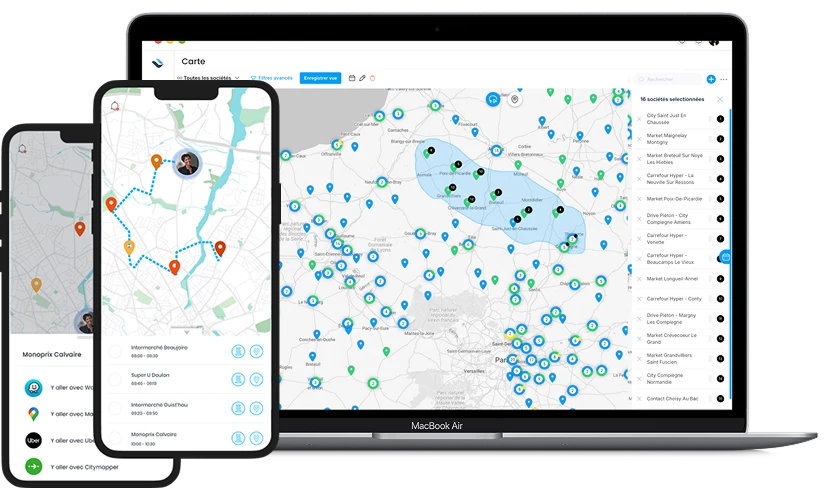
With Sidely's automated planning, the rep simply enters the number of days available in the week, and the tool automatically selects priority stores according to current objectives (out-of-stocks, innovations, promotional campaigns) and then proposes an optimized route that takes into account the scheduling constraints of contacts and the visit order. The stated goal: cut weekly preparation time in half.
Source : CRM Sidely
We can see that the optimized route represents a strategic as well as operational lever: less time on the road means more time spent selling, and better store satisfaction thanks to more regular and predictable visits. In practice, saving one hour of travel per day across a team of ten promoters is the equivalent of regaining a full-time position every week.
Facilitate field execution during the visit
Structure merchandising audits
It is during the visit itself that the field CRM truly changes practices. Instead of writing information down on paper or memorizing it to transcribe later, the sales promoter directly fills out forms tailored to their profession on their smartphone or tablet.
On tablet, mobile, or computer, the promoter can collect all essential information for their missions, such as merchandising audits, shelf share tracking, price audits, or store profiling, with a seamless offline mode and automatic synchronization to never lose data.
Photos taken in-store are automatically linked to the store, the relevant promotional operation, and the product. A missing facing, poorly installed POS material, or an out-of-stock: everything is documented in context with actionable visual proof. We thus understand why, without regular audits, in-store visibility remains theoretical and does not necessarily translate into sales performance: securing in-store execution means transforming commercial agreements into real, measurable visibility.
Sidely X Easypicky

Source : Field visit by Guillaume Dubos Data becomes faster to collect, more consistent, and above all more reliable, opening the way to a much more accurate steering of in-store execution.
Guarantee the quality of field data
A field CRM is not just an input tool: it is also a reliability tool. Required fields prevent common omissions (an audit without a photo, a report without an associated action). Quality checks alert the sales promoter if data seems inconsistent with the store history.
In CRMs dedicated to retail, field audits are automatically linked to the brands, stores, assortments, and products concerned, which makes the analysis and tracking of essential KPIs such as numeric distribution, shelf share, and merchandising indicators reliable. The geolocation of actions provides an extra layer of traceability: headquarters can verify that visits actually took place, and the promoter has a reliable history of their visits. We see that the coverage rate, meaning the number of audits conducted across all visited stores, then becomes a key KPI for judging the effectiveness of field operations.
Value the work of the promoter after the visit
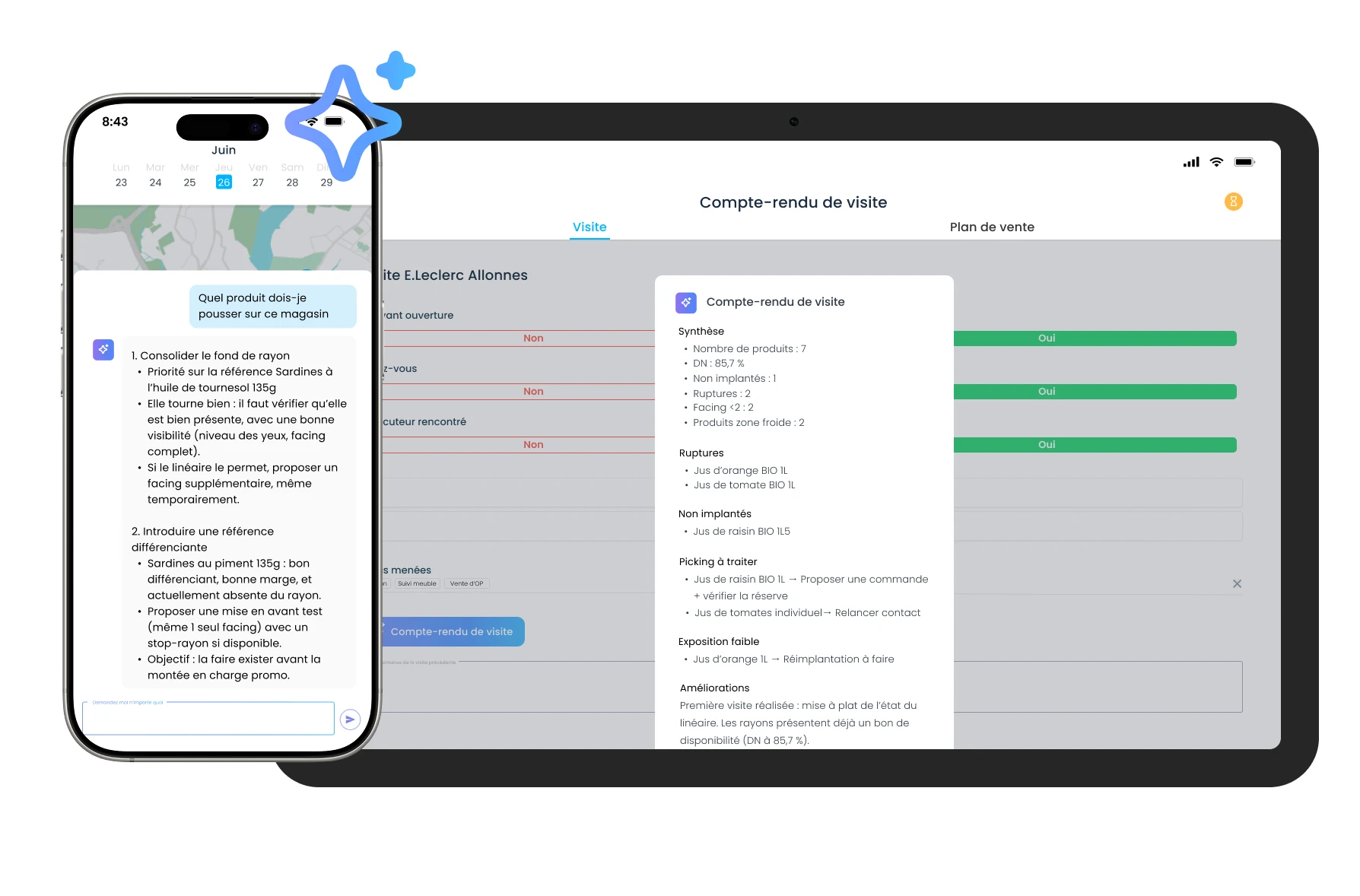
Automate visit reports
This is often where the most time is wasted: writing the visit report after a day in the field. Without a tool, this administrative work can easily exceed 30 minutes per evening: an accumulation that weighs on motivation as much as on the time budget.
The latest field CRMs, boosted by AI, automatically generate a visit report based on the actions logged during the visit: goals achieved, observed anomalies, remarks, and follow-up points. In some solutions, up to 90% of the report is pre-filled, so the promoter only has to double-check and validate in a few seconds. Voice dictation, available on tools like Sidely or Salesforce Field Service, also allows capturing observations out loud directly in the app, without having to type a single line.
Source : Coach IA CRM Sidely
According to ChapsVision, a Sales Force CRM reduces the time spent collecting and transcribing data by about 40% thanks to the automation of administrative tasks. Applied to a team of ten promoters each doing 200 field days per year, this is potentially more than 400 hours regained and reinvested in additional visits or in the quality of execution.
Give visibility to field activity
This is perhaps the most underestimated benefit of a field CRM: making visible what was invisible. The work of the promoter, such as resolving an out-of-stock, checking a facing, or resetting an endcap, finally produces actionable data accessible in real-time to the area manager and sales manager.
We see that tracking actions by store and by sales rep allows understanding the direct impact of field initiatives on store performance, and ensuring that teams are successfully executing their missions. Dedicated dashboards allow tracking the coverage rate, execution indicators, and compliance of operations at the point of sale.
These dashboards can be filtered by retailer, sales rep, region, or product. For example, a sales director can detect that a promotion is well-implemented in most stores of one retail chain, but heavily lacking in another, and redirect resources accordingly. According to McKinsey, companies that rely on data analysis for their commercial decisions show 5% to 6% higher productivity compared to their competitors, a gap that can quickly widen in a sector as competitive as retail.
The sales promoter is not a simple executor: they are the guarantor of commercial execution in stores, and their work directly conditions the performance of brands in retail. Yet, without the right tools, this activity remains dense, poorly structured, and difficult to showcase, both for the promoter themselves and for the headquarters teams.
A field CRM changes the game at every stage of the visit cycle. Before the visit, it gives the promoter the context and priorities they need to act effectively. During the visit, it structures audits, secures data reliability, and cuts down on omissions. After the visit, it automates reports and feeds actionable dashboards for the entire team.
Ultimately, the challenge is even broader: to build a data-driven commercial execution logic, where each store visit contributes to a detailed understanding of the field, and where the promoter's work finally becomes fully visible, measurable, and recognized for its true value.
Taina left her position as Area Manager at AB InBev for marketing and communications, a true career choice. Having experienced the reality of the sales force from the inside, she writes about the profession without ever distorting it. She doesn't just talk about the field; she comes from it. Outside the office, she tracks down the best tables in town: finding the right spot is a serious business.
See also

Artificial intelligence and field professions: what our 2026 studies reveal
Adoption, barriers, use cases: discover what our three studies reveal about the role of AI among sector managers, sales representatives, and foodservice sales reps.

CHR and RHF Sales Representatives: portrait of a relationship-driven profession in the era of data
Equipment, productivity, AI: discover the major trends for the HORECA and food service sales profession in 2026 through our field study.

Pharmaceutical Sales Representative in France: Portrait of a Field Job Under Pressure
Compensation, aspirations, AI usage: discover the major trends in the pharmaceutical sales representative profession in 2026 through our field study.

Area Sales Managers in France: who are they and how is the profession evolving in 2026?
Compensation, aspirations, AI usage: discover the major trends in the field sales representative profession in 2026 through our field study.
The area manager professions in 2026
Discover the trends, the challenges, and the key figures.